Navigating the loss of a loved one is overwhelming, and being tasked with managing their final affairs can add a layer of legal complexity that feels daunting. In Texas estate law, you’ll encounter two key roles: the administrator vs executor. While they sound similar, understanding the difference is critical. At its heart, the distinction is straightforward: an executor is the person named in a will to carry out a loved one's wishes, while an administrator is appointed by a court when there is no will to follow.
Though their duties often overlap, their source of authority is fundamentally different, and that single distinction shapes the entire probate journey. With the right legal guidance, you can fulfill your duties with clarity, confidence, and compassion.
Understanding the Primary Roles in Estate Administration
When someone passes away, their estate—all their property, assets, and debts—must be legally settled through a process called probate or estate administration. The person in charge of this process acts as a fiduciary, a role that comes with a strict legal duty under the Texas Estates Code to act in the best interests of the estate and its beneficiaries.
In Texas, that fiduciary is either an executor or an administrator. The title they hold depends entirely on whether the person who died (the decedent) left behind a valid Last Will and Testament. Getting this right from the start is crucial because it sets the stage for everything that follows.
- Executor: This person is hand-picked by the decedent in their will. Once a Texas probate court validates the will, the executor's authority flows directly from that document, guided by the decedent's expressed wishes.
- Administrator: This individual is appointed by a probate court according to a priority list set by Texas law. Their authority is granted by the court, and they typically remain under close judicial supervision.
This initial difference influences the person's independence, the potential costs involved, and the level of court oversight. A will simplifies the process by naming a trusted individual in advance. Without one, the court must intervene, following a rigid legal hierarchy to appoint a representative.
Quick Comparison: Executor vs. Administrator Roles
To put it simply, an executor follows a map drawn by the person who passed away, while an administrator follows a route laid out by Texas law. This table breaks down the key distinctions you'll encounter.
| Attribute | Executor | Administrator |
|---|---|---|
| Source of Authority | Named in the decedent's will | Appointed by a probate court |
| Guiding Document | The Last Will and Testament | Texas intestacy (inheritance) laws |
| Court Oversight | Often minimal (if an "independent executor") | Typically requires significant court supervision |
| Requirement for Bond | Often waived by the will | Usually required to post a probate bond |
This infographic gives a great visual summary of how these two critical roles come to be.
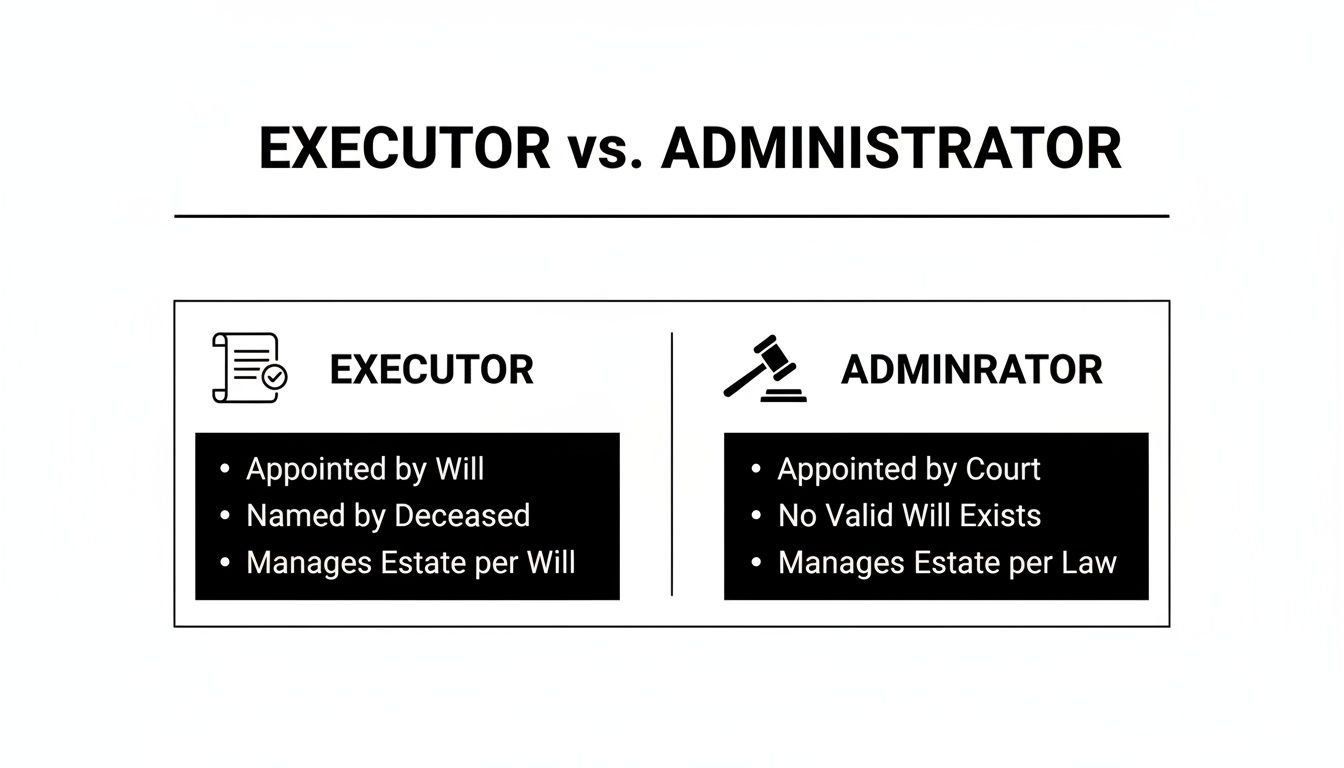
Ultimately, an executor's path is guided by personal choice, while an administrator's is directed by statute. Both roles carry an immense level of responsibility and require strict adherence to the fiduciary duties in Texas outlined in the Texas Estates Code.
Whether you've been named an executor or find yourself needing to step up as an administrator, the best first step is to speak with a Texas estate administration lawyer. Gaining expert guidance from the start is the surest way to fulfill your duties correctly and protect the assets you've been entrusted with.
How Texas Appoints an Executor Through a Will
When someone creates a Last Will and Testament, they are doing more than just deciding who gets their property. They are hand-picking a trusted person to see those wishes through. This individual is called the executor. The will becomes their instruction manual, giving them the power and direction to manage the estate exactly as the decedent wanted.
This ability to pre-select a representative is a key benefit of proactive estate planning. It eliminates guesswork and allows a trusted person to take charge, rather than leaving that critical decision to a probate judge. The official process begins when the will is filed for probate in a Texas court.

From Nominee to Fiduciary: The Probate Process
Simply being named in a will does not grant someone authority. The nominated executor must go to court and formally ask a judge to validate the will and officially appoint them. This starts with filing an application to probate the will.
Once the court confirms the will is valid and verifies the nominated person is qualified under Texas law, it issues Letters Testamentary. This legal document is the executor's official authorization. It empowers them to act for the estate—from accessing bank accounts and paying debts to selling property. The clarity of a will makes this process significantly smoother than when there is no will.
The Power of an Independent Executor in Texas
Texas law offers a highly efficient option called an independent administration. If a will specifically includes language to create one, the appointed executor can handle most of the estate’s business without needing to ask the court for permission at every turn. This saves a tremendous amount of time, reduces legal fees, and maintains greater privacy for the family.
An independent executor can pay debts, sell property, and distribute assets with minimal court oversight, as long as they adhere to the will's terms and the Texas Estates Code. This is the preferred method for most Texas estates because it allows the executor to act quickly and effectively.
The power to name an independent executor is a major advantage of a well-drafted will. It reflects the decedent's trust in their chosen representative and streamlines the entire settlement process. While the will provides the playbook, people often wonder how much flexibility an executor has. It's a common question, and one resource dives into the details of if, or how, Can an executor change a will?
When you look at the numbers, the difference between an executor and an administrator all comes down to whether people have a will. National surveys show that only about 30–40% of American adults have a current will. This means the majority of estates will end up needing a court-appointed administrator instead of the decedent's chosen executor.
Choosing the right person for this job is one of the most important decisions in estate planning. The executor is responsible for carrying out your final wishes, so it's critical to select someone who is responsible, trustworthy, and capable of handling complex financial and legal tasks.
The Court's Process for Appointing an Administrator
When a loved one passes away without leaving a will, it's known in legal terms as dying intestate. This creates a legal vacuum—there’s no document naming an executor to manage the estate. To fill that gap, a Texas probate court must step in and appoint someone to serve as the estate’s administrator.
Unlike an executor who was personally chosen, an administrator is selected by the court based on a strict legal hierarchy. This court-supervised process ensures someone qualified is put in charge, but it is almost always more public, time-consuming, and expensive than probating a will.

The Legal Hierarchy for Appointment
The Texas Estates Code provides a clear order of priority for who has the right to be appointed as administrator. This list is designed to give the most closely related and suitable person the first opportunity to serve.
The general order of priority is as follows:
- The surviving spouse
- The principal beneficiary from a will that wasn't properly executed but would have been valid otherwise
- Any other principal beneficiary from that same will
- The decedent's next of kin, starting with the closest relatives
This legal framework brings order to a potentially chaotic situation. However, it can sometimes spark disagreements if multiple family members at the same priority level wish to serve.
Filing for Administration and Determining Heirs
The process begins when an interested party, usually a potential heir, files an Application for Letters of Administration with the probate court. This application formally requests that the court open an estate and appoint an administrator. But without a will to identify the beneficiaries, the court must take another critical step.
A determination of heirship proceeding is required. This is a formal court hearing where a judge legally identifies all of the decedent’s rightful heirs and determines their shares of the estate according to Texas intestacy laws. Evidence such as birth certificates, marriage licenses, and witness testimony is presented to establish the family tree. This public hearing adds a layer of complexity and cost that a valid will avoids. You can see how the steps add up in our in-depth guide to the probate process in Texas.
Across common-law jurisdictions, the distinction between an executor and an administrator has been consistent for over a century. In the U.S., studies of probate filings show that between 55% and 65% of adult deaths in many counties still involve no valid will, meaning an administrator—not an executor—handles the estate.
The Probate Bond Requirement
One of the most significant differences between an administrator and an executor is the requirement for a probate bond. Since the administrator wasn't personally chosen by the decedent, the court requires them to purchase a type of insurance policy known as a bond.
A probate bond protects the estate’s heirs and creditors from potential mismanagement, fraud, or honest mistakes by the administrator. The judge sets the bond amount, and the administrator must pay the premiums from the estate's funds, adding another expense to the process.
In contrast, a well-drafted will almost always includes a simple clause that waives the bond requirement for the executor. This provision reflects the decedent's trust in their chosen representative and is another way that good estate planning saves the estate money and reduces administrative burdens.
Comparing the Day-to-Day Duties and Powers
On the surface, executors and administrators might seem like two sides of the same coin. Both have a significant legal and ethical responsibility known as a fiduciary duty—the highest standard of care under Texas law. This means they must act with complete loyalty, putting the interests of the estate and its beneficiaries above their own.
While their daily tasks can look similar—gathering assets, paying legitimate debts, filing taxes, and distributing what remains—the rules they follow are very different. An executor gets their instructions from the will. An administrator, however, is bound strictly by the Texas Estates Code. This distinction creates major practical differences in their operations.
Authority and Decision-Making
The single biggest difference between an administrator vs executor lies in the origin of their authority. This directly shapes their power to make decisions, especially regarding the management or sale of estate property.
- Executor's Authority: An executor's power flows directly from the will. The will serves as their roadmap, outlining who gets what and often granting them broad powers to act without needing constant court permission, especially if named an "independent executor."
- Administrator's Authority: An administrator derives their power from the probate court and the Texas Estates Code. They must follow a rigid set of intestacy laws that dictate who inherits property, which may not align with the decedent's actual wishes.
Under the Texas Estates Code, any fiduciary must manage the estate with the same care a "prudent person" would use for their own property. For an executor, this duty is interpreted through the lens of the will. For an administrator, it means adhering strictly to the letter of the law.
This fundamental difference impacts every decision, from paying a utility bill to selling real estate. For a deeper look into these responsibilities, you can review the complete list of the duties of an executor of an estate in Texas.
Real-World Scenario: Selling the Family Home
Let's walk through a common scenario to illustrate the contrast: selling the family home. This single transaction highlights the efficiency of a will versus the hurdles of an intestate estate.
The Executor's Path (with Independent Administration):
If a will names an independent executor and grants them the power to sell real estate, they can typically list the house, negotiate a price, and close the sale without a judge's approval. As long as the sale is in the estate's best interest, they have the flexibility to act quickly. This freedom is one of the biggest advantages of solid estate planning.
The Administrator's Path (with Dependent Administration):
An administrator, on the other hand, almost always operates under a "dependent administration." The name says it all—they are dependent on the court for approval on most major actions. To sell the family home, they must:
- File a formal application with the court seeking permission to sell the property.
- Provide evidence that the sale is necessary, typically to pay debts or for the benefit of the estate.
- Wait for a court order approving the sale, which might even set a minimum sales price.
- After the sale, report all details back to the court for final confirmation.
This court-supervised process adds significant delays, increases legal fees, and creates extra stress for the heirs.
Comparing Fiduciary Responsibilities and Authority
To make it even clearer, let's look at how the source of authority impacts common estate tasks. This table breaks down the different paths an executor and an administrator must take.
| Task | Executor's Authority & Process | Administrator's Authority & Process |
|---|---|---|
| Asset Distribution | Follows the specific instructions laid out in the will, distributing assets to named beneficiaries. | Must strictly follow Texas intestacy laws to identify heirs and calculate their legal shares. |
| Paying Debts | Uses estate funds to pay valid creditor claims as directed, often with discretion on timing. | Must follow a formal, court-supervised process for notifying creditors and paying debts. |
| Selling Property | Can often sell assets without court approval if the will grants independent powers. | Almost always requires filing an application and getting a court order to sell real estate or major assets. |
| Decision-Making | Guided by the decedent’s expressed wishes in the will and their fiduciary duty to beneficiaries. | Guided by the rigid requirements of the Texas Estates Code and direct orders from the probate court. |
Ultimately, both roles have the same goal: to settle an estate. But an executor's journey is paved by the personal choices of the decedent, making for a more direct and often smoother road. An administrator's journey is dictated entirely by state law, which provides a necessary framework but is undeniably a more complex and regulated process.
How Estate Disputes and Litigation Risks Differ
Losing a loved one is difficult enough, but family disagreements can make the process even more painful. While any estate settlement can encounter challenges, the risk of a full-blown dispute increases dramatically when there is no will. Estates managed by an administrator are simply more prone to legal conflicts than those guided by the clear wishes of an executor.
The absence of a will creates a vacuum of information. Who is in charge? What were the decedent's wishes? Without answers, the law intervenes, but that doesn't stop family members from having their own opinions. This uncertainty is often where trouble begins, turning a time of grieving into a battle over control and assets.

Common Ground for Administrator-Led Disputes
When the court appoints an administrator, several common disputes tend to arise. These conflicts not only prolong the process but also incur legal fees that diminish the inheritance intended for the family.
Here are some common areas of conflict:
- Appointment Contests: Texas law establishes a priority for who can serve as administrator. But if several adult children all want the role, a court battle may ensue over who is most qualified.
- Asset Inventory Challenges: The administrator must identify and list all estate assets. It’s not uncommon for heirs to question the valuation of an item or claim that assets are missing, leading to formal objections in court.
- Distribution Disagreements: Administrators must follow Texas intestacy laws precisely. These rigid rules can lead to outcomes that feel unfair, such as when a distant relative inherits as much as a close family friend who was like a child to the decedent.
How a Will Minimizes Litigation Risk
A well-drafted will is the best defense against family disputes. By naming a specific person as executor, the decedent resolves the debate over who should be in charge from the outset.
Furthermore, the will serves as a clear roadmap for asset distribution, leaving little room for argument. When the deceased’s wishes are detailed in a legal document, it becomes much more difficult for a dissatisfied heir to successfully challenge the plan. The executor's best defense is simply, "I am following the instructions in the will."
The real difference in risk comes down to clarity. An executor follows a path chosen by the decedent, while an administrator navigates a path dictated by state law. It's a critical distinction for anyone serving in these roles to understand their fiduciary duties in Texas and limit personal liability.
From a risk perspective, both executors and administrators are legally accountable, but conflicts are far more common when an administrator is involved. In some jurisdictions, probate courts see contested issues—such as petitions to remove a representative or challenge a distribution—in about 5–10% of all estates. A significant portion of those cases involves administrators in intestate situations. You can find more insights about these key differences on probatelend.com.
Whether you are an executor or an administrator, understanding your legal obligations is the best way to avoid costly legal drama. Adhering to your fiduciary duties protects the estate and, just as importantly, protects you. A knowledgeable Texas estate planning attorney can provide the guidance you need to handle these responsibilities, reduce risk, and settle the estate as peacefully as possible.
Why You Need an Experienced Estate Administration Attorney on Your Side
Whether you've been named an executor or need to serve as an administrator, the role is a significant honor, but the weight of the legal and financial duties can feel overwhelming. It can be tempting to try to handle it alone to save money, but that path is often filled with hidden risks, including costly mistakes, family disputes, and even personal liability.
Hiring an experienced estate administration attorney is not a luxury; it is a critical protection for both you and the estate you are responsible for managing.
A seasoned lawyer acts as your guide through the maze of effective estate management, ensuring every detail complies with Texas law. They are more than just a legal representative; they become your trusted advisor, making sure every action you take aligns perfectly with the Texas Estates Code.
Guidance When You're the Named Executor
Even with a clear will, the executor's role involves complex legal duties. An attorney can help you:
- Properly navigate the probate process and obtain your official "Letters Testamentary."
- Fully understand and carry out your fiduciary duties in Texas to avoid personal liability.
- Meet all legal deadlines for notifying heirs and creditors.
- Handle any disputes or challenges from beneficiaries with confidence and a solid legal foundation.
Having a lawyer in your corner ensures you honor the decedent's wishes while protecting yourself from claims of mismanagement.
Essential Support When You're Appointed as an Administrator
If you are serving as an administrator, the need for legal counsel is even more pressing. Without a will as a guide, the entire process is governed by rigid state laws that are nearly impossible to navigate alone.
Your lawyer is indispensable in this situation. They will handle the complex determination of heirship, help you secure the required probate bond, and obtain court approval for major actions—from selling a house to distributing assets. Attempting to manage this court-supervised process on your own almost guarantees delays and errors.
At the end of the day, whether you're sorting out the differences between an administrator vs executor or are already serving in one of these roles, partnering with a skilled attorney provides invaluable peace of mind. A compassionate lawyer from a firm like The Law Office of Bryan Fagan, PLLC, can prevent costly mistakes, limit your personal liability, and provide the support needed to settle a loved one’s affairs correctly and efficiently. This partnership empowers you to close this chapter with the confidence that every detail was handled with care and legal precision.
If you’re managing an estate or planning your own, contact The Law Office of Bryan Fagan, PLLC for a free consultation. Our attorneys provide trusted, Texas-based guidance for every step of the process.
Got Questions About Executors and Administrators in Texas? We've Got Answers.
Stepping into the role of managing an estate can feel like navigating a legal maze, whether you're named as an executor in a will or appointed as an administrator by the court. It’s natural to have a ton of questions. Let's tackle some of the most common ones we hear, grounding our answers in the Texas Estates Code to clear things up and help you move forward with confidence.
Can an Executor or Administrator Get Paid for Their Work in Texas?
Yes, absolutely. Texas law recognizes that settling an estate is a significant responsibility that requires considerable time and effort. Under the Texas Estates Code, both executors and administrators are entitled to reasonable compensation for their services.
This fee is typically calculated as a percentage of the estate's total value and is paid directly from the estate's funds before any assets are distributed to beneficiaries or heirs. It is considered an administrative expense—a well-deserved payment for the fiduciary managing the process.
What if the Person Named as Executor Says "No Thanks"?
This situation is more common than you might think. A person may be unable or simply unwilling to take on the role. A well-drafted will anticipates this by naming an alternate executor to serve as a backup. If the primary choice declines, the alternate is next in line.
But what if there is no alternate, or if they also cannot serve? In that case, the court will appoint an administrator to manage the estate, following the legal order of priority defined by Texas law. This hierarchy begins with the surviving spouse and then moves to the decedent's next of kin.
How Long Does It Take to Settle an Estate in Texas?
This is the classic "it depends" question. Every estate is unique, and the timeline can vary based on several factors: the complexity of the assets, the clarity of the will (or lack thereof), and whether family members are cooperative.
- A straightforward independent administration with a clear will and agreeable beneficiaries can often be settled in as little as six to twelve months.
- In contrast, a dependent administration or an intestate estate—which requires an administrator and a formal heirship proceeding—can easily extend beyond a year. If family disputes arise, the process can become even more prolonged.
Does an Administrator Have to Do What the Family Wants?
This is a common point of confusion, and the answer is a firm "no." An administrator's primary duty is to the law, not to the family's wishes. Their role is to follow the Texas intestacy statutes precisely. These laws dictate exactly who inherits property when someone dies without a will.
An administrator is legally bound to follow the state's rigid inheritance formula, regardless of what the family believes the decedent would have wanted. This is one of the most compelling reasons to create a will with an experienced Texas estate planning attorney. A will puts you in control of your legacy, not the state.
Hopefully, these answers have shed some light on the crucial differences between an executor and an administrator. Understanding these roles is the first step toward a smooth and lawful estate settlement.
If you’re managing an estate or planning your own, contact The Law Office of Bryan Fagan, PLLC for a free consultation. Our attorneys provide trusted, Texas-based guidance for every step of the process.