Managing a loved one’s trust or planning your own estate can feel overwhelming, especially when it comes to privacy. You're likely wondering: Are trusts public records in Texas? With the right legal guidance, understanding this complex area doesn't have to be.
The answer is a reassuring No. In Texas, trusts are specifically designed to be private documents. This privacy is one of the most significant advantages of using a trust in your estate plan.
Why Trusts Keep Your Texas Estate Plan Private
Taking on the role of managing a loved one’s trust carries a heavy responsibility. However, understanding its core benefits—especially privacy—can bring significant peace of mind.
Here's the key difference: a last will and testament must be filed in probate court after a person passes away. Once filed, it becomes a public document that anyone can look up. A trust agreement, on the other hand, remains confidential. This is one of the primary reasons so many Texas families choose trusts for their estate planning needs.
To give you a quick, at-a-glance look at how these two crucial documents stack up on the privacy front, we've put together a simple comparison.
Trusts vs. Wills: A Quick Comparison of Privacy in Texas
This table breaks down the fundamental differences in privacy between a will and a trust in the Lone Star State.
| Feature | Last Will and Testament | Revocable Living Trust |
|---|---|---|
| Public or Private? | Public record once filed for probate. | Private document by default. |
| Court Filing Required? | Yes, must be filed with the probate court. | No, not required to be filed or registered. |
| Asset Details Exposed? | Yes, all assets passing through the will are listed. | No, assets and their values remain confidential. |
| Beneficiary Info Exposed? | Yes, beneficiaries and their inheritances are named. | No, beneficiary identities are kept private. |
As you can see, if keeping your family's financial affairs out of the public eye is a priority, a trust offers a clear advantage over a traditional will.
How Trusts Stay Out of the Public Eye
The Texas Trust Code does not require a trust to be filed with any court or government agency to be valid. This is by design. It ensures that the specifics of your assets, who you've chosen as beneficiaries, and your final wishes remain a private family matter.
Think of a trust as a private contract. It’s an agreement between the person who creates it (the grantor), the person who manages it (the trustee), and the people who will benefit from it (the beneficiaries).
This guide will walk you through:
- Why trusts are fundamentally private instruments.
- How the type of trust you choose can affect your privacy.
- The rare, specific situations where trust details might become public.
- Practical advice for trustees to keep trust information confidential.
For example, some wills contain what’s known as a testamentary trust. Because it's created inside a will, this type of trust only becomes effective after the will goes through the public probate process. This guide provides the knowledge you need to protect your assets and beneficiaries effectively.
Why Trusts Are Fundamentally Private Documents
One of the most compelling reasons families in Texas use trusts for their estate planning is the rock-solid privacy they provide. At its core, a trust is a private agreement—a contract between the grantor who creates it, the trustee who manages it, and the beneficiaries who will benefit from it. The entire structure is designed to keep your financial life confidential.
This stands in stark contrast to how a will functions. A will must go through the public court process of probate to be legally effective. Think of a will as a public announcement that anyone can read at the courthouse. A trust, however, is like a sealed set of instructions, shared only with the individuals who absolutely need to see it.
The Legal Basis for Trust Privacy in Texas
The Texas Trust Code provides the legal foundation for this privacy. Texas law is clear: you do not have to file your trust documents with any court or government office for them to be valid. This simple lack of a public filing requirement is the primary reason the details of your assets, your chosen beneficiaries, and your specific wishes stay private.
This isn't just a local Texas quirk; it's a principle with deep roots in common law. The privacy of trusts is a global standard, distinguishing them from the public filing requirements for corporations. It’s why trusts stay off the public radar in 90% of common law countries. For example, even though 2023 Federal Reserve data shows a staggering $42 trillion in assets held by U.S. trusts, there's no central public database for them. You can learn more about the global view on institutional trust and information integrity on oecd.org.
How This Privacy Benefits Your Family
This confidentiality is a huge advantage for families who are already dealing with the emotional weight of settling an estate. It shields your loved ones from the prying eyes of the public and keeps nosy creditors, distant relatives, or even financial predators from seeing the details of your estate in public court filings.
By keeping your estate plan out of the public domain, a trust protects your family’s financial information and reduces the potential for disputes or challenges from those not named as beneficiaries.
A properly drafted trust, created with the help of a seasoned Texas estate planning attorney, ensures your legacy is handled exactly as you wish, without broadcasting those details to the world. It’s a quiet, dignified, and secure way to pass on your assets, giving you peace of mind that your family’s privacy will be protected. This is a critical component of effective asset protection.
Revocable vs. Irrevocable Trusts: How They Impact Privacy
While nearly all trusts are private, the two main types—revocable and irrevocable—handle confidentiality in slightly different ways. Understanding these distinctions will help you choose the one that best fits your family’s goals.
A revocable living trust is a popular choice for avoiding the public process of probate. It generally offers the highest level of privacy because you, the grantor, retain control over the assets during your lifetime. This structure allows you to make changes discreetly, without needing a court's permission. For a deeper dive, check out our guide on what a revocable trust is.
An irrevocable trust, on the other hand, is often used for more complex goals like advanced tax planning or robust asset protection. While it is still a private document, its nature changes the dynamic. Once you create one, you permanently transfer control of the assets to the trust.
Real-World Scenarios in Texas
That transfer of control can sometimes involve third parties, like a bank or a corporate trustee, who may have their own internal reporting requirements. This doesn't make your trust details public, but it does mean more parties are aware of the trust's terms and existence.
Let’s look at a couple of practical Texas examples:
- Scenario A (Revocable): A Houston family establishes a revocable living trust to pass their successful local business to their children. As the business grows or family circumstances change, they can amend the trust privately. There are no public filings or courthouse visits.
- Scenario B (Irrevocable): A family in Dallas creates an irrevocable trust to protect their home for Medicaid planning purposes. To prove they qualify for benefits, they will likely need to disclose the trust's existence and some of its terms to a state agency.
In both situations, the trust itself remains a private document. However, the purpose of the irrevocable trust required a strategic, limited disclosure to a specific entity.
While both trust types are fundamentally private, a revocable trust offers maximum confidentiality and control for the grantor. An irrevocable trust might require planned, limited disclosures to achieve specific goals like asset protection or tax savings.
This distinction is a major reason why revocable trusts are so popular. The data supports this: revocable living trusts are far more effective at avoiding public records. In the U.S. alone, 2.8 million living trusts were set up in 2024, a 15% increase from 2020, largely because they bypass probate—a public process in all 50 states. If you're curious about trust trends, you can discover more insights about public trust in institutions at voronoiapp.com.
When a Private Trust Can Become Public Record
While trusts are designed to keep your affairs private, certain events can pull them into the public eye. Think of a trust’s privacy as a sturdy fence; it’s strong and keeps prying eyes out, but specific situations can open a gate, allowing public access.
Understanding these exceptions is crucial for anyone involved with a trust, whether you’re a trustee fulfilling your duties or a beneficiary protecting your interests.
This decision tree illustrates how the two main types of trusts compare when it comes to privacy.
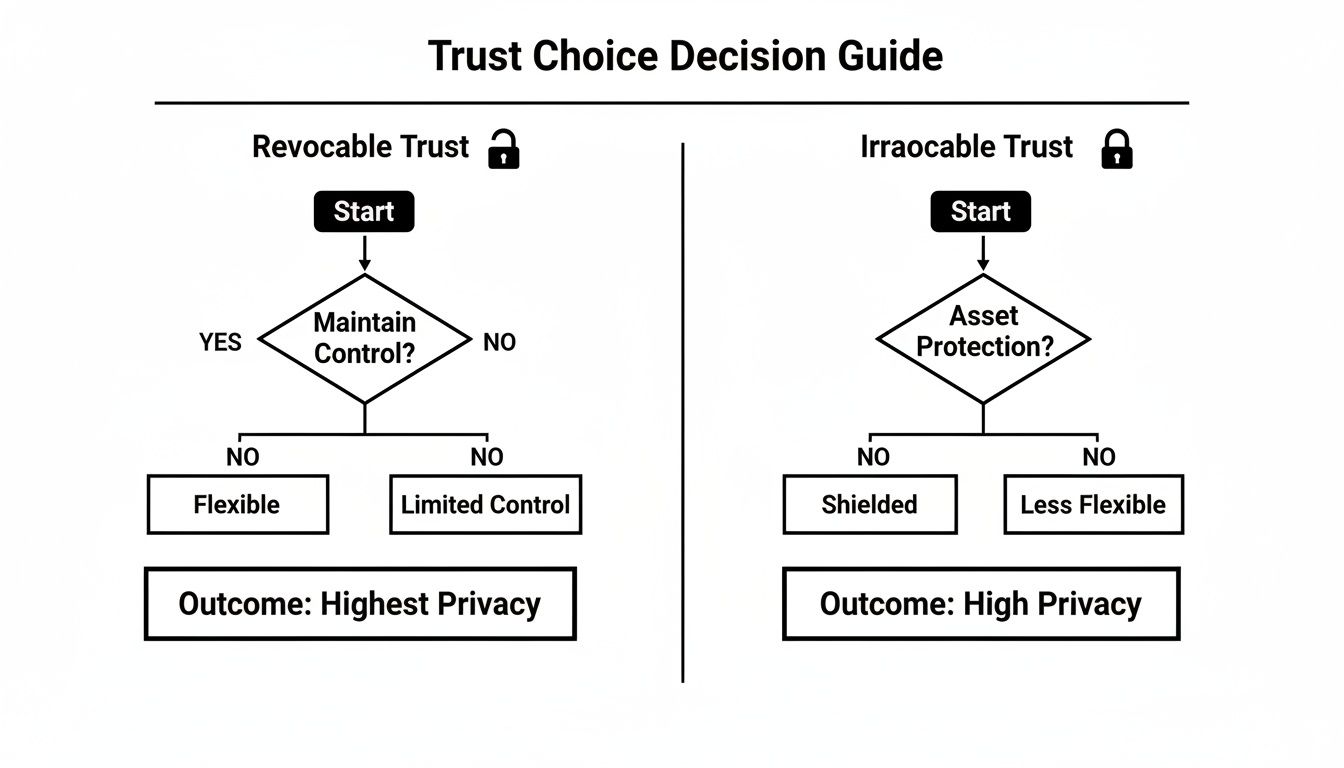
As you can see, both revocable and irrevocable trusts offer high levels of privacy. However, a revocable trust often provides the most confidentiality by steering clear of the probate process altogether.
Trust Litigation and Disputes
The most common way a private trust is exposed to the public is through a lawsuit. If a beneficiary sues a trustee for mismanaging funds, or if a disgruntled heir challenges the trust's validity, the trust document itself almost always becomes a central piece of evidence.
When that happens, the document is typically filed with the court as part of the legal proceedings. Court records are public records unless a judge seals them for a compelling reason. This means anyone can go to the courthouse, request the case file, and read the trust agreement.
Pour-Over Wills and the Probate Process
Another way a trust’s existence can become known is through a pour-over will. This special type of will is designed to "catch" any assets that were not properly transferred into the trust during the grantor's lifetime and then "pour" them into the trust after they pass away.
While this is a smart estate planning strategy, the will itself must go through the public probate process. During probate, the will is filed with the court, making it a public document. The will names the trust as its beneficiary, which reveals the trust's existence and name, but the private details of the trust itself remain confidential. Understanding the difference between probate and non-probate assets is key to maximizing privacy.
A pour-over will is a public document that points to a private trust. It confirms the trust exists without exposing its confidential terms and provisions.
Real Estate Transactions
Finally, trust information can become public when real estate is involved. Anytime a trust buys, sells, or transfers property in Texas, certain information must be recorded publicly to ensure a clear chain of title.
To prove the trustee has the authority to act on behalf of the trust, a document called a Certificate of Trust (or Memorandum of Trust) is recorded in the county’s public property records.
This certificate provides only the essential details, such as:
- Confirmation that the trust exists and is active.
- The names of the current trustees.
- The specific powers the trustees have to manage real estate.
Crucially, the Certificate of Trust does not include sensitive information. It will not list the beneficiaries' names or the specific instructions for distributing assets. This allows the trustee to meet legal requirements for property transactions while keeping the core of the estate plan private.
Trustee Responsibilities: How to Maintain Privacy Under Texas Law
Stepping into the role of a trustee means you are now the guardian of someone's legacy. It's a serious responsibility that includes a fiduciary duty to manage the trust's assets with care. Under the Texas Trust Code, a key part of that duty is protecting the trust's privacy. You are not just an asset manager but also a gatekeeper of sensitive family information.
Fulfilling this role correctly is about honoring the grantor's wishes to keep personal matters private. With a solid plan that includes clear communication and meticulous record-keeping, you can confidently administer the trust while keeping its business out of the public eye.

Step-by-Step Guidance for Texas Trustees
Here is some practical advice for trustees on how to maintain confidentiality and avoid common pitfalls that could lead to public disputes.
- Communicate Directly and Often: Keep beneficiaries informed. Regular, open updates about the trust's status can build goodwill and prevent the misunderstandings that often escalate into public lawsuits.
- Provide Private Accountings: The Texas Trust Code requires trustees to account for how they manage the trust's assets. Fulfill this duty by sending detailed accountings directly to the beneficiaries. This transparency can prevent a beneficiary from seeking a court-ordered accounting, which would make the information public.
- Keep Flawless Records: Document every transaction, decision, and communication. If a dispute ever arises, your detailed records will be your best defense and can often help resolve issues privately before a lawsuit is filed.
Using a Certificate of Trust to Protect Information
When dealing with banks, investment firms, or title companies, you will need to prove you are the trustee. However, you should not provide the entire trust document, as that would expose private family financial details. Instead, you should use a Certificate of Trust.
A Certificate of Trust is a condensed, legally recognized document that confirms the trust's existence and your authority as trustee without disclosing sensitive details like beneficiary identities or asset distribution plans.
This is one of the most effective tools for maintaining privacy. Think of it as showing your driver's license to prove your identity instead of handing over your entire personal file. An experienced Texas trust administration lawyer can prepare a Certificate of Trust that meets all state requirements, ensuring financial institutions will accept it without issue.
Taking these proactive steps is not just about fulfilling your legal duties in Texas. It is about protecting the very privacy and legacy the grantor intended.
Secure Your Legacy with a Texas Estate Planning Attorney
Trusts are powerful tools for keeping your family’s financial affairs private, but their effectiveness depends entirely on their proper creation and administration. Getting it right from the start is non-negotiable.
The surest way to build a plan that truly guards your legacy is to partner with an experienced Texas estate planning attorney. These professionals understand the nuances of state law and can help you navigate complex family dynamics, structure your assets for maximum privacy, and identify potential legal challenges before they arise. Whether you're just beginning your estate planning journey or need guidance fulfilling your fiduciary duties in Texas, professional legal advice is a wise investment. A solid plan is more than just documents; it’s the peace of mind that comes from knowing your wishes will be respected and your family shielded from public scrutiny.
A proactive approach to estate planning not only secures your assets but also preserves your family’s privacy for generations to come. It’s a final gift of security and stability.
Your legacy is worth protecting. Taking the time now to build a solid legal foundation ensures your private matters stay that way. From drafting the initial documents to handling the ongoing administration of a trust, having an expert in your corner makes all the difference in safeguarding what you’ve worked so hard to build.
Got Questions About Trust Privacy in Texas? We’ve Got Answers.
When you're navigating the complexities of trust administration, many questions can arise. Below, we’ve answered some of the most common concerns we hear from Texas families, explained in plain English.
Can a Beneficiary Demand a Copy of the Trust?
Yes. Under the Texas Trust Code, beneficiaries have a legal right to be kept reasonably informed about the trust and its administration. This right almost always includes obtaining a copy of the trust agreement itself.
However, this is a private exchange between the trustee and the beneficiary. It does not make the trust a public document. A key responsibility of a trustee in Texas is to balance transparency with beneficiaries while safeguarding the family's overall privacy from the public.
Do I Have to Register a Trust with the State of Texas?
No. In Texas, there is no state or county registry where you must file your trust documents. This is a significant feature and one of the main reasons trusts are such powerful tools for privacy.
Unlike a will, which must be filed with a probate court and becomes a public document, a trust is a private agreement that stays out of the public record system unless a specific legal issue, like a lawsuit, forces it into the open.
If My Trust Owns an LLC, Does That Become Public?
This is a "yes and no" situation. The existence of your Limited Liability Company (LLC) is public information. Anyone can search the Texas Secretary of State's website and confirm that your LLC is a registered business.
What remains private, however, is the ownership of the LLC. The public filings for an LLC typically do not require you to disclose that it is owned by your trust. This is a common and effective strategy for business owners to maintain a public-facing company while keeping their personal asset protection and estate plan confidential.
How Does a Certificate of Trust Keep Things Private?
A Certificate of Trust is an essential tool for a trustee. It acts as a condensed, summary version of the full trust document. It proves the trust is real and gives the trustee the authority to act on its behalf—all without revealing sensitive details.
When you provide a Certificate of Trust to a bank or financial institution, you are confirming, "Yes, I am the trustee, and I have the power to conduct this transaction," while keeping private information like beneficiary names and asset distribution plans out of their records.
This important document allows you to manage the trust’s business efficiently without having to show everyone the entire playbook for your family's estate.
If you’re managing a trust or planning your estate, contact The Law Office of Bryan Fagan, PLLC for a free consultation. Our attorneys provide trusted, Texas-based guidance for every step of the process.