Managing a loved one’s trust can feel overwhelming, especially when disagreements arise. But with the right legal guidance, it doesn’t have to be. While a trust isn’t a person, it can indeed be involved in lawsuits. The key is understanding that the power to sue—or defend the trust in court—lies with the trustee, the person or entity tasked with managing the trust's assets.
Think of the trust as a treasure chest filled with valuable assets meant for your beneficiaries. The trustee is the guardian of that chest, holding the key and the responsibility to protect everything inside. When those assets are threatened, the trustee has a legal duty to step up and defend them.
Yes, a Trust Can Sue, but the Trustee Leads the Charge

Stepping into the role of a trustee or discovering you're a beneficiary can feel like navigating a legal labyrinth. When a trust's property is at risk, the first question on everyone's mind is often, "Can the trust even fight back?" This question usually comes from a place of deep concern and a desire to do what's right.
The answer is found in the roles defined by Texas law. A trust is a legal arrangement, not a person. It can't walk into a courtroom or sign papers. That’s where the trustee comes in. The trustee is the trust's legal champion, holding both the power and the duty to protect its assets through legal action if necessary.
Key Roles in Texas Trust Litigation
To get a clear picture of how a lawsuit involving a trust unfolds, it helps to know who's who. Each party has a distinct and legally defined role to play, ensuring clarity and accountability.
Here’s a simple breakdown of the key players and their responsibilities:
| Party | Legal Role in a Lawsuit |
|---|---|
| The Trust | The legal entity that owns the assets. It is the named plaintiff or defendant in a lawsuit but acts through the trustee. |
| The Trustee | The legal representative and decision-maker. The trustee has the duty to sue or defend lawsuits on the trust's behalf to protect its assets. |
| The Beneficiary | The person or group the trust was created to benefit. They have rights to the trust assets and can sue the trustee for mismanagement. |
| Third Parties | Any outside individual or company. The trustee might sue a third party to recover trust property, or a third party might sue the trust over a debt. |
This framework is laid out in the Texas Trust Code, which grants trustees a wide array of powers to properly administer the trust. Among the most critical is the power to "prosecute or defend actions, claims, or proceedings for the protection of trust property."
This isn't just an option; it's a core responsibility. If someone damages property the trust owns, refuses to pay a debt, or breaks a contract, the trustee has a fiduciary duty to consider legal action. This duty demands complete loyalty and care, requiring the trustee to always put the beneficiaries' interests first. You can learn more about these obligations in our guide on trustee duties and responsibilities in Texas.
Failing to pursue a valid claim could be considered a breach of this duty, which could even make the trustee personally liable for any losses. Understanding this concept is the first step in handling trust disputes with confidence.
Trustee Responsibilities Under Texas Law: The Power to Sue

When you agree to serve as a trustee, you become the trust's frontline defender. This power to sue isn't just an option—it's a fundamental responsibility tied to your fiduciary duties in Texas. Gaining a firm grip on this authority is the first step toward managing a trust with confidence and competence.
The Texas Trust Code is clear on this point. It gives trustees the power to "prosecute or defend actions, claims, or proceedings for the protection of trust property." This isn't just dry legal text; it's a direct command. If the trust's assets are threatened, you are expected to take appropriate action to protect them.
Think of it this way: you are the CEO of the trust. If a competitor stole your company’s intellectual property or a key client refused to pay a major bill, you wouldn’t stand by. You would use every legal tool available. The role of a trustee is no different—the trust is your responsibility, and the beneficiaries are its stakeholders.
From Legal Theory to Practical Duty
The fiduciary duties of loyalty and prudence are the guiding principles behind the power to sue. While they might sound like abstract legal concepts, they have very real consequences in the day-to-day management of a trust. These duties demand that you act decisively to preserve the trust's value for the people it was created to support.
The duty of prudence, for instance, requires you to act as a reasonably careful person would when managing their own affairs. This isn’t just about making smart investments; it’s about actively shielding the assets from harm.
This duty becomes a concrete to-do list the moment the trust faces a real threat.
Real-World Scenarios Triggering Legal Action
Your duty to sue becomes undeniable in certain situations. Let’s walk through a few real-world scenarios where this power is not just an option, but a necessary tool for asset protection.
- Breach of Contract: A family trust in Austin holds a loan note for a business that suddenly defaults. Your duty of loyalty to the beneficiaries means you must take steps to collect the debt, which may include filing a lawsuit.
- Property Damage: A tenant living in a Houston rental property owned by the trust causes major damage and refuses to cover repair costs. Your duty of prudence demands you take action to recover that money.
- Fraudulent Claims: An outside party fabricates a claim against the trust, trying to siphon away its assets. It falls on you to legally defend the trust and protect its integrity.
In any of these cases, choosing not to act could be seen as a breach of your fiduciary duty. That inaction could leave you personally liable for any losses the trust suffers.
The ability of a trust to sue is a well-established principle in the U.S. legal system. Trustees routinely bring legal action against third parties, beneficiaries, and even co-trustees to defend trust assets. This field of law is active, tracking with broader litigation trends. For instance, recent research on debt collection lawsuits—which often involve trust-held debts—revealed that filings surged to pre-pandemic levels, with almost 4.7 million cases filed in 2022 alone. You can explore the findings of this research to see just how common this type of civil action has become.
Ultimately, the power to sue is deeply connected to the core responsibility of being a trustee. It’s a legal tool given to you to ensure the grantor's wishes are honored. An experienced Texas trust administration lawyer can provide critical guidance on when and how to use this authority to protect the trust and yourself.
Common Reasons a Trust Files a Lawsuit in Texas
Most people imagine trusts as quiet, behind-the-scenes vehicles for passing on a legacy. But in reality, a trustee’s duty to protect those assets isn't always a passive one. Sometimes, safeguarding the trust means stepping into the legal arena.
Filing a lawsuit isn't a sign of failure. On the contrary, it's often the most responsible and necessary tool a trustee has to fulfill their core duty: protecting the trust's value for the beneficiaries. The reasons for taking legal action are as varied as the assets a trust can hold, but they all boil down to this fundamental obligation.
Recovering Debts and Enforcing Contracts
One of the most common battlegrounds for a trust is the world of business and finance. Trusts are active financial players that can make loans, invest in businesses, and sign contracts. When those deals go south, the trustee must act.
For example, imagine a family trust in Texas that loaned a significant sum to a business partner to fund an expansion, all documented with a proper promissory note. If that partner stops making payments, the trustee can't just ignore it. Their fiduciary duty compels them to sue, collect the debt, and restore those funds to the trust.
Letting a major debt go uncollected without a fight could easily be seen as a breach of the trustee's duty of prudence. A trustee is expected to protect trust assets with the same care they would their own, and that includes pursuing what is rightfully owed.
In these cases, a lawsuit isn't an act of aggression. It's a defensive maneuver to reclaim assets that belong to the beneficiaries.
Addressing Property Damage and Lease Violations
Many Texas trusts hold significant real estate portfolios. As the legal owner, the trust—acting through its trustee—is responsible for managing these physical assets. That means dealing with tenants, contractors, and anyone else who interacts with the property.
Here's a common scenario: a trust owns a commercial building in Dallas. A tenant breaks their lease, disappears overnight, and leaves behind thousands of dollars in property damage. The trustee cannot simply absorb that loss.
To fulfill their duties, the trustee must take decisive steps to hold that former tenant accountable. This usually means filing a lawsuit to recover:
- Unpaid rent for the remaining lease term.
- The cost of repairs to fix the damage.
- Legal fees incurred while enforcing the lease agreement.
By suing for these damages, the trustee is doing more than recovering money; they are reinforcing the trust's rights as a property owner.
Fighting Fraudulent Claims and Defending Assets
Sometimes, the threat to a trust is more insidious, coming from an outsider making a fraudulent claim to siphon away assets. Someone might appear with a fabricated story, claiming the trust owes them money or that they have a right to a piece of trust property.
For instance, a third party could surface with a forged document, alleging the person who created the trust (the grantor) promised them a valuable painting now held by the trust. If the trustee knows this claim is false, they have a duty to defend the trust. This often involves filing for a declaratory judgment, which asks a court to officially declare the claim invalid.
Ignoring a fraudulent claim would be a massive failure of the trustee’s duty. Navigating these murky waters almost always requires an experienced attorney. If you're a trustee or beneficiary facing a dispute, our guide on dispute resolution and litigation in Texas trusts can help clarify your options. A seasoned Texas estate planning attorney can help you map out the best course of action to protect the trust's legacy.
When Beneficiaries and Trustees End Up in Court
While many trust lawsuits involve outside threats, some of the most difficult disputes erupt from within the trust itself. These internal conflicts, typically between the trustee and the beneficiaries, can feel intensely personal and emotionally charged.
It’s crucial to reframe these situations. Rather than seeing them as family squabbles, think of them as necessary legal procedures to keep the trust on the track the grantor intended.
When a beneficiary feels the person managing their trust is failing, they have every right to turn to the courts for help. Likewise, a trustee facing ambiguity may need a judge's guidance to do their job correctly. These actions are powerful tools for accountability and clarity.
Why a Beneficiary Might Sue a Trustee
The relationship between a trustee and a beneficiary is built on fiduciary duty. When a beneficiary has reason to believe that duty has been violated, they can petition the court. This is a fundamental check and balance in Texas trust law.
Common reasons a beneficiary takes a trustee to court include:
- Breach of Fiduciary Duty: The most frequent claim, this can cover anything from failing to invest assets wisely to favoring one beneficiary over another.
- Self-Dealing: A trustee is forbidden from using trust assets for personal benefit. If a trustee sells a trust property to themselves at a low price or "borrows" money from the trust, it's a clear conflict of interest.
- Failure to Distribute Assets: If the trust document requires distributions at a certain age or event, and the trustee fails to make them without a valid reason, beneficiaries can sue to compel payment.
- Failure to Provide an Accounting: Beneficiaries have a legal right to know what's happening with the trust's finances. A trustee’s refusal to provide a clear, accurate accounting is a major red flag.
If you’re a beneficiary and you suspect misconduct, our guide on how to sue a trustee in Texas offers a deeper dive into your rights and the steps involved.
When a Trustee Needs to Involve the Court
It might sound strange, but there are times when a trustee must initiate a lawsuit involving a beneficiary. This isn't about being aggressive; it's about a trustee trying to fulfill their duties properly and protect themselves from being sued later.
A trustee might file a declaratory judgment action, which is basically asking a court to interpret confusing or ambiguous language in the trust document. This is not about suing a beneficiary, but about getting a definitive legal ruling to ensure they distribute assets correctly and avoid future lawsuits.
Other scenarios include:
- Resolving Disputes Between Beneficiaries: If beneficiaries can't agree on their rights under the trust, a trustee can ask the court to step in and make the call, protecting the trust from getting caught in the crossfire.
- Approving a Controversial Action: Before making a major decision that is likely to be challenged—like selling a family business—a trustee might seek the court's blessing first. This shields them from future claims of mismanagement.
Trusts are frequently involved in major legal battles, not just locally but on a global stage. This is especially true for Texas families with complex business interests. For instance, the International Chamber of Commerce (ICC) reported a record 831 new arbitration cases in 2024, with the value of pending cases hitting an unprecedented US$354 billion. A significant number of these disputes involve trusts in the energy and construction sectors—industries that are the lifeblood of Texas. Explore more about these global dispute resolution trends to get a sense of the massive role trusts play in modern litigation.
Step-by-Step Guidance for Trust Litigation
When you’re a trustee, the thought of filing a lawsuit can feel overwhelming. But with the right guidance, you can navigate the process with confidence. Think of this as your step-by-step guide for handling trust litigation, designed to make each stage clear and manageable.
Step 1: Consult With a Texas Trust Litigation Attorney
Your first move should always be to seek professional legal advice. A skilled Texas trust administration lawyer will analyze the facts of your situation, review the trust document, and give you a straightforward assessment of your case's strengths and weaknesses.
This consultation is critical. An attorney helps you weigh the potential rewards against the costs and risks of a lawsuit, ensuring you’re acting in the best interest of the beneficiaries and upholding your fiduciary duties.
Step 2: Gather All Essential Documents
Once you and your lawyer have a game plan, it’s time to assemble your evidence. These documents form the backbone of your case, and organizing them early is crucial.
Your attorney will need to review:
- The Trust Agreement: The original document and any amendments.
- Correspondence: All emails, letters, and messages related to the dispute.
- Financial Records: Bank statements, investment reports, appraisals, and receipts.
- Contracts and Agreements: Any leases, loans, or other contracts at the center of the lawsuit.
Being thorough here streamlines the entire legal process and puts you on stronger footing from day one.
Step 3: Filing the Lawsuit and Navigating Discovery
With your evidence in hand, your attorney will draft and file a petition in the appropriate Texas court. This document officially begins the lawsuit by outlining the trust’s claims. The other side is then formally served and given an opportunity to respond.
This kicks off the discovery phase, a formal process where both sides exchange information and evidence. This can involve written questions (interrogatories), requests for documents, and depositions (sworn testimony given out of court). The goal is to ensure there are no surprises before trial.
The chart below shows how internal trust disputes often play out.
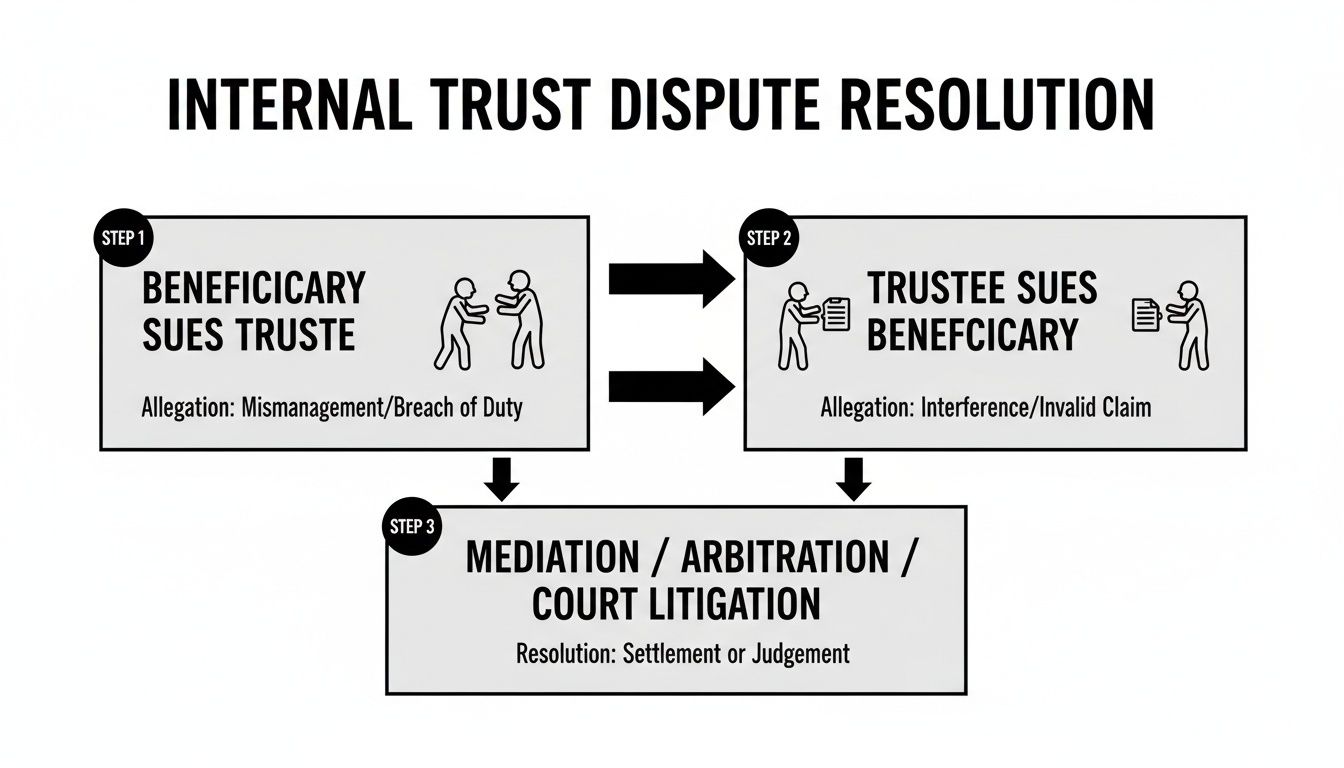
These formal steps exist to ensure a trust is administered properly and that everyone's rights are protected.
Step 4: Mediation and Preparing for Trial
Most Texas courts will require you to attempt mediation before going to trial. Mediation is a confidential meeting where a neutral third party helps both sides try to negotiate a settlement. It is often a quicker and less costly way to resolve the conflict.
If an agreement can't be reached in mediation, the final step is trial. Your attorney will handle the complex legal work—from filing motions to preparing witnesses—so you can stay focused on your duties as trustee.
The need for trusts to sue negligent third parties is increasingly common, especially with data breaches that expose sensitive financial information. Consider the major Equifax case, where attorneys general from 50 states, including Texas, secured a $600 million settlement in 2019 for a breach affecting 147 million people. In such situations, trusts may need to litigate to recover losses. Find out more about the rising importance of digital trust and how it's changing asset protection.
Wrapping It Up: Protecting the Trust with Purpose
So, can a trust sue? Absolutely. Through its trustee, a trust can and often must take legal action to defend its assets. This isn't about aggression; it's about protection. Whether you're shielding the trust from an external threat or resolving an internal dispute, litigation is a serious but sometimes necessary tool.
The idea of a lawsuit can be intimidating, but understanding your role and the legal landscape is the first step toward taking control.
With a skilled legal guide, you can confidently meet your obligations and secure the trust’s future. The Texas Trust Code provides the map, but an experienced attorney helps you navigate the terrain.
As a trustee or beneficiary, your fundamental duty is to protect the grantor's legacy. Sometimes, taking decisive legal action is the most responsible way to honor that legacy and ensure the trust’s assets are there for the next generation.
If you find yourself in this position—as a trustee, beneficiary, or someone beginning their estate planning journey—you don't have to walk this path alone. Our firm is deeply rooted in Texas probate, guardianship, and asset protection law. We provide clear, compassionate guidance to help you feel informed and secure in your next steps.
For anyone managing a trust or planning for the future, contact The Law Office of Bryan Fagan, PLLC for a free consultation. Our attorneys are here to provide the trusted, Texas-based guidance you need for every step of your journey.
Frequently Asked Questions About Trust Litigation
When you’re dealing with a trust, the thought of a lawsuit can be daunting. Getting straight answers to common concerns is the first step toward navigating trust administration with confidence. Here’s a look at what you need to know about trust litigation in Texas.
Can a Trust Be Sued in Texas?
Yes, it can. While a trust is not a person, it functions as a legal entity that owns property and can be held liable. Just as a trustee can sue on the trust's behalf, a third party—like a creditor or someone injured on trust property—can file a lawsuit against the trust.
When a claim is filed, the trustee’s fiduciary duty requires them to defend the trust. This involves hiring a qualified attorney and managing the legal strategy to shield the trust’s assets from the lawsuit.
Who Pays for Legal Fees When a Trust Sues?
Typically, the trust itself pays for its own legal expenses. The Texas Trust Code allows a trustee to use trust funds to pay for reasonable costs of administration, which includes litigation filed to protect the trust or enforce its rights.
However, there's a critical exception. If a judge determines the trustee acted in bad faith or breached their fiduciary duty—for example, by filing a frivolous lawsuit—the court can order the trustee to pay for legal fees out of their own pocket, including the other side's attorney costs.
What Is the Time Limit for Suing a Trustee in Texas?
For a beneficiary looking to sue a trustee for a breach of fiduciary duty, Texas law generally sets the statute of limitations at four years. The clock usually starts running from the moment the beneficiary knew, or reasonably should have known, that the breach occurred.
Determining when that clock starts can be complex, which makes acting quickly vital. If you are a beneficiary and suspect misconduct, you should speak with a Texas estate planning attorney right away. Waiting too long could mean losing your right to take legal action.
Are There Alternatives to a Full Lawsuit?
Yes, and in many cases, they are the better path forward. Litigation is often expensive, lengthy, and public. For this reason, Texas law strongly encourages alternative dispute resolution (ADR) methods.
- Mediation: This involves a neutral third-party mediator who helps the trustee and the opposing party negotiate a private, confidential settlement. It’s far less formal and confrontational than a courtroom battle.
- Arbitration: This is a more formal process where a neutral arbitrator listens to evidence from both sides and issues a binding decision, much like a judge.
In fact, many modern trust documents now include clauses that require parties to attempt mediation before a lawsuit can be filed.
If you’re managing a trust or planning your estate, contact The Law Office of Bryan Fagan, PLLC for a free consultation. Our attorneys provide trusted, Texas-based guidance for every step of the process.