Deciding to seek guardianship for elderly parents is one of the most significant and emotionally charged legal steps a family can take. It’s a path pursued only when a parent can no longer make safe decisions for themselves, involving a court-supervised process designed to protect them when all other supportive measures are insufficient. Managing a loved one’s well-being can feel overwhelming—but with the right legal guidance, it doesn’t have to be.
When Is Guardianship the Right Call for an Elderly Parent?
Watching a parent's health and independence decline is a difficult, emotional journey. It often begins with small incidents—a missed doctor's appointment or an unpaid bill. Over time, these concerns can escalate into serious problems that jeopardize their health, safety, and finances. This is typically the crossroads where families begin to consider the possibility of guardianship.
In Texas, guardianship is a formal legal process where a court appoints a qualified person (the guardian) to make critical decisions for someone else (the ward) who has been found legally incapacitated. Texas courts do not take this step lightly. It involves removing an individual's fundamental right to make their own choices, which is precisely why it is considered a last resort.
Recognizing the Signs of Incapacity
In the eyes of Texas law, incapacity is more than just aging or occasional memory lapses. The Texas Estates Code establishes a specific legal standard. A person must be substantially unable to provide their own food, clothing, or shelter, care for their physical well-being, or manage their financial affairs.
Real-world scenarios make this clearer. Consider a father with progressing Alzheimer's who begins wandering from home and forgets to take his essential heart medication. Or a mother whose dementia makes her vulnerable to financial scams, causing her to send thousands of dollars to strangers. In these situations, their safety is in immediate jeopardy, and they have lost the ability to protect themselves.
Key warning signs that might point toward a need for guardianship include:
- Poor Personal Hygiene: A significant decline in grooming, bathing, or maintaining a clean home.
- Unsafe Decision-Making: Forgetting to turn off the stove, getting lost in familiar areas, or being unable to respond in an emergency.
- Financial Vulnerability: Making unusual purchases, becoming entangled in scams, or completely losing track of bills and expenses.
- Medical Neglect: Forgetting to take critical medications, skipping doctor's appointments, or being unable to follow a treatment plan.
Guardianship as a Last Resort
Before a judge will consider guardianship, Texas law requires that all less restrictive alternatives be explored. If your parent had the foresight to engage in proactive estate planning while they still had legal capacity, you might be able to avoid the courtroom entirely.
For example, a properly drafted Durable Power of Attorney can grant a trusted agent the authority to handle finances, while a Medical Power of Attorney appoints someone to make healthcare decisions. These are powerful documents that honor a person's autonomy by allowing them to choose who acts on their behalf. You can learn more by reviewing our guide on planning for incapacity with power of attorney essentials.
But when those documents don't exist, or they are not sufficient to manage the crisis at hand, guardianship becomes the necessary path forward. It is a legal process designed to bring order and protection to a difficult situation.
Getting Started: The Texas Guardianship Court Process
Navigating the Texas legal system for a guardianship for elderly parents can feel daunting, but the process follows clear, defined steps. Once you understand the key stages and the roles of the individuals involved, you can approach the process with more confidence. It all begins with a formal petition to the court, which sets in motion a series of events designed to protect your parent above all else.
The first step is filing an "Application for Appointment of Permanent Guardian" with the appropriate Texas court. This document is the legal cornerstone of your case. In it, you must clearly explain why a guardian is necessary, detailing your parent's condition and how it prevents them from managing their own care or finances. You will also need to state why you are a suitable candidate for the role.
Once the application is filed, the court's immediate priority is to protect the rights of your parent, now referred to as the "proposed ward." A judge will appoint an independent, third-party attorney known as an attorney ad litem. This lawyer's sole duty is to be your parent's advocate, representing their personal wishes and legal interests—not what you or anyone else believes is best. This is a crucial safeguard built into the Texas Estates Code.
Key Figures Protecting Your Parent
In addition to the attorney ad litem, the court may also appoint a guardian ad litem. Although their titles are similar, their roles are distinct—and both are vital.
- Attorney Ad Litem: This is your parent's legal counsel. They will meet with your parent, explain the proceedings in plain language, and advocate for your parent's wishes in court, even if those wishes oppose the guardianship request.
- Guardian Ad Litem: This person acts as the "eyes and ears of the court." They serve as an independent investigator, examining the facts of the case. They will speak with family, doctors, and caregivers to get a complete picture, then provide a recommendation to the judge about what they believe is in the proposed ward's best interest.
This two-pronged approach ensures a balanced perspective. The court hears both what your parent wants and what an independent party thinks is best for them before making a decision as serious as removing someone's rights.
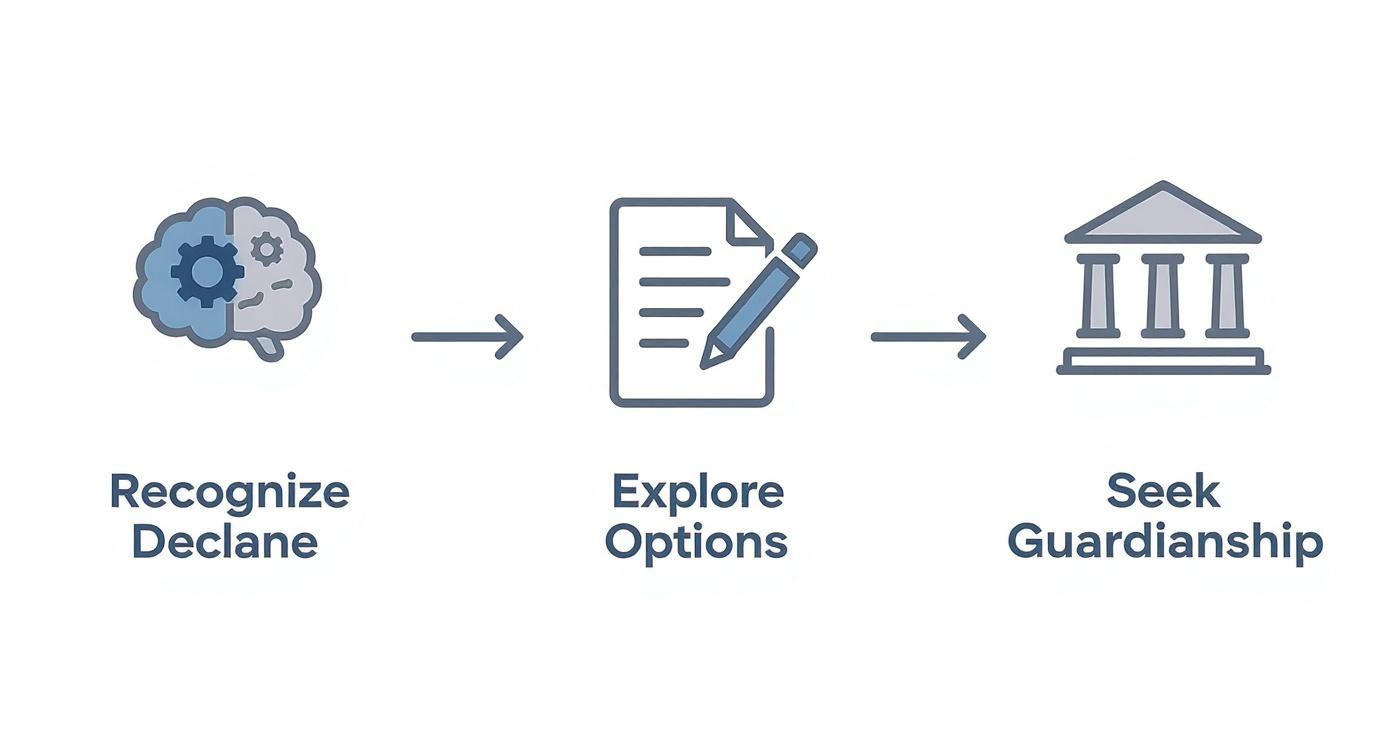
This process chart highlights that guardianship is not the first option. It is the final step taken after a decline has been recognized and less restrictive alternatives have been explored.
To help you keep track of these moving parts, here is a summary of the legal journey in a typical Texas guardianship case.
Key Stages in the Texas Guardianship Legal Process
| Stage of Process | Key Action Required | Primary Purpose |
|---|---|---|
| Filing the Application | Submit the "Application for Appointment of Permanent Guardian" with the court. | To formally initiate the legal process and state the reasons for needing a guardian. |
| Court Appointments | The judge appoints an Attorney Ad Litem and possibly a Guardian Ad Litem. | To ensure the proposed ward's rights and best interests are independently represented. |
| Medical Evaluation | Obtain a "Certificate of Medical Examination" (CME) from a physician. | To provide the court with objective medical evidence of incapacity. |
| Investigation Phase | The Ad Litems conduct interviews and gather information. | To give the court a comprehensive, unbiased view of the situation. |
| The Court Hearing | Present all evidence and testimony to the judge. | To allow the judge to make a final, informed decision based on the evidence. |
| Final Order | If granted, the judge signs an order and issues "Letters of Guardianship." | To legally appoint the guardian and grant them the authority to act. |
Each stage builds upon the last, ensuring the court has all the necessary information to make a fair and just decision for your parent.
The Medical Evidence the Court Needs
A Texas judge cannot simply take your word for it. The single most crucial piece of evidence is a "Certificate of Medical Examination" (CME). This is not just any doctor's note; it is a specific legal form that must be completed by a physician who has examined your parent within the last 120 days.
The CME must be detailed, describing the nature, degree, and severity of your parent's incapacity. It is the professional medical opinion the court relies on to assess their decision-making ability. Without a current and correctly completed CME, the case cannot proceed.
What to Expect During the Court Hearing
The hearing is where all the evidence comes together. You will attend with your attorney, along with the attorney ad litem and any other involved family members. Your parent has the right to be present at the hearing, and the court will make accommodations unless their doctor states it would be harmful to their health.
During the hearing, the judge will review the application, the doctor's report, and the findings from the ad litems. Witnesses, including you, the doctor, or others familiar with your parent's situation, may be called to testify.
The legal standard in Texas is high. A judge must find by "clear and convincing evidence" that your parent is incapacitated and that a guardianship is in their best interest. This is a much higher standard of proof than in most civil cases, reflecting the gravity of removing an individual’s fundamental rights.
If the judge finds the evidence compelling, they will sign an order appointing you as the guardian and issue "Letters of Guardianship." This official document is your legal proof of authority to make decisions for your parent. It marks the end of the court process and the beginning of your new role. Having an experienced Texas estate planning attorney can make a significant difference in navigating each step correctly and compassionately.
Exploring Powerful Alternatives to Guardianship
Pursuing a guardianship for elderly parents is a significant legal undertaking, and one that Texas courts approach with great caution. At its core, guardianship removes an individual's fundamental right to make personal and financial choices. For this reason, Texas law views it as a solution of last resort.
Before a court will consider guardianship, it requires that every less restrictive alternative is explored first. This approach empowers families to find supportive solutions that protect a loved one's dignity and independence for as long as possible.
The good news is that with proactive estate planning, a court-supervised guardianship can often be avoided. By putting the right legal tools in place while your parent still has the legal capacity to sign documents, they can decide who they trust to manage their affairs. This is not just a legal strategy; it's about honoring their wishes and saving your family the time, expense, and emotional turmoil of a court proceeding.
The Durable Power of Attorney for Financial Matters
One of the most essential tools for avoiding guardianship is the Durable Power of Attorney (DPOA). This document allows your parent (the "principal") to appoint a trusted person (the "agent") to handle their financial affairs. The word "durable" is key—it means the agent's authority continues even if your parent later becomes incapacitated.
With a DPOA, the agent can manage a wide range of financial responsibilities, such as:
- Paying bills and managing bank accounts.
- Filing tax returns.
- Overseeing investments and real estate.
- Collecting Social Security or other benefits.
For example, a mother meets with her Texas estate planning attorney and signs a Durable Power of Attorney, naming her daughter as agent. Years later, she suffers a severe stroke and can no longer communicate. Because of the DPOA, her daughter can immediately pay the mortgage and manage investments without court intervention, preventing a financial crisis.
The Medical Power of Attorney for Healthcare Decisions
Equally important is planning for healthcare. A Medical Power of Attorney (MPOA) empowers your parent to name an agent to make medical decisions for them if they are unable to communicate their wishes. This document is vital for ensuring their healthcare journey aligns with their personal values.
The agent named in an MPOA can consult with doctors, access medical records, and make critical decisions about treatments, surgeries, and long-term care. Without one, hospitals might require a court-appointed guardian before proceeding with major medical decisions, leading to stressful and potentially dangerous delays.
Under the Texas Estates Code, agents named in both financial and medical powers of attorney are considered fiduciaries. This imposes a strict legal duty to act only in the best interest of the principal, maintain detailed records, and avoid any conflicts of interest. Understanding these fiduciary duties in Texas is critical.
The Living Will for End-of-Life Wishes
Working in conjunction with a Medical Power of Attorney is the Directive to Physicians, commonly known as a Living Will. This document allows your parent to state their specific wishes about end-of-life care, particularly concerning the use of life-sustaining treatments. For a more detailed look, you can learn more by reviewing our guide on healthcare directives and living wills.
Having this document provides clarity and lifts the immense emotional burden from family members who would otherwise be forced to guess what their loved one would have wanted.
The push for alternatives to guardianship is part of a larger trend. The global elderly care market, valued at $49.29 billion in 2024, is projected to reach $98.19 billion by 2032. This growth in services like home care and assisted living provides families with more options than ever. You can discover more insights about this growing market on fortunebusinessinsights.com. When these practical supports are combined with solid legal planning, guardianship often becomes unnecessary.
Your Responsibilities as a Guardian in Texas
Stepping into the role of a guardian is a profound commitment, both legally and personally. The moment a Texas court appoints you, your relationship with your parent fundamentally changes. You are no longer just their son or daughter; you become a fiduciary, legally bound to a high standard of care under the Texas Estates Code.
This means you must act with absolute loyalty and transparency, always putting your parent's—now the court's "ward"—best interests first.

This responsibility is often divided into two distinct roles. The court may appoint you for one or both, and understanding the difference is the first step to fulfilling your duties properly.
Guardian of the Person vs. Guardian of the Estate
In Texas, guardianship is not a one-size-fits-all solution. The court tailors the appointment to meet your parent's specific needs, meaning your authority can be either broad or limited. The two primary types of guardianship are:
- Guardian of the Person: This role focuses on your parent's personal and medical well-being. It involves making decisions about where they live, the medical care they receive, and ensuring their daily safety and comfort.
- Guardian of the Estate: This role is strictly financial. You are responsible for protecting their property, paying bills, managing investments, and handling all aspects of their assets.
Often, an elderly parent requires assistance in both areas, and one person may be appointed to both roles. However, if the finances are particularly complex or family dynamics are strained, a judge might appoint a family member as Guardian of the Person and a neutral professional, like a bank or an attorney, as Guardian of the Estate.
Upholding Strict Fiduciary Duties
As a guardian, every decision must be made exclusively for your parent's benefit. This is a legal requirement, not a suggestion. You must meticulously avoid any conflicts of interest, meaning you cannot use your position for personal gain or make choices that benefit you at your parent's expense.
The Texas Estates Code requires guardians to manage the ward's assets with care, diligence, and prudence. This means every financial decision must be justifiable as being for the direct benefit of the ward, not the guardian or any other family member. These fiduciary principles ensure accountability and protect vulnerable adults.
Financial Oversight and Court Reporting
If you are named Guardian of the Estate, be prepared for significant financial oversight. This is a formal, highly supervised process.
Within 30 days of your appointment, you must file a detailed Inventory, Appraisement, and List of Claims with the court. This document provides a complete accounting of every asset your parent owns, from their home and bank accounts to their personal belongings.
You will also be required to post a bond, which acts as an insurance policy to protect the estate from potential mismanagement or fraud. The court sets the bond amount based on the value of the estate’s liquid assets.
Furthermore, you must file a comprehensive Annual Accounting each year. This report details every dollar that came into and went out of the estate. Every expense must be supported by receipts and justified as being for your parent's benefit.
A Real-World Scenario: Selling the Ward’s Home
Let's walk through a common situation. Suppose your mother is the ward, and you are the Guardian of both her Person and Estate. Her dementia has progressed, and her doctors recommend she move to a memory care facility for her safety. Her home is her largest asset, and you need to sell it to fund her long-term care.
You cannot simply hire a realtor and list the house. As guardian, you must first file an application with the court seeking permission to sell the property. In the application, you must prove to the judge that the sale is necessary and in your mother's best interest. The court will review the proposed sale price, the real estate contract, and the plan for the proceeds. A judge will only issue an order authorizing the sale after being fully satisfied that the transaction is fair and transparent. This process is in place to protect your mother by ensuring her most valuable asset is handled properly under judicial oversight.
The Emotional Realities of Family Caregiving
Stepping into the world of guardianship for elderly parents is far more than a legal procedure. It is often the culmination of months or even years of watching a loved one decline—a journey that is emotionally draining and practically overwhelming. Acknowledging this reality is a critical first step.
You are not just completing paperwork; you are navigating a profound shift in your family dynamic.

Many adult children are part of the "sandwich generation," caught between raising their own children and caring for aging parents. This dual role stretches your time, finances, and emotional resources to their limits. It is a role of incredible sacrifice, and it is important to remember you are not alone.
The Overwhelming Scope of Modern Caregiving
Family caregiving in America is a massive, often invisible, part of our society. An estimated 63 million adults provide unpaid care for family members. A significant number of these caregivers are under 50, juggling this responsibility during their peak career and child-rearing years.
The work itself has also become more demanding. Over 40% of caregivers now handle complex medical tasks, such as giving injections or managing specialized equipment, often with no formal training. This immense pressure also takes a financial toll. Half of all family caregivers report serious financial setbacks, with some struggling to afford groceries due to caregiving expenses.
This is why legal tools like guardianship are not just isolated court procedures; they are vital components of a comprehensive care plan. Seeking legal guidance is a proactive step toward bringing stability to a chaotic situation, protecting both your parent and yourself.
Finding Support and Stability
The emotional weight of making life-altering decisions for a parent can feel incredibly isolating. Feelings of guilt, burnout, and chronic stress are common. Building a support system is not a luxury—it is essential for your well-being.
Many family caregivers find a lifeline in caregiver support groups. Connecting with others who understand your experience can provide validation, practical advice, and a safe space to share your feelings.
- Acknowledge Your Limits. It is not a sign of weakness to admit you need help. Pushing yourself beyond your breaking point does not benefit anyone, least of all your parent.
- Seek Professional Guidance. Engaging a Texas guardianship attorney is not just about the paperwork. It is about creating a clear, stable framework so you can focus on providing love and care, not stressing about legal uncertainties.
- Prioritize Self-Care. You cannot pour from an empty cup. Making even small pockets of time for your own well-being is crucial for providing compassionate care over the long term.
By viewing these legal steps as part of a broader strategy for compassionate management, you can move forward with purpose, protecting your parent’s well-being while also preserving your own.
Common Questions About Texas Guardianship
Once you understand the guardianship process, practical questions often arise. It is one thing to know the steps and another to live them. Families frequently have valid concerns about the cost, potential for family conflict, and the permanency of the arrangement. Getting clear answers can make all the difference.
How Much Does Obtaining Guardianship in Texas Cost?
There is no flat fee for establishing a guardianship in Texas. The final cost can vary significantly depending on the complexity of your family's situation.
Key expenses include your own attorney's fees, court filing fees, and the fees for the court-appointed attorney ad litem representing your parent. If the case becomes contested—for instance, if a sibling objects to the guardianship—legal costs can increase substantially. It is an investment in your parent’s well-being, but it is crucial to have a frank discussion about potential costs with your lawyer from the outset.
Can a Guardianship Ever Be Reversed or Terminated?
Yes. A guardianship is not always permanent. The Texas Estates Code allows the ward (your parent) or anyone acting in their best interest to petition the court to restore their rights. This is a formal legal motion, not an informal request.
To terminate a guardianship, you must prove to the court with "clear and convincing evidence" that the person has regained the capacity to manage their own life and finances. This almost always requires new medical evaluations and another court hearing where the judge makes the final determination.
For example, if a parent suffered a severe but treatable medical issue that caused temporary incapacitation and then made a full recovery, they would have every right to petition the court to end the guardianship and regain their independence.
What Happens If Family Members Disagree on Guardianship?
Family disputes are one of the most challenging aspects of the process. It is not uncommon for one sibling to believe guardianship is necessary while another considers it an overreaction. When a family cannot reach a consensus, the judge makes the final decision.
The court's sole priority is the best interest of your parent. A judge will listen to all parties, review the evidence, and give significant weight to the reports from court-appointed professionals. If the disagreement is over who should be the guardian, the judge will appoint the person they deem most suitable, who may not be the individual who initiated the process.
Can I Be Paid for Being My Parent’s Guardian?
Being a guardian is a serious responsibility, and Texas law recognizes this. Whether you are a Guardian of the Person or Guardian of the Estate, you may be entitled to reasonable compensation from your parent's estate for your services. However, this is not a blank check.
You cannot set your own salary. All compensation must be approved by the court. You will need to file a detailed request explaining the services you provided and why the requested fee is fair. The judge will review it to ensure the amount is reasonable and that the estate can afford it. To avoid confusion, it is also helpful to understand the general distinction between guardianship and custody, as these roles have very different legal foundations and purposes.
If you’re considering guardianship or planning your estate, contact The Law Office of Bryan Fagan, PLLC for a free consultation. Our attorneys provide trusted, Texas-based guidance for every step of the process at https://texastrustadministration.com.