Thinking about who will care for your child if you are no longer able to is a profound act of love. This conversation often begins because of an unexpected tragedy, a sudden illness, or a parent's incapacity. Whatever the reason, establishing a plan ensures your child has unwavering stability and care when they need it most. Navigating this process can feel overwhelming—but with the right legal guidance, it doesn’t have to be.
The legal process for appointing a caregiver, known as guardianship, is a carefully constructed shield designed to provide security during life's most challenging storms.
Securing a Child’s Future During Difficult Times
This guide will walk you through establishing a guardianship of a minor in Texas, explaining complex legal matters in plain English. We will break down the steps into understandable concepts, helping you protect the child you love with clarity and confidence.
Our goal is to empower you with the knowledge to make informed choices for their future. The entire process is governed by the Texas Estates Code and overseen by probate courts to ensure every decision is made with the child’s best interest at heart.

Why Guardianship Matters
When parents cannot be there, guardianship provides a clear, official framework for a child’s care. This is not just an informal agreement; it is a court-ordered role with critical responsibilities:
- Legal Authority: The guardian gains the legal right to make important decisions, from where the child attends school to their medical care and daily life.
- Financial Management: If a child inherits money or property, a "guardian of the estate" can be appointed to manage these finances responsibly until they reach adulthood. You can learn more about protecting a child's assets by exploring how to go about setting up a trust for a child.
- Stability: Most importantly, guardianship creates a stable and secure home, minimizing chaos and disruption during what is already an incredibly difficult time for a child.
Your Role as a Potential Guardian
Stepping into the role of a guardian is a profound commitment. You become responsible for the minor's entire well-being. This extends beyond providing food and shelter; it includes nurturing their emotional and mental health. It means knowing how to spot the signs of depression in teenagers and ensuring they receive the support they need.
A guardian's primary responsibility—their fiduciary duty—is to always act in the best interest of the child. This guiding principle shapes every decision, from choosing a summer camp to managing an inheritance.
If you’re managing a loved one’s trust or planning your estate, contact The Law Office of Bryan Fagan, PLLC for a free consultation. Our attorneys provide trusted, Texas-based guidance for every step of the process.
Making Sense of Guardianship and Other Ways to Care for a Child
When a child needs a caregiver, you will hear legal terms like guardianship, custody, and adoption. It is easy to assume they are interchangeable, but in Texas, they represent distinct legal paths. Understanding these differences is the first crucial step toward ensuring a child is properly protected.
Guardianship is a formal process established by a probate court under the Texas Estates Code. It is implemented when a child's parents are unable to care for them due to death, serious illness, or other incapacitating circumstances.
Think of it as a legal safety net. A judge empowers a trusted adult to assume a parental role, ensuring the child's daily needs are met under the supervision of the court. The child's best interests are the court's sole focus. Unlike adoption, guardianship does not have to be a permanent change to the family structure.
Guardian of the Person vs. Guardian of the Estate
In Texas, the court can divide guardianship into two distinct roles. One person may handle both, or two different people can be appointed, depending on the child's needs. This practical separation ensures that both the child's daily life and their financial security are in capable hands.
Guardian of the Person: This individual is responsible for the child's physical and emotional well-being. They make everyday decisions: where the child lives, which school they attend, and who their doctor is. They act as a surrogate parent, providing the care, guidance, and stability necessary for a child to thrive.
Guardian of the Estate: This role is strictly financial. A Guardian of the Estate is appointed when a minor has assets—such as an inheritance, life insurance proceeds, or a legal settlement—that require professional management. This guardian has a strict fiduciary duty to protect and invest the child's property until they turn 18.
Here’s a real-world scenario: Imagine grandparents need to care for their grandchild after the child's parents tragically pass away. A court would likely name them the Guardian of the Person to handle school, doctor's visits, and daily parenting. If the child also inherited their parents' home and savings, the court might appoint the grandparents (or a financial professional) as the Guardian of the Estate to manage those assets under strict court supervision.
While these roles often work together, it's vital to understand the difference between a guardian and a power of attorney, as they are created for entirely different legal situations.
Comparing Guardianship, Custody, and Adoption
It is crucial not to confuse guardianship with other forms of child care. Each is built on a different legal foundation and leads to a different outcome. Custody, for example, is typically decided in family court during a divorce. Adoption creates a new, permanent parent-child relationship.
Guardianship is a protective measure, not a permanent termination of parental rights. It is established because a need exists and can be modified or terminated if circumstances change, such as a parent recovering from an illness.
To clarify, let's break down how these three arrangements compare in Texas.
Guardianship vs Custody vs Adoption in Texas
This table highlights the key differences between these common legal arrangements.
| Legal Arrangement | Parental Rights Status | Purpose and Duration | Common Scenario |
|---|---|---|---|
| Guardianship | Parental rights are suspended but not terminated. The biological parent-child relationship remains legally intact, even though the guardian has authority. | To provide care when parents are unable. It is temporary and can be ended by the court if the parent becomes capable of resuming care or the child turns 18. | Grandparents are appointed to care for a child after the single parent is incapacitated by a serious accident. |
| Custody (Conservatorship) | Parental rights are allocated between parents. Both parents typically keep their rights, but a family court designates who has primary authority for certain decisions. | To determine the rights and responsibilities of parents who are separated or divorced. It is part of a family law case. | A divorce decree outlines a possession schedule and designates which parent makes educational and medical decisions. |
| Adoption | The biological parents' rights are permanently and irrevocably terminated. The adoptive parents become the child's legal parents for all purposes. | To create a new, permanent parent-child relationship. This is a final arrangement that cannot be reversed. | A stepparent legally adopts their spouse's child, or a family adopts a child from foster care. |
As you can see, the right choice depends entirely on the family's specific situation. While all three aim to provide a stable home, the legal implications—especially concerning parental rights—are vastly different.
How to Appoint a Guardian Through the Texas Courts
Navigating the Texas court system to establish a guardianship of a minor can feel intimidating, but there is a clear, logical path forward. The process is built on a single foundational principle: every decision must serve the best interest of the child. Once you understand this roadmap, the legal steps become much more manageable.
The journey begins when a concerned individual files an "Application for Appointment of Guardian" with the appropriate probate court. The Texas Estates Code requires that the person filing, known as the applicant, has a genuine interest in the child's well-being. This could be a grandparent, an adult sibling, another relative, or even a close family friend who can demonstrate a strong, positive connection to the child.
Initiating the Guardianship Process
The initial application is the cornerstone of the case. It is a formal legal document that must present all essential facts to the court, explaining why a guardian is necessary and why the proposed person is the right choice.
You will need to provide key details, including:
- Basic information about the child, such as their name, address, and date of birth.
- The names and addresses of the child's parents and other immediate family members.
- A clear explanation of why the child needs a guardian—for example, are the parents deceased, incapacitated, or unavailable?
- Information about the proposed guardian to demonstrate they are qualified and not disqualified under Texas law.
- A summary of the child's property or assets, if you are also seeking to be appointed Guardian of the Estate.
Filing this application sets the legal process in motion and activates a series of checks and balances designed to protect the child’s rights at every stage.
This diagram helps visualize where guardianship fits within other child care arrangements in Texas.
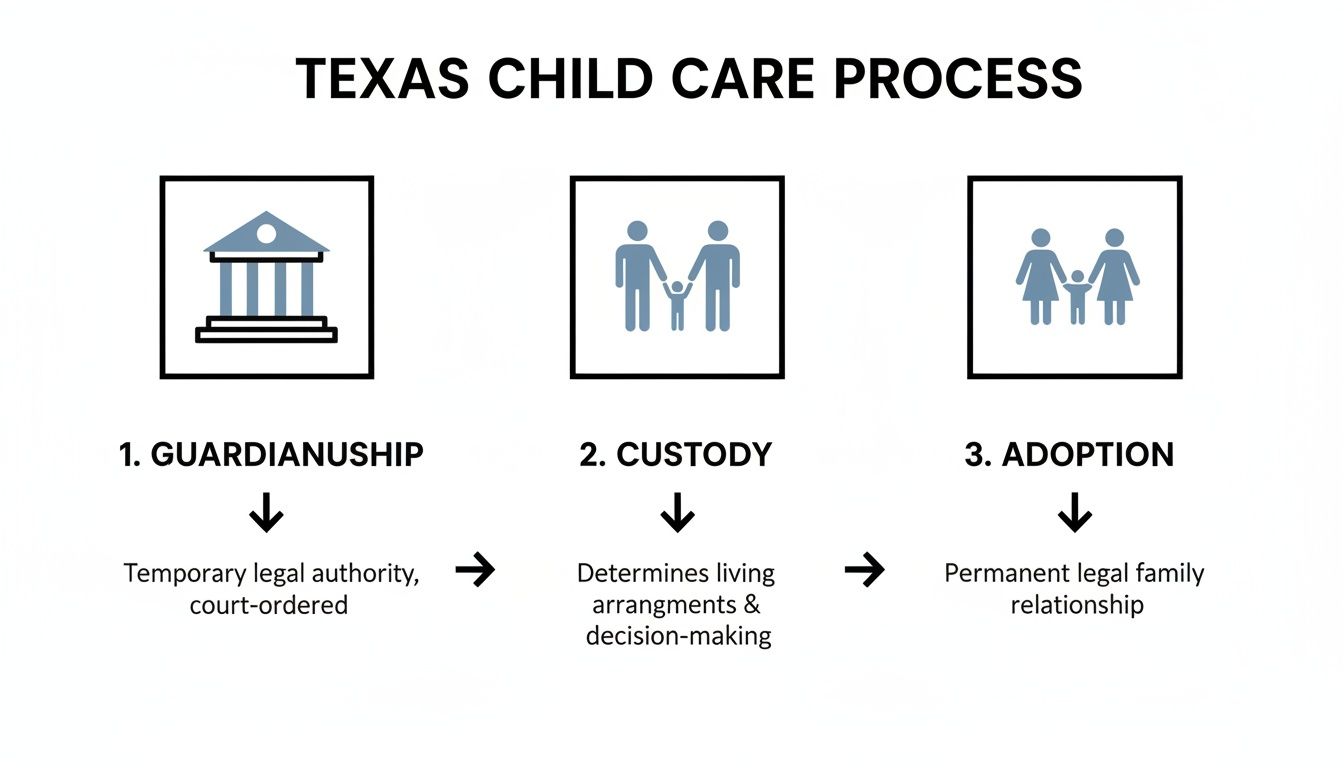
As you can see, guardianship is a distinct, court-supervised role, different from the family-law dynamics of custody or the permanence of adoption.
The Court's Investigation and Hearing
Once the application is filed, the court becomes actively involved. A "court investigator" is assigned to conduct an impartial review. This person acts as the court's eyes and ears, interviewing the child (if old enough), the potential guardian, and anyone else with relevant information. Their job is to provide the judge with a neutral, fact-based assessment.
At the same time, the court appoints an attorney ad litem. This is an independent lawyer whose sole client is the child. Their mission is to be the child's voice in the courtroom, advocating for their legal interests and ensuring their wishes are heard. The ad litem will meet with the child, review the evidence, and recommend to the court what they believe is the best outcome for their client.
The court investigator and the attorney ad litem are critical checks and balances in the system. Their involvement ensures the judge has a full, unbiased picture before making a decision that will profoundly shape a child's life.
Everything culminates in a formal court hearing. The judge reviews all paperwork, the investigator’s report, and the recommendation from the attorney ad litem. The applicant must then prove their case by a "preponderance of the evidence," meaning it is more likely than not that a guardianship is necessary and the proposed appointment is in the child's best interest. This is where having an experienced Texas estate planning attorney is invaluable; they know how to build and present a compelling case.
If the judge is convinced, they will sign a court order officially appointing the guardian. You will then be issued "Letters of Guardianship"—the official document granting you the legal authority to act on the child's behalf. It is a meticulous process designed to ensure that the significant responsibility of a guardianship of a minor is granted only when absolutely necessary and to someone truly prepared for the task.
What It Really Means to Be a Guardian: Understanding Your Fiduciary Duty
When a Texas court appoints you as a guardian, you are accepting one of the most serious legal and ethical responsibilities that exist: a fiduciary duty. This is not just a legal term for "doing a good job." It is a legally binding promise, rooted in the Texas Estates Code and fiduciary principles, to put the child's best interests above all else, including your own.
A fiduciary is the ultimate trusted steward. The law holds guardians to an exceptionally high standard because a child is so vulnerable. Every decision you make and every action you take must directly benefit the child. There is no room for self-interest.
Breaching this duty can lead to serious legal consequences, such as removal as guardian or being held financially liable for any losses the child suffers. Understanding your responsibilities is critical for protecting both the child and yourself.
The Two Pillars of Your Responsibility
Your fiduciary duty rests on two core principles: the duty of care and the duty of loyalty. Though they sound similar, they cover different aspects of your role and work together to protect the child.
The Duty of Care: This is about competence and diligence. You must act as a "reasonably prudent person" would when managing their own important affairs. This means being actively involved, asking questions, seeking expert advice when needed (like consulting a financial planner or a special education advocate), and keeping detailed records.
The Duty of Loyalty: This principle demands your complete, undivided loyalty to the child. You cannot use the child's money or property for your own gain, a practice known as "self-dealing." You must also avoid situations where your personal interests might conflict with the child's. Even the appearance of a conflict of interest is a serious concern.
For example, if a child inherits a house, the duty of loyalty would prohibit the Guardian of the Estate from selling that house to their cousin for a below-market price. Such an action would benefit the cousin, not the child, and would be a clear violation of fiduciary duties in Texas.
What This Looks Like for a Guardian of the Person
If you are a Guardian of the Person, your duties revolve around the child's daily life and overall well-being. You are making the hands-on decisions that shape their future.
Your responsibilities include:
- A Safe Home: Ensuring the child lives in a stable and nurturing environment where they feel safe.
- Health and Wellness: Arranging for medical, dental, and any necessary mental health support.
- Education: Enrolling them in school, attending parent-teacher conferences, and advocating for any special educational resources they may need.
- Personal Growth: Encouraging hobbies, friendships, and activities that help them develop into a well-rounded individual.
The Financial Duties of a Guardian of the Estate
As a Guardian of the Estate, you are the financial protector, and the court will monitor you closely. You are the steward of the child’s money and property, and every penny must be accounted for. A skilled Texas trust administration lawyer can be an indispensable guide in navigating these strict rules.
Your key financial responsibilities include:
- Gathering and Securing Assets: Your first step is to identify, collect, and secure all property the minor owns. This begins with filing a formal, detailed inventory of all assets with the court.
- Managing Money Wisely: You must protect and invest the child’s assets prudently. This often means seeking advice from qualified financial professionals to make responsible decisions.
- Keeping Flawless Records: Every transaction must be documented. You need a perfect paper trail for all income and expenses to prove that every expenditure was for the child's direct benefit.
- Reporting to the Court Annually: Each year, you must file a formal "accounting" with the court. This report provides a detailed breakdown of the estate's finances, which a judge will review to ensure you have fulfilled your duties correctly.
Navigating Guardianship in Special Situations
Not every path to a guardianship of a minor is straightforward. Families often face urgent, complex, or sensitive situations that require a specialized legal approach. Understanding how Texas law addresses these unique scenarios is key to protecting a child at their most vulnerable.
These cases demand decisive action, whether it's responding to a sudden emergency or planning for the long-term care of a child with a disability. For families in these moments, clear and compassionate legal guidance is essential.

When a Child Needs Immediate Protection
Sometimes, there is no time to wait for the standard court process. If a child faces immediate physical danger or the risk of significant financial loss, the Texas Estates Code allows for an emergency or temporary guardianship.
Emergency Guardianship: This is for true crises. A court can appoint a guardian for up to 60 days if there is clear and convincing evidence of imminent danger. It is a fast-tracked process designed to remove a child from harm's way immediately.
Temporary Guardianship: This option is used when a child needs a guardian for a specific, limited period. For instance, if a single parent must undergo a lengthy medical procedure, a temporary guardian can step in to manage the child's care until the parent recovers.
These appointments are powerful but short-term solutions. They act as a critical bridge, ensuring a child's safety while a more permanent, stable plan is established.
Guardianship for Children with Special Needs
Caring for a child with significant physical, developmental, or intellectual disabilities often presents challenges that extend far beyond their 18th birthday. For these families, a guardianship can be a vital tool to ensure continuous and appropriate care.
A guardian's role here often involves making critical decisions about specialized medical treatments, navigating Individualized Education Programs (IEPs), and arranging therapies. A guardian can also manage complex government benefits like Supplemental Security Income (SSI) and Medicaid, which are lifelines for the child's long-term well-being. You can learn more in our detailed guide to guardianship in Texas for individuals with special needs.
A guardianship for a child with special needs is often designed to transition seamlessly into an adult guardianship when the child turns 18. This proactive planning prevents any gaps in care and legal authority at a critical life stage.
By planning ahead, families ensure that as their child legally becomes an adult, a trusted person is already in place to continue managing their healthcare and financial needs without disruption.
Stability for Immigrant and Unaccompanied Minors
The journey for immigrant children, particularly those who arrive in the U.S. alone, is often filled with uncertainty. Securing a legal guardian is one of the most important steps toward providing them with a stable, secure future. A guardian serves as their legal advocate and safe harbor.
Without a guardian, these children face an uphill battle to access basic services. A legal guardian can enroll them in school, consent to medical treatment, and, crucially, provide the support needed to navigate complex immigration proceedings. Unfortunately, many vulnerable children lack this support. Recent data shows that for asylum-seeking children, the presence of a guardian during critical evaluations drops from 100% for young children to a mere 20% for older teenagers, revealing a significant protection gap for those who need it most.
How a Guardianship Can Be Modified or Ended
A guardianship is a protective legal measure, not a permanent, unchangeable arrangement. Life is unpredictable, and Texas law recognizes this. A guardianship is designed to be flexible, adapting as a child grows and circumstances change. It can, and often should, be modified or dissolved when it is no longer necessary.
The probate court that established the guardianship maintains oversight and can make adjustments whenever it serves the child's best interests. The ultimate goal is protection, not a lifelong legal bind.
Common Reasons for Terminating a Guardianship
Termination means the guardianship is officially over. The guardian's legal authority is removed, and their duties conclude. The Texas Estates Code specifies when this can occur.
The most common reasons for termination are:
- The Child Turns 18: When the minor becomes a legal adult, the guardianship automatically dissolves.
- The Child Gets Married: In Texas, legal marriage grants a minor the status of an adult, making the guardianship unnecessary.
- The Child is Adopted: Adoption creates a new, permanent parent-child relationship that legally supersedes the need for a guardian.
- The Original Need Disappears: If a parent who was incapacitated recovers and is able to resume their role, they can petition the court to end the guardianship and restore their parental rights.
When a Guardianship Needs to Be Modified
Modification involves changing the terms of the guardianship rather than ending it. This typically occurs when the current guardian can no longer fulfill their duties or the child's situation has changed significantly.
A petition to modify a guardianship is a formal request to the court explaining why a change is necessary and how the proposed change serves the child's best interests. The court will review the evidence as carefully as it did during the initial appointment.
For instance, if a grandparent-guardian's health declines, making it impossible to provide adequate care, a successor guardian would need to be appointed through a formal court process. Alternatively, a Guardian of the Estate may need different powers to properly manage a complex inheritance the child received.
Regardless of the reason, the child's well-being remains the court's primary concern. For any family facing these complex decisions, consulting a Texas estate planning attorney is the best way to navigate the court system and ensure the child remains protected.
Common Questions About Texas Minor Guardianship
As you explore the concept of a guardianship for a minor, many questions will naturally arise. The process can seem complex, but clear, straightforward answers can provide the confidence needed to move forward. Here are some of the most common questions we hear from families.
Can I Name a Guardian for My Child in My Will?
Yes, and it is highly recommended. Your Last Will and Testament is your final instruction manual for your loved ones. Designating a guardian for your children in your will is a critical part of responsible estate planning in Texas. It is your opportunity to make your wishes clear about who you trust to raise your children if you cannot.
While a probate court has the final authority to appoint a guardian, Texas courts give significant weight to a parent's nomination. This proactive step can create a stable, loving plan for your children’s future and help prevent potential family disputes.
Does a Guardian Get Paid in Texas?
The answer depends on the type of guardian, as outlined in the Texas Estates Code.
- Guardian of the Estate: An individual appointed to manage a child's finances, property, or inheritance may be entitled to reasonable compensation. This is not a blank check; any payment must come from the child's assets and be approved by the court, often based on the complexity of the financial management.
- Guardian of the Person: This role focuses on the child's daily care—ensuring they have a safe home, attend school, and are emotionally supported. Because these duties are similar to a parent's, a Guardian of the Person is typically not compensated for their time and effort.
What Is the Difference Between a Guardian and a Managing Conservator?
It is easy to confuse these two roles. While their day-to-day responsibilities can appear similar, they originate from two different areas of Texas law.
A managing conservator is a term from family law, used in divorce or custody cases to define parental rights and duties. It allocates responsibilities between parents who are still involved in the child's life.
A guardian, however, is appointed by a probate court when parents are deceased, incapacitated, or otherwise completely unable to care for their child. While both roles involve making important decisions for a child, guardianship is the specific legal tool used when parental care is no longer an option.
If you’re managing a trust or planning your estate, contact The Law Office of Bryan Fagan, PLLC for a free consultation. Our attorneys provide trusted, Texas-based guidance for every step of the process.