Managing a loved one's trust can feel overwhelming, especially when something about the last-minute changes doesn't sit right. You may have watched an aging parent grow isolated, become dependent on one person, or sign documents that don't reflect the family history you knew for years.
That uneasy feeling matters. In Texas, a trust challenge based on undue influence isn't about hurt feelings or ordinary family conflict. It's about proving that someone overpowered the trust maker's free will and caused a trust decision that would not have happened otherwise. If you're trying to understand how to prove undue influence in a Texas trust, it helps to break the process into clear legal and practical steps.
Defining Undue Influence Under the Texas Trust Code
When families first hear the phrase undue influence, they often assume it means pressure, persuasion, or a strong personality. Texas law asks a much narrower question. The issue is whether influence crossed the line into control.
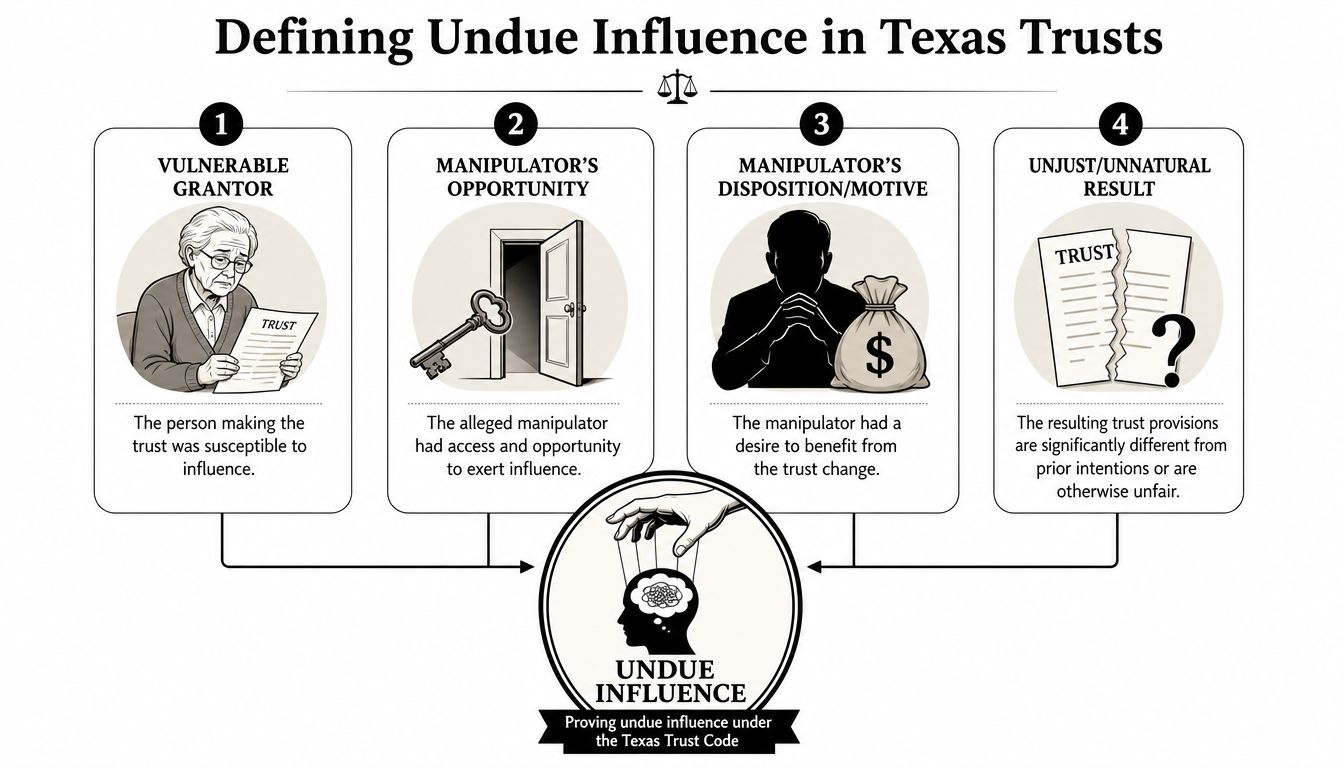
Under Texas law, to prove undue influence in a trust or will, a contestant must satisfy a strict three-part test: first, prove that the influence existed and was actively exercised; second, demonstrate that this influence overpowered or subverted the testator's mind regarding trust or estate matters; and third, establish that the influence caused the testator to make decisions or changes they would not have otherwise made, as explained by Dallas Probate and Trust's discussion of undue influence.
What the legal test means in plain English
The first part asks whether the alleged influencer used influence. That could involve isolation, control over access, repeated pressure, or manipulation around meetings and paperwork.
The second part is more demanding. You must show that the influence overpowered the settlor's mind on trust matters. Texas courts aren't looking for ordinary advice from a child, spouse, or caregiver. They're looking for influence so strong that the person creating or changing the trust was no longer acting freely.
The third part connects the conduct to the document itself. If the trust change would likely have happened anyway, the claim gets much harder. If the new terms make sense only because of the manipulator's involvement, that's a very different picture.
Practical rule: Suspicion starts a case review. Evidence wins the case.
How this fits with Texas trust and estate law
Texas trust disputes often involve both the Texas Trust Code and the Texas Estates Code, even though families may merely think of the issue as “the trust was changed unfairly.” The Trust Code governs trust creation, administration, and remedies. The Estates Code often supplies related principles used in probate and capacity disputes. In both settings, courts care strongly about free agency, genuine intent, and whether fiduciary or confidential relationships were abused.
That fiduciary piece matters. Trustees, agents under powers of attorney, and others in positions of trust owe duties of loyalty, honesty, and proper conduct. Those fiduciary duties in Texas don't automatically prove undue influence, but a broken fiduciary relationship can become an important part of the story.
If you're also trying to understand the larger duties surrounding trust management, this guide on Texas Trust Code trustee duties gives useful context.
One example families often recognize
A father has a long-standing estate plan that treats his children evenly. After a health decline, one child moves in, screens phone calls, takes over appointments, and drives him to a new attorney. A revised trust suddenly gives that child most of the assets and cuts out the others without any clear explanation.
That fact pattern doesn't automatically prove anything. But it does raise the exact legal questions Texas courts ask. Was there influence? Did it overpower the father's judgment? Did it cause a trust change he would not otherwise have made?
Recognizing the Red Flags of Financial Exploitation
Undue influence usually doesn't happen in the open. Families often notice it backward, after the trust has changed, communication has stopped, or a previously close relationship suddenly looks controlled.
One common pattern starts with dependence. An older adult becomes physically frail, grieving, confused, or heavily reliant on one person for rides, meals, medication, or paperwork. The helper may begin as a real source of support. The problem begins when support turns into gatekeeping.
The isolated parent scenario
A mother used to call her daughters every week. Then a new caregiver or “friend” starts answering her phone. Visits get canceled. Family members are told she's resting, upset, or doesn't want contact. Soon after, the trust favors the new helper in a way no one expected.
That doesn't prove undue influence by itself. But it creates a pattern lawyers watch closely. Isolation often gives the alleged influencer both opportunity and control over information.
Here are warning signs families often describe:
- Sudden isolation from children, siblings, church friends, or longtime advisors
- Abrupt estate changes that break sharply from prior wishes
- Unusual secrecy around lawyers, meetings, or trust amendments
- Financial gatekeeping by one person who controls accounts, statements, or mail
- Dependence that seems to increase the influencer's power over daily life
- Document involvement by the person who benefits from the change
The favored sibling scenario
Another frequent pattern involves a sibling who steps into a money-management role after a health event. That sibling may have access to checkbooks, online accounts, medical updates, and legal appointments. Then the trust changes heavily in that sibling's favor.
Sometimes there's an innocent explanation. Parents can treat children differently for valid reasons. But courts and attorneys look harder when the favored person also helped arrange the change, benefited from it, and limited other family members' access.
A trust change becomes more concerning when the same person has motive, access, and a direct benefit.
What trustees and family members should do early
If you've just stepped into a fiduciary role, don't ignore signs that the trust's recent history may be disputed. A useful starting point is First Steps for a Successor Trustee in Texas, which addresses what to do immediately after stepping into the trustee role.
Families also sometimes need help documenting concealed relationships, living arrangements, or day-to-day access patterns. In situations where cohabitation or hidden conduct may matter, resources on hidden asset private investigations can help people think more clearly about what kinds of facts may need to be verified.
Red flags are not proof, but they are direction
Texas courts understand that manipulators rarely announce what they're doing. They often use secrecy, selective information, and emotional pressure. That's why the early question isn't “Can I prove everything today?” It's “What pattern am I seeing, and what records will confirm or contradict it?”
That shift in mindset helps families move from fear to action.
How to Gather Evidence for an Undue Influence Claim
Most undue influence cases are built with circumstantial evidence. In plain terms, that means you usually won't find one dramatic confession or one perfect document. You build the case by showing a pattern that points to control, vulnerability, and a suspicious result.
Texas courts evaluating these claims typically consider four key circumstantial factors: a confidential relationship between the influencer and settlor, the settlor's susceptibility due to age or cognitive decline, the influencer's motive to gain financially, and the opportunity to manipulate decisions. Evidence often includes medical records showing mental incapacity, testimony from witnesses, and documentation of suspicious financial transactions, as described in Chargois Harper's discussion of undue influence evidence.
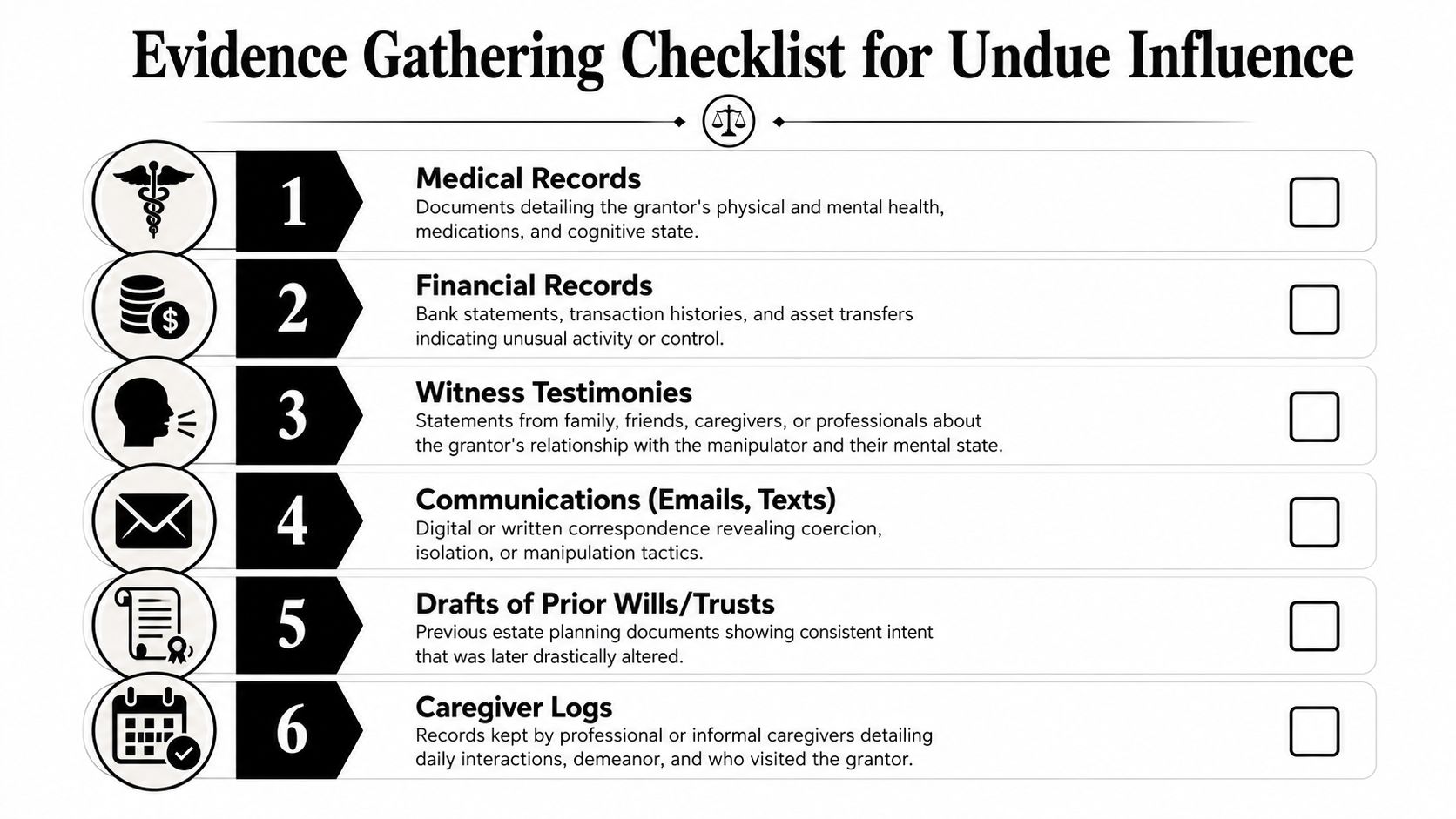
A visual checklist can help families organize what to collect first.
Start with the paper trail
Trust contests often turn on records that existed long before litigation began.
Medical records
Look for diagnoses, medication lists, memory concerns, confusion episodes, falls, strokes, hospitalizations, and physician notes about decision-making ability. You're trying to understand vulnerability, not just whether someone had a formal diagnosis.Financial records
Review bank statements, checks, wire transfers, credit card activity, and asset transfers near the time of the trust change. Unusual withdrawals, new joint accounts, and spending that benefits the alleged influencer may matter.Prior estate planning documents
Earlier trusts, amendments, wills, and beneficiary designations can show a stable pattern of intent. A sudden, unexplained departure may support the argument that the final change was unnatural.
Then gather the human evidence
People often notice the most important facts before any lawsuit begins.
- Family members may remember who blocked visits or controlled conversations.
- Friends and neighbors may have seen isolation happen in real time.
- Caregivers may know who attended appointments and who gave instructions.
- Lawyers, notaries, and office staff may recall who scheduled meetings, who stayed in the room, and who answered questions for the settlor.
Evidence habit: Write down names, dates, and specific observations while memories are still fresh.
Don't overlook communications
Texts, emails, voicemails, handwritten notes, and calendar entries can be powerful. These records may reveal pressure, fear, manipulation, or efforts to keep others away.
A message saying “Don't tell your brother” or “She doesn't need to speak with anyone else” can be important in context. So can a thread showing the beneficiary arranging legal meetings, sending drafting instructions, or speaking for the trust creator.
This video gives a helpful overview of common issues families face in trust disputes:
Ask for records the right way
Some records can be gathered informally. Others require legal process. Don't break into accounts, guess passwords, or remove original documents from a safe without authority. That can damage your credibility and create new legal problems.
Instead, organize what you already have and work methodically:
| Evidence type | Where it may come from | Why it matters |
|---|---|---|
| Medical files | doctors, hospitals, care facilities | shows mental and physical vulnerability |
| Account records | banks, brokerages, trust records | may show suspicious control or transfers |
| Prior trust drafts | estate planning files, home records | compares past intent with sudden changes |
| Messages | phones, email, printed letters | may reveal manipulation or active procurement |
| Witness accounts | family, neighbors, caregivers | fills in the day-to-day story |
Beneficiaries who suspect mismanagement often also need a clearer picture of trust finances. A request for a demand for trust accounting in Texas may become part of the evidence-building process when a trustee's records are incomplete or withheld.
Trustees should be careful too
A trustee who sees warning signs should not improvise. Documentation, neutrality, and legal advice protect both the trustee and the trust. The article When a Trustee Should Consult a Texas Attorney identifies the situations where legal guidance protects the trustee and the trust.
That's also where a Texas trust administration lawyer, a Texas estate planning attorney, or litigation counsel can help identify what evidence can be requested now, what must wait for discovery, and what needs to be preserved before it disappears.
Navigating the Legal Process of a Texas Trust Contest
A family often reaches this stage after weeks or months of unease. You have the records, the timeline is starting to make sense, and one question takes over: what happens if we challenge the trust?
A Texas trust contest is usually quieter than people expect. There are no surprise courtroom moments in the early stages. The work is methodical. Deadlines, pleadings, records requests, sworn testimony, and careful preparation often decide the case long before trial.
One timing issue deserves immediate attention. Texas law generally gives a limited window to bring this kind of claim, and delay can give the other side a powerful defense. As Dooley Noted's discussion of trust challenges in Texas explains, trust contests may be subject to a four-year limitations period, often tied to when the claimant knew or should have known of the problem. In plain terms, waiting can cost you the chance to be heard.
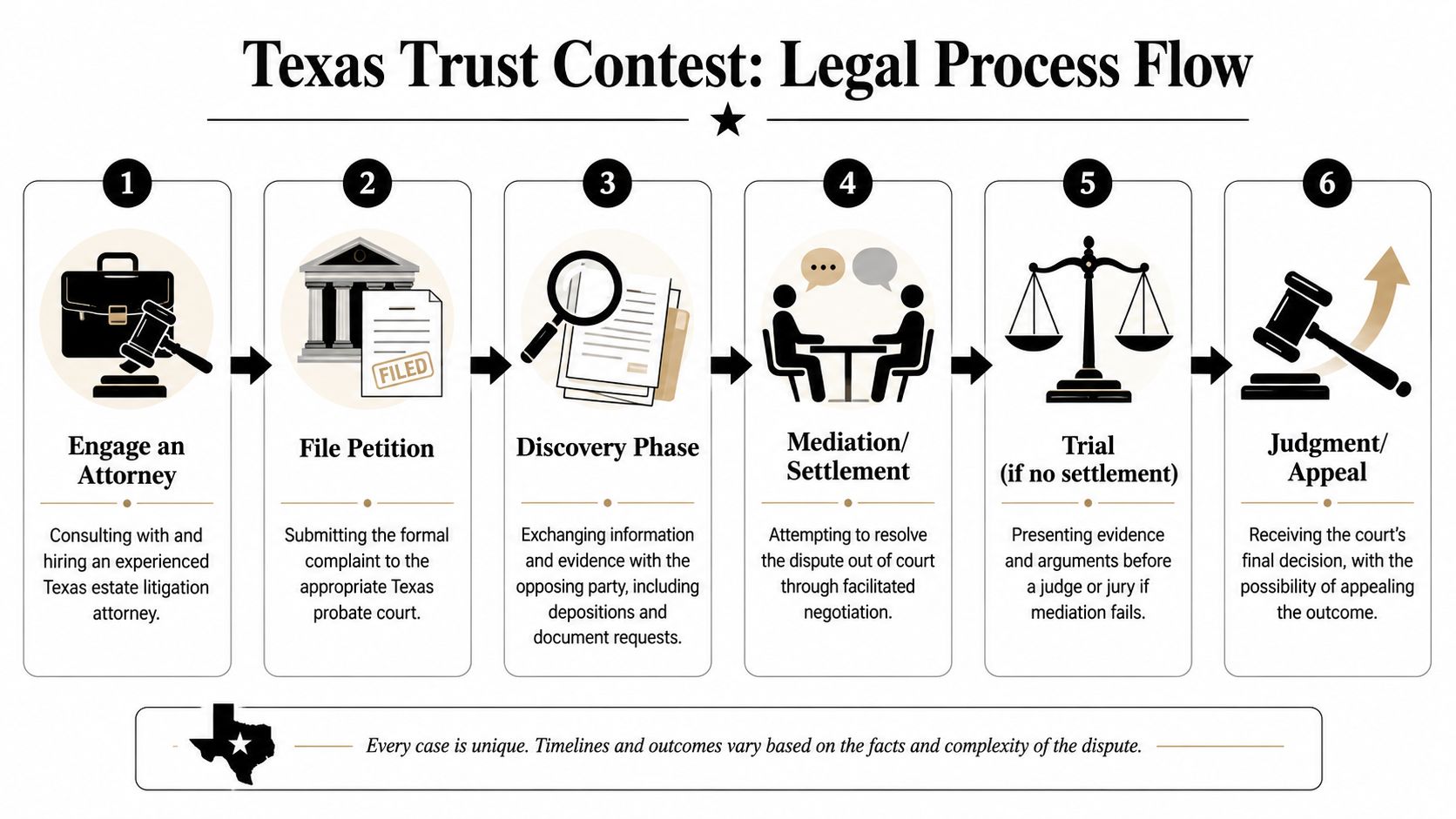
What the process usually looks like
Although every case has its own complications, a Texas trust contest often follows a predictable path:
Initial legal review
Your lawyer studies the trust documents, amendments, medical timeline, financial records, and the relationships surrounding the change.Filing the petition
The lawsuit sets out the facts, identifies the trust provision being challenged, and asks the court for specific relief.Discovery
Each side requests documents, sends written questions, and seeks information from banks, medical providers, lawyers, and other witnesses.Depositions
Key people testify under oath before trial. This often includes beneficiaries, caregivers, drafting attorneys, notaries, and anyone involved in arranging the trust change.Mediation
Many courts expect the parties to try settlement before trial. Some cases resolve here once the documents and testimony expose weaknesses in one side's story.Trial
If no agreement is reached, the judge or jury decides whether undue influence affected the trust or amendment.
Families who want a fuller procedural overview can review this guide on how to contest a trust in Texas.
The burden of proof. And why families should ask about shifting it early
This is the part many families do not hear about soon enough.
In an ordinary case, the person contesting the trust must prove undue influence. That can feel like trying to reconstruct a private conversation that no one else heard. But Texas law also recognizes a common-sense problem. When a trusted person controls access, helps arrange the legal documents, and then benefits from the result, the court may treat those facts differently.
Under Texas case law, a presumption of undue influence may arise when evidence shows a confidential or fiduciary relationship, active participation in procuring the transaction, and an undue benefit to the person accused. This procedural shift is significant because it changes the dynamic of the litigation. Instead of requiring the contestant to build every point from the ground up, it can force the benefiting party to come forward with a credible explanation.
That is why burden-shifting is not a technical side issue. It is often part of the case strategy itself.
A useful way to understand it is to picture a scale. At the start, the family usually has to place enough evidence on the scale to get the court's attention. If the proof shows trust, involvement, and benefit concentrated in one person, the scale may tilt in a way that requires that person to explain why the transaction was proper. Good case preparation aims at that shift from the beginning, not as an afterthought on the eve of trial.
How trust law and fiduciary duties affect the court's view
Trust contests rarely happen in isolation. The same conduct that suggests undue influence may also suggest a breach of fiduciary duty if the person involved was acting as trustee, agent under a power of attorney, or in another position of confidence.
Courts pay close attention to loyalty, fairness, and self-dealing. If someone used a position of trust to isolate the settlor, steer the drafting process, or secure a personal benefit, those facts can shape both liability and remedies. For trustees trying to stay neutral, the safer course is careful record preservation, even-handed communication, and strict avoidance of personal involvement in the family dispute.
Practical preparation before filing
Before any petition is filed, build a working case file. Start with a dated chronology. Add the trust versions, who arranged each meeting, who was present, what changed, and what records support each event.
That timeline works like the frame of a house. Without it, the documents feel scattered. With it, your lawyer can test whether the facts support undue influence, identify where subpoenas will be needed, and decide whether the immediate goal is filing suit, seeking emergency relief, or pressing for an early settlement from a position of strength.
Likely Defenses and Potential Remedies if You Win
A common scene in these cases looks like this. The family is alarmed by a late trust change, but the person who benefited has a ready explanation. They say the settlor was clear-minded, had talked about making this change for years, and signed voluntarily.
That defense can sound persuasive at first because it usually contains a few true pieces. The settlor may have signed the document. Witnesses may have been present. The beneficiary may point to old family tension and argue the new terms reflected settled wishes. In court, though, the question is narrower and more practical. Was this the settlor's independent decision, or did someone overpower that decision-making process?
How these defenses are usually answered
Undue influence cases are often proved the way a fire investigator proves cause. Rarely from one dramatic moment. More often from a pattern of small facts that fit together.
If the defense says the settlor acted alone, your evidence may show that the favored beneficiary chose the lawyer, drove the settlor to meetings, stayed close during discussions, screened calls, or fed the drafting instructions. If the defense says the change was perfectly logical, earlier trust documents, handwritten notes, and years of consistent planning may show a very different intent. If the defense says the settlor was too strong-willed to be influenced, medical records, medication history, isolation, grief, dependence, or fear of losing care may explain how influence worked anyway.
That last point confuses many families. A person does not have to be weak in every part of life to be vulnerable in one relationship. A proud parent can still be manipulated by the child who controls transportation, medication, or access to other relatives.
The burden of proof also matters here. In many trust contests, the person challenging the change starts with the duty to prove undue influence. But some fact patterns can shift pressure onto the other side in a practical sense. If you can show a confidential or fiduciary relationship, active involvement in the trust change, and a benefit to the accused person, the court may view the transaction with suspicion and require a convincing explanation. That is why strong case building starts long before trial. The goal is not only to accuse someone of wrongdoing. The goal is to assemble facts that make the court ask the right questions.
What a court can do if you succeed
If you prove undue influence, the court can set aside the trust document, amendment, or transfer that was tainted by that influence.
The remedy depends on what was challenged and what valid documents remain. Common outcomes include:
- An earlier valid trust controls if the court finds that a later amendment was improperly procured
- A specific amendment is invalidated if only one change was affected
- Property is restored to the proper trust or estate structure if assets were redirected through the influenced transaction
- Texas intestacy rules may apply if no valid controlling estate plan remains after the challenged document is removed
Sometimes families expect a win to feel like punishment for the wrongdoer. The legal remedy is usually more focused than that. The court's job is to restore the settlor's true plan as closely as the evidence allows.
And the repair work can be substantial.
A trustee may need to redo distributions, correct accountings, recover assets that were transferred out, or ask the court for instructions about how to administer the trust after the ruling. If someone acting as trustee, agent, or caregiver also breached fiduciary duties, additional remedies may be available, including removal, surcharge, or orders requiring repayment of misused funds.
Why the remedy stage still requires planning
Winning liability is only part of the job. Families also need a practical path to put the trust back in order.
That may mean tracing where money went, finding out whether real property was retitled, identifying which beneficiaries were paid under the wrong terms, and deciding whether temporary court orders are needed while assets are being recovered. In other words, the case does not end with proving influence. It ends when the court's order can be carried out.
That is why a strong undue influence case is built with remedies in mind from the start. The same evidence that helps prove manipulation often helps show what needs to be unwound, what can be recovered, and how to place the settlor's original intent back at the center of the case.
Find Clarity and Confidence with Trusted Legal Guidance
An undue influence case can feel personal in the worst way. You're not just reading legal documents. You're trying to understand whether someone took advantage of a vulnerable person and changed the course of a family's legacy.
The law gives families a path forward, but it's a demanding one. You have to identify the right facts, preserve records, understand the Texas Trust Code, watch deadlines, and present the story in a way a court can act on. That's true whether you're a beneficiary, trustee, executor, or family member trying to make sense of what happened.
This is also where broader planning matters. A strong estate plan, careful trust administration, attention to fiduciary duties in Texas, and timely action on disputes can reduce the damage caused by manipulation. The same is true for related issues such as probate administration, guardianship concerns when capacity declines, tax planning around trust assets, and even questions about how to modify a trust in Texas when lawful changes are needed.
Law Office of Bryan Fagan, PLLC assists Texas families with trust administration, estate planning, probate, guardianship, asset protection, and trust disputes, including cases involving suspected undue influence.
If you're carrying doubts about a trust change, don't ignore them and don't assume you have to solve the problem alone. Early legal advice can help you protect evidence, clarify your rights, and make a sound decision about what to do next.
If you're managing a trust or planning your estate, contact The Law Office of Bryan Fagan, PLLC for a free consultation. Our attorneys provide trusted, Texas-based guidance for every step of the process.