Planning for your family's future can feel overwhelming, but setting up a living trust is one of the most powerful steps you can take to protect your assets and loved ones in Texas. This legal tool allows you to pass your assets to your heirs privately and efficiently, often bypassing the lengthy, public, and expensive probate process. With the right legal guidance, you can secure your legacy with confidence.
Why a Living Trust Is a Foundational Step for a Secure Legacy

While most Texans recognize the importance of estate planning, a surprising number have not taken action. One major survey revealed that while 83% see its value, only 11% have actually established a trust. This gap leaves too many families vulnerable to the complexities of probate court.
When an estate goes through probate, assets can be frozen for months—or even years—while legal fees accumulate, often consuming 3-7% of the estate's total value.
So, what exactly is a living trust? Think of it as a legal container you create to hold your assets—your home, bank accounts, investments, and more. As the Grantor, you create the trust and typically appoint yourself as the initial Trustee. This means you maintain full control over your assets, just as you do now.
Core Benefits of a Texas Living Trust
The primary advantage of a living trust is avoiding probate. A will must be validated by a court in a public process. A trust, however, facilitates a private and often immediate transfer of assets to your Beneficiaries upon your passing, all according to the precise instructions you've laid out.
A living trust also provides critical protection if you become incapacitated. Should you be unable to manage your finances, your chosen Successor Trustee can step in immediately to pay bills and manage your assets without court intervention, which would be necessary in a guardianship proceeding.
Here is a summary of the key advantages:
- Avoiding Probate: Your estate can be settled more quickly, privately, and with lower costs compared to a will.
- Maintaining Control: As the Grantor and initial Trustee, you continue to manage and use your property as you always have.
- Ensuring Privacy: Probate is a public record. A trust keeps your family's financial matters private.
- Planning for Incapacity: A successor trustee can seamlessly manage your affairs if you become unable to, protecting you and your assets.
A living trust is more than a legal document; it's a clear instruction manual for your legacy, designed to protect your family from unnecessary stress and public scrutiny during a difficult time.
Ultimately, a living trust is a core component of effective wealth preservation strategies. It provides a structured framework to manage and transfer your life's work on your own terms. Understanding these fundamentals is the first step toward making informed decisions for your family's future.
Choosing the Right Trust for Your Texas Estate Plan
When creating your Texas estate plan, it's important to know that not all trusts are the same. Selecting the right type is a significant decision that will shape everything from the control you retain over your assets to the level of protection your family receives.
In Texas, the primary choice is between a revocable and an irrevocable living trust.
Think of this choice as the difference between a flexible blueprint that can be modified at any time and a permanent foundation set in concrete. One is designed for life's changes, while the other offers maximum long-term protection. The best option depends on your family's circumstances, your financial situation, and your ultimate goals.
The Revocable Living Trust: Flexibility for Life's Changes
The revocable living trust is the most popular choice for Texas families due to its remarkable flexibility. As the grantor, you retain complete control. You can amend it, add assets to it, or even dissolve it entirely, as long as you are mentally competent.
For example, if you purchase a new property in Fort Bend County, you can easily add it to the trust. If you decide to change who receives certain assets or appoint a new successor trustee, you can do so without complication. This adaptability is ideal for a growing family whose circumstances are likely to change. A revocable trust allows your estate plan to evolve with you while keeping your assets out of probate court.
The Irrevocable Living Trust: A Shield for Your Assets
In contrast, an irrevocable living trust is a more permanent arrangement. Once you transfer assets into it, you generally cannot modify the trust or reclaim the assets without court intervention.
Why would someone choose to relinquish this much control? The primary reasons are protection and tax benefits. By giving up control, you can achieve powerful asset protection and potentially reduce estate taxes. For instance, a Harris County business owner concerned about future lawsuits could transfer assets into an irrevocable trust. Because those assets are no longer legally theirs, they are typically shielded from creditors and may be excluded from their taxable estate.
According to the Texas Trust Code, an irrevocable trust creates a strong legal barrier between your personal liabilities and the trust's assets. It offers a level of security that a revocable trust simply can't match.
Revocable vs. Irrevocable Living Trusts in Texas
Deciding between revocable and irrevocable trusts can feel complex, but breaking it down feature by feature makes the choice clearer. This table gives you a side-by-side look at how they stack up.
| Feature | Revocable Living Trust | Irrevocable Living Trust |
|---|---|---|
| Flexibility | High. You can amend, revoke, or change the trust at any time during your life. | Low. Once created, it is very difficult or impossible to change without court intervention. |
| Control | You retain full control over the assets as the grantor/trustee. | You relinquish control of the assets once they are transferred to the trust. |
| Probate Avoidance | Yes, assets properly funded into the trust avoid the probate process. | Yes, assets in the trust avoid probate. |
| Asset Protection | Limited. Assets are still considered yours and are generally accessible to creditors. | High. Assets are typically protected from your future creditors and lawsuits. |
| Estate Tax Benefits | Generally no. Assets remain part of your taxable estate. | Yes. Assets are removed from your taxable estate, potentially reducing or eliminating taxes. |
| Best For | Individuals and families who want to avoid probate while maintaining control over their assets. | Individuals seeking to protect assets from creditors, minimize estate taxes, or for Medicaid planning. |
Ultimately, the right choice boils down to your primary goal: do you need the freedom to adapt, or is rock-solid protection your top priority?
Specialized Trusts for Unique Family Needs
Beyond these two main types, Texas law allows for specialized trusts designed for specific family situations. One of the most important is the Special Needs Trust.
This trust is a crucial tool for families caring for a loved one with a disability. It allows you to set aside funds for their care and quality of life without jeopardizing their eligibility for essential government benefits like Medicaid or Supplemental Security Income (SSI). These trusts must be drafted with great care to comply with strict legal requirements. Working with an experienced Texas estate planning attorney is essential to ensure the trust is structured correctly to support your loved one without disrupting their vital support systems.
Key Roles in a Living Trust: Grantor, Trustee, and Beneficiary
A living trust is like a script for your family's future, but it requires the right people in place to bring it to life. Understanding the key roles—Grantor, Trustee, and Beneficiary—is crucial to building a plan that functions as intended.
The Grantor: The Creator of the Trust
The Grantor (also known as the Settlor or Trustor) is you—the person who creates the trust. You establish the rules, define the terms, and transfer your assets into it.
During your lifetime, you will likely fill multiple roles. In a typical revocable living trust, you are the Grantor, the initial Trustee, and the primary Beneficiary. This structure gives you complete control over your assets, allowing you to manage them just as you did before. The trust simply acts as the legal container.
The Trustee: The Manager of the Trust Assets
The Trustee is the person or institution responsible for managing the trust's assets. This is not a casual role; the Trustee has a strict legal obligation, known as a fiduciary duty, to act solely in the best interests of the beneficiaries.
Initially, you will serve as your own Trustee. The most critical decision is choosing who will take over when you are no longer able to. This brings us to the Successor Trustee.
The Successor Trustee: The One Who Steps In
Your Successor Trustee is the individual or institution that assumes control of the trust when you become incapacitated or pass away. This role is built on immense trust and responsibility, so this choice should be made carefully.
The Successor Trustee will manage everything from paying medical bills to gathering assets, settling debts, and distributing the remaining property to your beneficiaries according to your instructions. Their job is to follow your trust document precisely.
Under the Texas Trust Code, a Successor Trustee is held to a high legal standard. Their fiduciary duties in Texas require them to act with prudence, loyalty, and impartiality, always putting the beneficiaries' interests first.
When selecting a Successor Trustee, consider these qualities:
- Trustworthiness and Integrity: This is non-negotiable.
- Financial Acumen: They should be responsible with their own finances and capable of managing yours.
- Willingness to Serve: This role requires significant time and effort.
- Impartiality: This is especially important if you have multiple beneficiaries, as they must navigate family dynamics without favoritism.
For a detailed explanation of this role, our guide on the duties and responsibilities of a trustee in Texas breaks down the legal obligations involved.
The Beneficiaries: The Reason for Your Plan
The Beneficiaries are the individuals, charities, or other entities who will ultimately receive the assets from your trust. You have complete control to determine who receives what, when, and how.
This is where a trust offers far more flexibility than a simple will. For example, you can:
- Stagger distributions over time. A beneficiary could receive one-third of their inheritance at age 25, another third at 30, and the remainder at 35.
- Set aside funds for specific purposes. You can direct the trustee to use trust funds for a grandchild's education or a down payment on a home.
- Provide for a loved one with special needs. As discussed, a special needs trust can support a vulnerable family member without disrupting their government benefits.
Defining these roles thoughtfully is what transforms a legal document into a functional plan that protects your family. A knowledgeable Texas estate planning attorney can help you navigate these choices and prevent future conflicts.
The Critical Step of Funding Your Trust
Drafting a living trust is a major accomplishment, but it is only half the process. A common and costly mistake is failing to "fund" the trust.
Think of your trust document as an empty vault. It is well-designed but offers no protection until you place your assets inside. Funding is the process of transferring ownership of your assets from your personal name into the name of the trust.
An unfunded or partially funded trust can be a heartbreaking discovery for a family. For example, a family may believe they have a comprehensive plan, only to learn after a loved one's death that the family home was never formally transferred. This oversight forces that asset back into the public and expensive probate process the trust was designed to avoid. A Texas trust administration lawyer can help ensure this critical step is completed correctly.
How to Title Different Types of Assets
Transferring assets requires different procedures depending on the type of property.
Real Estate in Texas
To transfer real estate in Texas, you must execute a new deed. An attorney will draft a document, such as a "Quitclaim Deed" or "Warranty Deed," to legally move the property from your name as an individual to your name as the trustee of your trust. This new deed must be signed, notarized, and recorded with the county clerk's office where the property is located to be legally effective.
This flowchart breaks down the key players in any trust, showing how the Grantor, Trustee, and Beneficiary are all connected.
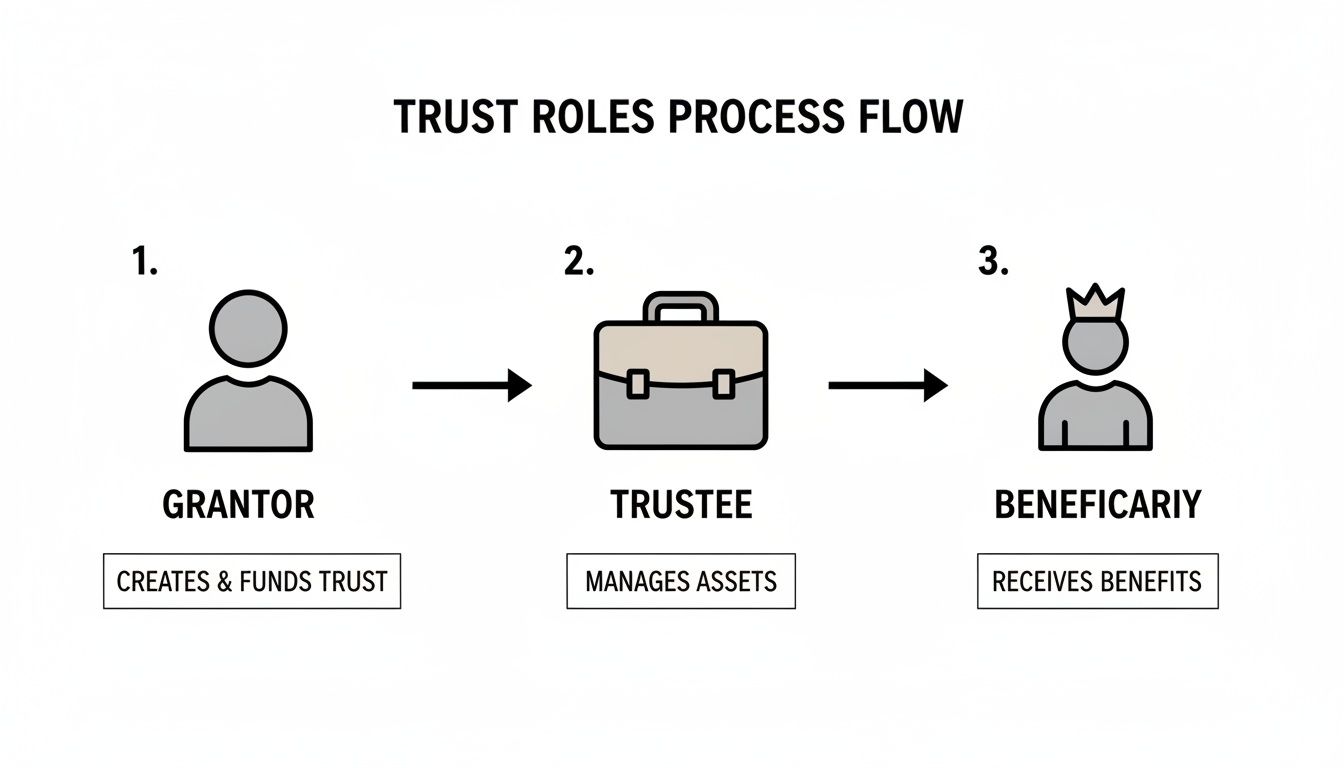
As the flowchart illustrates, funding the trust is the Grantor's responsibility. This action empowers the Trustee to manage assets for the Beneficiaries in the future.
Bank and Investment Accounts
For checking, savings, and brokerage accounts, the process is called "retitling." You will need to contact each financial institution and provide them with a copy of your trust document or a Certificate of Trust. They will have you complete new paperwork to change the account owner's name (e.g., from "Jane Smith" to "Jane Smith, Trustee of the Jane Smith Revocable Living Trust").
Handling More Complex Assets
Some assets require a different approach.
- Retirement Accounts (401(k)s, IRAs): Do not change the ownership of these accounts to your trust, as this could trigger significant taxes and penalties. Instead, you update the beneficiary designation to name the trust as the primary or contingent beneficiary.
- Business Interests: If you own an LLC or partnership, you must consult the operating or partnership agreement for specific rules on transferring ownership.
- Life Insurance Policies: Similar to retirement accounts, you typically name the trust as the beneficiary of the policy rather than changing ownership of the policy itself.
A critical but often overlooked detail is ensuring all intended assets are properly moved. An experienced Texas estate planning attorney can provide a checklist and guide you through the funding process for each asset, ensuring no stone is left unturned.
Understanding the difference between probate and non-probate assets is the foundation of a smart funding strategy.
The Importance of a Fully Funded Trust
Failing to fund your trust undermines your entire estate plan. This forces families into a probate process that can last 9-18 months and consume 4-8% of the estate in fees. For high-net-worth families, these mistakes can be particularly costly. It is why a high percentage of individuals with significant assets have a trust—they understand that proper funding is what brings the plan, and its protections, to life.
Finalizing and Maintaining Your Living Trust

You have drafted your trust and begun the crucial process of funding it. A few final steps are necessary to ensure your trust remains a powerful tool that adapts to your family's changing needs.
First, you must formalize the trust. Under Texas law, you must sign your trust agreement in the presence of a notary public. This signature and seal transform the document into a legally binding instrument, confirming your identity and making your intentions official.
The Pour-Over Will: Your Critical Safety Net
Even the most diligent person can overlook an asset. A forgotten bank account or a surprise inheritance might not be funded into the trust before you pass away. This is why a pour-over will is an essential component of a comprehensive Texas estate plan.
A pour-over will works in conjunction with your living trust. Its sole purpose is to "catch" any assets left outside the trust and "pour" them in after your death. While these assets will still have to go through probate, the will ensures they are ultimately distributed according to your trust's instructions rather than Texas intestacy laws.
Don't Set It and Forget It: The Importance of Regular Reviews
A living trust is not a one-time task. Life changes, and your estate plan must keep pace. A trust that was perfect five years ago may be outdated today.
We recommend reviewing your trust documents with a Texas estate planning attorney every three to five years, or after any major life event, such as:
- Marriage, divorce, or remarriage.
- The birth or adoption of a child or grandchild.
- A significant change in financial status.
- The death of a trustee or beneficiary.
- Changes in Texas or federal law, such as the Texas Estates Code.
As your life evolves, knowing how to modify a trust in Texas is key. The process of amending legal documents ensures your plan remains aligned with your current wishes.
Proactive management is the secret to a successful living trust. A periodic review isn't a chore; it's your chance to ensure the plan still does exactly what you want it to do and gives your loved ones maximum protection.
This proactive approach is more important than ever. For blended families or unmarried partners, a trust offers a level of precision a will cannot match, allowing for specific distributions. Taking the time to finalize and maintain your trust transforms it from a static document into a dynamic plan that serves your family for generations.
Answering Your Top Questions About Texas Living Trusts
As you delve into setting up a living trust, questions will naturally arise. Here are clear answers to some of the most common inquiries we receive from Texas families.
How Much Does It Cost to Set Up a Living Trust in Texas?
The cost of setting up a living trust varies based on the complexity of your assets and family situation. While low-cost online services may seem appealing, they often provide generic documents that can lead to costly errors. A mistake in a DIY document could even invalidate the entire trust.
Working with an experienced Texas estate planning attorney is an investment in your family's future. Most attorneys work on a flat-fee basis for a comprehensive plan that includes custom drafting, legal advice, and guidance on funding the trust in accordance with the Texas Trust Code. This upfront investment typically saves families significant time, stress, and money by avoiding probate.
Can I Create a Living Trust Myself Without a Lawyer?
Legally, you can use DIY forms, but it is a risky endeavor. Estate planning is not one-size-fits-all, and a generic template cannot account for the nuances of Texas law, complex family dynamics, or unique assets. Common mistakes like improper funding or vague language can render a trust ineffective, forcing your estate into the probate system you sought to avoid. A qualified attorney provides the peace of mind that comes from knowing your trust is structured correctly and will work when your family needs it most.
Does a Living Trust Protect My Assets From Creditors?
The answer depends on the type of trust. A standard revocable living trust does not shield assets from your personal creditors, because you retain control over them. The law still considers them your property.
However, an irrevocable trust can provide powerful asset protection. By relinquishing control and ownership of the assets placed within it, you create a legal barrier between those assets and your personal liabilities. Both trust types can also include a "spendthrift clause" to protect a beneficiary's inheritance from their future creditors. An attorney can help you determine the best strategy for your goals.
"Understanding the distinction between asset control and asset protection is fundamental. A revocable trust offers control, while an irrevocable trust can offer protection. Choosing the right structure depends entirely on your long-term financial and family objectives."
What Happens if I Forget to Put an Asset Into My Trust?
This is a common oversight, which is why a pour-over will is an essential part of any trust-based estate plan. This special will acts as a safety net. Its sole function is to "catch" any assets still in your individual name at your passing and direct them to be "poured over" into your trust. While these specific assets must go through probate, the pour-over will ensures they are ultimately distributed according to your trust's instructions, preventing a simple mistake from derailing your entire plan.
If you’re managing a trust or planning your estate, contact The Law Office of Bryan Fagan, PLLC for a free consultation. Our attorneys provide trusted, Texas-based guidance for every step of the process. Visit us at https://texastrustadministration.com.