Planning for your family's future can feel overwhelming, but with the right legal guidance, securing your legacy doesn't have to be. For many Texans, a living trust is more than just a legal document—it's a powerful tool for managing your property, avoiding the public probate process, and ensuring your assets go exactly where you want them to. Think of it as a private, flexible alternative to a will, giving you more control during your lifetime and making things smoother for your loved ones down the road.
Why Texans Should Consider a Living Trust

Discussing the future can feel heavy, but creating a clear plan brings an incredible sense of relief. For countless Texas families, a living trust is the bedrock of a solid estate plan, offering a level of security that a simple will cannot provide.
So what is it, exactly? A living trust is a legal arrangement where you, the grantor, transfer ownership of your assets into a trust that you control as the trustee while you're alive. When you pass away, the successor trustee you’ve chosen takes over, managing and distributing those assets according to your instructions—all without getting tangled in the often slow and public probate court system.
The Problem With Incomplete Planning
It's an unfortunate truth, but many families are left in a difficult position without a clear plan. A recent survey from Caring.com was a real eye-opener: it found that only 13% of Americans have a living trust, and a shocking 55% don't have any estate planning documents whatsoever. This gap leaves families vulnerable to the costly and public probate system, which is governed by the Texas Estates Code.
A well-drafted living trust offers significant advantages:
- Avoids Probate: Assets held in a trust can pass directly to your beneficiaries, bypassing the court-supervised process entirely.
- Ensures Privacy: A will becomes a public record once it goes through probate. A trust, on the other hand, keeps your family's financial affairs private.
- Provides for Incapacity: If you become unable to manage your own affairs, your successor trustee can step in immediately to handle things for you without court intervention.
- Offers Greater Control: You can specify how and when your beneficiaries receive their inheritance, helping protect it for their future.
Understanding the key distinctions between a living trust vs a will is a crucial first step. While both are vital for estate planning, they serve very different primary roles.
Deciding to create a living trust is a forward-thinking act of care for your family. The Law Office of Bryan Fagan, PLLC, provides the compassionate and expert insight you need to craft a plan that truly protects your legacy.
How Does a Living Trust Work in Texas?
Let's break down the legal concepts into plain English. Think of a living trust as a secure box you create to hold your most valuable assets—your home, savings, and investments. While you are alive and well, you remain in charge of the box and everything in it. You can add items, remove items, and use them however you wish.
When you pass away, the person you have pre-selected (your successor trustee) simply follows the instructions you left. They distribute the contents to the people you named, all without needing to go to court. This private, efficient process is what makes a living trust a cornerstone of any solid Texas estate planning strategy.
If you're just getting started, it can be helpful to review the basics of what a trust is and how it works. This foundation will help you understand the specific Texas laws we will cover next.
The Key Players in a Living Trust
Every living trust has three main roles, and at the beginning, you will likely fill all of them. It's simpler than it sounds.
- The Grantor (or Settlor): That’s you. You are the one who creates the trust and transfers your assets into it. As the grantor, you establish all the rules.
- The Trustee: This is the manager of the trust. As long as you are able and willing, you serve as the trustee, managing your property just as you always have. The key is naming a successor trustee—the person or institution who steps in to manage the trust if you become incapacitated or after you pass away. Their responsibilities are guided by strict fiduciary principles under Texas law.
- The Beneficiary: This is who benefits from the assets in the trust. During your lifetime, you are the primary beneficiary. After you pass away, the people or organizations you have chosen become the beneficiaries.
This structure allows for a seamless transfer of control. If you ever become unable to handle your finances, your successor trustee can begin paying bills and managing your property immediately. No court orders or lengthy guardianship proceedings are needed.
Revocable vs. Irrevocable: A Critical Distinction
Living trusts in Texas come in two primary forms, and choosing the right one is essential. The decision comes down to a trade-off between flexibility and protection.
A revocable living trust is the most common tool for estate planning. Think of it as being written in pencil. You can change it, add or remove property, change beneficiaries, or even dissolve it entirely whenever you wish. As life changes, a revocable trust can change with it.
On the other hand, an irrevocable trust is more like being written in permanent ink. Once you create it and place assets inside, you generally cannot take them back or alter the terms. The benefit of giving up that control is that you can gain powerful advantages, like significant protection from creditors or a reduction in potential estate taxes. It is a more specialized tool for specific asset protection goals.
The good news? Under the Texas Trust Code, a trust is automatically presumed to be revocable unless the document explicitly states it is irrevocable. This gives Texans peace of mind, knowing their plans can remain flexible unless they intentionally decide otherwise.
Trust vs. Will: Understanding the Difference
Many people ask, "I have a will, isn't that enough?" While both are crucial for estate planning, they function in completely different ways. A will is essentially a set of instructions for the probate judge that only takes effect after you die. It must be validated by the court in a public process known as probate.
A living trust, however, is active from the moment you sign and fund it. It works for you during your lifetime (protecting you in case of incapacity) and after you're gone (by avoiding probate altogether). For example, if you own a home in Dallas, a will requires that property to go through the Dallas County probate court. With a funded living trust, your successor trustee can transfer the home privately to your heir without court involvement.
Living Trust vs Will: Key Differences in Texas
When deciding between a living trust and a will, it helps to see their core features compared directly. This table breaks down how each tool functions under Texas law, highlighting the distinct advantages a trust can offer.
| Feature | Living Trust | Will |
|---|---|---|
| When it's Active | Immediately upon creation and funding. | Only after your death and probate court validation. |
| Probate | Avoids the probate process entirely. | Must go through the public probate court process. |
| Privacy | Kept private. | Becomes a public court record. |
| Incapacity Plan | Successor trustee can manage assets if you are incapacitated. | Does not provide for your incapacity. |
As you can see, a will primarily handles asset distribution after death, and only after going through probate. A trust, however, is a versatile tool that provides benefits throughout your life and beyond.
What a Revocable Living Trust Actually Does for You
It's one thing to discuss the legal mechanics of a living trust, but it's another to see how it benefits Texas families in the real world. The practical advantages offer a level of protection that a simple will cannot match. This is why so many people work with a Texas estate planning attorney to build their entire legacy around a trust.
The most significant benefit? It allows your family to completely avoid the Texas probate process.
Steering Clear of the Texas Probate Court
When someone passes away with only a will, their estate must go through probate. This is a court-supervised process for validating the will, paying outstanding debts, and finally distributing assets to the heirs. While it serves a legal purpose, probate in Texas can be a difficult experience.
- It’s Public: Every document filed with the court—from the will to a detailed inventory of your assets—becomes public record.
- It’s Slow: A straightforward probate can easily take six months to a year. If any complications arise, it can drag on much longer.
- It Costs Money: Legal fees, court costs, and administrative expenses can accumulate, reducing the inheritance you intended for your family.
A properly funded living trust avoids all of this. Because the trust—not you personally—owns the assets, the probate court has no jurisdiction. Your successor trustee can step in and privately distribute everything according to your wishes, saving your family time, money, and stress.
Unmatched Protection if You Become Incapacitated
This is where a living trust truly shines and represents one of the most compassionate things you can do for your family. An unexpected illness or serious accident could leave you unable to manage your financial affairs, creating a crisis. Without a trust, your family would be forced to go to court to establish a guardianship—a public, often draining, and expensive process just to get the authority to pay your bills.
A revocable living trust provides a seamless, immediate solution. The successor trustee you’ve already chosen is empowered to step in and manage the trust’s assets on your behalf. Your mortgage is paid, your investments are managed, and your financial life continues without interruption. This built-in protection is a major reason why families create living trusts in Texas.
In Texas, living trusts offer powerful incapacity protection that wills simply don't have. Shockingly, while 55% of Americans lack any estate plan, only 13% have a trust. This leaves countless families exposed to lengthy, court-managed guardianships. Under Texas law, a funded living trust lets your successor trustee take over automatically if you're ill or injured—no court approval needed. They can pay bills and manage assets immediately. You can discover more insights about this critical advantage from Texas probate experts.
Keeping Your Family’s Affairs Private
Most of us prefer to keep our family's financial matters private. Because a will must be probated, it becomes a public document. This means the details of what you owned, who you owed, and who inherited your property are available for public inspection. This can lead to unwanted solicitations for your heirs and a general loss of privacy.
A living trust is a completely private agreement. The terms, assets, and distributions remain confidential, known only to the trustee and your beneficiaries. This privacy protects your family's dignity during an already difficult time.
More Control Over Your Legacy
A living trust gives you far more control over how and when your beneficiaries receive their inheritance. A will typically distributes assets in one lump sum. That may not be ideal for a young adult, a loved one who struggles with money management, or a beneficiary with special needs.
With a trust, you set the rules. You can provide step-by-step guidance for your trustee to:
- Distribute the inheritance in stages—for example, at ages 25, 30, and 35.
- Release funds only for specific purposes, like education or a down payment on a home.
- Hold assets in the trust for a beneficiary's entire life, protecting them from potential creditors or divorce.
This level of detailed control ensures your hard-earned assets support your loved ones exactly as you intend. A knowledgeable Texas trust administration lawyer can help you craft these provisions to perfectly match your family’s unique needs.
Creating and Funding Your Texas Living Trust: A Step-by-Step Guide
Creating a living trust is a powerful step toward protecting your family's future. The process is straightforward with the guidance of an experienced Texas estate planning attorney, who can ensure your trust is legally sound and functions as intended.
Think of an empty trust like a new safe. It only protects the valuables you place inside it. This crucial step of transferring your assets into the trust is called funding the trust, and it’s what gives the entire structure its power.
The Four Key Steps to a Functional Trust
Creating a living trust is a deliberate process that requires careful thought and precise legal steps to ensure it is legally valid and ready to perform its duties.
- Choose Your Key People: First, you will name your successor trustee. This is the person or institution you trust to manage the trust if you cannot, or after you are gone. You will also name your beneficiaries—the people who will ultimately receive the assets from your trust.
- Draft the Trust Document: Next, you and your attorney will draft the legal agreement. This document is your rulebook, laying out all your instructions for how assets should be managed and distributed. When you are legally setting up your living trust, having a solid grasp of good drafting contracts principles is a huge advantage, as this single document will govern your entire estate.
- Sign and Notarize: In Texas, a trust document becomes official once it is signed in front of a notary public. This formal step, which complies with the Texas Trust Code, legally creates the trust.
- Fund the Trust: This is the most important step—and the one most often overlooked. You must formally transfer ownership of your assets from your name into the trust's name.
The Crucial Process of Funding Your Trust
A trust is only effective if it is funded. If you create a trust but never transfer assets into it, those assets will likely have to go through probate, defeating one of the primary purposes of having a trust. Funding means legally changing the title of your assets from your individual name to the name of your trust.
For instance, a house in Houston would need a new deed to transfer it from "Jane Smith" to "Jane Smith, Trustee of the Jane Smith Revocable Living Trust."
Here are some common assets that need to be retitled:
- Real Estate: This involves preparing and filing a new deed with the county clerk's office.
- Bank Accounts: You will need to work with your bank to retitle your checking, savings, and money market accounts into the trust's name.
- Investment Accounts: Non-retirement brokerage accounts must also be retitled.
- Business Interests: If you own part of an LLC or partnership, that ownership interest may need to be formally assigned to the trust.
A Common Mistake to Avoid: Incomplete funding is the number one error we see in DIY estate plans. Families believe they are protected, only for their heirs to discover later that a home or a major bank account was never properly transferred. This mistake forces that asset right back into the public, expensive, and time-consuming probate process.
The flowchart below illustrates the clear advantage of a properly funded trust. It allows for a private, direct transfer of assets, whereas a will requires public court involvement.
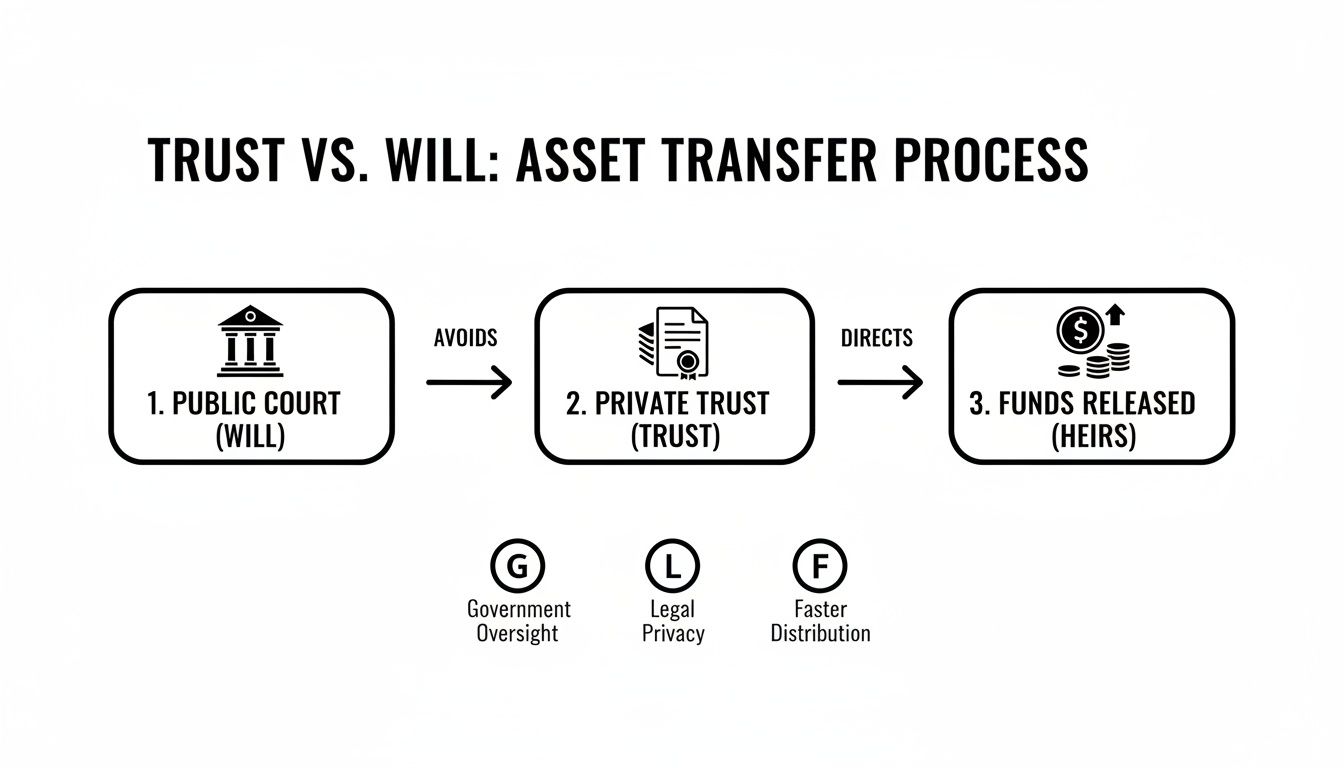
This visual shows how a trust maintains privacy and efficiency, ensuring your assets are managed and distributed without being tied up in court. For a more detailed walkthrough, see our guide on how to transfer property to a trust.
Working with a legal professional ensures every detail is handled correctly, providing the genuine peace of mind you deserve.
Trustee Responsibilities Under Texas Law

Being asked to serve as a successor trustee is a significant vote of confidence. It means someone trusts your integrity and judgment to manage their legacy. However, this is not just an honorary title—it is a serious role with significant legal duties defined in the Texas Trust Code. Understanding these duties is the first step to managing the trust with the confidence and care it requires.
A trustee is a fiduciary. This is a legal obligation to act solely in the best interests of another—in this case, the trust's beneficiaries. This is the highest standard of care recognized by law, demanding absolute loyalty and transparency. A trustee must set their own interests aside and focus on two things: carrying out the grantor's wishes and protecting the beneficiaries' inheritance. These are known as fiduciary duties in Texas.
Core Fiduciary Duties in Texas
The Texas Trust Code outlines several key duties that every trustee must follow. These should be seen as guideposts for fair and responsible management. Two of the most important are the Duty of Loyalty and the Duty of Prudence.
The Duty of Loyalty requires you to always put the beneficiaries' interests first. This means no self-dealing, such as selling a trust property to yourself at a discount or making investments that benefit you personally. Every decision must be impartial.
The Duty of Prudence requires you to manage the trust's assets as a sensible, cautious person would handle their own affairs. This includes making sound investment choices, keeping immaculate records, and avoiding overly risky financial moves that could jeopardize the trust's value.
A real-world scenario we often see is a trustee wanting to keep the family home for sentimental reasons, even though taxes and upkeep are draining the trust's funds. The Duty of Prudence would compel the trustee to make the difficult but financially sound decision—perhaps selling the home to preserve the trust's value for all beneficiaries.
A Trustee's Practical Responsibilities
Beyond these core legal principles, a trustee has many practical tasks. The role is similar to being the CEO of a small company, where your job is to manage operations smoothly and report to the beneficiaries. Practical advice for trustees includes:
- Inventory and Secure Assets: The first step is to identify all trust assets and take legal control of them.
- Keep Meticulous Records: You must track every dollar coming in and going out. Every transaction must be documented.
- Communicate with Beneficiaries: Texas law requires trustees to keep beneficiaries reasonably informed about the trust's administration.
- File Taxes and Pay Debts: The trustee is responsible for filing the trust's tax returns and settling any of the grantor's final bills.
- Distribute Assets: Once all other duties are complete, your final job is to distribute the remaining assets to the beneficiaries exactly as the trust document directs.
Juggling these duties can be overwhelming, which is why working with an experienced Texas trust administration lawyer is so important. An attorney provides clarity, ensures you comply with the law, and helps protect you from personal liability. To learn more, read our detailed guide on trustee duties and responsibilities.
Advanced Strategies for Asset Protection and Tax Planning
For many Texas families, especially those with businesses or significant assets, a living trust is more than just a tool to avoid probate. It is the cornerstone of a broader strategy designed to shield wealth from creditors and minimize taxes, ensuring your legacy endures for generations. This is where the true power and flexibility of living trusts in Texas become apparent.
A standard revocable living trust is excellent for managing incapacity and probate. However, for serious asset protection, an irrevocable trust is the stronger tool. Once you move assets into an irrevocable trust, they legally no longer belong to you. While that may sound intimidating, it is the key to its protective power. If a lawsuit or creditor emerges later, those assets within the trust are generally beyond their reach.
Shielding Your Assets With Irrevocable Trusts
Think of an irrevocable trust as a vault with a one-way door. Assets go in, but you cannot simply take them out. This feature is what provides such robust protection. This strategy is especially beneficial for doctors, business owners, and other professionals in high-risk fields who want to create a firewall between their personal wealth and professional liabilities.
- Creditor Protection: By legally removing assets from your personal estate, you create a formidable barrier against future lawsuits or claims.
- Medicaid Planning: Certain types of irrevocable trusts can be instrumental in qualifying for long-term care benefits without exhausting your life savings.
- Legacy Preservation: These trusts ensure that assets intended for your children or grandchildren are protected from their own potential divorces or creditors.
Strategic Tax Planning for Your Estate
With the federal estate tax exemption subject to change, proactive tax planning is more important than ever. For individuals with a high net worth, irrevocable trusts are a primary tool for reducing the size of their taxable estate.
As we approach potential changes to the federal estate tax exemption, it is a critical time for Texas families with larger estates to use living trusts for strategic gifting and tax planning. Advanced strategies, like establishing an Irrevocable Life Insurance Trust (ILIT), can remove life insurance proceeds entirely from your taxable estate—a vital move for high-net-worth clients. Learn more about preparing for 2026 estate tax exemption changes.
An Irrevocable Life Insurance Trust (ILIT) is a classic example. The trust, not you, owns your life insurance policy. When the death benefit is paid, it goes to the trust, not your estate. This allows the full amount to pass to your beneficiaries free of estate taxes, which can result in significant savings.
Specialized Trusts for Unique Family Goals
The beauty of trusts is their versatility. A skilled Texas estate planning attorney can draft highly specific trusts to achieve particular family goals.
- Special Needs Trusts (SNTs): These are essential for families with a loved one with a disability. They are designed to provide financial support without jeopardizing eligibility for crucial government benefits like Medicaid or SSI.
- Charitable Trusts: If you have philanthropic goals, these trusts allow you to support causes you care about while often creating tax benefits for you or your family.
Implementing these advanced strategies requires a deep understanding of the Texas Trust Code and complex federal tax laws. The team at The Law Office of Bryan Fagan, PLLC, has the expertise to design and implement these trusts, securing your family’s financial future with the precision it deserves.
Common Questions About Living Trusts in Texas
Embarking on estate planning can feel like learning a new language, so it is natural to have questions. To provide clarity and confidence, we've compiled answers to some of the most common questions we hear about living trusts in Texas.
Do I Still Need a Will if I Have a Living Trust?
Yes, absolutely. A will remains a vital component of a comprehensive estate plan, even with a trust. We use a specific type called a "pour-over" will that functions as a safety net for your trust.
Its job is to "catch" any assets you may have forgotten to transfer into your trust or acquired just before you passed away. Without this will, those assets would be subject to probate and distributed according to Texas intestacy laws, which could undermine your wishes. The pour-over will simply directs those assets into your trust, ensuring everything is handled according to your plan.
How Much Does It Cost to Set Up a Living Trust?
While a living trust has a higher upfront cost than a simple will, it is best viewed as an investment in a smoother, more cost-effective process for your family later. The alternative—probate—can be very expensive. Court fees, attorney fees, and administrative costs often far exceed the initial cost of creating a trust.
By establishing a trust now, you are saving your loved ones significant time, money, and stress in the future. It is a proactive measure to keep your estate private and ensure the administration is as seamless as possible.
There's a common myth that trusts are only for the ultra-wealthy. The reality is, any Texan who owns a home or has moderate assets can benefit immensely by avoiding the public, slow, and costly probate process that a will all but guarantees.
When to Modify or Terminate a Trust
Flexibility is a key advantage of a revocable living trust. Life changes—you might marry, have children, divorce, or acquire new property. As these events occur, you can and should update your trust to reflect your new circumstances.
Amending a trust is a straightforward process with the help of a skilled Texas estate planning attorney. You can easily change beneficiaries, name a new successor trustee, or add and remove assets as your life evolves. This adaptability ensures your plan remains current, and a good lawyer can guide you on how to modify a trust in Texas when the time comes.
Are My Assets Protected from Creditors?
This is an excellent question that highlights the different purposes of trusts. A standard revocable living trust does not offer protection from your own creditors. Because you maintain complete control over the assets and can revoke the trust at any time, the law still considers them your property.
For robust asset protection, you would need an irrevocable trust. When you transfer assets into an irrevocable trust, you relinquish control, and legally, they are no longer your property. This is the key step that shields them from potential lawsuits or creditors. A Texas trust administration lawyer can walk you through the powerful benefits—and the trade-offs—of this more advanced strategy.
If you’re managing a trust or planning your estate, contact The Law Office of Bryan Fagan, PLLC for a free consultation. Our attorneys provide trusted, Texas-based guidance for every step of the process.