Planning for a loved one’s future, especially when it involves a power of attorney for aging parents, can feel overwhelming—but with the right legal guidance, it doesn’t have to be. This isn't about taking control; it’s about ensuring your parents' wishes are legally protected and that someone they trust is ready to act on their behalf if needed. A Power of Attorney (POA) is a tool of empowerment, allowing your parents to stay in charge of their future, no matter what comes.
Starting the Conversation About a Power of Attorney
Talking with your parents about a Power of Attorney is a significant conversation, but it's one of the most important you'll have for their well-being. Approaching the topic with empathy and clarity is key. Frame it as a partnership in planning for their future, which can prevent immense legal headaches and family stress down the road.

Finding the Right Moment
Like any sensitive discussion, timing is crucial. Avoid formal "family meetings" that can feel like an ambush and put your parents on the defensive. Instead, look for natural, low-pressure opportunities to introduce the topic.
Here are a few gentle ways to bring it up:
- When a friend's family goes through it: "Mom, I was talking to Susan, and her family had a difficult time when her dad got sick because none of his legal paperwork was in order. It made me think we should get our ducks in a row so we never have to face that kind of stress."
- Following a doctor's appointment: "Dad, after our visit to the doctor, it seems like a good time to ensure we have a plan for healthcare decisions. Have you considered a medical power of attorney?"
- While discussing finances: "As we're reviewing these retirement accounts, it's just smart planning to decide who would manage them if you ever couldn't. A financial power of attorney would make that transition seamless."
These approaches connect the idea to practical, real-world scenarios rather than abstract fears.
Framing the POA as a Tool of Empowerment
Many parents fear losing their independence. Your role is to demonstrate that a Power of Attorney achieves the opposite—it preserves their autonomy by allowing them to choose, right now, who will make decisions for them. Without a POA, if something happens, a court may have to appoint a guardian. That is a public, expensive process that takes the decision entirely out of their hands.
A power of attorney is your parents' chance to write the script for their own future care. They get to pick the actors and decide what roles they play, ensuring their wishes are the star of the show, no matter what happens.
When you discuss it, use language that puts them in control. Phrases like, "This gives you the power to decide," or "Let's get your wishes down in writing," reinforce their authority.
Explain that their chosen agent has a fiduciary duty under the Texas Estates Code. This is a profound legal obligation to act only in their best interest—a duty of absolute loyalty. By establishing a POA, you are helping them maintain control over their life's narrative.
Understanding the Different Powers of Attorney in Texas
The term "Power of Attorney" is not a one-size-fits-all document. In Texas, it is a toolkit of distinct legal instruments, each designed for a specific purpose to help you care for your aging parents. Understanding these differences is the first and most critical step in building a plan that truly protects their health, finances, and dignity.
The All-Important Durable Power of Attorney
When discussing a power of attorney for aging parents, the most vital distinction is between a "general" POA and a "Durable" Power of Attorney. A general POA terminates automatically if your parent becomes incapacitated—the very moment it is most needed.
A Durable Power of Attorney, however, is designed to endure. It contains specific language required by the Texas Estates Code that keeps it in effect even after your parent can no longer make their own decisions. This "durability" is what allows you to help them without resorting to a court-ordered guardianship.
Planning for incapacity is a practical necessity. Insurance industry data indicates that one out of every two Americans will experience a period of prolonged incapacity in their lifetime. Without a durable document, families are forced into expensive, public, and stressful court proceedings just to gain the authority to pay bills or consult with doctors. You can learn more about why this is essential for effective estate planning on brillantlaw.com.
Splitting the Responsibilities: Financial vs. Medical Decisions
A common misconception is that one POA document covers everything. In Texas, that is not the case. We use two separate, equally important documents to address the two main areas of life: finances and healthcare.
- Statutory Durable Power of Attorney: This is the workhorse for all financial matters. It authorizes your agent to manage property, pay bills, handle investments, file taxes, and conduct other financial transactions.
- Medical Power of Attorney: This document is exclusively for healthcare. It empowers your agent to communicate with doctors, access medical records, consent to medical procedures, and make critical treatment decisions if your parent is unable to.
Having both documents properly drafted by a skilled Texas estate planning attorney is crucial to ensure there are no gaps that could cause significant problems later.
Think of it this way: A Power of Attorney isn't a single tool but a toolkit. A Statutory Durable POA manages the financial engine of your parent's life, while a Medical POA navigates the personal and often delicate path of their healthcare journey.
To help you see the differences more clearly, let's break down the primary types of Power of Attorney used in Texas.
Comparing Key Power of Attorney Types in Texas
Understanding the specific roles of each Power of Attorney is key to building a comprehensive plan. This table lays out the fundamental differences between the main documents you'll encounter in Texas.
| Power of Attorney Type | Primary Purpose | When It Becomes Effective | Key Consideration in Texas |
|---|---|---|---|
| Statutory Durable POA | Manages financial and property matters (banking, real estate, taxes, etc.). | Can be immediate or "springing" (upon incapacity). | Must contain specific "durable" language from the Texas Estates Code to remain valid after incapacity. |
| Medical POA | Makes healthcare decisions (treatments, procedures, doctors, etc.). | Only when a physician certifies the principal is unable to make their own medical decisions. | This is a separate document from the financial POA and is crucial for medical crises. |
| General POA | A non-durable financial POA. | Typically effective immediately. | Becomes void upon incapacity, making it unsuitable for long-term planning for aging parents. |
Having both a Statutory Durable Power of Attorney for finances and a Medical Power of Attorney for healthcare ensures that you have a complete plan to protect your parents.
Effective Immediately vs. Springing Powers
Another critical decision is when the agent's authority begins. This choice can significantly impact the document's usefulness in a crisis.
Immediate Power of Attorney
An "immediate" POA is effective the moment it’s signed. This does not mean your parent loses control; they can continue managing their own affairs. It simply means their chosen agent also has the authority to step in and assist. This is incredibly convenient for an adult child already helping a parent with banking or bill payments.
Springing Power of Attorney
A "springing" POA only becomes effective after a specific event—usually, a physician must certify in writing that your parent has become incapacitated. While this may seem safer, it can create a bureaucratic nightmare when you need to act quickly. Obtaining the necessary physician certifications can take days or weeks, leaving your family in limbo during an emergency.
For these reasons, most experienced Texas attorneys recommend an immediate Durable Power of Attorney, provided the agent is completely trustworthy. The focus should be on selecting the right person, not creating hurdles that prevent them from fulfilling their duties.
Choosing a Trustworthy Agent for Your POA
Naming an agent in a Power of Attorney is the most critical decision your parents will make in this process. This person, also known as the "attorney-in-fact," will be granted immense power over your parents' financial and personal affairs. The role demands absolute integrity, as the agent is legally bound by fiduciary duties to act solely in your parents' best interests.
This choice is not about tradition or convenience; it’s about identifying the person with the character, skills, and composure to handle life-altering responsibilities with care and precision.
Qualities of a Dependable Agent
The ideal agent is more than just a loving family member; they must be a responsible steward. When helping your parents evaluate candidates, focus on traits that signal reliability and sound judgment under pressure. You are looking for someone who is organized, financially responsible in their own life, and an effective communicator.
Consider these essential qualities:
- Financial Competence: While they don’t need to be a financial expert, they must be comfortable managing money, from paying monthly bills to making sound decisions about investments.
- Unwavering Honesty: This is non-negotiable. The chosen agent must have a proven history of integrity and transparency.
- Assertiveness: The agent may need to advocate for your parents with financial institutions, healthcare providers, or government agencies. They need the confidence to ask tough questions and ensure your parents' wishes are honored.
- Level-Headedness: During a health or financial crisis, emotions run high. The best agent is someone who can remain calm, objective, and focused on the necessary tasks.
A capable agent will also take the time to understand complex financial situations, such as researching strategies to maximize Social Security benefits to ensure your parents' financial security.
Understanding Fiduciary Duties Under Texas Law
In Texas, an agent under a POA has strict legal obligations known as fiduciary duties. This is a high standard of care, defined by the Texas Estates Code, that legally requires the agent to act with complete loyalty and good faith. Failure to uphold these duties can result in serious legal consequences.
The core idea of a fiduciary is simple but powerful: the agent must always, always put the principal's interests ahead of their own. They can't use the position for personal gain or make decisions that benefit themselves.
Key fiduciary responsibilities in Texas include:
- Acting in Good Faith: Every decision must be made honestly and with your parent's well-being as the top priority.
- Avoiding Conflicts of Interest: An agent cannot engage in self-dealing, such as selling your parent’s property to themselves at a discount or loaning your parent’s money to others.
- Prudent Asset Management: They have a duty to manage your parent’s property and investments carefully, as a prudent person would manage their own finances.
- Keeping Meticulous Records: The agent must maintain detailed records of every transaction made on behalf of your parent and be prepared to provide a full accounting upon request.
These responsibilities are similar to those of a trustee. To learn more, explore the topic of fiduciary duties and responsibilities in Texas on our blog.
A Real-World Scenario
Imagine Sarah names her son, Mark, as her agent. Mark is organized and financially responsible. When Sarah suffers a stroke, Mark steps in seamlessly. He uses the POA to pay her medical bills, consults with her financial advisor, and keeps a detailed spreadsheet of all transactions, which he shares with his siblings. He acts with transparency and care, easing the family's burden during a difficult time.
Now, consider if Sarah had chosen her other son, David. David means well but is disorganized and avoids difficult conversations. When Sarah is incapacitated, David is overwhelmed. Bills go unpaid, financial deadlines are missed, and he accidentally commingles Sarah’s funds with his own. His actions create financial chaos and family disputes, adding stress to an already heartbreaking situation. This scenario underscores why choosing the right agent is so crucial for your family's future.
How to Create a Valid Texas Power of Attorney
A Power of Attorney is only as strong as its legal foundation. If it is not drafted and executed correctly, financial institutions and hospitals may reject it, leaving your family powerless when your parents need help the most.
Creating a valid Texas POA involves more than downloading a generic form; it requires careful adherence to the specific language and procedures outlined in the Texas Estates Code.
The goal is to create a document with clear, unambiguous language that grants the precise powers your parents intend for their agent. Vague phrasing like "handle finances" is too broad and can lead to confusion or legal challenges. The document should specify powers, such as accessing named bank accounts, paying bills, filing taxes, and managing investment portfolios.
This visual guide provides an overview of the fundamental steps, from selecting the right person to the official signing.
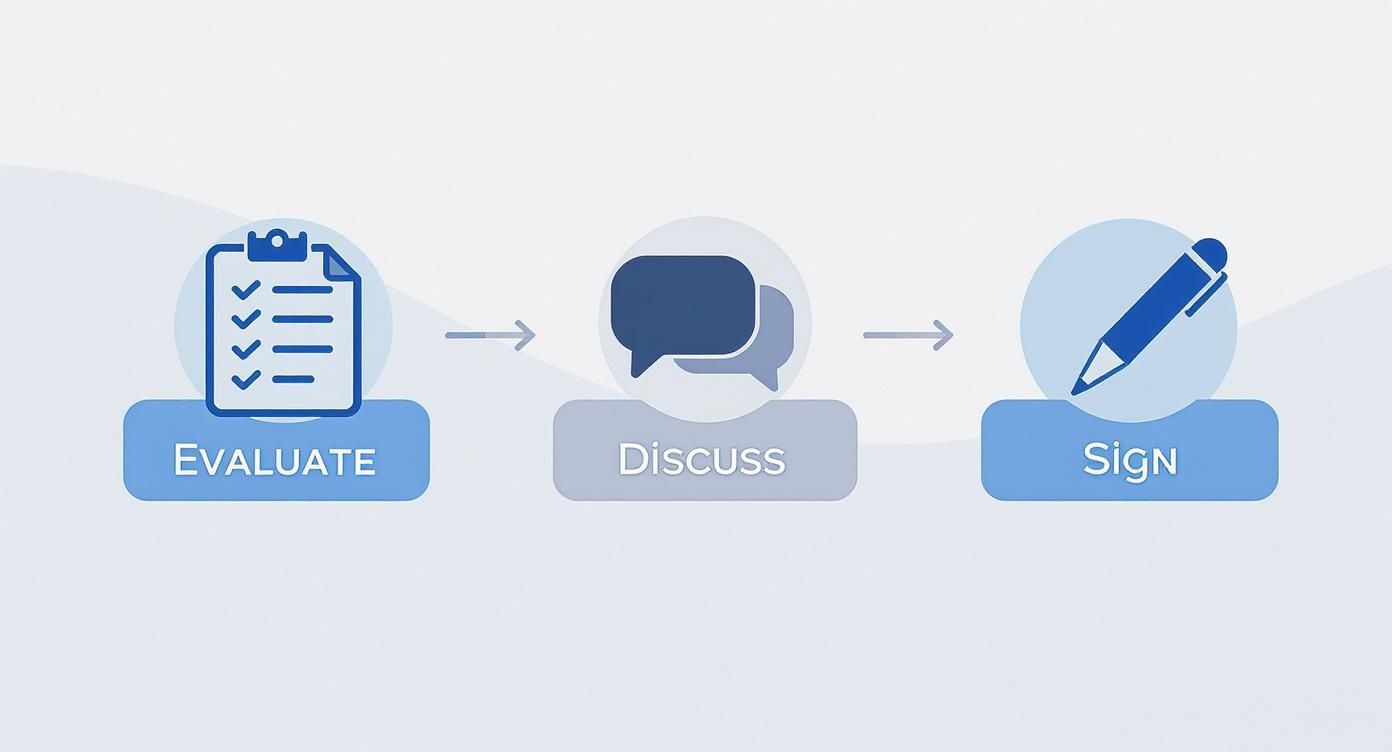
As you can see, this is a thoughtful process built on careful evaluation, open communication, and precise legal execution.
Essential Elements of a Texas POA
For a Statutory Durable Power of Attorney to be legally valid in Texas, it must meet several key requirements. These are not mere suggestions; they are legal necessities that make the document enforceable.
The document must be in writing and clearly identify the principal (your parent) and the agent. It must also contain specific language granting the agent authority and—most critically—state that the power is "durable." This ensures it remains effective if your parent becomes incapacitated.
Most importantly, the POA must be signed by your parent in the physical presence of a notary public. Notarization is a crucial safeguard against fraud, as the notary verifies the signer’s identity and confirms they are signing willingly.
The Formalities of Signing and Witnessing
Texas law is very specific about how a Power of Attorney must be executed. Your parent, the principal, must sign it. If they are physically unable to, another person may sign on their behalf, but only in your parent's presence and at their explicit direction.
The signing must be acknowledged before a notary public. This means your parent must personally appear before the notary, present valid identification, and sign the document in the notary's presence. The notary then affixes their official seal and signature, making the document legally binding.
A common mistake is downloading a generic online form and having a parent sign it without a notary. This simple error can render the entire document invalid, creating a legal nightmare when you try to use it.
While witnesses are not required for a financial POA in Texas, they are mandatory for a Medical Power of Attorney. Understanding these details is vital. You can learn more about the differences between a POA and other advance directives in Texas to ensure all legal requirements are met.
Storing and Distributing the Document
Once the Power of Attorney is signed and notarized, proper storage and distribution are equally important. The original document holds the legal authority and should be stored in a safe yet accessible location, such as a fireproof safe at home or a safe deposit box. The agent must know where it is and how to access it.
You should also distribute copies to key individuals and institutions:
- Financial Institutions: Provide a copy to your parents' banks, credit unions, and investment firms. They may have their own internal forms, but the official POA is the first step.
- Healthcare Providers: The agent for the Medical POA should have a copy, and you should provide another to your parents' primary care physician and local hospital to keep on file.
By properly creating, executing, and distributing a power of attorney for aging parents, you establish a reliable tool to protect them and provide peace of mind.
Sidestepping Common Pitfalls and Financial Abuse
Granting someone a Power of Attorney is an act of profound trust. While necessary for future planning, this authority can create vulnerabilities if not handled carefully. Protecting your parents involves not only choosing the right agent but also building safeguards into the document to prevent common mistakes and, in the worst cases, financial exploitation.
Financial fraud against older adults is a significant problem. Studies show that this type of exploitation costs seniors over $36 billion annually in the U.S. A well-drafted power of attorney for aging parents is a primary defense, empowering a trusted individual to act in their best interest. With projections showing that by 2030, one in five Americans will be 65 or older, these legal protections are more critical than ever. For more information, you can get guidance from J.P. Morgan on this topic.

Building Protections Right Into the Document
A common mistake is using vague, overly broad language in a POA. A phrase like "manage all financial affairs" is dangerously ambiguous and leaves too much room for misinterpretation or abuse. A strong POA should be specific, granting clear powers while also setting firm limitations.
This is where an experienced Texas estate planning attorney is invaluable. We can incorporate specific, protective clauses that safeguard your parent's finances.
- Requiring Co-Agents for Major Decisions: You can structure the POA to require two agents to approve significant actions, such as selling real estate or accessing large investment accounts. This creates an immediate system of checks and balances.
- Mandating Regular Reports: The POA can legally require the agent to provide regular financial statements to a third party, such as another sibling or a family accountant. This transparency is a powerful deterrent to misconduct.
- Limiting Gifting Authority: Without clear restrictions, an agent could potentially "gift" your parent's assets to themselves or others. The document must specify what, if any, gifting authority the agent has.
In addition to legal safeguards, it is wise to educate yourself and your parents on common financial scams. Learning to recognize red flags, such as spotting a Ponzi scheme, adds another crucial layer of protection.
The Wisdom of Naming Successor Agents
Another common oversight is failing to name a backup agent. What happens if the primary agent passes away, becomes ill, or is otherwise unable to serve? Without a successor named, your family could be forced into a costly and public guardianship proceeding.
Naming at least one—and ideally two—successor agents ensures a smooth transition if the primary agent must step down. This simple foresight can prevent a crisis from becoming a legal nightmare, keeping control within the family and out of the courts.
A Power of Attorney is like a line of defense for your parents' well-being. The primary agent is the first guard, but the successor agents are the essential reserves, ready to step in and ensure the post is never left unprotected.
A Real-World Example of Financial Abuse
Consider Mrs. Davis, an 85-year-old widow who named her charismatic nephew as her agent using a generic online form with sweeping powers. Initially, he helped with bills. Soon, however, he began making "loans" to himself from her accounts, convincing her they were "investments."
By the time the family became suspicious, her life savings were depleted. The generic POA, lacking specific limits or reporting requirements, allowed him to operate unchecked. A professionally drafted document—requiring a co-agent for withdrawals over $1,000 or annual reports to her daughter—could have prevented this tragedy.
This story is a stark reminder of why professional legal guidance is a necessity for true asset protection. Thoughtful drafting closes the loopholes that predators exploit, ensuring the POA protects your parents rather than putting them at risk.
If you’re managing a trust or planning your estate, contact The Law Office of Bryan Fagan, PLLC for a free consultation. Our attorneys provide trusted, Texas-based guidance for every step of the process.
When a Guardianship Becomes the Only Option
Establishing a power of attorney for aging parents is the ideal approach. It is a private, respectful process that allows your parents to choose who they trust, keeping critical life decisions within the family and out of the courtroom.
However, sometimes a POA is no longer possible, and a court-supervised guardianship becomes the only remaining option to protect a loved one.
A guardianship is a formal legal process where a Texas court declares an adult (the "proposed ward") to be incapacitated and appoints a "guardian" to make decisions on their behalf. Unlike a private POA, a guardianship is a public court case that is often expensive, emotionally draining, and results in the loss of an individual's basic rights.
This is precisely why we advocate for proactive planning with a durable POA. A guardianship is not a backup plan; it is the last resort when planning was not possible.
Scenarios That Might Force a Guardianship
Several heartbreaking scenarios can lead families to seek a guardianship because a Power of Attorney is no longer an option. These situations highlight the critical importance of acting before a crisis occurs.
A guardianship may become necessary when:
- There’s No POA and It’s Too Late: This is the most common scenario. If a parent has already lost the mental capacity to understand and sign a legal document due to dementia, a stroke, or another illness, a valid POA cannot be created. Texas law requires contractual capacity to sign a POA. Once that is lost, court intervention is required.
- Family Disputes Paralyze the Agent: Sometimes, even with a valid POA, family conflict prevents the agent from performing their duties. If siblings constantly challenge the agent's decisions, a judge may need to appoint a neutral guardian to manage the situation and protect the parent.
- The Agent is Abusing Their Power: In the worst cases, the agent may be exploiting or neglecting the parent. A guardianship proceeding can be used to remove an abusive agent and have the court appoint a responsible guardian.
The Guardianship Process in Texas
The guardianship process is a formal, public affair, unlike the private signing of a POA.
It begins by filing an application with a probate court, which must include a physician's written statement certifying the parent's incapacity. The court appoints an "attorney ad litem," an independent lawyer who represents the parent's interests. A court investigator may also be involved. Finally, a formal hearing is held where a judge hears evidence and determines if the parent is incapacitated and if the proposed guardian is suitable.
The core difference is control. A Power of Attorney empowers the individual to choose their decision-maker. A guardianship empowers a judge to make that choice for them. The legal system views it as a profound step, as it involves removing a person’s fundamental right to self-determination.
Understanding the significant difference between these two legal paths is crucial. A Power of Attorney is a choice made in advance, while a guardianship is a solution imposed by a court in response to a crisis. For a clearer comparison, see our detailed article on Power of Attorney versus a Guardianship. It reinforces why having these conversations and executing a durable POA early is one of the most important steps you can take for your aging parents.
If you’re managing a trust or planning your estate, contact The Law Office of Bryan Fagan, PLLC for a free consultation. Our attorneys provide trusted, Texas-based guidance for every step of the process.