Losing a loved one is hard enough; facing the legal system right after can feel like a mountain you’re not prepared to climb. Managing an estate can feel overwhelming—but with the right legal guidance, it doesn’t have to be. Probate is simply the court-supervised process for approving a will and settling an estate, and Probate Court 1 in Harris County, Texas, is one of the specialized courts tasked with guiding these sensitive matters.
Think of the court as the official referee, making sure a person's final wishes are carried out exactly as they intended according to Texas law.
What Is the Role of Probate Court 1?
When someone passes away, everything they owned—their property, bank accounts, and debts—becomes part of their "estate." This estate needs to be legally sorted out, and that's where the probate courts come in. In a massive, bustling place like Harris County, these courts are absolutely essential for keeping things orderly and fair.
Probate Court 1 isn't just a courthouse; it's a system designed to give families a clear path forward. At its heart, the court's job is to interpret and follow the state's rulebook, the Texas Estates Code, which spells out how property gets transferred after death. Whether your loved one left a perfectly drafted will or passed away without one (which is called dying "intestate"), this court provides the legal stamp of approval needed to settle their affairs.
Key Functions of the Court
The court's duties are wide-ranging, but most of what they do falls into a few main buckets. Getting a handle on these functions can make the whole process feel a lot less intimidating and empower you to move forward.
Essentially, the court is responsible for:
- Validating Wills: This is where the court officially confirms that a will is the real deal—the decedent’s true final testament.
- Appointing Executors: The court grants legal authority to the person named in the will (the executor) to manage the estate, following clear fiduciary principles.
- Overseeing Estate Administration: It makes sure the executor does their job right—gathering assets, paying off debts, and giving the remaining property to the right heirs or beneficiaries.
- Handling Guardianships: The court also steps in to appoint legal guardians for minors or for adults who are incapacitated and can't manage their own affairs.
The core purpose of the court is to provide a structured, supervised environment for winding up a person's financial life. This judicial oversight protects everyone involved, from the family and beneficiaries to creditors.
While the system is built to be methodical, the sheer number of cases moving through Harris County means that getting every detail right is critical. An experienced attorney can be your guide, ensuring every form is filed correctly and every deadline is met. To get started, you can learn more about the fundamental steps in our complete guide to the probate process in Texas. Having this knowledge is the first step toward handling this process with confidence.
What Kinds of Cases Land in Probate Court 1?
Stepping into the court system can feel like trying to navigate a maze blindfolded. But when you understand what goes on inside Probate Court 1 Harris County Texas, the path becomes a whole lot clearer. Think of this court as a specialist, tasked with managing some of life's most profound and sensitive transitions. Its job is to make sure everything is handled by the book, specifically the Texas Estates Code.
The court's daily schedule is more than just a list of cases; it's a reflection of families navigating loss, seeking protection for loved ones, and trying to find closure. Most of what happens here falls into three big buckets: probating wills, settling estates when there's no will, and setting up guardianships. Each one provides a crucial legal framework when life gets complicated.
Probating a Will
When a loved one leaves behind a will, they've left you a map detailing their final wishes. But before you can follow that map, it needs an official stamp of approval from the court. This validation process is the most common reason people find themselves in Probate Court 1.
Known as "probating a will," the process looks something like this:
- Filing an Application: The person named as the executor in the will submits it to the court.
- Validating the Will: The court’s job is to confirm the document is legally solid and that the deceased created it freely, without any outside pressure.
- Issuing Letters Testamentary: Once the will gets the green light, the court gives the executor official power to manage the estate.
For example, imagine a father passes away, and his will names his son as the executor. That son, with his lawyer's guidance, files the will in Probate Court 1. The judge reviews it, agrees it’s valid, and issues "Letters Testamentary." This document is the key that empowers the son to handle his father's affairs—paying bills, accessing accounts, and ultimately, distributing the property to the heirs just as his dad wanted.
Administering an Estate Without a Will
But what if someone dies without a will? In Texas, this situation is known as "intestate succession," and it's where Probate Court 1 plays an equally vital role. When there's no map, Texas law provides a default plan for who gets what.
The court steps in to appoint an "administrator"—usually a close relative—to take charge of the estate. It's a bit more involved because the court first has to legally determine who the heirs are. This often requires bringing in a court-appointed attorney, called an attorney ad litem, to track down and represent all possible heirs. Once that’s settled, the court gives the administrator "Letters of Administration," which grant the same kind of authority an executor has.
According to the Texas Estates Code, the court acts as a neutral referee. When there’s no will, its purpose is to make sure assets are divided fairly and legally among the decedent's rightful heirs, preventing family disagreements from turning into chaos.
Guardianship Proceedings
Probate Court 1 also handles deeply personal cases that don't involve a death at all—they're about caring for our most vulnerable. A guardianship is a legal proceeding where the court appoints a responsible person (the guardian) to make decisions for someone who can't.
This typically happens in two scenarios:
- Guardianship of a Minor: This becomes necessary if a child's parents die without legally naming a guardian for them in a will.
- Guardianship of an Incapacitated Adult: This is for adults who, because of an illness like dementia or a severe injury, can no longer manage their own personal or financial well-being.
The court keeps a very close eye on these cases. Its number one priority is protecting the "ward," the person who needs care. Anyone who wants to be a guardian has to prove to the court they are the right person for the job, and they’ll have to file regular reports to show they are always acting in the ward’s best interest.
Complex Disputes and Fiduciary Litigation
While many cases are straightforward, Probate Court 1 is also where the tough fights happen. If a family member suspects a will is fake or was signed under coercion, they can file a "will contest." This immediately turns the probate process into a full-blown lawsuit, where the judge hears evidence from both sides to decide if the will is valid.
Likewise, if an executor or trustee is not performing their job correctly—what the law calls a breach of their fiduciary duties in Texas—the beneficiaries can go to court to have them removed. These aren't simple disagreements; they're complex legal battles. They demand a sharp Texas estate planning attorney who knows how to build a powerful case and fight for your rights within the court's unique rules.
Why Court Efficiency Matters for Your Family
When you’re grieving the loss of a loved one, the last thing your family needs is to get stuck in a legal logjam. The probate process can feel overwhelming on its own, and a slow, backlogged court system only adds to the stress and expense. This is precisely why the efficiency of Probate Court 1 in Harris County, Texas, is so critical for your peace of mind.
A court that moves cases smoothly means a faster resolution for your family. But don't mistake efficiency for an empty docket. It’s quite the opposite. This court’s effectiveness comes from its ability to manage a massive caseload, which creates an environment where there's absolutely no room for error. One small mistake on a form or a single missed deadline can send your case to the back of a very long line.
A Look at the Numbers
To get a real sense of what Probate Court 1 is up against, you have to look at the data. This court is a powerhouse, handling a constant flood of cases that impact thousands of families across the Houston area each and every year. Its performance is a testament to its structured processes, but it also reveals the intense pressure on the entire system.
This image gives you a snapshot of the court's recent caseload, from deceased estates to guardianships, and its impressive clearance rate.
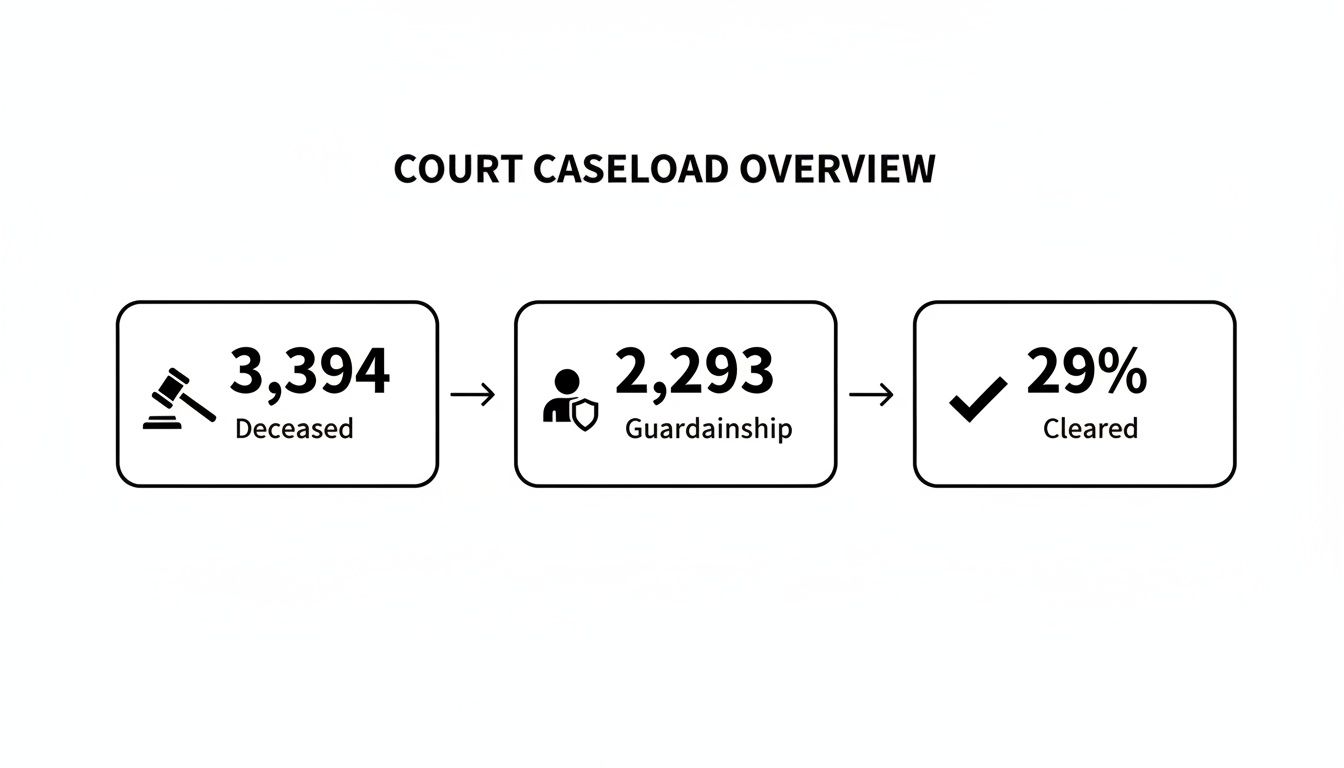
While the court does an incredible job resolving cases, the sheer volume it faces is staggering.
What the Data Means for You
The numbers don’t lie—this court is working at maximum capacity. Harris County Probate Court No. 1 is known for its efficiency, but in a recent year, it managed an astonishing 3,394 deceased cases and 2,293 guardianship cases. Its clearance rate was remarkable, resolving about 29% more cases than were newly filed, which shows just how hard the court works to keep the docket from overflowing.
Think about it: in an average week, the court holds 65 hearings, processes 206 motions, and signs 258 orders. Even with a fifth probate court added in late 2023, the caseload remains immense. You can dig deeper into how these statistics shape the probate landscape in Harris County to see the full picture.
This high-speed environment is exactly why having a knowledgeable attorney isn't a luxury—it's a necessity. You need someone who knows the specific rhythm and rules of Probate Court 1.
In a system juggling thousands of cases, a perfectly prepared file sails through. An incomplete or incorrect one gets flagged, leading to frustrating and expensive delays for your family.
An experienced Texas trust administration lawyer understands what it takes to get a case file approved without a hitch. This means:
- Ensuring every form is filled out perfectly before it ever reaches the clerk's desk.
- Anticipating the judge's potential questions and addressing them proactively in the filings.
- Meeting every single deadline set by the court and the Texas Estates Code.
By presenting a clean, thorough, and well-documented case, your attorney helps the court do its job efficiently. This, in turn, helps your family find closure and move forward. In the high-volume world of Harris County probate, that level of preparation can make all the difference.
Navigating a Backlogged Harris County Probate System
Knowing the rules of the road is one thing, but navigating Houston traffic during rush hour is another beast entirely. The same can be said for our local probate courts. While you might understand the basic purpose of probate, actually getting a case through the system in Probate Court 1 Harris County Texas presents a unique set of challenges.
The reality on the ground for Houston-area families is that the entire probate system is under immense strain. As our communities grow, so does the number of families needing the court’s assistance. This has created a bottleneck where having a solid strategy isn't just a good idea—it's an absolute necessity.
Even with five specialized probate courts trying to manage the flow, the sheer volume of cases means delays are almost inevitable. This is why having a clear plan and error-free legal work is more critical than ever before.
The Challenge of a Growing Caseload
It's no secret that Harris County is booming. As Houston and its surrounding suburbs like Sugar Land and Katy expand, the probate courts have felt the growing pains. This relentless population growth has fueled a significant backlog, stretching out timelines for executors and heirs trying to settle their loved ones' affairs.
Harris County has tried to keep up by creating five dedicated statutory probate courts—a huge number considering there are only 24 in the entire state. All are housed at 201 Caroline in Houston, where they handle everything from wills and guardianships to complex estate disputes.
But even with this infrastructure, the shared dockets are overwhelmed. Simple, routine steps can get bogged down in the system. If you want to dive deeper into this issue, you can explore the details of the Harris County probate backlog and see how it directly impacts families like yours.
Practical Advice: Strategies to Minimize or Avoid Probate
While you can't always sidestep probate, many families have options to bypass the court system entirely. A skilled Texas estate planning attorney can help you use the right legal tools to structure your estate for a smooth, private, and efficient transfer of assets to your loved ones.
Here are some of the most effective tools for avoiding probate:
- Revocable Living Trusts: Think of this as a private instruction manual for your assets. By transferring your property into a trust, you appoint a successor trustee to distribute everything according to your wishes when you pass away, no court approval needed. This is a foundational strategy for modern asset protection and estate management, guided by the Texas Trust Code.
- Transfer on Death Deeds (TODDs): For your real estate, a TODD is a game-changer. It allows you to name a beneficiary who will automatically receive the property upon your death, completely avoiding the probate process for that asset.
- Payable on Death (POD) and Transfer on Death (TOD) Accounts: You can add these simple designations to your bank accounts, investment portfolios, and retirement funds. It works just like a TODD, allowing the funds to pass directly to the person you name.
By planning ahead, you can create a private and efficient path for your legacy, keeping your family’s affairs out of a public and potentially backlogged court system. This is one of the most compassionate gifts you can give your loved ones.
The table below breaks down the typical steps in a Harris County probate case and points out where court congestion can create real-world delays.
Key Steps and Potential Delays in Harris County Probate
| Probate Step | Typical Action Required | Potential Delay Factor in Harris County |
|---|---|---|
| Initial Filing | Submitting the Application for Probate with the court clerk. | Simple clerical errors on the application can lead to rejection, forcing you to refile and lose your place in the queue. |
| Posting Notice | The County Clerk posts a public notice for a minimum of 10 days before a hearing can occur. | This is a statutory waiting period, but court scheduling backlogs can extend the wait for a hearing well beyond this minimum. |
| Proving the Will | A court hearing where the judge legally recognizes the will as valid. | Finding an open hearing date on a crowded docket can take weeks or even months, delaying the entire process from the start. |
| Appointing an Executor | The judge formally appoints the executor and grants them "Letters Testamentary." | Delays in the initial hearing directly postpone the executor's ability to legally manage and access estate assets. |
| Inventory & Appraisement | The executor must file an inventory of all estate assets within 90 days of being appointed. | If the court has questions or an heir contests the inventory, scheduling a new hearing to resolve the issue can add significant delays. |
Understanding these potential bottlenecks is the first step. The next is having an experienced guide who knows how to navigate around them.
Making the Probate Process Smoother
If going through probate is unavoidable, the name of the game in a busy system like Harris County's is perfection. There is no room for error. Every single document—from the initial application to the final inventory—must be precise, complete, and perfectly compliant with the Texas Estates Code and the local court rules.
An experienced probate lawyer steers you clear of these pitfalls by:
- Ensuring Flawless Filings: We treat every document like it’s the most important one, triple-checking every detail to prevent the rejections that cause so many delays.
- Strategic Scheduling: We know the ins and outs of the court’s docket. We work to schedule hearings at the right times to keep your case moving forward without unnecessary lulls.
- Proactive Communication: We maintain a direct line of communication with the court clerks and staff, allowing us to resolve small issues before they can escalate into major problems that stall your case.
Navigating the crowded hallways of the Harris County Civil Courthouse requires a guide who knows the map by heart. At the Law Office of Bryan Fagan, our attorneys provide the expertise needed to manage your case effectively, even when the system is under pressure.
Your Step-By-Step Guide as an Executor
Being named an executor is a huge honor, but it can also feel like a ton of responsibility has landed on your shoulders. The role is serious, but the path forward doesn't have to be a mystery. We're here to provide step-by-step guidance so you can carry out your duties with clarity and confidence.
This is your practical roadmap, built from the ground up based on the Texas Estates Code. We'll walk you through it, ensuring you can honor your loved one's final wishes correctly and with care.
To make this real, let's consider a real-world scenario. Meet Maria, a Houston resident just named the executor of her father's will. She's feeling overwhelmed but is determined to get everything right. This is the exact path she'll take, and it's the one you can follow, too.

Step 1: File the Will for Probate
Your first official move is to file an Application to Probate the Will with the Harris County Clerk. This is a formal petition asking the court to legally validate the will and officially name you as the executor. You must get this done within four years of your loved one's passing.
For Maria, this means she'll work with her lawyer to prepare the application and submit it along with her father's original will. The case will then be assigned to one of the probate courts, like Probate Court 1 Harris County Texas.
Step 2: Attend the Initial Court Hearing
After a required waiting period, the court will set a hearing. This is usually a short, straightforward affair. You'll be asked to "prove up" the will, which just means you'll give testimony confirming a few facts about the will and the person who passed away.
Once the judge is satisfied, they'll sign an order that officially admits the will to probate and appoints you as the executor. A short time later, the court gives you something called Letters Testamentary.
Letters Testamentary are your golden ticket. This official document is the proof you need to show banks, financial institutions, and other entities that you have the legal authority to manage the estate’s assets.
Learning more about how to obtain and use Letters Testamentary or of Administration is a crucial part of understanding your power as an executor. This piece of paper unlocks your ability to do the job.
Step 3: Notify Creditors and Beneficiaries
As an executor, you have a fiduciary duty to the estate. That's a legal way of saying you must act in the best interests of everyone involved, including both creditors and beneficiaries. The Texas Estates Code is very specific about who you need to notify and when.
- Notice to Beneficiaries: You have 60 days from the day the will is probated to formally notify every beneficiary named in the will. This letter simply lets them know the court has approved the will and that they have an interest in the estate.
- Notice to Creditors: You're also required to publish a general notice in a local newspaper. This is to alert any potential creditors that they need to present their claims. For any known secured creditors—like a mortgage company—you’ll need to send a direct, specific notice.
Step 4: Gather and Inventory Estate Assets
This is one of the biggest parts of your job. You are responsible for finding, securing, and valuing all the property that belongs to the estate. We're talking about everything from the house and bank accounts to cars, stocks, and personal belongings.
Within 90 days of your appointment, you must file a detailed document with the court called an "Inventory, Appraisement, and List of Claims." This is a complete list of all estate assets and their fair market value on the date of death. It provides a clear and transparent record for the court and all beneficiaries.
Step 5: Pay Debts and Taxes
Once you have control of the estate's assets, your next task is to use those funds to pay all legitimate debts and final expenses. This includes funeral costs, outstanding medical bills, credit card balances, and any final income taxes. It's absolutely critical to handle this step with precision to avoid becoming personally liable for any of the estate's debts.
Step 6: Distribute Assets and Close the Estate
After all debts and expenses are settled, you can finally move on to the best part: distributing the remaining assets to the beneficiaries according to the will's instructions. Always get a signed receipt from each beneficiary to prove they received their inheritance.
Once everything has been distributed and all your duties are done, your attorney can help you file the last bit of paperwork to formally close the estate with the court. This final step officially releases you from your role and responsibilities as executor.
Tackling these steps requires attention to detail and a solid grasp of Texas law. While it might seem like a lot, you don't have to go it alone. A knowledgeable probate attorney from a firm like The Law Office of Bryan Fagan, PLLC can be your guide through every stage, ensuring the process is as smooth and stress-free as possible. It’s also a good reminder that thoughtful estate planning and asset protection during one's lifetime can make this entire process so much simpler for the people left to handle things.
How Our Experienced Attorneys Can Help You Succeed
Trying to navigate the probate process after losing a family member is tough enough without the added stress of a complex court system. It's a path no one wants to walk alone.
The Harris County probate courts are known for their high volume, which means every single detail on your filing is under a microscope. One small misstep, one forgotten form, can bring everything to a grinding halt and lead to frustrating delays. At The Law Office of Bryan Fagan, PLLC, we know this system inside and out. We’re here to guide your family through it with both compassion and the sharp precision it demands.
Our attorneys have spent years representing clients right here in Probate Court 1 Harris County Texas. We’re in the trenches, providing dedicated support from the moment an application is filed until the final asset is correctly and efficiently distributed.
Our Comprehensive Probate and Estate Services
We offer a full range of services built to give you clarity and peace of mind when you need it most. It doesn’t matter if you’re an executor trying to fulfill your duties, a beneficiary protecting your inheritance, or someone planning for the future—we have your back.
Here’s how we can help:
- Estate Administration: We’ll walk with executors and administrators every step of the way, making sure their fiduciary duties are met and every action aligns with the Texas Estates Code.
- Guardianship Proceedings: Our team provides compassionate and solid legal support for families who need to establish a guardianship for a child or an incapacitated adult loved one.
- Fiduciary Litigation: If disagreements pop up—like a will contest or an accusation of mismanagement—our attorneys are ready to stand up in court and vigorously defend your rights and interests.
- Proactive Estate Planning: We help families create smart, forward-thinking estate plans. By using tools like trusts and other strategies, we can often minimize or even completely avoid the need for court involvement down the road.
Success in a busy court system like Harris County requires more than just knowing the law. It demands meticulous preparation, strategic thinking, and crystal-clear communication. We handle the legal heavy lifting so you can focus on your family.
Our team knows that winning in probate court also depends on running an efficient practice. For those interested in how a modern law firm operates, you can see how we prioritize clear communication and client intake with tools like specialized answering services for law firms. You can also get more insight into our approach by reading our guide on navigating probate law with the best Houston probate attorney.
If you’re managing a trust or planning your estate, contact The Law Office of Bryan Fagan, PLLC for a free consultation. Our attorneys provide trusted, Texas-based guidance for every step of the process.
Frequently Asked Questions About Harris County Probate
When you're dealing with the loss of a loved one, the last thing you want is a mountain of confusing legal questions. Especially in a place as busy as Harris County, it's natural to feel overwhelmed. Let's clear the air and tackle some of the most common questions we hear from families just like yours.
How Long Does Probate Usually Take in Harris County?
This is often the first question on everyone's mind, and the honest answer is: it depends. Think of it like a journey—a simple, uncontested estate is like a straight shot down the highway, while a complex, disputed one has detours and traffic jams.
Even with efficient courts like Probate Court 1 Harris County Texas, the timeline hinges on the estate's complexity. A smooth, uncontested probate might wrap up in as little as six to nine months. However, if someone contests the will or there are procedural hiccups, the process can stretch out significantly longer.
Having an experienced attorney in your corner is like having the best GPS for this journey. They know the shortcuts and how to file everything correctly the first time, helping you avoid unnecessary delays.
Do I Have to Hire a Lawyer for Probate in Texas?
Yes, for almost every probate case in Texas, the answer is a firm yes. The law doesn't generally allow you to represent an estate on your own (or “pro se”). Why? Because as an executor, you’re not just acting for yourself; you're a fiduciary responsible for the estate's beneficiaries and creditors.
Think of it this way: hiring a lawyer isn't just about following a rule; it's your most important safeguard. A good attorney ensures you follow the Texas Estates Code and all local court rules to the letter, protecting you from personal liability and keeping the entire process on track.
What Happens if Someone Contests the Will?
When a will is contested, the probate process shifts gears and becomes a formal lawsuit. This is what we call fiduciary litigation. The person challenging the will files a legal objection, usually claiming things like undue influence, fraud, or that the person who passed away wasn't of sound mind.
From there, the court sets hearings to look at the evidence and listen to testimony from all sides. These disputes are legally tangled and emotionally charged, requiring a skilled attorney to either defend the will's validity or make a strong case for your challenge.
A will contest immediately raises the stakes. The court must carefully weigh all evidence before deciding how to proceed, which can add substantial time and expense to the probate process.
What Are the First Steps When a Loved One Passes Away?
First things first, take a deep breath. Your initial task is to locate your loved one’s original will and make sure their major assets, like their house and car, are secure. It is absolutely crucial that you do not start distributing property or paying off debts before the court officially gives you the authority to do so.
Your next and most important step is to talk to a qualified probate attorney. They will review the will, get a clear picture of the estate, and guide you on the right legal path. From there, your attorney will handle preparing and filing the application with the Harris County Clerk to get the probate process officially started.
If you’re managing a trust or planning your estate, contact The Law Office of Bryan Fagan, PLLC for a free consultation. Our attorneys provide trusted, Texas-based guidance for every step of the process.