Planning for the future can feel overwhelming, especially when considering the high cost of long-term care. You've worked hard to build a secure life for your family, and the thought of nursing home expenses depleting your savings is a valid concern. But with the right legal guidance, protecting your assets from nursing home costs is not only possible—it can provide profound peace of mind. This guide will walk you through practical, Texas-based strategies to safeguard your legacy while ensuring you or your loved ones receive the quality care you deserve.
Navigating the High Cost of Long-Term Care in Texas
Facing the possibility of long-term care is an emotional conversation for any family, but the financial reality can be daunting. In Texas, the rising cost of nursing home care can quickly exhaust a lifetime of savings if you are not prepared.
This isn't about causing alarm; it's about empowering you with knowledge. Understanding the financial landscape is the first, most important step toward protecting your family’s future. Proactive planning is not just about money—it’s about ensuring your loved ones receive quality care without sacrificing the legacy you worked so hard to build.
The Financial Reality of Long-Term Care
The costs of long-term care are significant and continue to climb. Without a plan, many families are forced to pay for care out-of-pocket until their assets are gone, only then qualifying for public assistance like Medicaid.
Across the United States, the average annual cost for a semi-private nursing home room is projected to exceed $133,000, with private rooms approaching $153,000 per year. Projections show these figures could more than double by 2050. You can explore the data in this research from Statista.
Seeing these numbers can be unsettling, but it’s important not to feel discouraged. You have powerful legal options available. The key is to approach this challenge with a clear, informed strategy developed with a trusted Texas estate planning attorney.
Introducing Medicaid Planning as a Solution
Fortunately, Texas law provides effective tools to manage these expenses through a process called Medicaid planning. This is a legal and ethical strategy for structuring your finances to meet the strict eligibility requirements for Medicaid, which can then cover the high costs of long-term care. It is not about hiding money; it's about strategically repositioning your assets in full compliance with the rules set by the Texas Estates Code and federal regulations.
Effective Medicaid planning helps you achieve several crucial goals:
- Preserve Your Assets: You can safeguard your home, savings, and investments for your spouse and children. Our firm offers dedicated asset protection services to help you do just that.
- Ensure Quality Care: You gain access to the medical and personal care you need without depleting your finances.
- Provide Peace of Mind: You can eliminate the stress of a potential financial crisis during an already difficult time.
Here is a brief overview of the key strategies we will discuss, giving you a roadmap for protecting your assets.
Key Asset Protection Strategies at a Glance
| Strategy | Primary Goal | Best Time to Implement |
|---|---|---|
| Medicad Asset Protection Trust (MAPT) | Shield assets from being counted for Medicaid eligibility while protecting them for heirs. | At least 5 years before needing long-term care (to avoid the look-back period). |
| Spousal Protections (CSRA/MMMNA) | Protect a significant portion of assets and income for the healthy spouse living at home. | When one spouse enters a nursing facility and applies for Medicaid. |
| Miller Trust (QIT) | Help individuals whose income is too high to qualify for Medicaid manage their excess income. | When applying for Medicaid if income exceeds the limit. |
| Medicaid-Compliant Annuity | Convert countable assets into a non-countable income stream for the community spouse. | During the "spend-down" phase, just before applying for Medicaid. |
| VA Aid and Attendance | Provide a monthly pension to eligible veterans and their spouses to help cover care costs. | As soon as a veteran meets the service, medical, and financial requirements. |
| Long-Term Care Insurance | Cover the costs of care directly, preserving personal assets for other uses. | Years before care is needed, typically in your 50s or early 60s. |
Each of these tools serves a specific purpose. Knowing which one to use—and when—is the secret to a successful plan. By taking thoughtful, legally sound steps today with an experienced Texas trust administration lawyer, you can protect what you’ve built and provide for your loved ones for years to come.
How Texas Medicaid and the Look-Back Period Work
Any successful asset protection plan must begin with a clear understanding of how Texas Medicaid operates. While it can seem complex, the core concept is straightforward: Medicaid is a needs-based program designed to help those with limited financial resources cover the staggering cost of long-term care. To qualify, you must meet very strict income and asset limits.
Seeing these low limits can be a shock, but it’s important not to panic. With the right strategy, you can legally and ethically structure your finances to meet these eligibility rules. This is not about hiding money; it's about strategically positioning your assets in full compliance with state and federal law—a critical step to prevent your life savings from being wiped out by nursing home bills.
What is the Five-Year Look-Back Period?
If there is one rule you must understand, it is the five-year look-back period. When you apply for long-term care Medicaid, the Texas Health and Human Services Commission (HHSC) will examine your finances with a fine-tooth comb. They will scrutinize every financial transaction for the 60 months immediately preceding your application date.
What are they looking for? Any assets you transferred, gifted, or sold for less than fair market value.
The state implemented this rule to prevent individuals from giving away their assets to family members right before needing care simply to qualify for benefits. Any non-exempt transfer during this five-year window can trigger a penalty period, meaning you will be responsible for paying for your own care for a certain amount of time, delaying your Medicaid coverage. Even a well-intentioned gift can cause serious, unintended consequences.
Key Takeaway: The look-back period means that proactive planning is essential. The earlier you begin structuring your assets with a Texas estate planning attorney, the more options you will have to protect them without incurring a penalty.
How an Improper Transfer Can Create a Penalty
Let’s walk through a real-world scenario to see how this plays out.
Imagine Sarah, a widow in her late 70s, gives her son, Mark, $50,000 for a down payment on his first home. It’s a wonderful gesture, and she’s happy to help him. Two years later, Sarah experiences a sudden health crisis and needs to move into a nursing home. The family applies for Medicaid to help cover the costs.
This is where the problem arises. During the application review, HHSC identifies the $50,000 gift to Mark. Because it occurred within the five-year look-back period, it is considered an improper transfer for Medicaid purposes.
The state then calculates a penalty period by dividing the gift amount by the "penalty divisor," which is the state's average monthly cost of nursing home care. If that divisor is $7,000 per month, Sarah’s penalty would be:
$50,000 / $7,000 = 7.14 months
This means Sarah is now ineligible for Medicaid for over seven months, even though she otherwise meets all financial requirements. Her family is now forced to pay for her care out-of-pocket during that penalty period, creating immense financial and emotional strain. This is precisely why understanding how to avoid Medicaid estate recovery and transfer penalties from the very beginning is so vital.
This timeline illustrates just how crucial it is to plan your financial moves with Medicaid's rules in mind.
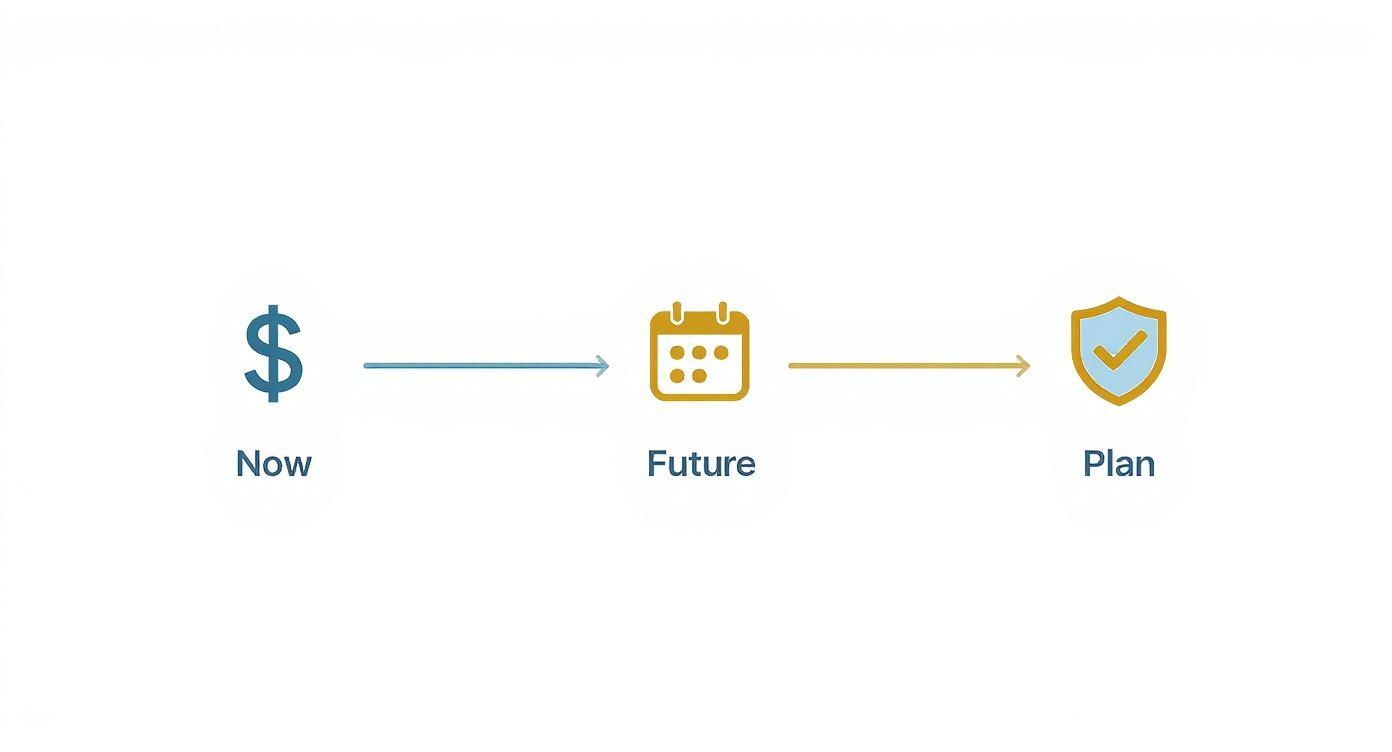
The decisions you make today have a direct impact on your financial security and care options years from now. A protective legal plan is an invaluable tool.
Navigating Strict Income and Asset Limits
In addition to the look-back rule, Texas Medicaid has very low thresholds for income and "countable" assets.
- Countable Assets: For a single person applying for Medicaid, the limit is typically just $2,000. This includes cash, checking and savings accounts, stocks, bonds, and any real estate that is not your primary home.
- Exempt Assets: Fortunately, not everything is counted. The state generally exempts your primary residence (up to a certain equity limit), one vehicle, pre-paid funeral plans, and personal belongings.
Attempting to navigate these rules alone is a significant risk. Around 62% of all nursing home residents rely on Medicaid to pay for their care. With the average monthly cost for a semi-private room in Texas at about $8,390 in 2023—and private rooms over $9,584—it's clear why proper planning is essential.
An experienced estate planning attorney who understands Texas Medicaid law can help you distinguish between countable and exempt assets. More importantly, they can help you implement legal strategies, like a Medicaid Asset Protection Trust, to convert countable assets into non-countable ones long before you might need care. This careful, forward-thinking planning is the key to protecting what you've worked for while ensuring you can get the care you need.
Using Trusts to Safeguard Your Family's Assets
When determining how to protect your life’s savings from nursing home costs, trusts are an essential topic. For many Texas families, a properly structured trust is the most powerful tool available for legally shielding the assets you've worked a lifetime to build.
However, not just any trust will work. It is crucial to understand the difference between types of trusts, as choosing the wrong one can offer a false sense of security and fail to protect your assets when you need it most.

The Key Player: The Irrevocable Trust
For Medicaid planning, the gold standard is a specific type of irrevocable trust, often called a Medicaid Asset Protection Trust (MAPT). The term "irrevocable" simply means that once you create the trust and place assets inside it, you cannot easily dissolve it or take the assets back. This feature is what gives the trust its protective power.
Under the Texas Trust Code, when you transfer assets like your home or investments into a MAPT, you no longer legally own them—the trust does. A trustee you appoint, such as a responsible adult child, then manages those assets for the benefit of your chosen beneficiaries.
Because the assets are no longer in your name, Medicaid cannot count them when determining your eligibility. This is the central principle that allows you to qualify for benefits to cover nursing home care without first spending down every dollar you have saved.
Why Your Revocable Living Trust Won't Work
Many families have a revocable living trust as part of their estate plan. While these are excellent tools for avoiding probate, they offer zero protection against long-term care costs.
A "revocable" trust is one you completely control. You can amend it, dissolve it, and move assets in and out at will. Because you retain full access and control, Medicaid considers those assets 100% available to you. They are treated no differently than money in your checking account and will be counted against you.
Relying on a revocable trust for long-term care protection is one of the most common and devastating mistakes we see. Only an irrevocable trust, like a MAPT, can effectively shield your assets from Medicaid spend-down requirements.
How a MAPT Works in a Real-World Scenario
Let’s walk through an example to see how this strategy benefits a Texas family.
Meet John and Mary, a couple in their late 60s. They own their home outright (worth $400,000) and have an additional $250,000 in savings. They are currently healthy but want to plan for the future.
After consulting with their Texas estate planning attorney, they establish a Medicaid Asset Protection Trust and name their daughter, Emily, as the trustee.
- Funding the Trust: John and Mary transfer the deed to their house and their investment portfolio into the MAPT. Legally, the trust is now the owner.
- Starting the Clock: This transfer begins the five-year Medicaid look-back period. John and Mary continue to live in their home just as before.
- Years Later: Seven years later, John’s health declines, and he needs to move into a nursing home. The cost is nearly $9,000 a month.
Because more than five years have passed since the assets were transferred, the $650,000 inside the MAPT is completely protected and is not counted by Medicaid. John qualifies for benefits to pay for his care, and the family's entire nest egg is preserved. The house and savings are safe and will be passed to Emily as intended.
The Trustee's Role: Fiduciary Duties in Texas
When you establish a MAPT, you appoint a fiduciary—a person with a strict legal and ethical duty under Texas law to act in the best interests of the trust's beneficiaries.
A MAPT trustee's responsibilities under the Texas Trust Code include:
- Duty of Loyalty: The trustee must always act in the beneficiaries' best interests.
- Duty of Prudence: The trustee must manage trust assets responsibly, as a careful person would manage their own.
- Duty to Account: The trustee must keep detailed records of all transactions and provide regular reports to the beneficiaries.
Choosing a trustee is a critical decision. You need someone responsible, trustworthy, and who understands these important legal duties. We provide practical, step-by-step guidance for trustees to ensure they can manage their role with confidence. And while a MAPT is irrevocable, it doesn't mean you lose out on tax advantages. We cover the irrevocable trust tax benefits in another one of our guides.
Protecting Your Home and Supporting Your Spouse
When a couple faces the prospect of long-term care, two questions almost always arise, filled with anxiety: "Will we lose our home?" and "How will my spouse manage financially if I go into a nursing home?"
These are deeply personal concerns. The good news is that Texas law includes specific protections to prevent the healthy spouse from being left financially devastated. The system is designed so that one person's need for care does not impoverish the other. Understanding these spousal protections is a cornerstone of any asset protection plan and can bring tremendous peace of mind.

Keeping the Community Spouse Financially Secure
When one spouse (the "institutionalized spouse") requires nursing home care, the spouse still living at home (the "community spouse") is not expected to become impoverished. Texas Medicaid has "spousal impoverishment" rules to prevent this exact scenario.
These rules allow the community spouse to keep a significant portion of the couple's joint assets and income.
- Community Spouse Resource Allowance (CSRA): This rule allows the community spouse to retain a substantial portion of the couple's countable assets. For 2024, that amount can be up to $154,140. This is significantly more than the standard $2,000 asset limit for the person applying for Medicaid.
- Monthly Maintenance Needs Allowance (MMNA): This rule addresses income. The community spouse is entitled to keep a certain amount of the couple’s total monthly income, up to $3,853.50 in 2024. If the community spouse’s own income is less than this amount, they can claim a portion of the institutionalized spouse’s income to make up the difference.
These protections are a lifeline, ensuring the community spouse can continue to pay the mortgage, buy groceries, and maintain their quality of life without financial ruin.
Safeguarding Your Primary Residence
Your home is more than just an asset; it's filled with family memories. Under Texas Medicaid rules, the primary residence is typically considered an exempt asset.
This means it is not counted toward eligibility limits, as long as its equity value is under a certain threshold ($713,000 in 2024) and the community spouse is still living there.
While this exemption helps you qualify for Medicaid, it does not protect the home from a potential Medicaid Estate Recovery Program (MERP) claim after the Medicaid recipient passes away. For that, you need more robust legal tools.
A Common Misconception: Many families assume that because the home is "exempt," it is safe forever. This is not entirely true. Without proper planning, the state can seek reimbursement from the home's value after death, which can be a devastating blow to heirs.
Using a Lady Bird Deed for Home Protection
A Lady Bird Deed (technically an enhanced life estate deed) is a highly effective tool in Texas for protecting the family home. It allows you to arrange for the transfer of your property to a beneficiary upon your death, completely bypassing the public and often costly probate process.
Here’s how it fits into a Medicaid plan:
- You retain complete control over your property while you are alive. You can sell it, mortgage it, or change your mind.
- Upon your death, the property automatically transfers to the beneficiaries you named.
- Because the home does not become part of your probate estate, it is shielded from a MERP claim.
This simple yet powerful document can be a key part of a comprehensive strategy. While a Lady Bird Deed offers specific protections, other tools may be a better fit depending on your family's goals. For example, you can learn more about how a Qualified Personal Residence Trust works in our detailed guide. Consulting with a Texas estate planning attorney is the best way to determine the right strategy for your unique situation.
Exploring Additional Asset Protection Strategies
While a Medicaid Asset Protection Trust is a strong foundation for safeguarding your legacy, a truly comprehensive plan often layers multiple strategies. Thinking beyond a single trust can add critical layers of security, especially when you need immediate solutions or want to bolster your long-term plan. These additional tools provide flexibility and ensure your family has the resources it needs when it matters most.
This multi-faceted approach is becoming increasingly vital. The long-term care market is expanding globally as populations age, raising the stakes for protecting your assets. In 2022, the market was valued at USD 1.1 trillion, with projections showing it could nearly double by 2032. With millions of Americans expected to need long-term care, having robust financial safeguards is more urgent than ever. You can review more of these long-term care statistics for a complete picture.
Long-Term Care Insurance as a Financial Bridge
Long-term care insurance pays for the costs of care, whether at home, in an assisted living facility, or in a nursing home. While premiums can be a consideration, this insurance can be a game-changer for your asset protection plan.
Its most valuable role is often as a financial "bridge." For instance, if you need care before the five-year Medicaid look-back period on your trust is complete, you might otherwise have to start liquidating the very assets you were trying to protect. Long-term care insurance can provide the funds to privately pay for care, allowing you to ride out any potential Medicaid penalty period without draining your savings.
Using Medicaid-Compliant Annuities in Crisis Planning
Sometimes, families face a crisis where a loved one needs nursing home care immediately, with no prior planning. In these stressful moments, a Medicaid-compliant annuity can be an invaluable tool for protecting remaining assets.
This specialized financial product allows you to convert a large, countable asset (like cash from a savings account) into a non-countable income stream.
Here’s how we use this in a crisis scenario:
- The Problem: A single individual has $100,000 in savings, far exceeding the $2,000 asset limit for Texas Medicaid.
- The Solution: We use the excess $98,000 to purchase a Medicaid-compliant annuity.
- The Result: The lump sum is no longer a countable asset. It is converted into a monthly income payment to the individual, which is then used to pay their portion of the nursing home bill. This allows them to qualify for Medicaid benefits almost immediately.
This strategy helps a person achieve Medicaid eligibility without "spending down" their life savings on unnecessary things. However, it must be structured perfectly to meet strict state and federal rules. This is not a DIY project; the guidance of an experienced Texas elder law attorney is absolutely essential.
Unlocking Benefits for Our Veterans
Veterans and their surviving spouses may be eligible for additional resources that can ease the financial burden of long-term care. The VA Aid and Attendance pension is a key benefit for those who qualify.
This is a monthly, tax-free payment in addition to a regular VA pension. It is specifically designed to help cover the costs of long-term care, including in-home assistance, assisted living, or a nursing home. Eligibility depends on specific service, medical, and financial requirements.
This pension can provide a steady income stream that preserves other family assets for a spouse or for inheritance. Combining VA benefits with a broader Medicaid plan can create an incredibly strong financial safety net for your family.
Common Questions About Asset Protection Planning
Navigating the world of asset protection can feel complex. As Texas estate planning attorneys, we hear the same pressing concerns from families every day. We've gathered some of those common questions here to provide clear, direct answers and help you feel more confident about your next steps.
Is It Too Late to Plan If My Loved One Already Needs Care?
No, while planning at least five years in advance is ideal, it is never too late to seek professional legal help.
Even if a loved one has already moved into a nursing home, an experienced elder law attorney can implement "crisis planning" strategies. These immediate actions, such as using a Medicaid-compliant annuity or leveraging spousal protection rules, can still preserve a significant portion of remaining assets. Powerful options are still available, but you must act quickly with an attorney who understands these complex rules.
Does Adding My Child's Name to My Deed Protect My House?
This is one of the most common—and riskiest—DIY estate planning mistakes. When you add a child’s name to your home’s deed, Medicaid views it as a gift. This action triggers the five-year look-back period and will likely result in a penalty that delays eligibility for benefits.
Furthermore, it exposes your home to your child’s financial problems, such as creditors, lawsuits, or divorce. Under the Texas Trust Code, there are much safer and more effective tools, like a Medicaid Asset Protection Trust or a Lady Bird Deed, designed to protect your home without these significant risks.
Can I Just Give My Money to My Kids to Qualify?
Simply giving away your assets to get under the Medicaid limit is another major mistake. Any gift or transfer made for less than fair market value within the five-year look-back period will trigger a penalty, making you ineligible for benefits for a calculated period.
This is very different from a strategic transfer into a legally sound irrevocable trust. A proper transfer must be structured by a qualified attorney to comply with Texas law and effectively protect your assets. To learn more, check out this guide on Essential Strategies for Protecting Assets from Nursing Home Costs. A smart, proactive approach ensures your plan is sound and your legacy is secure.
If you’re planning your estate or concerned about protecting your assets from long-term care costs, contact The Law Office of Bryan Fagan, PLLC for a free consultation. Our attorneys provide trusted, Texas-based guidance for every step of the process.