Managing a loved one's long-term care can feel overwhelming, especially when you've gathered the records, started the Medicaid process, and then learn that income is the problem. Many Texas families reach that point after a hospital stay, a decline at home, or a sudden move into skilled nursing care. The shock usually isn't that care is expensive. It's that a parent can be only slightly over the Medicaid limit and still be treated as ineligible.
That's where a Qualified Income Trust can make a practical difference. In Texas, this trust is often the legal tool that turns an over-income Medicaid case into an eligible one, but only if it is created and managed correctly. Small administrative mistakes can create large problems.
A careful plan matters here. The Texas Trust Code, Texas Estates Code, and basic fiduciary principles all point to the same truth. When someone agrees to act for another person in a legal or financial role, that person must act carefully, loyally, and in line with the governing documents and applicable law. A trustee, an executor, an agent under a power of attorney, and even a family caregiver helping with paperwork all need a clear system.
Facing the Medicaid Income Cap in Texas
A daughter sits at her kitchen table with bank statements, Social Security letters, and a facility admission packet. Her mother needs nursing care now. The medical need is obvious. The finances seem manageable at first, until the Medicaid application reveals a hard obstacle. Her mother's income is too high for the program.
That moment often feels unfair. A family may have too much monthly income to qualify, but nowhere near enough to pay privately for long-term care month after month. In many cases, the answer isn't giving up or spending recklessly. It's using a legal structure that Medicaid recognizes when handled the right way.

Families who are also thinking more broadly about long-term care planning often find it helpful to read about protecting assets from nursing home costs, because income qualification and asset planning are related but separate issues.
Why this problem feels so urgent
Medicaid eligibility for long-term care is not flexible in the way many people expect. Income cap rules are rigid. If the applicant is over the allowed amount, the state can deny benefits unless the person uses the proper legal remedy.
Practical rule: A qualified income trust is not a shortcut. It is a compliance tool. It only works when the trust is drafted, funded, and administered with precision.
This is why families often need both legal guidance and an administrative checklist. A qualified income trust can solve the income-cap issue, but it also creates ongoing trustee duties. Those duties must be handled with the same care expected under Texas fiduciary standards, including loyalty to the beneficiary and disciplined recordkeeping.
What Is a Qualified Income Trust
A Qualified Income Trust, sometimes called a Miller Trust, is an irrevocable trust used to help a Medicaid applicant qualify for long-term care benefits when monthly income is above the applicable cap. The easiest way to understand it is to think of it as a legal redirect valve. Income that would otherwise count against eligibility is redirected into a special trust account so Medicaid does not treat it the same way for income-cap purposes.
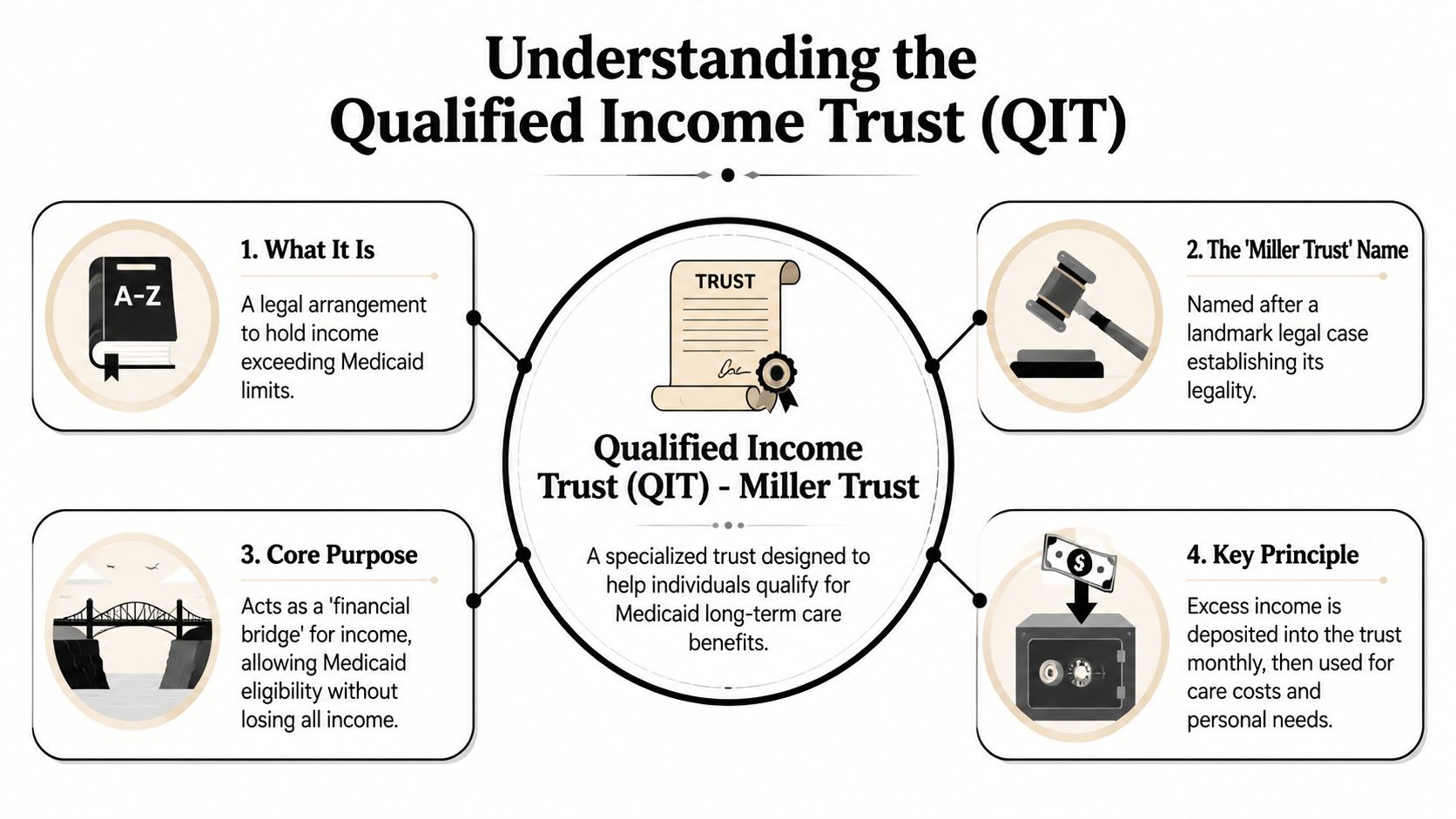
The money doesn't disappear. It still belongs in the overall care plan, and it must still be used according to strict rules. That's why a QIT is better understood as an eligibility mechanism than a wealth-preservation tool.
Why the trust has to be irrevocable
A QIT must be locked in. The rule is straightforward. The QIT must be structured as an irrevocable trust, and upon the beneficiary's death, any remaining trust assets must be paid to the state's Medicaid agency up to the total amount Medicaid spent on the beneficiary's care according to Georgia Medicaid policy section 2407. That state-payback feature is part of what makes the trust acceptable for Medicaid purposes.
This surprises many families. They assume a trust always exists to protect money for heirs. A qualified income trust is different. Its main purpose is to create Medicaid eligibility for long-term care, not to pass money to children or preserve an inheritance.
How the trustee fits into the process
Someone has to manage the trust. That person is the trustee. In Texas practice, the trustee's role is serious and ongoing. The trustee handles deposits, pays approved expenses, keeps records, and follows the trust terms. Those duties line up with broader fiduciary principles under the Texas Trust Code, which expects a trustee to act prudently, keep trust property separate, and honor the trust's purpose.
If you're stepping into that role for the first time, First Steps for a Successor Trustee in Texas offers a factual overview of what to do immediately after taking on trustee responsibilities.
A good QIT trustee isn't just trustworthy. That person must also be organized enough to follow the rules every month.
Determining If You Need a QIT in Texas
Some families don't need a qualified income trust. Others absolutely do. The key is comparing the applicant's gross monthly income to Texas's income cap for the relevant Medicaid program.
For 2026, the Texas income cap is $2,982, and applicants must deposit only the amount exceeding that figure into the trust. If the applicant's income is $3,500, the mandatory deposit is $518, as explained by Texas Law Help's discussion of qualified income trusts.
A simple way to check your situation
Use this question first: Is your loved one's gross monthly income above the Texas cap?
If the answer is no, a QIT may not be necessary for the income side of Medicaid. If the answer is yes, a QIT is often the next legal step to explore.
A common example helps. Suppose your mother receives retirement income totaling $3,500 in a month. Because the Texas cap is $2,982, she is over the limit. Under the Texas example above, $518 must be deposited into the QIT for that month.
Income and assets are not the same issue
This point causes a lot of confusion. A qualified income trust addresses an income problem. It does not solve an asset problem.
That distinction matters in estate planning and Medicaid planning alike. The Texas Estates Code often becomes part of the picture when a loved one has no valid power of attorney, lacks capacity, or needs a guardian to act. The Texas Trust Code matters when a trustee must manage a trust account correctly. But neither code changes the basic Medicaid distinction between income and assets.
Here's a quick comparison:
| Issue | What it means | Does a QIT solve it |
|---|---|---|
| Monthly income over the Medicaid cap | Too much gross income for eligibility | Yes, often |
| Savings, real estate, or investments | Countable resources or exempt assets must be analyzed separately | No |
| Lack of legal authority to sign documents | Family may need power of attorney, guardianship, or other authority | No |
When families ask whether a QIT is enough, the honest answer is that it depends on the full legal and financial picture. A Texas estate planning attorney or Texas trust administration lawyer can help identify whether the underlying problem is income, assets, authority, or all three.
How to Establish and Fund Your Texas QIT
A daughter is sitting at the kitchen table with a stack of papers. Her father has been told he is over the Texas Medicaid income cap. The nursing facility needs an answer. The family has heard that a qualified income trust can fix the problem, but they are afraid of making a mistake that delays coverage for another month.
That concern is justified. Setting up a Texas QIT is usually straightforward. Keeping each procedural detail aligned is the part that protects eligibility. The trust document, the signer's legal authority, the bank account title, and the monthly deposits all have to match what Medicaid expects.
Families also ask about cost. Fees vary by attorney, by region, and by how complicated the legal authority issues are. A simple QIT often costs less than a broader Medicaid planning matter, but the better question is whether the trust will be set up correctly and whether someone is ready to handle it every month after signing.
For families who want background on the mechanics of trust creation generally, this guide on how you form a trust helps explain the broader process.
Start with the document and the signer
The trust has to be drafted to satisfy Medicaid rules. It must be irrevocable. It must clearly identify the beneficiary and trustee. It must also direct what happens to funds remaining at death in a way that complies with Medicaid requirements.
Just as important, the right person has to sign it.
That point trips up many Texas families. If the Medicaid applicant still has capacity, the applicant usually signs. If not, the family may need a valid power of attorney or other legal authority before anyone can create the trust. A QIT problem can begin as an authority problem long before the bank account is opened.
The Texas Trust Code matters here in a practical way. A trust that is vague on trustee powers or payment instructions may still look fine to a family reading it at home, yet create confusion during Medicaid review or later administration. Clear drafting gives the trustee a map to follow month after month.
For some families, Law Office of Bryan Fagan, PLLC is one option for trust and estate guidance involving trust drafting, trustee duties, estate planning, probate, and related Medicaid planning concerns.
Choose a trustee who can follow a monthly system
A QIT trustee does not need to be a financial expert. The trustee does need to be organized, reliable, and willing to treat the trust like a separate legal bucket for income. A good trustee is often the family member who pays attention to dates, keeps folders, and does not cut corners.
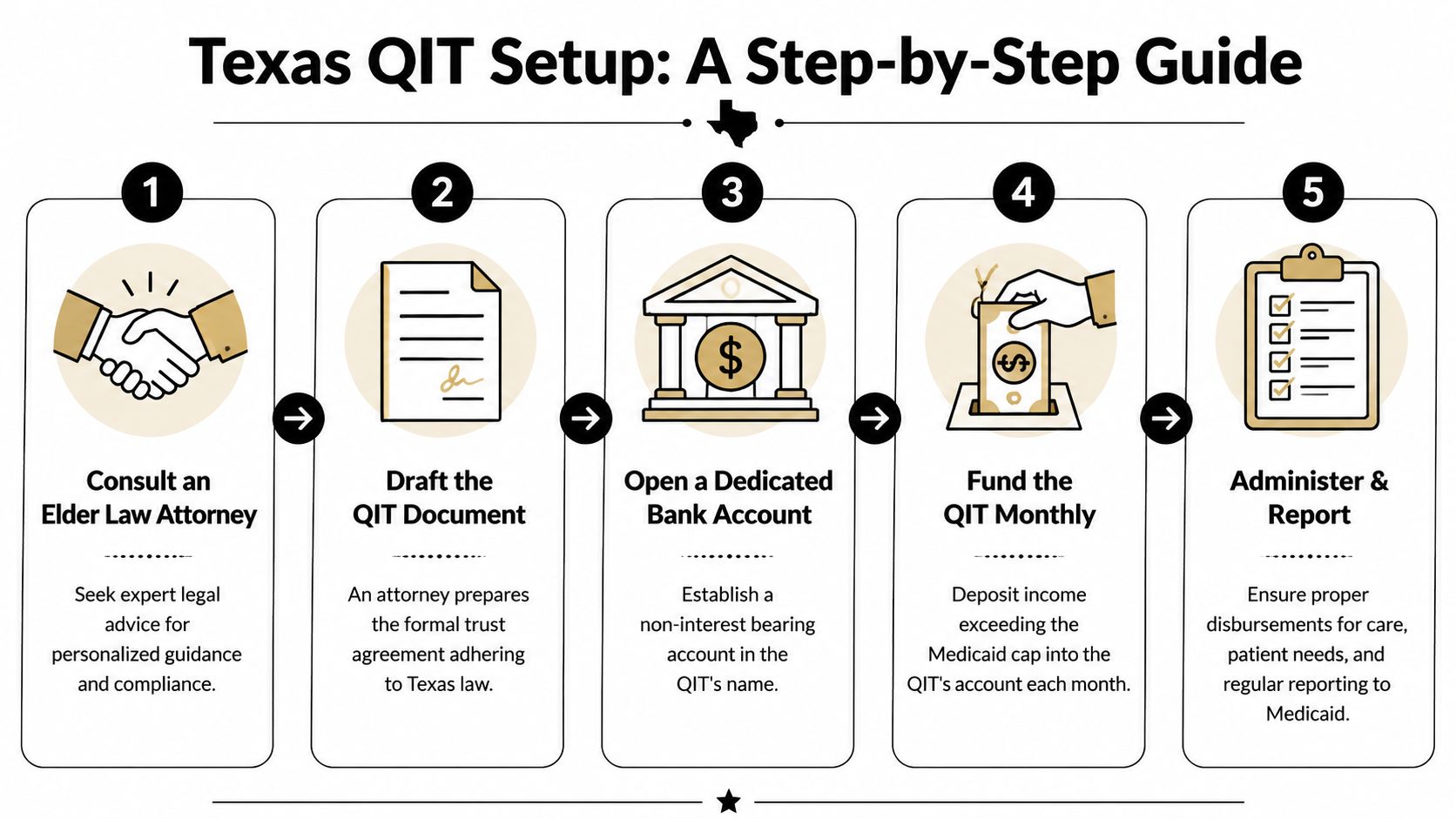
The basic setup usually looks like this:
- Sign the trust correctly. The applicant or authorized signer signs the trust, and the trustee accepts the role.
- Open a dedicated bank account. The account should be in the name of the Qualified Income Trust and set up consistently with the trust terms.
- Use the correct taxpayer identification approach. Many QIT accounts are tied to the beneficiary's Social Security Number, but the bank's paperwork still needs to reflect the trust properly.
- Keep trust funds separate. Do not mix personal savings, household money, or unrelated deposits into the account.
- Create a deposit routine immediately. Waiting until the end of the month is one of the easiest ways to create a problem.
A QIT works like a narrow-purpose pipeline. Income that needs to pass through the trust must go into that pipeline in the proper month. If the money never enters the pipeline, the trust may not help for that month at all.
A short video can help families visualize what this process looks like in real life.
Funding the trust is the step that protects eligibility
Signing the paperwork is only the beginning. The trust must also be funded correctly for each month in which income exceeds the cap. In practice, that means the trustee needs a calendar, copies of income statements, bank records, and a repeatable plan for deposits and approved payments.
Families often stumble during trust administration, not trust creation. The legal document opens the door. Monthly compliance keeps it open.
This is the Texas-specific trap many families do not see at first. They focus on whether the trust exists, while Medicaid is also looking at whether the trust was funded properly and administered according to its terms. A missed deposit, a deposit made from the wrong source, or money left in the wrong account can create a benefit problem for that month.
Good administration starts here, on day one. Set up the document correctly. Confirm legal authority before signing. Title the account carefully. Fund it on time, every month that funding is required.
Administering the Trust and Trustee Duties
Once the trust is active, the main work begins. The trustee becomes the person responsible for protecting eligibility through daily habits, monthly deposits, and careful disbursements. In Texas, that responsibility fits within familiar fiduciary ideas under the Texas Trust Code. The trustee must act loyally, follow the trust terms, avoid self-dealing, and keep trust property distinct from personal property.
The Texas Estates Code can matter too. If the applicant can no longer manage legal or financial affairs, the family may need valid authority through a power of attorney, guardianship, or another legal arrangement before anyone can sign trust documents or deal with the account. Many QIT problems are really authority problems in disguise.
What the trustee does each month
A trustee's job is repetitive by design. That's good. A repeatable system reduces mistakes.
The core tasks usually include:
- Deposit the required income on time. The trustee must follow the trust's funding rules and the timing required for eligibility.
- Pay approved expenses only. QIT money can't be treated like a general household account.
- Track patient responsibility. The trustee needs to understand what portion goes toward care costs and what the beneficiary may retain for approved purposes.
- Keep records. Bank statements, receipts, facility statements, and insurance premium notices should be retained in an organized file.
Trustees who are new to this role often benefit from practical trustee education, including guidance on successor trustees and fiduciary process. Families also commonly seek related reading on investment and management duties under Texas law, especially when one person is serving in multiple fiduciary roles across different accounts or trusts.
What the trust can and cannot pay
Families often get tripped up regarding this point: Funds in a QIT are legally restricted to health-related expenses, including medical bills, health insurance premiums, and the recipient's personal needs allowance; they cannot be used for property taxes, gifts, or household utilities, as explained in this discussion of qualified income trust spending rules.
Here is a simple reference table:
| Expense Category | Permissible from QIT | Example |
|---|---|---|
| Medical expenses | Yes | Incurred medical bills |
| Health coverage costs | Yes | Health insurance premiums |
| Personal needs allowance | Yes | The beneficiary's approved personal needs amount |
| Housing costs | No | Household utilities |
| Taxes on property | No | Property taxes |
| Transfers to others | No | Gifts to family members |
The rule behind the table is simple. The money must have a clear connection to the beneficiary's health-related needs or approved personal allowance. If a payment looks like ordinary household support, a gift, or an attempt to move money elsewhere, the trustee should stop and get legal advice.
Fiduciary duties in Texas in plain English
Inquiries about fiduciary duties in Texas often pose a practical question. What does the trustee owe the beneficiary?
In plain English, the trustee must:
- Follow the trust first. Personal preferences do not override trust terms.
- Stay organized. Good intent is not enough if the records are incomplete.
- Avoid shortcuts. Convenience payments from the wrong account can create eligibility trouble.
- Communicate clearly. If adult children, care facilities, and benefits workers are all involved, confusion spreads fast unless one person keeps a consistent paper trail.
Keep every trust transaction easy to explain to a Medicaid reviewer, a judge, and the family member who asks about it six months later.
That standard also helps in dispute resolution. If a sibling later questions the trustee's conduct, accurate records and faithful compliance usually tell the story better than memory does. That's true in QIT administration, probate matters, and ordinary trust administration alike.
Common QIT Mistakes That Can Jeopardize Benefits
The most dangerous mistake families make is assuming that a QIT is forgiving. It isn't. This area rewards precision and punishes casual handling.

A single error can trigger a denial for the month at issue, delay care coverage, or force a family to sort out payment problems with a facility while under stress.
The timing trap
One of the most serious traps involves deposit timing. A critical detail often missed is the strict month-by-month interplay between “Patient Responsibility” calculations and QIT deposit timing, where a single late deposit could invalidate an entire month's eligibility rather than just result in a penalty, as noted in the Florida Families policy material discussing timing issues.
That should get every trustee's attention. A missed deadline may not be a small bookkeeping problem. It may affect eligibility for that month.
Other errors families make
A few mistakes show up again and again:
- Mixing funds together. The trustee uses the QIT account like a personal checking account, or deposits non-trust money into it.
- Paying the wrong bills. A mortgage payment, utility bill, or family reimbursement comes out of the trust account.
- Keeping weak records. No receipts, incomplete statements, or no clear reason for a payment.
- Assuming the bank will guide compliance. A bank can open an account, but it does not manage Medicaid compliance for the trustee.
Why professional review matters
QIT administration can overlap with other legal issues, including guardianship, probate, estate planning updates, and disputes among family members about who should control the process. In those situations, the safest path is usually to get legal review before the mistake spreads.
That's especially true when a trustee is also acting as agent under a power of attorney or handling bills for a parent informally. Blended roles create confusion. Clear records and role separation prevent that confusion from turning into a Medicaid problem.
Your Next Steps for Texas Medicaid Planning
A qualified income trust can be the tool that keeps long-term care planning on track when income is too high for Texas Medicaid. But success usually depends less on the idea of the trust and more on the administration behind it. The document must be valid. The trustee must understand fiduciary duties in Texas. The deposits and payments must be handled correctly every month.
If your family is also trying to make sense of claims, reimbursements, or who handles program-related billing questions, practical resources like these answers on government insurance billing can help clarify the billing side of care coordination.
Some families also need to think ahead about what happens after death, including state recovery issues. This overview on how to avoid Medicaid estate recovery can help place the QIT in the larger Medicaid planning picture.
A calm, methodical approach usually works best:
- Gather the income records first. The exact income sources and timing matter.
- Identify who has legal authority. If no one can sign or manage funds, that issue must be solved early.
- Choose a trustee who can handle details. Reliability matters as much as good intentions.
- Get legal advice before funding begins. It is easier to prevent a QIT mistake than to repair one.
If you're managing a trust or planning your estate, contact Law Office of Bryan Fagan, PLLC for a free consultation. Our attorneys provide trusted, Texas-based guidance for every step of the process.