Skip to content
Planning for your family’s future can feel overwhelming, but building a defense against life's inevitable curveballs is one of the most compassionate things you can do. A protective trust is a core part of that defense—a legal structure meticulously designed under Texas law to safeguard your hard-earned assets for the people you love most.
Think of it as a financial fortress, built brick by brick with the guidance of a skilled Texas estate planning attorney, to shield an inheritance from a beneficiary's potential creditors, lawsuits, or even their own financial mistakes.
Understanding the Purpose of a Protective Trust
When you sit down to create a trust, the main goal is always to make sure your assets are managed and handed out exactly how you want. A protective trust simply adds a critical layer of security to that plan. It’s a specific kind of trust built from the ground up to keep a beneficiary’s inheritance from vanishing due to circumstances you can't predict.
This legal tool is a game-changer for beneficiaries who might be young and financially inexperienced, work in high-risk professions, or face potential legal battles down the road. The trust essentially puts up a wall between the assets and the beneficiary's personal liabilities. This means if your loved one gets sued or has to file for bankruptcy, the assets tucked away in the trust are generally untouchable by their creditors.
Core Goals and Functions Under Texas Law
At its heart, a protective trust is all about one thing: asset preservation. It gets the job done through carefully worded provisions that anticipate future risks. The main functions break down like this:
- Creditor Protection: This is the big one. It shields trust assets from claims popping up from a beneficiary’s debts, lawsuits, or even divorce proceedings.
- Responsible Wealth Management: It helps prevent a beneficiary from blowing through an inheritance by putting a responsible trustee in charge of the finances.
- Long-Term Security: It ensures the funds you set aside will actually be there to support your loved one for years, no matter what financial storms rage outside the trust's walls.
Under the Texas Trust Code, these trusts run on clear-cut fiduciary principles. The trustee has a legal obligation to manage the assets wisely and always in the beneficiary's best interest, adding a professional buffer that makes the trust's protective shield even stronger.
A protective trust isn’t about controlling a beneficiary; it's about protecting their future. It provides a structured safety net, making sure your legacy supports them just as you planned, without being left vulnerable to risks you can't even see coming.
While protective trusts are an incredibly powerful legal tool, it's also smart to look at other concepts like asset protection insurance to get a fuller picture of how to secure your financial future. These strategies, while different, both aim to insulate wealth from liability. An experienced Texas trust administration lawyer can help you figure out the perfect mix of strategies for your family, whether that involves trusts, insurance, or other estate planning vehicles.
To make this a bit easier to digest, here’s a quick breakdown of the key parts of a protective trust.
Quick Guide to Protective Trusts
Understand the core components of a Texas protective trust at a glance.
| Component | Simple Explanation |
|---|---|
| Grantor | The person who creates the trust and puts assets into it (that's you). |
| Trustee | The person or institution in charge of managing the trust assets. |
| Beneficiary | The person who will receive the benefits from the trust (your loved one). |
| Trust Assets | The money, property, or investments held inside the trust. |
| Protective Provisions | Specific clauses (like a "spendthrift clause") that restrict access to the assets. |
This table simplifies the moving parts, but putting them together to create a truly effective shield requires the skill and foresight of an experienced attorney.
How a Protective Trust Actually Works
Think of a protective trust not as a simple bank vault, but as a sophisticated financial fortress with a smart alarm system. It’s designed to operate in two distinct phases, automatically adapting to protect a beneficiary’s assets precisely when they become most vulnerable.
In the beginning, things are calm. The primary beneficiary has what’s legally known as a 'determinable life interest.' This is a legal term for having a right to the income the trust's assets generate. During this stable period, it functions much like any other trust, providing the steady financial support the creator (the settlor) intended.
The Tripwire: When Protection Kicks In
The real genius of a protective trust comes to life when a specific 'triggering event' happens. This isn't a random occurrence; it's a pre-defined condition, a tripwire written directly into the trust document that signals a clear and present danger to the assets.
Common triggering events include things like:
- A beneficiary filing for bankruptcy.
- A creditor getting a court judgment against the beneficiary.
- The start of messy legal battles, like a major lawsuit or divorce proceedings.
When one of these tripwires is hit, the fortress goes on lockdown. The beneficiary’s automatic right to the income—their determinable life interest—is immediately terminated. In that instant, the trust transforms into a 'discretionary trust.' This legal shift is the whole ballgame. It severs the beneficiary’s absolute right to the money, placing the assets just out of reach of creditors banging on the door.
The Key Players on the Field in Texas
For this entire structure to work, you need a team of key players, each with a specific role. In Texas, their responsibilities are all guided by the strict fiduciary duties laid out in the Texas Trust Code.
A protective trust involves a few crucial roles, and understanding who does what is key to seeing how it all comes together.
Key Roles in a Texas Protective Trust
| Role | Description | Primary Responsibility |
|---|---|---|
| The Settlor (or Grantor) | The architect and visionary who creates the trust. | Works with an attorney to draft the trust, define triggers, and appoint the other key players. Their foresight is the foundation of the protection. |
| The Trustee | The on-site manager and gatekeeper of the trust's assets. | After a trigger event, they gain full control to decide how, when, and if distributions are made, always acting in the beneficiaries' best interests. |
| The Beneficiary | The individual the trust is designed to support and protect. | Benefits from the trust's assets but does not legally own them. This separation is what shields the assets from their personal financial troubles. |
Each person's role is distinct but interconnected, ensuring the trust operates as intended under Texas law.
This diagram helps paint a clearer picture of how the creator's plan flows through the protective structure to the beneficiary.
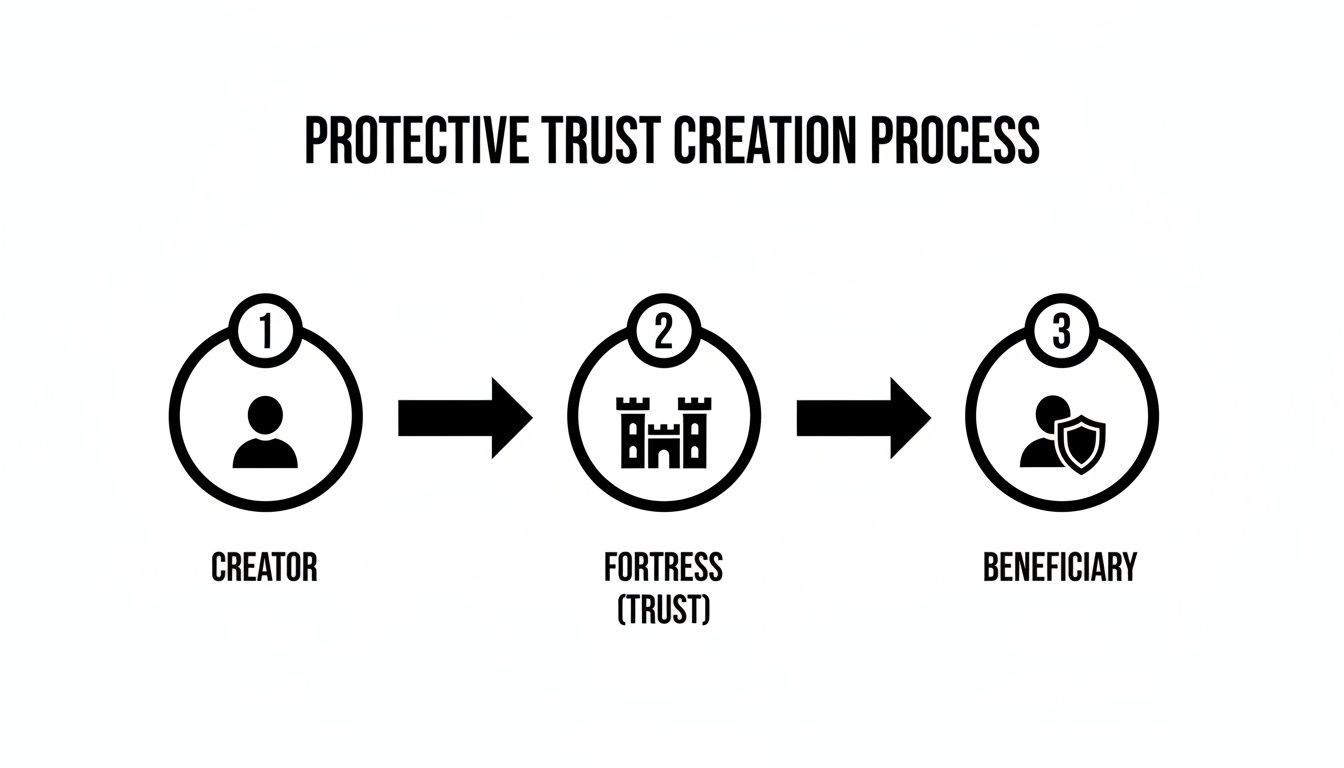
You can see how the trust acts as a fortress, standing guard between the assets and any external threats that could jeopardize the beneficiary's financial security.
This idea of a trust that can change on the fly isn't new. It has deep roots in English common law and was officially spelled out in the UK's Trustee Act 1925. This law created the blueprint for the 'determinable life interest' that automatically ends upon a 'determining event' like bankruptcy, converting the trust into a discretionary fund for the family and walling off the assets from creditors. If you're interested, you can read more about the historical background of protective trusts and their legal foundations.
A Look at How Different Asset Protection Trusts Stack Up
To really get a handle on what a protective trust does, it helps to see where it fits in the larger family of asset protection tools. Think of it like a legal toolbox. While the protective trust's two-stage, trigger-based system is a unique gadget, several other tools in that box share similar goals. Picking the right one isn't a one-size-fits-all deal; it comes down to your family's unique situation and the kinds of curveballs life might throw at your beneficiaries.
Let's unpack that toolbox and compare a few of these structures—like spendthrift, discretionary, and support trusts—to see how they work and which one might align best with what you're trying to accomplish. The whole game is about matching the trust's features to the real-world scenarios your loved ones could actually face.
Spendthrift Trusts: For Beneficiaries Who Need a Financial Guardrail
A spendthrift trust is probably the most common asset protection trust you'll run into here in Texas. Its job is pretty simple: protect a beneficiary who may not be the best at managing a budget or has a knack for making questionable financial choices.
The magic happens in what's called a spendthrift clause. This little provision, fully recognized under the Texas Trust Code, is a legal barricade. It stops the beneficiary from selling or giving away their interest in the trust. More importantly, it tells their creditors they can't come knocking on the trust's door to collect on debts.
Real-world Texas scenario: Imagine you want to leave a significant inheritance to your adult son, but he has a history of accumulating credit card debt. If you place those assets into a spendthrift trust, the trustee can provide him with regular distributions for living expenses. But if a creditor sues him and gets a judgment, they cannot force the trustee to raid the trust to pay it off. The money stays safe for his long-term benefit, just as you intended.
Discretionary Trusts: When You Need Maximum Flexibility
A discretionary trust puts the trustee squarely in the driver's seat. They get the final say on when, how much, and even if a beneficiary receives a distribution. The beneficiary has no legal entitlement to demand money; they only get what the trustee, in their sole discretion, decides is appropriate.
This setup creates a seriously powerful shield against creditors. Why? Because if the beneficiary has no guaranteed right to the assets, their creditors have nothing to legally grab onto. This makes it a fantastic tool for beneficiaries who might be in high-risk professions or whose future needs are just too hard to predict.
Under Texas law, a trustee of a discretionary trust has a profound fiduciary duty. This isn't about playing favorites or being arbitrary. They must act in good faith and always in line with the trust's original purpose, serving the beneficiaries' best interests as you, the creator, envisioned.
Support Trusts: For Covering the Essentials
A support trust is more specific. It instructs the trustee to make payments for a defined purpose, most often the beneficiary's "health, education, maintenance, and support" (you'll often see this called a "HEMS" standard). Unlike a fully discretionary trust, the trustee doesn't have total freedom here; they are required to distribute funds when needed for these specific reasons.
While this structure provides more predictability, it can sometimes offer a weaker defense against creditors compared to a discretionary trust. A clever creditor could argue that the services they provided—say, medical care—fall squarely under the "support" category and try to force the trustee to pay them directly from the trust. For a deeper dive, you can explore the different types of trusts available in Texas and see how their features compare.
Protective Trusts vs. Special Needs Trusts: Two Different Jobs
It's also really important not to mix up a protective trust with a Special Needs Trust (SNT). They both have "protective" in their DNA, but they are built for entirely different purposes.
An SNT is a highly specialized tool designed to hold assets for a person with a disability without kicking them off crucial government benefits like Medicaid or Supplemental Security Income (SSI). These programs have strict income and asset limits, and an SNT is engineered to work around them.
A protective trust, on the other hand, is all about shielding assets from a beneficiary's general creditors, a messy divorce, or just plain bad financial decisions. It's not designed to preserve eligibility for means-tested government aid. A Texas estate planning attorney is the best person to help you figure out which of these structures is the right fit for your loved one's specific circumstances.
The Core Benefits for Texas Families and Business Owners
It's one thing to understand the textbook definition of a protective trust, but it's another thing entirely to see how it can truly shield your family's future. For Texans, this isn't just an abstract legal tool; it’s a powerful strategy that translates complex legal language into a real, tangible firewall around your legacy.
Whether you're a parent worried about a child's inheritance or a business owner trying to insulate your personal assets from professional risks, this structure provides genuine peace of mind. Its unique combination of rock-solid security and surprising adaptability makes it a must-have in any serious Texas estate planning strategy.

Safeguarding Inheritances From Life’s Uncertainties
Life is messy and unpredictable. Even the most responsible and well-intentioned person can stumble into unexpected financial or legal storms. A protective trust acts as a formidable shield when life throws a curveball, safeguarding an inheritance from challenges your loved ones might not see coming.
Here’s where it really shines:
- Divorce Proceedings: An inheritance in Texas is usually considered separate property, but that line can get blurry fast if the funds are mixed with marital assets. A protective trust keeps that inheritance completely separate, making it practically untouchable in a beneficiary's divorce.
- Creditor Claims and Lawsuits: If your beneficiary gets sued or racks up debt, creditors can come after their personal assets. But with a protective trust, the beneficiary doesn't technically own the assets. This means the money stays safely out of reach of judgments and liens.
- Poor Financial Decisions: Let's be honest—not everyone is a financial wizard. A trust prevents a beneficiary from blowing through their inheritance on a whim. The trustee, who is legally bound by fiduciary duties in Texas, ensures the funds are managed responsibly for long-term well-being.
This isn't about distrusting your family. It's about providing an unbreakable safety net for the "what-ifs" in life.
A Crucial Tool for Texas Business Owners
For entrepreneurs, the line between personal and business finances can get dangerously thin. A protective trust draws a bold, clear line in the sand, creating a firewall that protects your family’s assets from your business's liabilities.
Imagine your small business gets hit with a lawsuit that blows past your insurance coverage. Without the right asset protection, creditors could potentially seize your personal home, your savings, and your investments.
By placing these personal assets into a protective trust, you effectively segregate them from your business operations. This ensures that even if your business faces financial turmoil, your family’s financial security remains intact. It’s a foundational strategy for managing risk and ensuring your hard work benefits your family, not your business's creditors.
Flexibility That Standard Trusts Can’t Match
When people hear "asset protection," they often picture rigid, unchangeable irrevocable trusts where you sign away all control. But modern protective trusts are a different breed, offering a surprising amount of flexibility that makes them a far more appealing option for many Texans.
Unlike old-school irrevocable trusts, these structures can be designed to be both secure and adaptable. In many cases, you can use your own Social Security number for tax purposes, making the administration feel as simple as if the assets were still your own. You can even retain the power to change beneficiaries without cracking open the door to creditor claims.
To give you a clearer picture, let's compare a modern protective trust with a standard irrevocable trust.
Protective Trust vs Standard Irrevocable Trust
| Feature | Protective Trust | Standard Irrevocable Trust |
|---|---|---|
| Primary Goal | Shield assets from future, unknown creditors of both the creator and the beneficiaries. | Remove assets from the creator's estate for tax purposes; cannot typically be changed. |
| Flexibility | Often allows the creator to retain some powers, like changing beneficiaries or investment advisors. | Extremely rigid; the creator gives up nearly all control and cannot make changes. |
| Creditor Protection | High level of protection for assets held within the trust against claims from creditors. | High, but primarily focused on removing assets from the creator's estate rather than ongoing protection. |
| Tax Simplicity | Can often be structured as a "grantor trust," allowing the creator to report income on their personal tax return. | Typically requires its own tax ID number and files its own separate, more complex tax returns. |
| Control | The creator can indirectly influence the trust while still achieving protection. | The creator relinquishes all control to the trustee. |
Domestic asset protection trusts in states like Texas provide a straightforward setup, offering a shield against lawsuits—a major concern for the 95% of millionaires who worry about litigation, according to surveys. You can find more details about the modern benefits of a protective trust and their flexible design.
This powerful combination of robust protection and practical flexibility is what makes the protective trust a cornerstone of sophisticated Texas estate planning. A skilled Texas estate planning attorney can help you structure a trust that fits your unique family and business needs, giving you security without locking you into unnecessary constraints.
Understanding Trustee Responsibilities and Beneficiary Rights in Texas
A protective trust is a powerful legal document, but its real-world strength comes from the people who bring it to life. For a trust to work as intended, both the trustee and the beneficiaries need a crystal-clear understanding of their roles under Texas law. Grasping these responsibilities isn't just about avoiding legal trouble; it’s about making sure the trust creator's wishes are honored and disputes are kept at bay.
At the heart of it all is a fiduciary relationship—the highest standard of care in the legal world. This means the trustee must put the beneficiaries' best interests ahead of everything else, including their own. It's a serious legal and ethical commitment, guided every step of the way by the Texas Trust Code.
Trustee Responsibilities Under Texas Law
Being a trustee is an active, hands-on role with very specific responsibilities. The Texas Trust Code serves as the official rulebook, laying out the duties that ensure the assets are protected and the trust administration process is smooth for everyone involved.
These fiduciary duties in Texas are non-negotiable and include:
- Duty of Loyalty: The trustee must manage the trust only for the benefit of the beneficiaries. No self-dealing, no conflicts of interest—period. Their own interests must take a backseat.
- Duty of Prudence: A trustee must handle the trust's assets with the same care, skill, and good judgment that a sensible person would use for their own affairs. This often means making smart investment choices and avoiding unnecessary risks.
- Duty of Impartiality: If the trust has more than one beneficiary, the trustee cannot play favorites. They must treat everyone fairly and even-handedly unless the trust document explicitly tells them otherwise.
- Duty to Inform and Report: Transparency is key. Trustees are required to keep beneficiaries in the loop about the trust's administration, its assets, and any major decisions. This simple act of communication builds trust and prevents misunderstandings.
A trustee acts as the guardian of the settlor's legacy. Their faithful execution of these duties is what gives a protective trust its power, transforming a legal document into a tangible shield for the beneficiaries.
Beneficiary Rights in Texas
While the trustee carries the weight of responsibility, beneficiaries aren't just passive bystanders. They have fundamental rights that empower them to hold the trustee accountable. These aren't just suggestions; they are legally enforceable entitlements designed to ensure the trust is being run properly.
Beneficiaries have the right to:
- Receive Information: A beneficiary is entitled to get information about the trust's assets and how it's being managed. This includes the right to see the actual trust document.
- Request an Accounting: Beneficiaries can demand a formal accounting from the trustee. This is a detailed report that breaks down every transaction—all income, expenses, and distributions—over a certain period.
- Enforce the Trust: If a beneficiary believes the trustee is mismanaging assets or failing to follow the trust's terms, they have the right to take legal action to compel the trustee to fulfill their duties.
Getting these roles right isn't just about avoiding a courtroom. It's about creating an environment of cooperation and transparency. To dig deeper, you can learn more about a trustee's specific duties and responsibilities in our dedicated guide. When both sides know the rules of the game, the trust can operate exactly as intended, providing security for years to come.
Step-by-Step Guidance: Creating and Funding Your Protective Trust
Bringing a protective trust to life is a deliberate and thoughtful process, but it doesn't have to be a complicated one. With a clear roadmap and the right legal partner, you can confidently turn your good intentions into a rock-solid legal shield for your loved ones. The journey breaks down into a few key stages, from the initial planning to the final, crucial step of actually funding the trust.
Think of it this way: you wouldn't build a fortress without a detailed blueprint. Working with a qualified Texas estate planning attorney is that essential first step. This initial conversation is where your goals become the architectural plan for the entire structure. Your lawyer will help you hash out your objectives, pinpoint potential risks for your beneficiaries, and outline the specific terms needed to create robust protection under the Texas Trust Code.
Step 1: Drafting the Trust Document
Once your goals are crystal clear, the next move is drafting the legal document. This is so much more than paperwork; it’s where your wishes are translated into legally binding language. Your attorney will meticulously craft the precise clauses that officially establish the trust, name the beneficiaries, and clearly define the "triggering events" that would flip the switch, converting the trust into a fully discretionary one.
This document will also lay out the fiduciary duties in Texas that your chosen trustee is legally bound to follow, making sure they manage the assets with care and absolute loyalty. This is the legal architecture of your financial fortress.

Step 2: Selecting the Right Trustee
Choosing a trustee is one of the most critical decisions you'll make in this entire process. This person or institution will be the guardian of your legacy, holding the responsibility for managing assets and making distributions exactly as you've laid out.
It's a big job, so consider these factors carefully:
- Trustworthiness and Integrity: You need someone with impeccable ethics who truly understands the gravity of their role. This is non-negotiable.
- Financial Acumen: The trustee should be comfortable managing investments and making sound financial decisions.
- Impartiality: They have to be able to act fairly, especially if you have multiple beneficiaries. Avoiding any conflicts of interest is a must.
- Longevity: If your trust is designed to last for a long time, a corporate trustee (like a bank's trust department) can offer a level of continuity that an individual simply can't.
Step 3: The Final Step: Funding Your Trust
A trust is just an empty vault until you put something inside it. The final, absolutely vital step is funding the trust by legally transferring assets into its name. A beautifully drafted trust document with no assets in it offers zero protection.
This process involves re-titling assets so that the trust—not you personally—is the legal owner. Some common assets you might place in a protective trust include:
- Real estate (like your home or investment properties)
- Bank and brokerage accounts
- Business interests or stocks
- Other valuable personal property
Properly funding a trust is a meticulous process, as every type of asset has its own specific transfer rules. A skilled attorney can provide step-by-step guidance to ensure every asset is correctly transferred, making your trust legally sound and ready to protect your legacy exactly as you intended.
Here are some of the questions we hear all the time from Texas families trying to make sense of protective trusts. Getting clear, straightforward answers is the best way to feel confident about your estate plan. Let's dive in.
Can I Be the Trustee of My Own Protective Trust?
This is a big one. Generally, if your main goal is to shield your assets from your own creditors, making yourself the sole trustee is not the way to go here in Texas. For a protective trust to really have teeth, you typically want an independent, third-party trustee.
Think of it this way: that separation is crucial. It creates a clear line showing you don't have total control over the assets, which is the whole point when it comes to protecting them from your personal liabilities. Now, that doesn't mean you give up all say. You can often keep certain powers, like the ability to replace the trustee down the road. A savvy Texas estate planning attorney can help you strike the right balance, maximizing protection while still keeping you comfortable with the setup.
Are Trust Assets Safe from a Beneficiary's Divorce?
Yes, and this is one of the most powerful benefits of a well-drafted protective trust. It's designed to keep inherited assets from getting tangled up and classified as marital property during a beneficiary's divorce.
Because the beneficiary doesn't legally own the assets—the trust does—they are usually considered separate property under the Texas Estates Code. That means a family court can't divide them up.
The secret sauce is in the trust's spendthrift and discretionary clauses. These provisions are what stop a beneficiary's spouse from successfully making a claim on the trust funds, ensuring the inheritance you worked so hard for stays in your family, just like you planned.
What Happens If Trust Laws Change in the Future?
Fantastic question. It shows you're thinking long-term, which is exactly what estate planning is all about. The legal world is always evolving, and modern protective trusts are built with that in mind.
Many Texas protective trusts now include a role for a “Trust Protector.” This is an independent third party who is given a specific, limited set of powers. For instance, they might be able to modify the trust to adapt to new tax laws, remove a trustee who isn't working out, or help settle a dispute. Having a Trust Protector is a forward-thinking strategy for anyone wondering how to modify a trust in Texas, keeping it flexible and functional for generations, no matter what changes come down the pike.
If you’re managing a trust or planning your estate, contact The Law Office of Bryan Fagan, PLLC for a free consultation. Our attorneys provide trusted, Texas-based guidance for every step of the process.