Navigating the details of a loved one's trust can feel overwhelming, especially when you suspect something isn't right. The primary question on your mind is likely, "can a trust be contested?" The answer in Texas is yes, but it’s a legal process that requires specific grounds and careful navigation. While trusts are designed to avoid court and ensure a person's wishes are followed, they are not immune to legal challenges, particularly when the circumstances surrounding their creation are questionable.
This guide is here to provide clarity and confidence during a difficult time. We will explain in plain English how to approach a trust contest, what your rights are, and the steps involved, all within the framework of Texas law.
Understanding How a Texas Trust Can Be Challenged
Discovering that a loved one’s trust doesn't reflect their true intentions can be deeply distressing. Your first instinct may be to question its validity. Fortunately, Texas law provides a pathway for beneficiaries and heirs to raise legitimate concerns.
Trusts and Estates are powerful tools for managing assets and facilitating a smooth transfer of wealth. However, their legal integrity depends on the circumstances of their creation. A trust contest is not just about disagreeing with the terms; it's a formal legal action claiming the trust itself is invalid. This process can feel complex, but understanding the basics is the first step toward empowerment.
Our goal is to equip you with the knowledge needed to make informed decisions. We will walk you through who can file a challenge, what legal grounds a court will recognize, and what to expect from the process.
Why Trusts Can Be Contested
A trust contest is a legal objection asserting that the trust document does not reflect the genuine, uncoerced wishes of the person who created it (the grantor). The Texas Trust Code governs how trusts are created, administered, and challenged. To succeed in a contest, you must prove a fundamental flaw existed at the time the trust was signed.
Common scenarios that often lead to a trust contest include:
- Sudden Changes: An unexpected, last-minute amendment that disinherits long-standing beneficiaries.
- Suspicious Beneficiaries: A new acquaintance, caregiver, or relative suddenly receives a disproportionate share of the assets.
- Lack of Transparency: The trust was created or altered in secret, without the knowledge of close family members.
Understanding these foundational concepts is crucial. For a deeper dive into the legal mechanics, our guide on dispute resolution and litigation in Texas trusts provides more detailed information.
Who Has the Legal Standing to Contest a Trust?
Before a Texas court will hear the merits of a trust contest, the person bringing the lawsuit must first prove they have legal standing. This is a critical threshold requirement. Think of it as a key to the courthouse door—without it, you cannot proceed, no matter how strong your case may seem.

The standing requirement ensures that only individuals with a direct financial interest in the trust's outcome can initiate a legal challenge. This prevents frivolous lawsuits and ensures the court's resources are dedicated to legitimate disputes. Simply being unhappy with the grantor's decisions is not enough to grant you standing.
Defining an "Interested Person" in Texas
The Texas Estates Code clearly defines an “interested person” as someone who has a property right in or claim against the estate. In the context of a trust contest, this is generally limited to individuals whose financial position would be directly impacted by the court's decision.
The essential question is: If the trust were invalidated, would you stand to inherit assets you would not otherwise receive? If the answer is yes, you likely have standing.
Typically, "interested persons" include:
- Named Beneficiaries: Individuals listed in the current or a prior version of the trust who are challenging a change that reduces or eliminates their share.
- Disinherited Heirs: A spouse or child who was excluded from the trust but would inherit under Texas intestacy laws if the trust did not exist.
- Beneficiaries of a Prior Trust: A person who was a beneficiary in an earlier version of the trust but was removed or had their share reduced in the final document.
Real-World Scenarios of Standing
Let's consider a practical example to illustrate this principle. A mother’s original trust divided her estate equally between her two children. Shortly before her passing, a new amendment is signed that leaves 95% of her assets to a new caregiver and only 5% to be split between her children. In this scenario, the two children would have clear standing to contest the trust. Their direct financial interest is tied to the validity of the prior trust document.
Conversely, a lifelong friend who was never named in any trust document but felt they "deserved" an inheritance would almost certainly not have standing. Their connection is emotional, not financial, in the eyes of the law. Understanding your beneficiary rights in a trust is a critical first step in determining your position.
At its core, a person’s right to challenge a trust is directly tied to their potential financial gain if they win. The court’s very first question will always be: “What’s your financial stake in this?”
Determining if you qualify as an "interested person" is the foundational first step. Consulting with a seasoned Texas estate planning attorney is crucial to evaluate your standing and avoid investing time and resources in a challenge you are not legally permitted to bring.
Valid Grounds for Contesting a Trust in Texas
Challenging a trust in Texas requires more than just dissatisfaction with its terms. To successfully invalidate a trust, you must prove that the document is legally flawed based on specific grounds recognized by the Texas Trust Code. The burden of proof rests entirely on the person contesting the trust to provide clear and convincing evidence.
A trust contest argues that the document fails to represent the true, voluntary wishes of the grantor (the person who created it). Let's review the primary legal reasons a Texas court may find a trust invalid.
Lack of Testamentary Capacity
One of the most common grounds for a trust contest is that the grantor lacked the mental capacity required to create the trust. Under Texas law, this is known as having testamentary capacity. This legal standard is not about perfect memory or physical health; it is about a specific level of mental awareness.
To have testamentary capacity, the grantor must have been of "sound mind" at the moment they signed the document. This means they understood:
- That they were signing a legal document that would distribute their property.
- The general nature and extent of their assets.
- Who their immediate family members were (the "natural objects of their bounty").
- How all these elements related to one another to form a coherent plan.
A medical diagnosis such as Alzheimer's or dementia does not automatically mean a person lacks capacity. The key is the grantor's mental state on the specific day the trust was executed. Evidence in these cases often relies on medical records, physician testimony, and statements from those who witnessed the grantor's cognitive abilities at the time.
Undue Influence Coercion and Manipulation
Undue influence occurs when a person in a position of trust or power exploits their relationship with the grantor to manipulate them. This coercion effectively replaces the grantor's free will with the desires of the manipulator, making the trust a reflection of the influencer's wishes, not the grantor's.
This is more than just offering advice. It involves a level of pressure that the grantor cannot resist, often due to vulnerability from age, illness, or emotional distress.
A classic red flag for undue influence is a sudden, dramatic change from a long-standing estate plan. This is especially suspicious when the new plan primarily benefits someone who recently gained significant control over the grantor’s life, like a new caregiver, a late-in-life romantic partner, or even an overly aggressive child.
To prove undue influence, a court will look for a pattern of manipulative behavior and consider several factors:
- Did the influencer have the opportunity to exert control, perhaps by isolating the grantor?
- Was the grantor particularly vulnerable?
- Did the influencer actively procure the new trust by, for example, hiring the attorney and directing the terms?
- Is the result an unnatural distribution of assets that primarily benefits the influencer?
Fraud or Forgery
A trust can be invalidated if it was created through fraudulent means or if the grantor's signature was forged. These grounds directly challenge the document's authenticity.
Fraud can occur in two main ways:
- Fraud in the Execution: The grantor is tricked into signing the document without understanding what it is (e.g., being told it is a simple greeting card).
- Fraud in the Inducement: The grantor knows they are signing a trust but is intentionally fed false information to influence their decisions (e.g., one child lying to a parent about another sibling's character or circumstances to get them disinherited).
Forgery is more straightforward: someone faked the grantor's signature or fabricated the entire document. Proving forgery often requires the expert testimony of a forensic handwriting analyst to compare the signature against known genuine samples.
Improper Execution or Legal Formalities
Finally, a trust can be contested on a technicality if it was not created according to the legal formalities required by Texas law. While trusts can sometimes have more relaxed signing requirements than wills, certain rules must be followed for a trust to be valid.
For example, a written trust must be signed by the grantor. If a trust is intended to function like a will (a testamentary trust), it may need to be executed with the same formalities, which in Texas requires the signatures of two credible witnesses in the grantor's presence.
If these procedural requirements were not met, a court could declare the trust void. These grounds are distinct from issues like a trustee's breach of fiduciary duty, which concern the mismanagement of an already valid trust.
To help clarify these concepts, here is a quick summary of the grounds we've discussed.
Key Grounds for Contesting a Texas Trust
| Legal Ground | What It Means | Common Evidence | Key Question for the Court |
|---|---|---|---|
| Lack of Capacity | The grantor was not of "sound mind" when signing the trust. | Medical records, doctor testimony, witness statements about cognitive decline. | Did the grantor understand the nature of their assets, their family, and the document they were signing? |
| Undue Influence | Someone in a position of trust manipulated the grantor, overpowering their free will. | Isolation of the grantor, suspicious timing of changes, unnatural distribution of assets. | Was the trust the product of the grantor's own wishes or the result of overwhelming pressure from someone else? |
| Fraud | The grantor was deceived into signing the trust or was lied to about key facts that influenced their decisions. | Witness testimony, evidence of deception (e.g., false statements made to the grantor). | Was the grantor tricked into creating or changing the trust based on intentional misinformation? |
| Forgery | The grantor's signature on the trust document is not genuine. | Forensic handwriting analysis, testimony from witnesses who saw the signing (or didn't). | Is the signature on the document authentic? |
| Improper Execution | The trust document was not signed or witnessed according to Texas legal requirements. | The trust document itself, testimony from witnesses (or lack thereof). | Did the creation of the trust follow the specific procedural rules required by Texas law? |
Understanding these valid grounds is the essential first step in determining if you have a legitimate case. An experienced Texas trust administration lawyer can help you analyze the facts of your situation and identify the strongest legal path forward.
Navigating the Trust Contest Process Step-by-Step
Facing a legal battle over a loved one's trust can feel like navigating a maze without a map. Understanding the structured path of a trust contest in Texas can provide a sense of control and clarity. This step-by-step guidance will demystify the journey from filing your claim to reaching a final resolution.
Here's a look at the most common legal grounds that kick off the trust contest process in the first place.
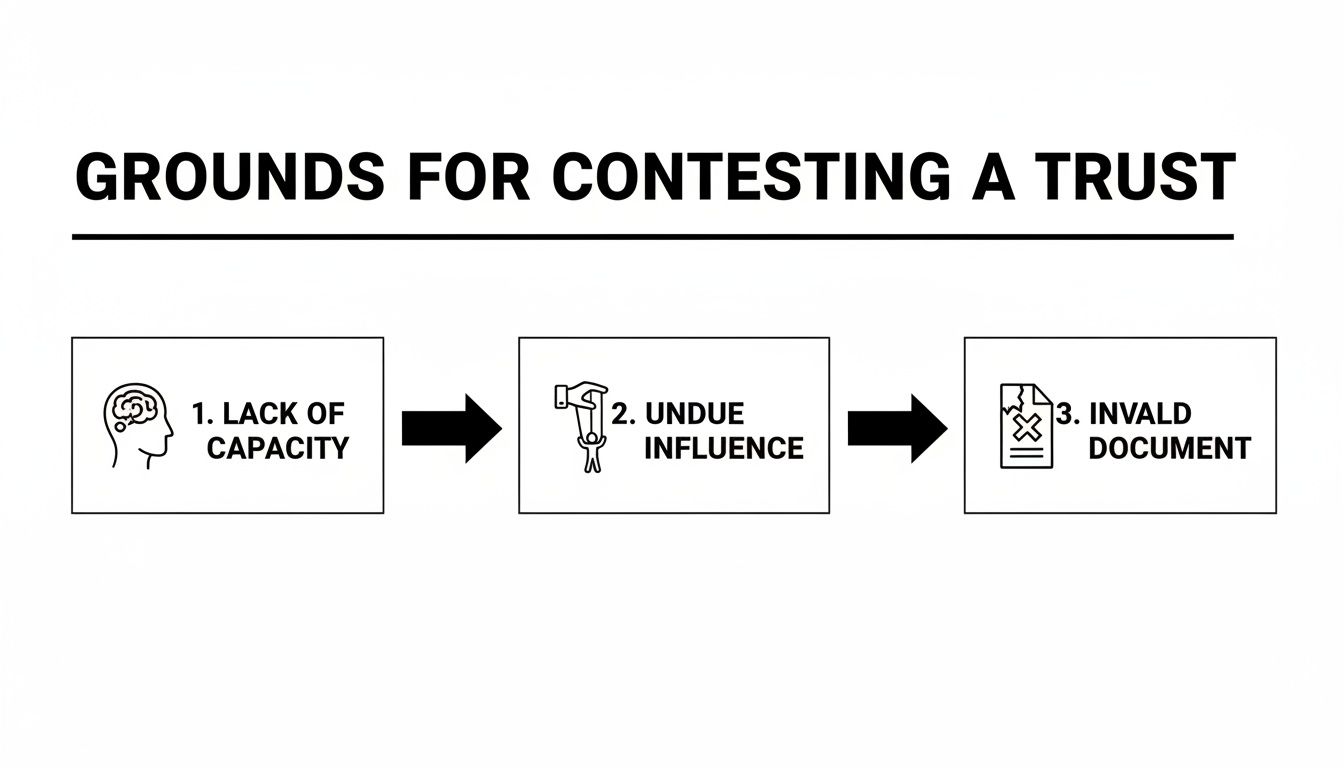
This visual guide breaks down the core reasons a trust's validity might be questioned, whether it's the grantor's mental state, manipulation from an outside party, or fundamental errors in the document itself.
The Clock is Ticking: The Statute of Limitations
Before taking any legal action, you must be aware of the most critical deadline in trust litigation: the statute of limitations. This is a strict time limit imposed by Texas law for filing a lawsuit. If you miss this window, your claim will almost certainly be permanently barred, regardless of its merits.
In Texas, the statute of limitations to contest a trust is generally two years from the date of the grantor's death. However, this deadline can sometimes vary based on the specific circumstances of a case. For this reason, it is absolutely essential to consult a Texas trust administration lawyer as soon as you suspect a problem. Prompt action is the only way to preserve your right to be heard in court.
Filing the Petition and Initial Pleadings
The formal process of contesting a trust begins when an interested party files a petition with the appropriate Texas court. This legal document serves as the foundation of your case.
The petition must clearly state:
- Your legal standing as an "interested person."
- The specific legal grounds for the challenge (e.g., undue influence, lack of capacity).
- The relief you are seeking from the court, such as having the trust declared void.
Once the petition is filed, the trustee and all other named beneficiaries must be formally notified. They will then have the opportunity to file a response, typically an "answer" denying the claims. This exchange of legal documents officially commences the lawsuit.
The Discovery Phase: Gathering Your Evidence
Following the initial pleadings, the case enters the discovery phase. This is often the longest part of the process and is dedicated to evidence gathering. Both sides use legal tools to request information from each other to build their respective cases. It is a formal investigation where all relevant facts are brought to light.
During discovery, attorneys will:
- Request Documents: Obtain copies of all trust versions, the grantor's medical and financial records, and any related correspondence.
- Send Interrogatories: Submit formal written questions that the opposing party must answer under oath.
- Conduct Depositions: Take sworn, out-of-court testimony from key witnesses, such as family members, caregivers, the drafting attorney, and medical experts.
The evidence uncovered during discovery is crucial. It is used to prove or disprove the claims of incapacity, undue influence, or fraud and forms the backbone of a successful trust contest.
"Most trust contests are won or lost during the discovery phase. The strength of your case depends entirely on the quality of the evidence you can gather and present to the court."
Pre-Trial Motions and Resolution Paths
As discovery concludes, either side may file pre-trial motions asking the court to rule on specific legal issues. For example, a trustee might file a motion for summary judgment, arguing that the challenger has failed to produce sufficient evidence and that the case should be dismissed without a trial.
However, a full-blown trial is the exception, not the rule. The vast majority of trust contests are resolved before reaching a courtroom through alternative dispute resolution methods:
- Negotiation: Attorneys for the involved parties negotiate directly to reach a private agreement.
- Mediation: A neutral third-party mediator facilitates a discussion to help the parties find common ground and forge a mutually agreeable settlement agreement. Texas courts often require mediation before a trial can proceed.
- Settlement: The parties agree to resolve the dispute on their own terms, formalized in a legally binding contract.
These alternatives save significant time, reduce legal costs, and keep sensitive family matters private. An experienced Texas estate planning attorney will always explore these avenues to protect your interests while minimizing conflict.
Defending a Trust and Exploring Alternatives to Court
When a trust is contested, the focus is often on the challenger. However, for a trustee or beneficiary defending a trust they believe is valid, the challenge is equally significant. Defending a trust is about honoring the grantor's final wishes and protecting their legacy. It requires a proactive and strategic approach grounded in Texas law.
At the same time, prolonged court battles can be emotionally and financially draining for a family. Fortunately, Texas law encourages resolving disputes outside the courtroom. These alternatives offer practical, compassionate solutions that can help preserve family relationships while achieving a fair outcome.
Strategies for Defending a Trust
As a trustee or beneficiary defending against a trust contest, your primary goal is to demonstrate that the trust is a legitimate expression of the grantor's intentions. A strong defense is built on compelling evidence and a clear understanding of the claims being made.
Key defensive strategies include:
- Gather Evidence of Capacity: Collect medical records, personal correspondence, and testimony from credible witnesses who can affirm the grantor's sound mind at the time the trust was signed.
- Demonstrate Clear Intent: Present evidence that the grantor understood the document's provisions, such as notes from meetings with their attorney or testimony from the attorney who drafted the trust.
- Counter Undue Influence Claims: Rebut claims of manipulation with evidence showing the grantor was independent and not isolated. Testimony from friends, family, and professionals who interacted with the grantor can be invaluable.
- Uphold Fiduciary Duties: For trustees, demonstrating meticulous adherence to the Texas Trust Code and your fiduciary duties in Texas strengthens your credibility and reinforces the trust's legitimacy.
While the challenger has the burden of proof, a well-organized defense can make their claims very difficult to substantiate.
Mediation: A Path to Amicable Resolution
Before a trust dispute proceeds to trial, Texas courts frequently order the parties to attend mediation. This is a confidential and structured meeting where a neutral mediator helps facilitate a productive conversation. The mediator's role is not to make decisions but to guide the parties toward a mutually acceptable resolution.
Mediation offers several key advantages:
- Privacy: Keeps sensitive family matters out of the public court record.
- Cost-Effectiveness: Is significantly less expensive and faster than litigation.
- Flexibility: Allows for creative solutions that a judge may not be able to order.
- Preservation of Relationships: Fosters collaboration rather than the adversarial "winner-take-all" dynamic of a trial.
Learning how to approach this process by preparing for mediation can make a significant difference in achieving a positive outcome.
Trust Modification and Reformation
Sometimes a dispute arises not from invalidity but from a simple error or an outdated provision. A typo, ambiguous language, or a term that is no longer practical due to changed circumstances does not need to result in a full contest.
In such cases, an interested party can petition the court for:
- Trust Modification: To alter the trust's administrative terms, often with beneficiary consent, to address unforeseen circumstances.
- Trust Reformation: To correct a clear mistake or clerical error in the document to ensure it accurately reflects the grantor's original intent.
These legal tools can resolve underlying issues without dismantling the entire estate plan. A knowledgeable Texas estate planning attorney can advise whether modification or reformation offers a constructive solution to the problem.
How a Trust Litigation Attorney Can Guide You
When a trust dispute arises, it involves more than just financial stakes; it is a complex intersection of Texas law and deeply personal family dynamics. Attempting to navigate this landscape alone is a significant risk that could jeopardize your inheritance and family relationships. An experienced Texas trust litigation attorney serves as both your legal advocate and your steady guide through this challenging process.
With so much at stake, you need a professional who brings clarity, strategy, and strength to your side. Your attorney will first assess whether you have legal standing, then identify the strongest legal grounds for your case. From there, they will begin the meticulous work of gathering the evidence necessary to build a compelling argument.
Building Your Case and Protecting Your Legacy
The right legal partner does far more than file paperwork. At The Law Office of Bryan Fagan, PLLC, we understand our role is to protect your interests and ensure your voice is heard.
Here’s our approach to providing practical advice and step-by-step guidance:
- Investigating the Facts: We conduct a thorough investigation, analyzing medical records, financial documents, and interviewing key witnesses to uncover the truth behind the trust's creation.
- Navigating Legal Deadlines: We ensure all legal filings are accurate and submitted on time, protecting your case from being dismissed on a technicality like a missed statute of limitations.
- Representing You with Integrity: Whether we are negotiating a settlement, advocating for you in mediation, or presenting your case in court, we are committed to representing your best interests with professionalism and unwavering integrity.
An attorney's guidance is just as critical for defending a trust as it is for contesting one. Trustees have a fiduciary duty to protect the trust's assets and honor the grantor's wishes, and solid legal counsel is absolutely essential to fulfilling that responsibility without missteps.
Why You Should Not Go It Alone
If you are considering contesting a trust—or are responsible for defending one—our team has the specialized expertise in Texas trust and estate law to help you achieve the best possible outcome. We are deeply familiar with the nuances of the Texas Trust Code and understand what it takes to build a persuasive case.
Let us manage the legal complexities so you can focus on your family. Don’t risk your inheritance by navigating this difficult terrain without a trusted advocate. A skilled Texas estate planning attorney can make all the difference.
Answering Your Top Questions About Trust Contests
When you first begin to wonder, "can a trust be contested?" in Texas, a wave of questions naturally follows. During such a stressful time, you need clear, straightforward answers.
Here are some of the most common questions we hear from families like yours.
How Long Do I Have to Contest a Trust in Texas?
Time is a critical factor. In Texas, the statute of limitations generally gives you two years from the date of the grantor's death to file a trust contest. However, this deadline can be affected by various circumstances, making it vital to seek legal advice as soon as possible to protect your rights.
What Is a "No-Contest" Clause and Is It Enforceable?
A "no-contest" clause (or in terrorem clause) is a provision in a trust that disinherits any beneficiary who challenges it. While these clauses are generally enforceable in Texas, there is a significant exception: the clause will not be upheld if you bring your challenge in good faith and with just cause. This means that if you have a legitimate reason and evidence to support your claim, you can proceed without fear of automatic disinheritance.
Is Contesting a Trust Expensive?
Litigation costs can vary widely, from $5,000 to $50,000 or more, depending on the complexity of the case and whether it goes to trial. The good news is that most trust disputes are resolved through lower-cost alternatives like mediation or direct settlement, which can significantly reduce the overall expense.
Other Common Questions on Your Mind
Families also frequently ask about the types of evidence needed and whether alternatives to a court battle exist.
"A thorough understanding of timelines and legal grounds is vital to prevent missing critical deadlines or weakening your case," says Bryan Fagan.
If you are considering taking action, this simple checklist can help guide your first steps:
- Confirm you have legal "standing" as an interested person.
- Identify the specific legal grounds for your contest.
- Begin gathering all available evidence to support your claim.
- Always consider mediation as a path to resolution before committing to litigation.
Consider this real-world scenario: A son was unexpectedly written out of his father's trust in a last-minute amendment that left the entire estate to a new acquaintance. He filed a contest within the two-year deadline, alleging undue influence. Through the mediation process, he was able to present his evidence and reach a settlement that honored his father's long-standing intentions and restored his inheritance.
Comparing Your Options for a Dispute
When weighing your next steps, it helps to see the options side-by-side.
| Option | Timeline | Cost Range | Privacy Level |
|---|---|---|---|
| Mediation | 3–6 months | $5,000–$15,000 | High |
| Litigation | 1–2 years | $20,000–$50,000+ | Low |
| Settlement | 6–12 months | Varies | Medium |
Understanding what each path entails empowers you to make an informed choice for your family. By getting answers to these key questions, you can better understand how the law applies to your situation and move forward with confidence.
If you’re managing a trust or planning your estate, contact The Law Office of Bryan Fagan, PLLC for a free consultation. Our attorneys provide trusted, Texas-based guidance for every step of the process.