Being named a beneficiary in a loved one's trust is a profound gesture of care and foresight. However, understanding your role and what it entails can feel overwhelming, especially during an emotional time. With the right legal guidance, it doesn’t have to be.
Simply put, beneficiary rights in a trust are your legal safeguards under the Texas Trust Code. These rights are designed to ensure the wishes of the person who created the trust—the settlor—are honored and that you receive your inheritance fairly and transparently. Understanding these rights is the first step toward navigating the trust administration process with confidence and peace of mind.
What It Means to Be a Trust Beneficiary

When a loved one establishes a trust, they create a legal framework to protect their assets and provide for you. This framework involves three key roles working in concert:
- The Settlor: This is the person who created the trust and funded it with their assets. They are the architect of the plan.
- The Trustee: This is the individual or institution responsible for managing the trust’s assets according to the instructions in the trust document. They are the manager.
- The Beneficiary: That’s you. You are the person or entity the trust was created to benefit.
The entire arrangement is governed by the trust document and the Texas Trust Code. As a beneficiary, your role is not merely passive. You have specific, enforceable rights that empower you to hold the trustee accountable and ensure the trust is managed properly, protecting the legacy your loved one intended for you.
The Foundation of Your Rights
Beneficiary protections are the result of a long legal evolution. Historically, trustees held immense power, often leaving beneficiaries with little recourse. Over time, Texas courts and lawmakers recognized this imbalance and established robust safeguards to protect beneficiaries' interests.
The modern Texas Trust Code gives you the legal standing to enforce the trust's terms and hold the trustee to the highest standards of conduct. This is a cornerstone of our estate planning philosophy.
Under Texas law, a beneficiary’s rights are not just suggestions—they are legal entitlements. The trustee has a fiduciary duty to act with loyalty, prudence, and impartiality, always prioritizing your interests above their own.
This legal obligation, known as a fiduciary duty, is the bedrock of your security. It ensures the person managing the assets does so honestly and in your best interest. Your rights provide a framework for transparency, allowing you to ask questions, receive information, and safeguard your inheritance during what can often be a challenging time.
Your Right to Information and Trust Accounting

Transparency is not optional in trust administration—it is a legal requirement. One of your most fundamental rights as a beneficiary in Texas is the right to be kept informed about the trust's assets and management. This isn’t about being intrusive; it is about exercising your power to protect your financial interests.
The Texas Trust Code mandates that the trustee communicates with you. At a minimum, you are entitled to receive a complete copy of the trust document. This document is the official rulebook that outlines how the trust operates, including distribution schedules and the trustee's powers.
Your right to information extends beyond the initial document. You also have the right to request a detailed financial report, known as a trust accounting.
So, What Exactly Is a Trust Accounting?
A trust accounting is a formal, comprehensive financial statement for the trust. It details every asset held, all income received, and every expense paid out. This report is a critical tool for ensuring the trustee is upholding their fiduciary duties in Texas.
A proper accounting under Texas law must be specific and clear, providing a transparent view of the trust’s financial health and the trustee’s actions.
A beneficiary's right to an accounting is a powerful check and balance. It ensures transparency and allows you to verify that the trust assets are being managed prudently and in your best interest, just as the settlor intended.
For example, imagine you are the beneficiary of your mother’s trust. You receive the annual accounting and notice several large payments for "consulting fees" to a company you don't recognize. This is a red flag. The accounting provides the evidence you need to demand a detailed explanation and receipts from the trustee. Without it, you would have no way of knowing if trust funds were being mismanaged. This is precisely why these reports are vital for protecting your inheritance.
The Key Ingredients of a Texas Trust Accounting
When you request an accounting, you should expect a thorough and detailed report. According to the Texas Trust Code, a formal accounting must clearly list:
- All Trust Property: A complete inventory of assets at the beginning of the accounting period and a current list of all assets the trust now owns.
- All Receipts and Disbursements: A detailed log of every transaction, including income received (e.g., rental income, stock dividends) and all payments made (e.g., trustee fees, property taxes, distributions to beneficiaries).
- Liabilities: A clear disclosure of any debts or obligations owed by the trust.
- Trustee Compensation: A specific breakdown of any fees or compensation paid to the trustee from trust funds.
Reviewing this information is how you confirm the trustee is acting responsibly. If a trustee ignores your request or refuses to provide a proper accounting, it may be time to consult with a Texas trust administration lawyer. Such a refusal can be a serious breach of fiduciary duty, and you have legal options to compel the trustee to provide this essential information.
Understanding Your Right to Trust Distributions

The ultimate purpose of a trust is to ensure you receive the assets your loved one intended for you. The how and when of these payments are dictated by the trust document through what are known as distribution standards.
As a beneficiary, understanding these standards is key to knowing what you are entitled to receive. Some trusts might direct a single lump-sum payout upon reaching a certain age. Others are designed to provide ongoing support over many years through smaller, regular payments.
What are the Rules for Payouts?
A common distribution standard in Texas trusts is abbreviated as "HEMS," which stands for Health, Education, Maintenance, and Support. This standard provides the trustee with a clear framework for making distributions.
Here is a practical breakdown:
- Health: Typically covers medical, dental, and vision care expenses, including insurance premiums and potential long-term care costs.
- Education: Can be used for tuition, books, and living expenses for college or vocational training programs.
- Maintenance and Support: This is a broader category intended to help you maintain your accustomed standard of living. It can cover expenses like mortgage payments, utilities, property taxes, or car repairs.
The trustee’s duty is to interpret these terms reasonably, balancing your immediate needs against the long-term preservation of the trust, particularly if other beneficiaries are involved. The amount of discretion the trustee has depends entirely on the specific language of the trust.
A trust document will specify certain standards for making distributions. These standards guide the trustee on how to use the trust's assets for the beneficiaries. Here are some of the most common ones you'll encounter in Texas.
Common Trust Distribution Standards in Texas
| Distribution Standard | What It Typically Covers | Trustee's Level of Discretion |
|---|---|---|
| HEMS (Health, Education, Maintenance, and Support) | Medical care, tuition, housing, and other costs to maintain the beneficiary's lifestyle. | Moderate. The trustee must follow the standard but has some leeway in interpreting what fits. |
| Ascertainable Standard | Similar to HEMS, this is a clear, objective standard tied to specific needs. | Limited to Moderate. The IRS prefers this for tax reasons, so the rules are fairly strict. |
| Absolute Discretion | The trustee can distribute funds for any reason they see fit, or not at all. | Very High. The trustee has total control, as long as they aren't acting in bad faith. |
| Mandatory Distributions | The trust requires specific payments at certain times (e.g., $5,000 per month). | None. The trustee has no choice; they must make the distribution as instructed. |
Understanding which standard applies to your trust is the first step in knowing what to expect from the trustee.
When a Trustee Says "No"
What happens if you believe the trustee is unfairly withholding a distribution? Let's consider a real-world scenario.
Suppose you are the beneficiary of a trust with a HEMS standard and you need funds for a down payment on your first home. This request would likely fall under "maintenance and support." You submit a formal request to the trustee with a clear explanation.
However, the trustee denies your request without a valid reason or simply ignores you. This is a significant red flag. When a trustee unreasonably refuses to make a legitimate distribution, they may be breaching their fiduciary duty to act in your best interest.
Your first step should be to put your request in writing, formally outlining how it aligns with the trust's distribution standard.
If you receive no response, it may be time for stronger action. A skilled Texas estate planning attorney can help you determine the best path forward, whether that involves a formal demand letter or petitioning the court to compel the distribution. For more guidance, see our in-depth article on the distribution of trust assets.
Remember, you have the right to advocate for the inheritance you were meant to receive.
Holding Trustees to Their Fiduciary Duties
Serving as a trustee is more than a management role—it is a position of significant legal and ethical responsibility. Under the Texas Trust Code, a trustee is a fiduciary, which means they are legally bound to place your interests above their own.
A trustee is the guardian of your loved one's legacy, tasked with protecting it with the highest standard of care. This legal commitment, known as a fiduciary duty, is the foundation of your protection as a beneficiary. It ensures the trustee acts honestly, prudently, and with your well-being as their top priority.
Understanding these duties is crucial for recognizing when a trustee is fulfilling their obligations—and when they may be violating the law.
The Three Pillars of Fiduciary Duty
While a trustee's responsibilities are numerous, their actions are guided by three core principles under Texas law:
- The Duty of Loyalty: This is the most important duty. A trustee must act solely for the benefit of the beneficiaries. This means no self-dealing, such as selling trust property to themselves or investing trust funds in their own business. Their loyalty must be undivided.
- The Duty of Prudence: A trustee must manage trust assets with the care that a reasonably prudent person would use for their own property. This includes making sound investment decisions, avoiding excessive risk, and working to preserve the trust's value for both current and future beneficiaries.
- The Duty of Impartiality: When a trust has multiple beneficiaries, the trustee cannot play favorites. They must treat all beneficiaries fairly and balance competing interests according to the terms of the trust. For example, a trustee cannot approve a large distribution for one sibling while denying a similar, legitimate request from another. You can learn more about these obligations in our guide on the duties and responsibilities of a trustee in Texas.
What a Breach of Duty Looks Like
Identifying a breach of fiduciary duty is essential for protecting your rights. A breach is not always as dramatic as theft; it can also manifest as negligence or a conflict of interest.
A trustee’s failure to act with loyalty, prudence, and impartiality can cause significant financial harm to a trust and its beneficiaries. Holding them accountable is not just your right—it is essential for preserving the trust's purpose.
For example, if a trustee invests a large portion of the trust's funds in a single, high-risk startup owned by a friend, they are likely breaching the duty of prudence. If they consistently ignore your requests for information or favor one beneficiary over others, they are failing in their duties of loyalty and impartiality.
These fiduciary principles are more critical than ever, with trust assets valued in the trillions worldwide. When a trustee fails to uphold these duties, Texas law provides you with clear legal options to seek recourse and protect the trust.
How to Remove a Trustee in Texas
When a trustee's actions jeopardize a trust, it can feel like your loved one's legacy is at risk. While removing a trustee is a significant step, Texas law provides a clear process for beneficiaries to take action in serious situations. This is a fundamental right you have to protect the trust's assets and purpose.
This legal action is reserved for situations where a trustee's misconduct or incompetence is causing tangible harm, not for minor disagreements. The Texas Trust Code specifies the legal grounds for removal.
Grounds for Removing a Trustee
To successfully petition a court to remove a trustee, you must provide compelling evidence of a serious issue. Simply disliking the trustee or disagreeing with a reasonable decision is not sufficient. A court will look for specific violations, such as:
- A Serious Breach of Trust: This includes misusing trust funds, self-dealing, or failing to make required distributions without a valid reason.
- Gross Mismanagement or Incompetence: A trustee who makes consistently poor investment decisions that diminish the trust's value or fails to maintain proper records may be removed.
- Conflict of Interest: If a trustee's personal or business interests interfere with their ability to act impartially for the beneficiaries, this is grounds for removal.
- Failure to Comply with the Trust's Terms: A trustee who willfully disregards the instructions in the trust document is not fulfilling their legal obligations.
When considering such a serious legal action, knowing how to conduct legal research effectively can help you understand the strength of your case and prepare for the process ahead.
The infographic below provides an overview of the typical trustee removal process in Texas.
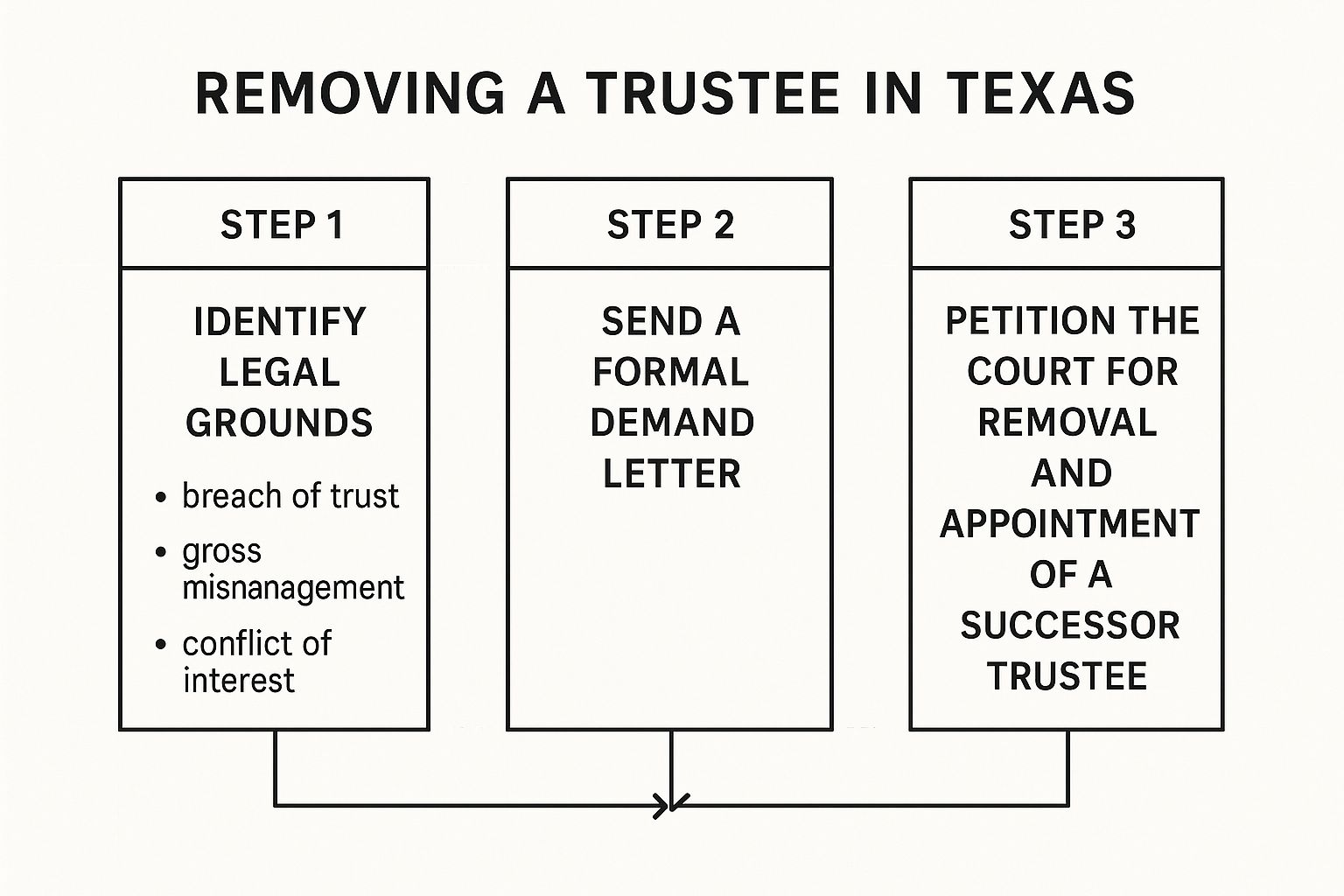
This is a formal, court-supervised process that begins once you have established solid legal grounds for your claim.
The Removal Process Step-by-Step
Removing a trustee is a formal legal process. Here is a step-by-step guide to how it generally unfolds:
- Document Everything: Begin by keeping a detailed record of every instance of mismanagement, poor communication, or suspected breach of duty. Save all emails, letters, and notes from conversations.
- Send a Formal Demand: Before filing with the court, your attorney will likely send a formal demand letter to the trustee. This letter will outline the issues and demand that the trustee either correct the problems or resign voluntarily.
- Petition the Court: If the trustee refuses to step down, your Texas trust administration lawyer will file a formal petition with the court. This legal document requests the trustee's removal and presents the evidence you have gathered.
- Appoint a Successor: If the court agrees to remove the trustee, a successor trustee must be appointed. The court will follow the instructions in the trust document for naming a successor or will appoint one if no successor is named.
Common Questions About Your Beneficiary Rights
It is natural to have questions as a beneficiary. To provide further clarity, we have addressed some of the most common concerns regarding beneficiary rights in a trust. This information is intended to empower you with the knowledge to handle your situation confidently.
Can a Trustee Change the Trust Without My Consent?
Generally, no. An irrevocable trust is designed to be permanent to protect the settlor's wishes. A trustee’s role is to administer the trust according to its existing terms, not to rewrite them.
The Texas Trust Code does allow for a trust to be modified or terminated under very specific and rare circumstances. This typically requires a court order and the consent of all beneficiaries. If you suspect a trustee is attempting to alter the trust unilaterally, you should immediately contact a Texas estate planning attorney to protect your inheritance and learn about your options, such as understanding how to modify a trust in Texas.
What Should I Do If the Trustee Is Not Communicating?
Trustee communication is a legal obligation, not a courtesy. Under Texas law, you have a right to be kept reasonably informed about the trust's administration.
If your attempts to communicate are met with silence, your first step should be to send a formal, written request for the specific information you need, such as an annual accounting. Be sure to document every attempt you make to contact the trustee. If the silence continues, the trustee may be in breach of their fiduciary duty. At this point, a Texas trust administration lawyer can intervene by sending a formal legal demand and, if necessary, petitioning the court to compel the trustee to communicate.
A trustee’s silence is not just frustrating—it can be a serious red flag. Consistent failure to communicate may signal deeper issues with trust management, making it essential for beneficiaries to assert their right to information promptly and formally.
When you're dealing with a complex trust situation and need another perspective, professional resources can be incredibly helpful. Platforms like Ask Experts can offer additional clarity and complement the legal advice you receive from your attorney.
Am I Responsible for Taxes on Trust Distributions?
The tax implications of receiving trust distributions can be complex and depend on the source of the funds.
Here is a simple breakdown:
- Principal Distributions: If you receive a distribution from the trust's principal (the original assets used to fund it), it is typically not considered taxable income to you.
- Income Distributions: If you receive a distribution of income that the trust has earned (such as interest, dividends, or rental income), that amount is generally taxable to you as the beneficiary.
A trust is a separate taxable entity that files its own income tax return. The rules are intricate, so it is always wise to consult with your attorney and a qualified tax advisor regarding your distributions. This will help you understand your tax obligations and avoid any surprises from the IRS.
If you’re managing a trust or planning your estate, contact The Law Office of Bryan Fagan, PLLC for a free consultation. Our attorneys provide trusted, Texas-based guidance for every step of the process at https://www.texastrustadministration.com.