When you are responsible for a loved one who can no longer make safe decisions for themselves, navigating the legal process can feel overwhelming. Families often hear the terms "guardianship" and "conservatorship," but what do they really mean, especially here in Texas? Understanding the critical difference is the first step toward finding a clear path forward.
In Texas, the law simplifies these concepts under one main legal proceeding: guardianship. This is then divided into two distinct roles. The Guardian of the Person is responsible for healthcare and personal well-being. The Guardian of the Estate—which is what other states typically call a conservator—manages all financial affairs.
Understanding the Key Roles Under Texas Law
Managing a loved one’s personal or financial affairs can feel overwhelming—but with the right legal guidance, it doesn’t have to be. Getting a handle on Texas's specific legal framework is the first step toward finding clarity and peace of mind.
A key point to understand is that the Texas Estates Code does not use the term "conservatorship." Instead, it provides a comprehensive system where a court can appoint a guardian to oversee different aspects of a person's life. The individual requiring protection is legally known as the "ward."

This distinction is more than just semantics; it reflects a legal philosophy that separates personal care from financial management. For instance, a person might be capable of making decisions about their daily health needs but become confused when trying to manage their property, or vice versa. The court’s primary goal is always to impose the least restrictive arrangement necessary to keep the ward safe.
If you are facing this situation, our guide on securing a guardianship for elderly parents offers practical, step-by-step guidance.
Guardianship vs. Conservatorship: A Quick Comparison
To make these roles clear, the table below breaks down the primary distinctions between the two types of guardianship under Texas law.
| Aspect | Guardian of the Person | Guardian of the Estate (Texas's Conservatorship Equivalent) |
|---|---|---|
| Primary Focus | Personal well-being, healthcare, and daily living decisions. | Financial matters, assets, property, and legal affairs. |
| Key Responsibilities | Making medical decisions, choosing a place of residence, and ensuring daily needs are met. | Paying bills, managing investments, filing taxes, and protecting the ward's property. |
| Legal Authority | Granted by the court to make decisions about the ward's physical and emotional care. | Granted by the court to manage and protect the ward's entire financial estate. |
| Who It's For | An individual who cannot make safe and sound decisions about their personal welfare. | An individual who is unable to manage their financial affairs effectively. |
This breakdown highlights how Texas law tailors the solution to the person's specific needs rather than taking a one-size-fits-all approach. A court may appoint one person to handle both roles or assign two different people, depending on what is in the ward's best interest.
The Guardian of the Person
A Guardian of the Person is appointed by a court to make decisions about the ward’s physical and personal well-being. This is the deeply personal side of caregiving, focused on the day-to-day choices that keep someone safe and healthy when they cannot make those decisions for themselves.
The responsibilities are significant and touch every aspect of the ward's life. This guardian has a fiduciary duty to:
- Make decisions on medical, surgical, and psychiatric treatments.
- Choose where the ward will live, whether at home, with a relative, or in a care facility.
- Ensure the ward has proper food, clothing, and a safe living environment.
- Oversee the ward’s daily life, including social and educational activities.
Essentially, this guardian steps into the ward’s shoes for all non-financial, life-sustaining decisions, always bound by law to act in the ward's best interest.
The Guardian of the Estate
On the other side is the Guardian of the Estate. This is the Texas equivalent of what most other states call a conservator. This role is strictly financial. A court appoints this guardian when a person can no longer manage their own property or financial affairs. This person becomes the fiduciary responsible for protecting the ward’s assets.
The core duty of a Guardian of the Estate is to prudently manage the ward’s property to provide for their care and maintenance. This is a position of immense trust, subject to strict court oversight and reporting requirements under the Texas Estates Code.
Their authority covers the ward’s entire financial world, including paying bills, collecting income, managing bank accounts, overseeing investments, and filing tax returns. For major transactions, such as selling a house, the guardian must obtain court approval first. A Texas estate planning attorney can be an invaluable partner, helping navigate these complex fiduciary duties in Texas while ensuring full compliance with the law.
Comparing the Scope of Authority and Power
It is vital to understand the precise legal authority each type of guardian holds. This is not just a matter of wording; it defines the boundaries of power one person has over another's life. These roles are separated to address the fundamentally different tasks of managing personal well-being and financial stability.
When a court establishes a guardianship, its order is incredibly specific. It spells out exactly what the guardian can and cannot do, ensuring they only have the authority needed to protect the ward. This approach is rooted in the core Texas legal principle of preserving as much of an individual's independence as possible.
The Guardian of the Person: Powers in Action
A Guardian of the Person is granted the power to make critical life and healthcare decisions. Their authority is focused on the ward’s physical safety, comfort, and general well-being. It is a deeply personal role that demands compassion and sound judgment.
For a real-world scenario, imagine your elderly mother has advancing dementia. As her Guardian of the Person, you would be legally empowered to:
- Consent to medical treatment, including surgeries, medications, and therapy.
- Choose her living arrangements, such as finding a memory care facility that provides specialized support.
- Ensure her daily needs are met, from nutrition and hygiene to social engagement.
This diagram provides a clear, side-by-side look at the two main guardianship roles in Texas.
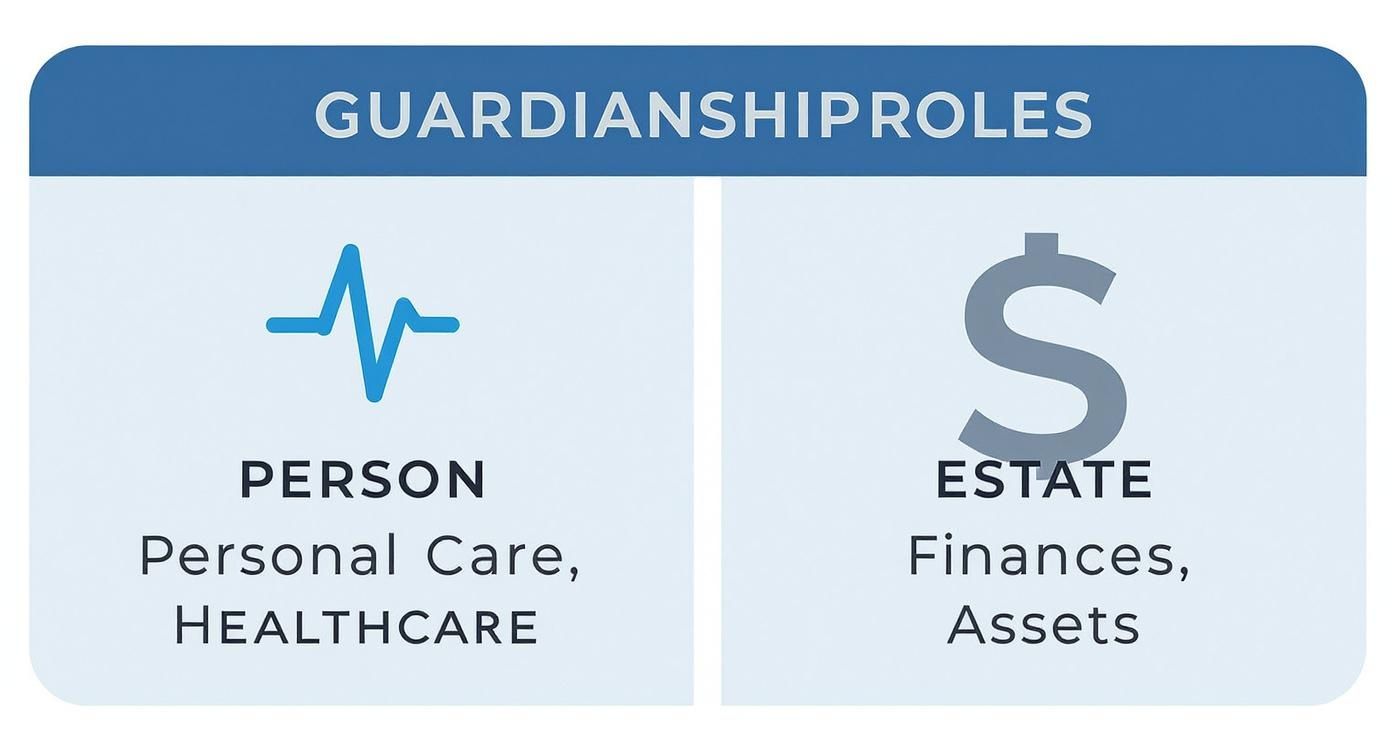
As you can see, the Guardian of the Person is focused on personal welfare, while the Guardian of the Estate deals strictly with financial matters.
The Guardian of the Estate: Financial Authority
In contrast, the Guardian of the Estate has no authority over the ward’s personal or medical care. Their power is strictly confined to managing the ward’s property and finances. This position comes with a weighty fiduciary duty—a legal obligation to manage assets with the highest degree of care and loyalty.
Using the same scenario with your mother, your role as Guardian of the Estate would be purely financial. You would be responsible to:
- Access her bank accounts to pay monthly bills and residential care costs.
- Manage her investment portfolio and collect income from pensions or Social Security.
- File her annual income tax returns.
A critical point to remember is that major financial actions, like selling your mother’s house to pay for her care, require prior court approval. This judicial oversight is a vital safeguard under the Texas Estates Code, designed to prevent mismanagement and protect the ward’s assets.
Both roles demand meticulous records and an unwavering commitment to act only in the ward's best interests. Whether managing healthcare or finances, you are accountable to the court, which acts as the ultimate protector. An experienced Texas guardianship attorney can provide trusted, Texas-based guidance as you navigate these powerful responsibilities.
Breaking Down the Texas Guardianship Appointment Process
Establishing a guardianship in Texas is a formal court process. Understanding the required steps can reduce stress for everyone involved. The Texas court system follows a specific, step-by-step procedure designed to protect the rights of the "proposed ward."
It begins when someone files an Application for Appointment of a Guardian with the appropriate court. This formal legal document must explain exactly why a guardianship is necessary and why less restrictive options are not suitable. The application also names the proposed guardian and provides a full picture of the proposed ward and their family.
Proving Incapacity and Notifying Family
One of the most critical pieces of evidence is the physician's certificate of medical examination. This sworn statement from a doctor who has recently examined the proposed ward must clearly explain the nature and severity of their incapacity. This provides the court with the objective medical proof it needs to consider limiting someone's legal rights.
At the same time, the law requires that all "interested parties"—such as the proposed ward’s spouse, children, and other close family members—receive formal notification of the proceeding. This ensures transparency and gives the family an opportunity to participate.
At the heart of the Texas guardianship process is the role of the 'attorney ad litem.' The court appoints this independent lawyer for one reason: to represent the proposed ward's wishes and interests. Their job is to ensure their client's voice is heard and their rights are fiercely protected throughout the process.
The Hearing: What You Need to Prove
The final step is the court hearing, where a judge evaluates all the evidence. What you must prove depends on the type of guardianship you are seeking.
- Guardian of the Person: You must show the judge that the person cannot provide for their own basic needs—such as food, clothing, or shelter—or manage their own physical health.
- Guardian of the Estate: The focus is on finances. You must prove the person is unable to manage their property or financial affairs. Evidence might include unpaid bills, poor financial decisions, or vulnerability to scams.
Meeting these legal standards and navigating court procedures is why working with a skilled Texas guardianship attorney is essential. An experienced lawyer ensures every step is handled correctly, from filing the initial application to presenting a solid case in court, protecting both your family and the loved one you are trying to help.
Ensuring Protection Through Court Oversight and Accountability
Accountability is the bedrock of the guardianship system. It is not just about granting power; it is about ensuring that power is never misused. When a Texas court appoints a guardian, it remains involved as an ongoing supervisor to prevent abuse or financial mismanagement. Texas law establishes a strong framework of oversight for this reason.
Mandatory Reporting Under the Texas Estates Code
Guardians are legally required to file regular, detailed reports with the court. This is a core part of their fiduciary duty, and every action taken must be transparent and justified.
- Annual Report on the Person: A Guardian of the Person must file an annual report on the ward's condition, detailing their physical and mental health, living arrangements, and any significant changes. This allows the court to verify the ward is receiving proper care.
- Annual Accounting of the Estate: The Guardian of the Estate must submit a meticulous financial accounting that tracks every dollar that came in and went out on the ward's behalf. Receipts and supporting documentation are required.
This level of scrutiny is critical because the potential for exploitation is real. A guardian is more than a decision-maker; they are a fiduciary held to the highest legal and ethical standards.
Any action that places the guardian's own interests ahead of the ward's is a blatant violation of that sacred trust.
Failing to file reports or misusing the ward's assets has serious consequences. A guardian can be removed by the court and may face civil or criminal penalties. A breach of fiduciary duty is a severe offense. These checks and balances exist for one reason: to keep your loved one safe.
Exploring Less Restrictive Alternatives to Guardianship
Before a Texas court will impose a guardianship, it must determine if any less restrictive alternatives can protect the person. A guardianship is a serious legal action that removes an individual's fundamental rights, so the law treats it as a last resort.
Proactive estate planning provides powerful tools to avoid the need for a future court-supervised guardianship. These documents allow you to decide—while you are still able—who will make decisions for you if you become incapacitated. It is about preserving your autonomy and dignity on your own terms.
Empowering Trusted Agents with Powers of Attorney
One of the most effective alternatives is the Durable Power of Attorney. This legal document allows you to appoint a trusted person—your "agent"—to handle your financial affairs if you cannot. Your agent can pay bills, manage investments, and handle property transactions without court intervention.
Similarly, a Medical Power of Attorney lets you designate an agent to make healthcare decisions for you. If you cannot communicate your wishes, this person ensures your medical preferences are honored. These documents are cornerstones of a solid estate planning strategy. You can learn more about how a power of attorney differs from a guardianship by exploring the key legal distinctions in our detailed guide.
People often confuse powers of attorney and guardianships. The crucial difference is choice. A power of attorney is a decision you make when you are competent. A guardianship is a solution a court imposes after you have been found to be incapacitated.
Other Vital Estate Planning Tools
Beyond powers of attorney, other documents can add layers of protection and clarity, making court intervention even less likely.
- Directive to Physicians (Living Will): This document outlines your preferences for end-of-life medical care, giving clear instructions to your family and doctors about the treatments you do or do not want.
- Revocable Living Trust: By placing your assets into a trust, you appoint a successor trustee to manage them if you become incapacitated. This bypasses the need for a Guardian of the Estate because the trust already has a management plan in place.
Taking these steps provides a clear roadmap for your loved ones, ensuring your affairs are handled by people you trust according to your instructions and keeping the court out of your personal and financial life.
Got Questions About Texas Guardianship? We Have Answers.
When facing the possibility of guardianship, it is natural to have many questions. Below, we have answered some of the most common questions Texas families ask, providing clarity to help you feel more prepared for the road ahead.
Who Can Be a Guardian in Texas?
Texas law has a priority list for who may serve as a guardian, starting with a spouse, then adult children, parents, and other relatives. However, the court's final decision is always based on the best interest of the proposed ward. A person may be disqualified if they have a conflict of interest, owe money to the ward, or have a history that makes them unsuitable. The court carefully vets every potential candidate.
How Long Does the Process Take and What Does It Cost?
The timeline for establishing a guardianship can vary significantly depending on the complexity of the situation and whether family members contest the action. An uncontested case might take a few months, while a contested case can last much longer. Costs include court filing fees, the fee for the court-appointed attorney ad litem, and your own legal fees. The best way to get a realistic cost estimate is to discuss your specific circumstances with a Texas guardianship attorney.
Is a Guardianship Permanent?
No, a guardianship is not necessarily permanent. It can be modified or terminated by the court if circumstances change. For example, if the ward regains capacity or the guardian can no longer serve, a petition can be filed with the court. The court will require clear evidence to make any changes, as its primary and constant priority is the ward's protection.
If you’re managing a loved one's affairs or planning your estate, contact The Law Office of Bryan Fagan, PLLC for a free consultation. Our attorneys provide trusted, Texas-based guidance for every step of the process.