Planning for a time when you might not be able to manage your own affairs can feel overwhelming, but with the right legal guidance, it doesn’t have to be. A springing power of attorney is a legal document that stays dormant until a specific future event happens, usually when you're determined to be incapacitated. Think of it as a trusted emergency plan, lying in wait until it's absolutely necessary. This lets you keep full control over your life and finances for as long as you're able.
Planning For Incapacity With A Springing Power Of Attorney
Nobody likes to think about becoming unable to manage their own affairs, but it's a critical part of responsible estate planning. A sudden illness or an unexpected accident can leave you in a tough spot, creating chaos and stress for your loved ones right when they need clarity the most. Preparing now is one of the most compassionate gifts you can give your family, preventing legal headaches and potential disputes during an already emotional time.

This is exactly where a springing power of attorney (POA) comes in as a powerful solution. This vital estate planning tool gives a person you trust—your agent or attorney-in-fact—the legal authority to handle your financial and property decisions, but only after a specific "triggering event" takes place.
How A Springing POA Provides Peace Of Mind
The biggest advantage of a springing POA is the control it leaves in your hands. Unlike other POAs that kick in the moment you sign them, this document doesn't do anything as long as you can manage things yourself. This setup offers tremendous peace of mind, knowing that help is legally lined up without you having to give up your autonomy before you're ready.
When you start planning for incapacity, getting familiar with the different types of medical and financial power of attorney forms can give you a solid starting point for talks with your attorney. To give you a clearer picture, here's a quick look at what a springing power of attorney involves.
Springing Power of Attorney at a Glance
This table breaks down the core components of a springing POA in Texas.
| Feature | Description |
|---|---|
| Activation | Becomes effective only upon a specific, predefined triggering event (e.g., a doctor's declaration of incapacity). |
| Agent's Role | The person you appoint (the "agent") has no power until the document "springs" into effect. |
| Principal's Control | You maintain complete control over your own financial and legal affairs as long as you are capable. |
| Drafting Requirement | The triggering event must be clearly and unambiguously defined in the document to avoid confusion. |
| Incapacity Proof | In Texas, proof of incapacity typically requires a written statement from a physician. |
A well-crafted springing POA is your best defense against a court-supervised guardianship, which is both public and expensive.
A well-drafted springing power of attorney helps avoid the need for a court-supervised guardianship proceeding. This maintains your privacy, saves your family significant expense, and ensures the person you chose is the one making decisions for you.
Making sure this document is created correctly under the Texas Estates Code ensures your wishes are followed and your financial world keeps spinning smoothly, even if you can't be the one to oversee it. For a deeper dive, you can learn more about the essentials of planning for incapacity with a power of attorney in our detailed guide.
How a Springing POA Activates Under Texas Law
A springing power of attorney gets its name from how it quite literally "springs" into action when you need it most. Unlike a standard durable power of attorney that’s effective the moment you sign it, this document lies dormant until a very specific condition—the triggering event—takes place. That event is the key that unlocks your agent's legal authority to manage things on your behalf.
Think of it like a backup generator for your home. It sits quietly in the background, not using any power, but it’s ready to kick on the instant the main power goes out. In the same way, a springing POA is a crucial part of your estate plan that grants no power at all until the predetermined trigger occurs. This setup lets you keep total control over your financial and legal decisions for as long as you're able.
The Triggering Event Explained
Under the Texas Estates Code, the triggering event can’t be a casual suggestion; it has to be spelled out with crystal clarity right in the POA document. Ambiguity is the enemy here. If the conditions for activation are vague, you can bet that banks, hospitals, and other institutions will hesitate—or flat-out refuse—to honor it. That can lead to frustrating delays and legal headaches right when your family can least afford them.
By far, the most common and legally solid trigger for a springing POA in Texas is a formal determination that you've become incapacitated. And this isn't just someone's opinion; it's a documented medical process.
- Physician Certification: The document will typically state that it becomes effective only after one—or more often, two—licensed physicians have examined you and certified in writing that you no longer have the capacity to manage your own financial affairs.
- Defining Incapacity: The POA should also define what "incapacity" means, such as being unable to understand the nature and consequences of your financial choices.
Getting this language exactly right is non-negotiable. Using fuzzy terms like "when I'm not feeling well" or "when my family thinks it's time" is a recipe for disaster and will almost certainly make the document useless when it's needed.
Legal Formalities for a Valid Texas POA
For a springing POA to hold up in Texas, it has to meet some strict execution requirements. Just writing down what you want isn't enough to give it legal teeth.
The Texas Estates Code mandates that the principal (that’s you, the person creating the POA) must sign the document or have someone else sign it for you in your presence. The most critical step? Your signature must be acknowledged before a notary public. This notarization is the official stamp of approval, verifying your identity and confirming you signed the document of your own free will.
A properly signed and notarized springing power of attorney is a private, effective tool for managing your affairs. Without these legal formalities, the document holds no weight, and your family could be forced into a public and costly guardianship proceeding to gain the authority they need to help you.
Historically, springing POAs gained popularity after the 1980s as dementia cases became more prevalent. By 1990, Texas had formalized their use under the Texas Estates Code, often requiring two physicians to certify incapacity as a key safeguard. While well-intentioned, this double-check sometimes created delays. A Journal of Elder Law study found that in over 40% of certain probate disputes during the 2008 financial crisis, activation was held up. You can discover more insights about these historical challenges on legal-resources.uslegalforms.com.
Figuring out the fine print of POA language and legal execution can feel overwhelming. To see how these documents fit in with other essential directives, check out our guide on unraveling POA and advanced directive mysteries. Getting proper legal guidance from a Texas estate planning attorney ensures your document is not only valid but also practical for your agent to use when the time finally comes.
Choosing Between a Springing POA and a Durable POA
One of the biggest decisions you'll make in your estate plan boils down to a single question: When should your agent be able to step in and act for you? It's a simple question with big implications, and it's the fundamental difference between a springing power of attorney and an immediate durable power of attorney.
An immediate durable POA goes live the moment you sign it. Your agent can manage your finances right away, even while you’re perfectly healthy. In stark contrast, a springing POA lies dormant. It only “springs” into action when a specific, future event happens—almost always, your legal incapacity.
Understanding the Key Differences
The choice between these two powerful documents really comes down to your personal comfort level. It’s a trade-off between control, privacy, and how quickly your agent can act in a crisis.
An immediate durable POA is all about speed and convenience. If something happens, your agent can step in that very day without jumping through any hoops. But this means you're handing over immense trust and authority from day one.
On the other hand, a springing POA lets you keep 100% exclusive control over your life until you are medically certified as unable to manage things yourself. This approach puts your autonomy first, but it can create logistical headaches and delays right when your family needs help the most.
The decision tree below maps out the activation path. It’s a simple visual, but it clearly shows that an agent’s power remains locked away until incapacity is formally confirmed.
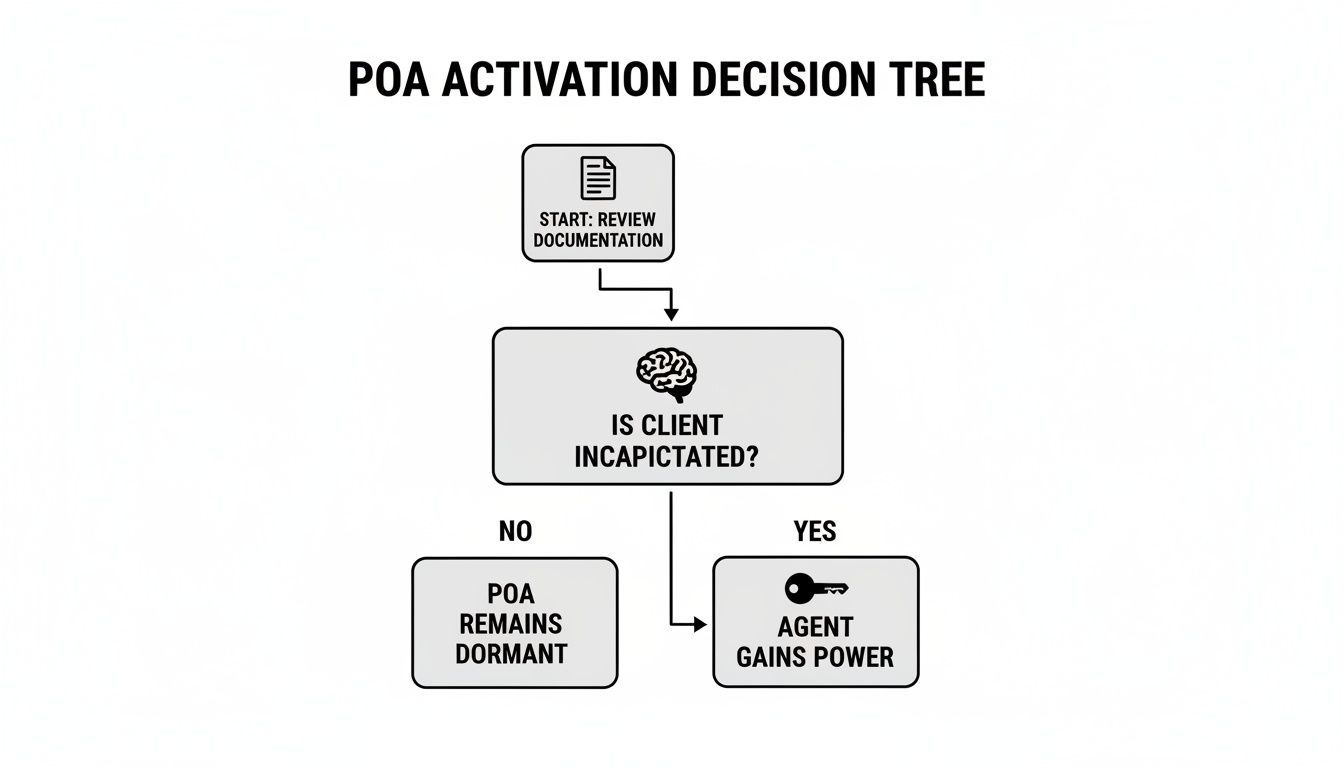
As you can see, that "triggering event" is the key that unlocks the agent's authority. Without it, the document is just a piece of paper.
A Practical Comparison
To really get a feel for which might be right for you, it helps to see them side-by-side. Here’s a breakdown of the trade-offs involved, which are crucial for making a choice that aligns with your family dynamics and personal risk tolerance.
Comparing Springing vs. Immediate Durable Power of Attorney
A side-by-side analysis to help you decide which power of attorney best fits your estate planning needs.
| Consideration | Springing Power of Attorney | Immediate Durable Power of Attorney |
|---|---|---|
| Activation Timing | Activates only upon a future triggering event, like a doctor certifying you're incapacitated. | Effective the moment you sign and have it notarized. |
| Principal's Control | You keep 100% control over all your affairs until the document is triggered. | You share authority with your agent immediately, even while you are fully capable. |
| Privacy | Your financial and personal details stay completely private until you're declared incapacitated. | Your agent has the legal right to access your financial information as soon as it's signed. |
| Emergency Access | There's a real risk of delays while your agent works to get the necessary doctor's letters. | Your agent can act instantly in a crisis, with no third-party verification needed. |
| Risk of Misuse | The risk of premature or unauthorized use is lower since the agent has no power while you're capable. | There's a higher risk if the agent isn't completely trustworthy, as their power is active from day one. |
Scenarios to Consider
Your own life circumstances are often the best guide for which document makes more sense.
- For the Long-Term Planner: A healthy person in their 40s or 50s might lean toward a springing POA. It acts as a safety net for the distant future without giving up any control today. It just feels more secure for someone who doesn’t see an immediate need for help.
- For the High-Risk Situation: Someone about to have major surgery or who has received a serious health diagnosis might choose an immediate durable POA. This ensures their agent can pay the mortgage and manage investments without any delay if complications arise.
Choosing the right POA is not just a legal decision; it's a personal one. It requires an honest assessment of your family relationships, your health, and your comfort level with delegating authority over your life's work.
At the end of the day, the goal is to create a plan that provides seamless protection for you and your family. The right POA helps you avoid the public, expensive, and emotionally draining process of a court-ordered guardianship. Whether you choose a springing or an immediate durable POA, a Texas estate planning attorney can help you draft a document that is clear, legally sound, and tailored to your unique situation, giving you and your family true peace of mind.
Why Defining Incapacity Is Your Most Important Decision
The entire backbone of a springing power of attorney is built on one thing: how you define incapacity. Think of this “triggering clause” as the key that starts the engine, giving your agent the authority to act. If that key is poorly cut—or the definition is vague—the whole document can stall out. Your family could be left scrambling, possibly even facing a costly and public court battle to get things moving.
Getting this definition right isn't just a detail; it's everything. It gives clear, black-and-white instructions to your agent, your family, and the financial institutions holding your money. Without that clarity, banks might refuse to honor the POA, and disagreements among family members can erupt into full-blown legal fights.

Crafting a Clear and Defensible Trigger
Under the Texas Estates Code, the usual starting point is a written letter from a physician stating you can no longer manage your financial affairs. While that’s a solid foundation, a thoughtfully drafted POA goes much further. It adds specific layers to prevent any confusion and protect you from someone jumping the gun.
This is where an experienced Texas estate planning attorney really shows their value. They’ll help you customize this clause to fit your exact wishes and family situation. You have a surprising amount of control here.
- Specify the Number of Physicians: You can require a written opinion from just one doctor, or you can demand two for a more solid confirmation.
- Designate a Specific Doctor: You could insist that one of the certifying physicians must be your longtime primary care doctor, ensuring the call is made by someone who knows your health history inside and out.
- Require a Specialist’s Opinion: For conditions like dementia or Alzheimer's, you might require an evaluation from a qualified specialist, like a neurologist or psychiatrist.
These details transform a generic form into a precise legal tool made just for you.
The goal is to build a trigger that’s nearly impossible to argue with. It should create a clear, objective roadmap for your agent to follow, taking all the guesswork out of the equation and minimizing the chance of conflict during an already tough time.
A Cautionary Tale of Ambiguity
Imagine a family squabble where a father’s springing POA just said it kicks in "when I am unable to make my own decisions." When he started showing the early signs of dementia, one of his kids thought it was time for the POA to activate. Another child, however, strongly disagreed, arguing Dad was still perfectly capable.
Because the definition was so subjective, the disagreement landed them in court. The result? A long, expensive guardianship proceeding—the exact nightmare scenario the POA was created to prevent. This story is a perfect example of why precision is so critical. You can explore more on the significant differences between guardianship and power of attorney in our deep-dive article.
Real-world cases constantly highlight these risks. In one dispute, an agent sold property before incapacity was officially certified by a doctor. Although the court eventually upheld the sale, the case illustrates how blurry triggers are an open invitation for legal challenges. In fact, some analyses show that nearly 30% of legal fights over springing POAs come from vague trigger clauses, causing major probate delays and racking up costs. You can read more about the risks of vague triggers on mblawfirm.com.
The best way to sidestep these landmines is to work with an experienced Texas estate planning attorney. They can ensure your triggering clause is legally sound, practical, and crystal clear. This doesn't just protect your assets—it protects your family from the emotional and financial toll of uncertainty.
The Hidden Dangers: Common Pitfalls of Springing POAs
While a springing power of attorney feels like a safe, responsible choice, its biggest strength can quickly become its greatest weakness. Think of it like a safety lock that’s a little too good—great in theory, but a nightmare in an emergency.
Understanding these potential roadblocks is the first step toward creating a document that doesn't just look good on paper but actually works when your family is counting on it.
The Problem with Proving Incapacity
The most common trap is the logistical nightmare of proving you're incapacitated. Let's paint a picture: you have a sudden, severe stroke. Your chosen agent needs immediate access to your accounts to handle medical bills and keep your finances from falling into disarray. But they can't.
First, they have to hunt down one or even two physicians to get a written certification of your incapacity. This isn't like a quick trip to the doctor's office. We're talking about a process that can drag on for days, sometimes weeks, especially if doctors are swamped or wary of signing off on such a critical legal document.
Delays, Red Tape, and Skeptical Banks
This delay isn't just a minor hassle; it can create a financial crisis. While your agent is chasing down doctors and paperwork, your mortgage could go unpaid, or critical business decisions could be left hanging. The clock is ticking.
Even worse, once your agent finally has the physician letters in hand, they might run into another brick wall: the bank. Financial institutions are on high alert for fraud, and an older or slightly ambiguous springing POA can set off all their alarm bells. They might put a freeze on everything while their legal team scrutinizes the document, adding another layer of delay and frustration when time is of the essence.
The real test of a power of attorney isn't just its legal validity—it's whether a bank will actually accept it on a Tuesday afternoon when you need it most. A document that institutions refuse to honor quickly is of little help in a true emergency.
Best Practices for a Bulletproof POA
The good news is that you can get ahead of these problems with some smart, proactive planning. By anticipating these challenges, you and your attorney can build in safeguards to ensure your springing POA is ready for action.
A few key strategies can make all the difference:
- Pick Your Agent Wisely: Don't just pick someone you like; pick someone who is organized, assertive, and won't get flustered by bureaucracy. Just as crucial, name at least one—and preferably two—backup agents in case your first choice can't or won't serve.
- Dust Off That Document: An outdated POA is one of the top reasons banks reject them. Plan to review your POA with your Texas estate planning attorney every three to five years, or after any major life event like a marriage, divorce, or the death of a named agent.
- Have "The Talk" with Your Agent: Your agent can't step in if they don't know they've been appointed or where to find the original document. Sit down with them and have a frank conversation about their duties, your wishes, and where you keep all your important estate planning documents.
Why a Skilled Attorney is Your Best Defense
Ultimately, the surest way to sidestep these pitfalls is to work with an experienced Texas estate planning attorney. A good lawyer does more than just fill out a form; they help you build a comprehensive strategy.
For instance, they might add specific language that protects a financial institution from liability if they accept the POA in good faith. This simple clause can make them far more willing to act quickly. They can also craft your incapacity clause with surgical precision, removing any grey areas that might give a bank a reason to pause.
This professional guidance transforms your springing POA from a generic template into a powerful tool built for your life. While avoiding a court-supervised guardianship is a huge goal, making sure your POA is practical and effective is just as vital for your family's peace of mind.
Integrating Your POA into a Comprehensive Estate Plan
A springing power of attorney is a powerful tool, but it doesn't work in a vacuum. To truly safeguard your legacy and your family's future, it needs to be carefully woven into a complete estate plan. Think of your plan like a team of specialists; each document has a unique job, but they all need to communicate and work together to protect you.
Your POA might be the financial quarterback, but it needs the rest of the team on the field. Without this coordination, you’re leaving dangerous gaps in your plan that can lead to confusion, family conflict, and expensive court battles—all at a time when your loved ones are already under stress.

How Your Estate Planning Documents Work Together
A truly solid plan is one where every document complements the others. It's crucial that the agent you name in your financial POA can work hand-in-glove with the people you appoint in your other documents.
Here’s a quick look at how they connect:
- Living Will and Healthcare Directive: This document spells out your medical wishes. Your financial POA agent may need to step in and pay for the specific care you’ve requested, so these two documents must align.
- Last Will and Testament: While your Will is all about distributing assets after you pass away, your POA is in charge of managing those same assets if you become incapacitated while you are still alive.
- Revocable Living Trust: If you have a trust, your POA agent might need to handle assets that aren't in the trust or pay for expenses not covered by trust funds. Sometimes, the agent and the successor trustee are the same person, which requires extremely careful drafting to define their distinct roles and prevent conflicts.
This interconnectedness is everything. When these documents are drafted in harmony, they create a protective shield around you and everything you've worked for, ensuring your wishes are followed no matter what life throws your way.
Avoiding the Guardianship Trap
One of the most compelling reasons to build a holistic estate plan is to stay out of a court-supervised guardianship. If you become incapacitated without a valid POA and healthcare directive in place, your loved ones will have no other option but to go to court and ask a judge to appoint a guardian to manage your affairs.
Guardianship proceedings are public, often incredibly expensive, and can be emotionally devastating for families. A comprehensive estate plan, with a well-drafted springing power of attorney at its core, is the single most effective way to keep your personal matters private and out of the courtroom.
By taking a thoughtful approach to estate planning, you make sure every piece of your plan functions exactly as intended. This strategy provides a clear roadmap for your family, minimizes the potential for arguments, and gives you genuine peace of mind. An experienced Texas estate planning attorney can help you build this cohesive plan, ensuring your financial and healthcare wishes are buttoned up and protected.
Common Questions We Hear About Springing POAs
When Texas families start digging into the details of a springing power of attorney, a lot of practical questions pop up. It's completely normal. Here are some of the most common concerns we address, answered in plain English.
Can I Change My Mind and Revoke My Springing POA?
Yes, you absolutely can. Think of it this way: as long as you're in the driver's seat mentally and have the capacity to make your own decisions, you have every right to change course or tear up the map entirely.
But you have to do it the right way under Texas law. This isn't a casual conversation; it requires a formal, written revocation. You'll need to get that document notarized and then—this is key—hand-deliver copies to your current agent and any bank or financial institution that has the original POA on file. This step makes sure everyone is on the same page and your new wishes are legally binding.
What Happens if My Chosen Agent Can't Do the Job?
This is a huge "what if" that trips a lot of people up, and it really underscores why you need to plan carefully from the start. If your primary agent can't or won't step in when needed—maybe due to their own health, a personal crisis, or even death—you're in a tough spot.
Without a backup named in your document, your family might be forced to go to court to establish a guardianship. This is often the very expensive, time-consuming, and public process that creating a POA is meant to avoid. The solution is simple: always name at least one alternate agent, and if you can, name a second. It's a critical safety net.
Do Banks Actually Have to Accept My Springing POA?
While the Texas Estates Code is clear that third parties are required to honor a valid POA, the reality on the ground can be a bit different. Some financial institutions get nervous and overly cautious, especially with older documents. They might hit pause and send your POA to their legal department for a lengthy review, causing frustrating delays right when your family needs access.
To avoid this headache, it's smart to have your POA reviewed and updated every few years. An experienced Texas estate planning attorney can also draft it with specific language that banks and other institutions are comfortable with, which helps grease the wheels for a smoother acceptance down the road.
How Does My Agent Prove I've Become Incapacitated?
Your agent can't just decide on their own; they must follow the exact instructions you laid out in the POA document. Typically, this means they have to get written letters from one or two doctors. These letters must state clearly that, in the physicians' professional opinions, you are no longer capable of managing your own financial affairs.
Once they have those letters, your agent will present them, along with the original POA document, to the relevant institutions. This is the official trigger that "springs" the POA into effect and activates their authority to act on your behalf.
If you’re managing a trust or planning your estate, contact The Law Office of Bryan Fagan, PLLC for a free consultation. Our attorneys provide trusted, Texas-based guidance for every step of the process at https://www.texastrustadministration.com.