Skip to content
When a loved one passes away, managing their final affairs can feel overwhelming. Amidst the grief, one of the most critical first steps is finding their last will and testament. This legal document is the key to understanding their final wishes, from distributing family heirlooms to naming the person in charge of settling their estate—the executor.
Without a will, you are left to navigate a more complex legal road dictated entirely by Texas state law, not by what your loved one might have wanted. This guide provides practical, step-by-step advice to help you locate this crucial document and understand your next steps under the Texas Estates Code.
Starting the Search After a Loved One Passes
The best approach is to begin your search in the most obvious and personal places. Think about where your loved one kept their most important papers. People typically store a will where they feel it is secure yet accessible when needed.
Put yourself in their shoes. Where was their trusted spot for important documents?
Common Places to Begin Your Search
Your initial search should be a careful exploration of their personal space. This is often the quickest way to find the will or, just as importantly, clues that point you in the right direction.
Here are the prime spots to check first:
- The Home Office or Desk: Go through file cabinets, look in every desk drawer, and check any area they used for paperwork. A will is often filed alongside other critical legal and financial documents.
- A Personal Safe or Lockbox: A fireproof safe is a very common place for original documents like a will. Of course, you will need the key or combination to get inside.
- With Other Important Papers: Look through binders or folders where they kept birth certificates, marriage licenses, social security cards, property deeds, or insurance policies.
While looking, keep an eye out for anything from a Texas estate planning attorney—a business card, a letter, or an invoice. Finding the name of the lawyer who drafted the will is a significant breakthrough. Their office will almost certainly have a copy on file, a key fiduciary responsibility they uphold for their clients.
These related documents can be the breadcrumbs that lead you to the official will. To get a better sense of what comes next, especially when property is involved, you might find it helpful to look over a guide on probate property for sale. This methodical search is the first step toward a respectful and smooth administration of your loved one's estate.
A Comprehensive Checklist for Where to Look
If you have checked the most obvious spots and come up empty, do not panic. This happens more often than you would think. It usually means the will was stored in a place considered more secure or simply in a location that is not intuitive. Now is the time to broaden the search methodically.
Think of this as a systematic investigation, moving from personal spaces to professional connections and even into the digital world.
This flow chart gives you a great visual starting point for the most common places people keep these critical documents.
Starting with the most personal and accessible locations is always the best first move. If that does not yield results, it is time to expand the search.
Checking Secure and Professional Locations
Once you've thoroughly searched the home, the next logical step is to check places where important documents are professionally stored for safekeeping. This is where you will often find either the original will or an official copy.
Here’s a breakdown of where to look when you need to expand your search beyond the deceased’s personal property.
Key Locations to Search for a Will
| Location | What to Look For | Key Tip for Texas Residents |
|---|---|---|
| Safe Deposit Box | The original signed will, deeds, and other valuable papers. | Accessing a safe deposit box after death in Texas requires a court order. An attorney can help you obtain one specifically to search for a will. |
| Estate Planning Attorney | An official copy of the will, or sometimes the original. | Look for any correspondence, invoices, or business cards from law firms. The attorney who drafted the will is your best resource for finding a copy. |
| Financial Advisors | A copy of the will, trust documents, or other estate planning files. | These professionals often keep copies of estate documents for financial and tax planning purposes and can be an invaluable resource. |
| Digital Accounts | Digital copies of the will, emails with an attorney, or clues to its location. | Check personal computers, cloud storage (Dropbox, iCloud), and email accounts for any communication related to estate planning. |
This checklist should help you systematically cover all the key bases where a will might be stored.
Expanding into the Digital Realm
In today's world, a search for a will is not confined to file cabinets. The digital footprint a person leaves behind can hold the key. Just remember to approach this part of the search with respect for their privacy.
Here are some digital areas you should explore:
- Computer Files: Start with their personal computer or laptop. Search for folders with names like "Will," "Estate," "Legal," or "Important Papers." A simple file search for "last will and testament" can sometimes work wonders.
- Cloud Storage: Many people use services like Google Drive, Dropbox, or iCloud for backing up their most important documents. If you can gain access to these accounts, it’s worth a thorough look.
- Email Accounts: This can be a goldmine. Sifting through a loved one’s email might uncover correspondence with their Texas estate planning attorney. Look for messages about creating, reviewing, or signing a will. This could lead you straight to the law firm holding a copy.
Under the Texas Estates Code, anyone who has a deceased person's will is legally obligated to deliver it to the county clerk after learning of the death. This duty ensures the will is properly filed so the probate process can begin.
If you have gone through all these physical, professional, and digital locations and still have nothing, do not lose hope. The next step involves checking official public records, where the guidance of an experienced probate attorney becomes essential.
Diving into Texas Public Records and Official Channels
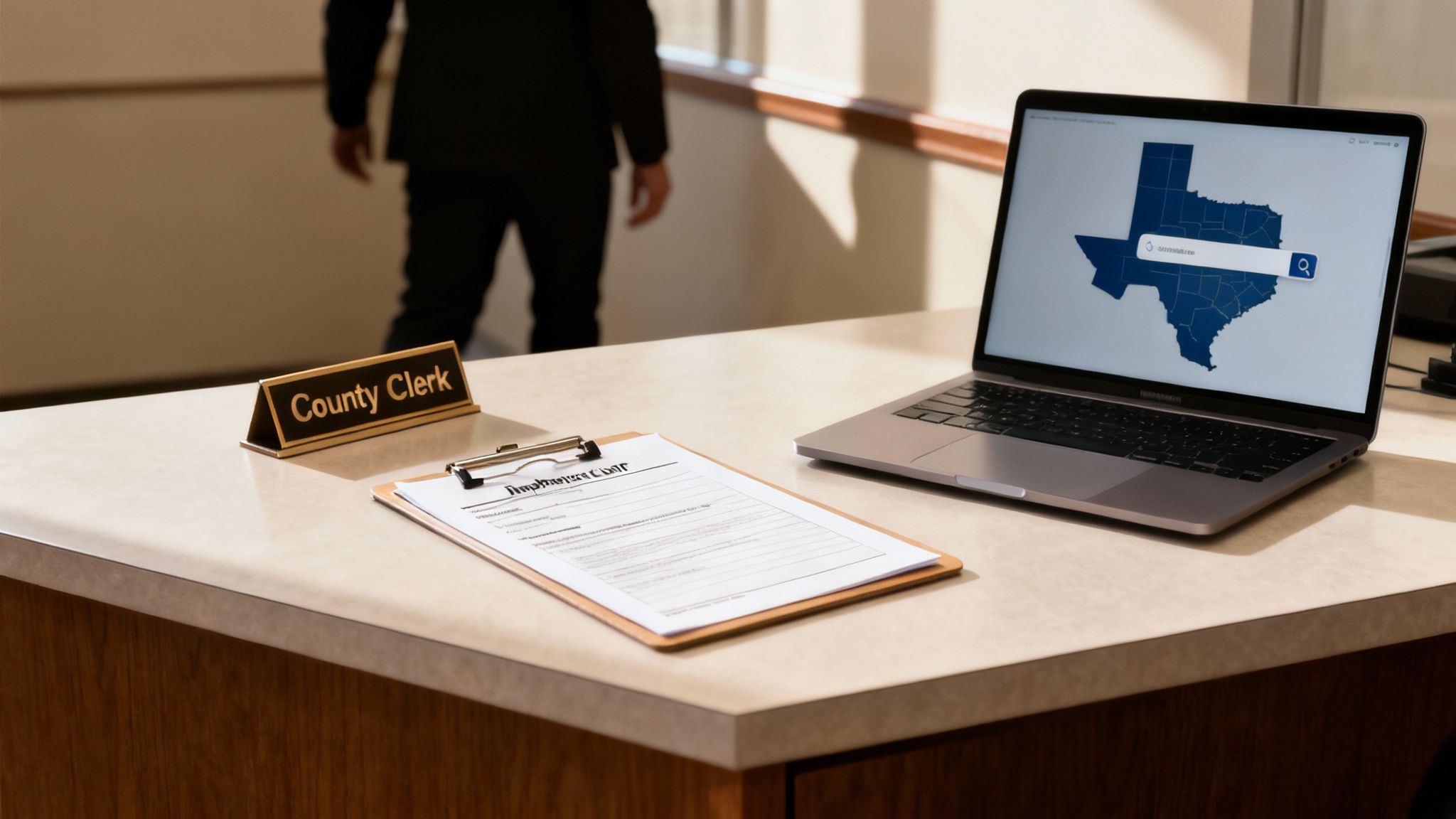
When your private search through personal files and professional contacts does not turn up a will, it is time to shift your focus to official public channels. In Texas, if the probate process has started, the will must be filed with the county clerk's office. This is the next logical step—moving from the personal to the public sphere to find the answers you need.
Your first move is to contact the county clerk in the county where your loved one resided when they passed away. This office is the official hub for all legal proceedings related to their estate.
How to Check Probate Court Records
Every county in Texas handles its own probate records, but many larger counties have moved their systems online, making searches much more straightforward. You can usually look up the decedent's name and see if a will has been filed or if an estate administration case is already open.
Here’s a quick rundown of how to approach this in some of Texas's largest counties:
- Harris County (Houston): The Harris County Clerk’s online records are the place to start for probate case information. Given the size of the county, thousands of estates are probated here every year. For a deeper dive, check out our guide on navigating the Houston County Probate Office.
- Dallas County: Similarly, the Dallas County Probate Courts offer a solid online case search system where you can look for recent filings.
- Travis County (Austin): The Travis County Clerk’s office gives the public access to probate records, which is perfect for checking if a will was filed for safekeeping or as part of a probate case.
If your online search comes up empty, your next move is a simple phone call or a visit to the county clerk's office. The staff can point you in the right direction for searching their records in person.
The Reality of Wills in Texas and Beyond
It is a fact that often surprises people: a significant number of Americans pass away without a valid will. Legal studies consistently show that roughly 60-70% of Americans die intestate (without a will), which can complicate matters for the family left behind. In Texas, where the Texas Estates Code lays out specific and sometimes complex probate rules, that statistic highlights why a thorough search for a will is so important. You can learn more about these trends from findings on will preparation and storage.
Key Takeaway: If a will was filed with the court, it becomes a public record. The county clerk's office is your best official resource to determine if a will has entered the legal system.
Exploring Will Registries
Another path to explore, though less common, is a will registry. These are private services where people can register the location of their will, making it easier for their loved ones to find it. While Texas does not have an official statewide registry, checking national services like the U.S. Will Registry might be worthwhile if you feel you have exhausted all other options.
Searching public records may sound intimidating, but it is a necessary and usually straightforward step. If you find the will through these channels, you are that much closer to honoring your loved one’s final wishes. If not, it may be time to consider the possibility that no will exists.
What Happens When You Cannot Find a Will?
Sometimes, after an exhaustive search, you must face a difficult reality: your loved one may not have left a will. When this happens, the process shifts from following your loved one’s specific wishes to adhering to the strict letter of Texas law.
When someone passes away without a will, they are considered to have died “intestate.” This means that instead of an executor they personally chose, the court will appoint an administrator to manage the estate.
Texas Law Steps In: Understanding Intestate Succession
With no will to serve as a roadmap, the Texas Estates Code provides a rigid legal framework for asset distribution. This is called intestate succession. It acts as a default estate plan created by the state—one that may look very different from what your loved one actually intended.
For example, a common scenario in Texas involves a blended family. If the deceased had children from a previous relationship, their surviving spouse does not automatically inherit everything. Instead, the law divides the property between the spouse and the children, a result that can be unexpected and create conflict.
The law follows a clear hierarchy based on family relationships:
- Spouse and Children: The division of property becomes complex, depending heavily on whether the property is separate or community and whether the children are from the current marriage or a previous one.
- No Spouse, But Children: The children inherit the entire estate, divided equally among them.
- Spouse, But No Children: The surviving spouse typically inherits all community property. However, separate property may be divided between the spouse and the deceased's parents or siblings.
Understanding these rules is key to managing expectations and preparing for the legal process ahead.
Key Takeaway: Intestate succession means the state of Texas decides who inherits, not your loved one. This rigid formula can lead to outcomes that feel surprising or even unfair to the family.
Simpler Options for Smaller Estates in Texas
Fortunately, not every estate without a will must endure a formal, lengthy probate process. Texas law offers streamlined alternatives, especially when the estate is relatively small or has few debts. These options can save significant time, money, and stress for families.
- Small Estate Affidavit (SEA): This is a valuable tool if the estate's value (not including the homestead and other exempt property) is $75,000 or less. As long as the assets outweigh the debts, the heirs can file an SEA to collect property without a formal court administration.
- Affidavit of Heirship: This document is most often used to transfer title to real estate. It is a sworn statement, usually signed by family members and disinterested witnesses, that officially identifies the deceased’s legal heirs according to intestate law. While not as powerful as a court order, it is widely accepted for clarifying property titles.
When a will is missing, the court must appoint someone to legally manage the estate. To learn more about obtaining this crucial authority, see our guide on the letter of administration of estate.
When You Need a Texas Estate Attorney's Help
While you can often handle the initial steps of searching for a will on your own, some situations can become complicated quickly. When that happens, seeking professional legal guidance is not just a good idea—it is essential for protecting the estate and ensuring you follow Texas law.
Trying to tackle complex estate issues alone can lead to costly mistakes, family disputes, and significant delays in settling your loved one's affairs.

Scenarios That Require Legal Counsel
Certain red flags indicate it is time to consult an experienced Texas trust administration lawyer. These situations almost always involve legal hurdles that demand a deep understanding of the Texas Estates Code and court procedures.
It is time to seek legal help if you encounter any of these roadblocks:
- Family Disputes: If siblings, a surviving spouse, or other relatives disagree about whether a will exists—or are fighting over a will they believe is lost—an attorney can help mediate and find a legal path forward.
- Accessing a Safe Deposit Box: Texas banks will not simply grant you access to a deceased person’s safe deposit box. You will almost certainly need a court order, which a lawyer can help you secure.
- Complex Assets: If the estate includes a family business, out-of-state property, or significant investments, the administration process becomes much more intricate. A probate attorney will ensure every asset is handled correctly.
- Potential Will Contests: If you have found a will but suspect it might be invalid due to fraud, undue influence, or the person's lack of capacity when they signed it, you need legal representation to challenge it properly.
The Value of an Experienced Probate Attorney
A skilled probate attorney does more than offer advice; they take the legal weight off your shoulders so you can focus on your family. With over 25,000 probate filings each year in major Texas counties alone, navigating the system efficiently is critical.
An experienced Texas probate lawyer can petition the court, manage all paperwork, and represent the estate’s best interests from start to finish. To better understand how an attorney can assist you, learn more about finding your ideal probate attorney in Texas.
A seasoned Texas probate attorney can manage disputes, simplify complex legal requirements, and provide invaluable peace of mind during an emotionally draining time, ensuring the estate is administered correctly and respectfully.
Common Questions About Finding a Will in Texas
When you are trying to locate a will under the pressure of legal deadlines, many questions arise. Getting clear, accurate answers can make all the difference. We have compiled some of the most common questions our clients ask to help you navigate this process with more confidence.
These answers are grounded in the Texas Estates Code and designed to provide the clarity you need.
How Long Do I Have to Find a Will and File for Probate in Texas?
In Texas, you generally have four years from the date of a person's death to file their will for probate. While this may sound like a long time, the search and document gathering can be time-consuming.
Although there are very narrow exceptions to this deadline, attempting to file after the four-year mark is an uphill battle that complicates everything, with no guarantee the court will allow it. It is always best to begin the search and probate process as soon as possible to avoid potential problems and settle the estate without unnecessary delays.
If you miss the four-year window, the estate is usually treated as if there was no will. This means Texas intestate law—not your loved one's wishes—will determine how assets are distributed.
What Should I Do If I Find More Than One Will?
It happens more often than you would think. People update their wills as their lives change, and older versions are sometimes left behind. If you find multiple wills, the general rule is that the most recent one is valid—as long as it was signed and witnessed correctly under Texas law.
However, it is critical that you do not destroy any version you find. Each document is a piece of the legal puzzle. A Texas probate attorney must examine every version to determine which is the legally valid will and confirm that any previous versions were properly revoked. Making this determination yourself could inadvertently spark a serious legal dispute among family members.
Can I Open a Safe Deposit Box If I Am Not the Executor?
The short answer is almost always no. Banks follow strict protocols and will not allow you into a deceased person's safe deposit box unless you have been officially appointed by a court as the executor or administrator of the estate.
If you believe the will is locked inside, you will need a court order. An attorney can help you file a motion with the probate court to get limited access. This order allows the bank to open the box for the sole purpose of searching for and retrieving the will.
If you’re managing an estate or planning your own, contact The Law Office of Bryan Fagan, PLLC for a free consultation. Our attorneys provide trusted, Texas-based guidance for every step of the process. Find out more at https://texastrustadministration.com.