Skip to content
When a loved one passes away, settling their affairs can feel overwhelming, especially when faced with the Texas probate process. It's often a long, emotionally taxing road. But what if there was a shortcut? For some estates, Texas law offers just that—a streamlined process called a muniment of title.
Think of it as an express lane at the grocery store. It's a way to legally transfer property based on a valid will, but without the full-blown hassle and cost of a traditional estate administration.
Navigating The Texas Probate Process After A Loss

Managing an estate is one of the toughest jobs you can have, especially when you're also grieving. The legal hurdles can feel overwhelming—but with the right legal guidance, it doesn’t have to be. Here at The Law Office of Bryan Fagan, PLLC, we understand the weight on your shoulders, and our goal is to offer clear, compassionate guidance every step of the way.
This guide is here to demystify the muniment of title in Texas so you can approach it with confidence. We want to give you the knowledge you need to make smart decisions that honor your loved one’s final wishes. Of course, the smoothest probate journeys often start with solid end-of-life planning, including wills and directives, which can make a world of difference down the line.
Understanding The Basics: A Clear Explanation
So, what exactly is a muniment of title? It’s a legal proceeding that's pretty unique to Texas. If an estate qualifies, you can ask the court to simply validate the will and issue an order that officially transfers ownership of the assets directly to the beneficiaries named in it.
That single court order acts as the "muniment"—or the proof—of their title to the property. It's a powerful piece of paper that cuts out a ton of administrative work.
The biggest perks of this process are clear:
- No Executor Needed: The court doesn't have to appoint an executor or administrator to manage the estate.
- Lower Costs: When you skip appointing an administrator, you also skip their fees, the cost of a bond, and many legal oversight fees.
- Much Quicker: This path is typically a whole lot faster than a traditional probate administration.
Now, this simplified route isn't for everyone. There are specific boxes you have to check, mainly related to the estate's debts, all laid out in the Texas Estates Code. If you want to compare it to the standard route, you can get the full rundown on the traditional probate process in Texas in our other article. We’ll break down exactly who qualifies for a muniment of title and what steps you'll need to take, so you can figure out if it’s the right choice for your family.
What Exactly Is A Muniment Of Title?

When you hear the term "muniment of title," it might sound like something pulled from a dusty old law book. But in Texas, it’s a surprisingly modern and efficient legal shortcut for certain estates. Think of it as an express lane through the often-congested highway of probate.
At its core, a muniment of title is a special legal process recognized under the Texas Estates Code. It allows a Texas court to look at a valid will, give it a legal stamp of approval, and then issue a court order that directly transfers property to the people named in that will.
That court order is the magic key. It becomes the new "muniment"—or evidence—of ownership. This means you get to sidestep some of the most time-consuming parts of traditional probate, like appointing an executor or going through a full-blown estate administration.
The Core Purpose and Function Under Texas Law
The main goal of a muniment of title is to create a clean, official record showing who now owns the deceased person's property. It acts as a legal bridge, connecting the property from the person who passed away to their beneficiaries, plain and simple.
This is especially handy for estates where the main assets are real estate, vehicles, or mineral rights—anything with a formal title. The court's order is filed in the county’s property records. This creates a crystal-clear chain of title, which gives banks, title companies, and any future buyers complete confidence.
The key takeaway is this: A muniment of title validates a will and transfers property in one efficient step. It avoids the need for an executor, letters testamentary, and the ongoing court supervision required in a full probate administration.
Because there’s no executor involved, the family is spared from taking on extensive fiduciary duties in Texas. This really simplifies things during what is already a stressful time. For estates that meet the specific criteria under Texas law, this streamlined approach is often the best path forward.
How It Differs From Full Probate Administration
It’s crucial to understand how a muniment of title stacks up against a full probate administration. While both journeys start with a valid will, they head down very different roads.
A full probate involves appointing an executor to actively manage the estate. This person has a long to-do list: inventorying assets, paying off debts, and eventually distributing what’s left. It's a hands-on, court-supervised process.
A muniment of title, on the other hand, skips that whole management phase. There's no executor, no formal inventory filed with the court, and no drawn-out process for notifying and paying creditors. It is simply a faster, more direct route to transfer ownership. An experienced Texas estate planning attorney can help you figure out which path makes the most sense for your loved one’s estate.
To make it even clearer, let's break down the fundamental differences between using a muniment of title and undergoing a traditional, full probate administration in Texas.
Muniment Of Title Vs Full Probate Administration At A Glance
| Feature | Muniment of Title | Full Probate Administration |
|---|---|---|
| Executor Appointed | No, an executor is not needed or appointed by the court. | Yes, the court appoints an executor to manage the estate. |
| Purpose | To legally transfer title and recognize the will's validity. | To manage the entire estate, pay debts, and distribute assets. |
| Court Oversight | Minimal, primarily focused on the initial hearing and order. | Ongoing, requiring inventories, notices, and court approval. |
| Typical Timeline | Often completed in a few months. | Can take six months to a year, or even longer. |
| Ideal For | Debt-free estates with a valid will and clear beneficiaries. | Estates with debts, complex assets, or potential disputes. |
As you can see, the choice between these two paths depends heavily on the estate's specific circumstances, particularly whether there are debts to be settled. For the right situation, a muniment of title is a powerful tool for simplifying the probate process in Texas.
Who Qualifies For This Probate Shortcut
Not every estate can take this simplified path. Think of it like an express lane at the grocery store—it's fast, but you have to meet certain conditions. The Texas Estates Code lays out a clear checklist for using a muniment of title, and it's designed specifically for straightforward situations where a full, formal probate process would be overkill.
For families hoping to use this shortcut, hitting every mark on that checklist is the critical first step. Each requirement is non-negotiable. Miss just one, and the estate will likely have to take the more traditional, longer route through probate.
The Essential Checklist for Eligibility
To successfully probate a will as a muniment of title in Texas, the situation has to be just right. The rules are there to protect any potential creditors and make sure the deceased person’s wishes are followed without a hitch.
Here are the critical requirements:
- A Valid Written Will Exists: This entire process is built on having a solid, legally valid will. No will, no muniment of title. If your loved one passed away without a will (which is called dying "intestate"), you'll need to explore other avenues. You can learn more by reading about the Affidavit of Heirship in Texas.
- No Unsecured Debts: This is often the biggest hurdle. The estate can't owe any money to anyone—with one major exception: a mortgage or other loan secured by real estate. If there are outstanding credit card bills, old medical expenses, or personal loans, the estate is disqualified.
- No Pending Medicaid Claims: If the deceased received Medicaid benefits, the State of Texas might have a claim against the estate to recover those costs. If a Medicaid claim exists, a muniment of title is off the table.
The logic behind these rules is simple. When an estate owes money, someone needs to be officially in charge of paying those debts. Since a muniment of title skips appointing an executor, it can only be used when there are no creditors waiting to be paid.
When Is Formal Administration Unnecessary?
Beyond those strict rules, the court also has to agree that there’s no other reason to open a formal administration for the estate. This is a crucial, catch-all requirement.
For example, if the beneficiaries are arguing over what the will means, or if there are complicated assets that need active management, a judge will almost certainly decide an executor is needed to keep things orderly. A muniment of title works best when the will is crystal clear, the beneficiaries are all on the same page, and the only real task left is to legally transfer the property.
Real-World Scenario: John passes away, leaving a home with a mortgage, a car that is paid off, and a checking account. His will leaves everything to his two children. He had no credit card debt or other loans. Because the only debt is a secured mortgage and the will is straightforward, his estate would be an excellent candidate for a muniment of title.
Ultimately, the goal of this probate shortcut is efficiency. It’s custom-made for simple, debt-free estates where the deceased’s intentions are clear as day. An experienced Texas estate planning attorney can look at the specifics of your loved one's estate and confirm if it meets all the criteria, making sure you choose the most direct and cost-effective path forward.
Your Step-By-Step Guide To The Filing Process
Walking through the courthouse procedure for a muniment of title can feel overwhelming, but it doesn't have to be. While every situation has its own unique wrinkles, the journey follows a clear path laid out by the Texas Estates Code. Let’s break down what you can expect, step-by-step, from filing the first piece of paper to getting that final court order in your hands.
Navigating this process means paying close attention to the details, since every step is a legal requirement. This is where an experienced Texas estate planning attorney is invaluable, making sure everything is filed correctly and on time to avoid painful delays during an already tough time.
Initiating The Court Process
The first move is to formally ask the court to recognize the will. This is done by preparing and filing a specific legal document called an "Application to Probate Will as a Muniment of Title."
This is more than a simple form; it's a formal petition that lays out all the critical facts for the judge. It needs to state that the person passed away, confirm they left a valid will, and, most importantly, swear that the estate meets the strict requirements—namely, that there are no unsecured debts to worry about. The original will must be filed right alongside this application.
The Waiting Period And Public Notice
Once your application is officially filed with the probate court in the right Texas county, the clock starts on a mandatory waiting period. The County Clerk will post a public notice at the courthouse, which is legally known as a "citation." This is the court's way of officially telling the world that a will has been submitted for probate.
This step is all about transparency. It gives anyone who might have a legal interest in the estate—like a long-lost cousin or a potential creditor—a chance to step forward. This notice period usually lasts about two weeks before the court will schedule your hearing.
This simple infographic boils down the essential qualifications you must meet before you can even think about filing.
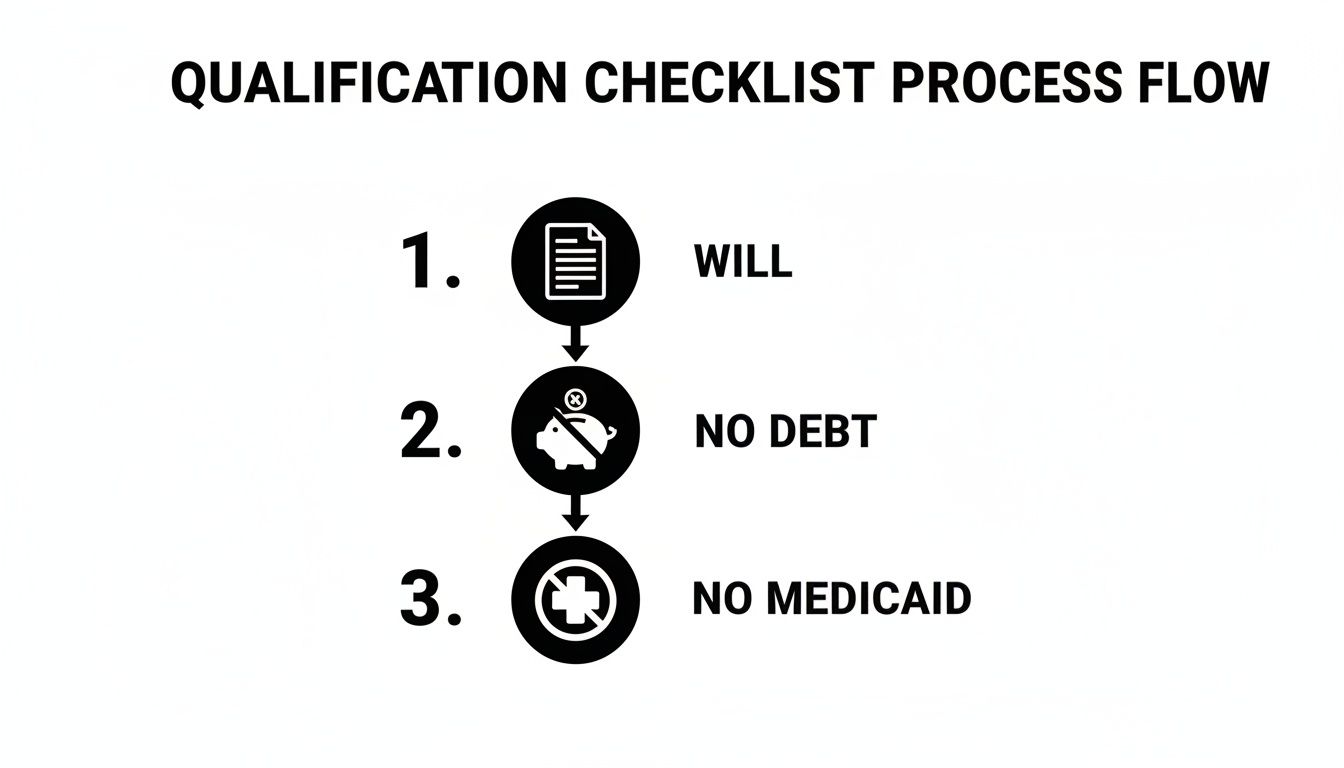
As you can see, having a valid will, no unsecured debt, and no Medicaid claims against the estate are the absolute, non-negotiable pillars for using a muniment of title.
The Court Hearing
After the waiting period is over, a hearing gets scheduled with a probate judge. This is the main event in the muniment of title in Texas process. The person who filed the application, who is typically a beneficiary from the will, has to show up in court to give sworn testimony.
During the hearing, the judge will ask a series of questions to confirm a few key facts:
- That the person who wrote the will (the testator) has passed away.
- That the will being presented to the court is their one and only true last will.
- That the estate doesn't have any outstanding unsecured debts.
- That there's no other reason why a full, formal probate administration is necessary.
You'll present evidence like the original will and a death certificate. The applicant's testimony is what officially proves the information in the application, all done under oath.
Receiving The Court's Order
If the judge is satisfied with the testimony and the evidence lines up, they will sign an Order Admitting Will to Probate as a Muniment of Title. This order is the powerful legal document you've been working toward, and it's what makes the whole process official.
This court order is the finish line. It’s what legally validates the will and acts as the official green light for transferring the decedent’s assets directly to the beneficiaries. In essence, it becomes the new proof of ownership for everything from the house to the bank accounts.
Once the judge signs it, you’ll need to get certified copies of both the will and the order from the clerk's office. These are the documents you'll take to banks, investment firms, and county property record offices to officially put the assets in the names of the rightful heirs. This completes the journey, giving you a clear and legally solid transfer of your loved one's property.
Weighing the Pros and Cons: Is a Muniment of Title Right for You?
When you're settling a loved one's estate, the path you choose makes all the difference. The muniment of title in Texas is a potential shortcut—a faster, less expensive route than the long road of full probate. But just like any shortcut, you have to know if it's the right one for your situation. For the right family, it can be a huge relief; for the wrong one, it can create brand new headaches.
The biggest draw is its sheer efficiency and how much money it can save. By completely skipping the appointment of an executor and the formal, step-by-step administration process, families can keep a significant amount of cash in their pockets. This simplified approach means fewer trips to the courthouse, no executor fees or bond costs, and typically, lower attorney's fees.
The Upside: Why a Muniment of Title Can Be a Lifesaver
The advantages are straightforward and tackle the most common frustrations people have with traditional probate. Families who qualify for this process often find it a much smoother and quicker way to get things resolved during an already tough time.
Here’s where it really shines:
- Serious Cost Savings: Full probate can get pricey. A muniment of title, on the other hand, is a much more budget-friendly option, with costs often landing somewhere under $3,000, depending on the will's complexity. That's a huge drop compared to what traditional probate can rack up. You can get more detailed cost comparisons on Dallas-Probate.com.
- A Quicker Timeline: Because you’re cutting out most of the administrative red tape, the time it takes from filing the application to getting that final court order is much shorter. This means beneficiaries get their inheritance and can start moving forward with their lives sooner.
- Less Hassle, Less Stress: With no executor, there are no ongoing fiduciary duties in Texas to manage. You don't have to create a detailed inventory of every asset or send out notices to creditors. The whole process is laser-focused on one thing: getting the title legally transferred according to the will.
The Downsides: Potential Roadblocks and Limitations to Know
As attractive as the benefits are, a muniment of title isn't a magic wand for every estate. The rules for qualifying are strict, and this is where some families hit a wall or run into unexpected issues later on.
The biggest deal-breaker is the "no debt" rule. If the estate has any unsecured debts—think credit card bills, medical expenses, or personal loans—it's immediately disqualified. This is a hard-and-fast rule under the Texas Estates Code.
Another potential snag pops up when you're dealing with assets located outside of Texas.
Financial institutions and transfer agents in other states can get confused by a muniment of title order. They are used to seeing Letters Testamentary—documents that are only issued when an executor is appointed. This can cause delays and require extra legal legwork to convince them to honor the Texas court's decision.
Imagine this scenario: a family successfully uses a muniment of title in Texas, only to have a brokerage firm in New York refuse to transfer stock accounts without hearing from an executor. This can bring the whole asset distribution process to a grinding halt and add surprise costs. A savvy Texas estate planning attorney can often help smooth things over, but it’s a risk you need to be aware of. A thoughtful approach to asset protection during the initial planning stages can sometimes head off these kinds of cross-state problems.
The Four-Year Rule And How Muniment Of Title Can Help
In Texas, the clock starts ticking the moment a person passes away. The Texas Estates Code is very clear: a will generally has to be submitted for probate within four years of the person's death. For most families, this is plenty of time, but what happens when a will turns up years later, discovered in a dusty attic or a forgotten safe deposit box? It happens more often than you'd think.
If you miss that four-year deadline, you can hit a serious legal wall. The court might refuse to probate the will altogether. This could force the estate into being handled under Texas intestacy laws—as if there was no will at all—which might be the exact opposite of what your loved one wanted.
A Critical Exception To The Rule
This is where the muniment of title process truly shines. Texas law provides a powerful and unique exception to this otherwise rigid deadline, recognizing that life is messy and sometimes delays are unavoidable. If the person trying to file the will was not "in default" for the delay, the court can still allow the will to be probated as a muniment of title, even after the four-year window has slammed shut.
So, what does it mean to not be "in default"? You must show the court you had a good, justifiable reason for the hold-up and were not negligent.
Courts are often understanding of situations like these:
- The will was genuinely lost and only just found after a serious search.
- You had no idea the will even existed until after the four-year mark.
- Someone gave you misleading information, causing you to believe probating the will wasn't necessary.
In Texas, you've got a four-year deadline to file a will for probate after someone dies. But the law carves out a remarkable exception through the muniment of title procedure. If you weren't at fault for the delay, you can often still probate the will using this process, even years later.
A Real-World Example
Let's imagine a scenario. Sarah’s father passed away six years ago. The whole family assumed he never got around to making a will, so they didn't open a probate case. While cleaning out his old workshop, Sarah stumbles upon his original, valid will locked away inside an old toolbox.
Under normal probate rules, she would be out of luck—two years too late. But since she had no knowledge of the will and acted as soon as she found it, a court would likely agree she was not "in default." Sarah could file an Application to Probate Will as a Muniment of Title, explain the situation to the judge, and successfully transfer her father's property just as he intended.
This exception acts as a crucial safety net. It ensures that an honest mistake doesn't stop a family from honoring their loved one's final wishes. Getting the timeline right is a huge part of the probate puzzle, and you can learn more by checking out our guide on how long probate typically takes in Texas. An experienced attorney can be invaluable in helping you build a compelling case for the court.
Your Questions Answered: Muniment Of Title FAQs
When you start digging into the details of a muniment of title, it's natural for questions to pop up. It's a less-common path, after all. Here are some straightforward answers to the questions we hear most often, clearing up the confusion and giving you a better handle on what to expect.
Do I Really Need a Lawyer for This?
It's tempting to think that because a muniment of title is simpler than full-blown probate, you can handle it yourself. But don't let the "simpler" part fool you—this is still a formal court process governed by the strict rules of the Texas Estates Code.
Going it alone is a huge gamble. One wrong move, like a mistake on the application or failing to notify the right people, can bring everything to a screeching halt. The court could delay your case for months or even throw it out entirely.
Hiring a Texas attorney who knows this area of law is one of the smartest moves you can make. They'll make sure every document is perfect, every deadline is met, and you walk into that court hearing completely prepared. It’s about more than just avoiding mistakes; it’s about the peace of mind that comes from knowing it’s done right.
What Happens if We Find a Small Debt Later On?
This is probably the biggest "gotcha" with this probate shortcut. The whole process hinges on your sworn statement to the judge that the estate has zero unsecured debts. If a surprise bill from an old creditor—say, a forgotten medical co-pay or a lingering credit card balance—shows up after the fact, you have a serious problem.
Discovering that debt can invalidate the court's order, forcing the beneficiaries right back to square one. You might have to start a completely different, more complicated probate process just to handle that one claim. This is exactly why a deep, thorough search for any and all debts before you file is absolutely non-negotiable.
Can This Process Really Transfer Things Like Bank Accounts and Cars?
Yes, it absolutely can. Once the judge signs the Order Admitting Will to Probate as a Muniment of Title, you're holding a powerful legal key. A certified copy of that order is all the authority you need to transfer most assets.
You can take that court order straight to:
- The Bank: They'll use it to close the deceased's accounts and release the funds directly to the beneficiaries named in the will.
- The Texas DMV: It's what you'll need to legally transfer the title for cars, trucks, or any other vehicles.
- The County Clerk's Office: This is how you officially record the transfer of a house or land, creating a clean and clear chain of title for the property.
Think of the court order as the legal bridge that carries ownership from the person who passed away to their rightful heirs, all without needing an executor to manage the process.
If you’re managing a trust or planning your estate, contact The Law Office of Bryan Fagan, PLLC for a free consultation. Our attorneys provide trusted, Texas-based guidance for every step of the process. You can learn more at https://texastrustadministration.com.