
Facing the reality that a parent might not be able to manage their own life is one of the toughest, most heart-wrenching journeys an adult child will ever take. Managing a loved one's affairs can feel overwhelming—but with the right legal guidance, it doesn’t have to be. To gain guardianship in Texas, you must prove to a court that your parent is legally incapacitated and that putting a guardian in place is genuinely in their best interest. This isn't a simple process—it involves filing a formal application, gathering solid medical evidence, and ultimately, attending a court hearing where a judge will make the final call.
When Is Guardianship Genuinely the Right Path?
Making the choice to seek guardianship for a parent is a profound decision. It’s a step born not out of a desire for control, but from a deep need to protect them. The legal bar in Texas is high; we're not talking about simple forgetfulness or the occasional bad decision. The standard is incapacity.
This means a person can no longer provide their own food, clothing, or shelter, properly care for their physical health, or manage their financial affairs. It's a significant threshold to meet.
We have to look past the normal signs of getting older. We all slow down, and our memories might not be as sharp as they once were. Legal incapacity, however, is a consistent pattern of behavior that puts your parent in real, tangible danger.
Spotting the Signs of Incapacity
Knowing the difference between typical aging and a situation that requires legal intervention is the first, and most critical, step. While every family's story is different, certain red flags pop up time and time again that point toward a potential need for guardianship.
Think about these real-world scenarios:
- Financial Chaos: Your dad, who was always so careful with his money, is suddenly getting past-due notices. Maybe you've seen strange, large withdrawals from his bank account or, worse, he's fallen for a financial scam. This could be a clear sign he can no longer manage his estate.
- Medical Neglect: Is your mom forgetting to take her heart medication? Is she missing crucial doctor's appointments? Can she no longer explain her own medical conditions to you or her doctors? This points to an inability to care for her own well-being.
- An Unsafe Home: When you visit, you find spoiled food in the fridge, the house is in serious disrepair, or you notice unexplained bruises from falls. These are all signs that your parent can't ensure their own physical safety at home anymore.
- Serious Cognitive Decline: A parent with a condition like Alzheimer's or dementia might start wandering away from home, show severe confusion, or become unable to communicate even their most basic needs. This level of vulnerability is a major cause for concern.
Guardianship Is Always the Last Resort
The Texas Estates Code is very clear: guardianship is a massive step because it removes a person's fundamental rights to make their own choices. Because of this, Texas courts always treat it as the absolute last resort. Before you even think about filing a petition, you have to be sure there are no less restrictive alternatives already in place.
For instance, did your parent set up a Durable Power of Attorney or a Medical Power of Attorney years ago? These documents can give a trusted person the power to make decisions without ever needing to go to court. Taking the time to understand the crucial differences between a power of attorney and legal guardianship is absolutely vital. If these documents are in place and working effectively, a guardianship might not be necessary at all.
A guardianship isn't about stripping your parent of their independence—it's about creating a legal safety net when that independence starts putting them in harm's way. The court's one and only goal is to protect the person who needs help.
At the end of the day, the decision to pursue guardianship is a profound act of love. It comes from a real, legitimate fear that your parent is no longer safe or capable of navigating life on their own. While the path involves legal hurdles and is emotionally draining, it's often the most responsible thing you can do to honor your parent and make sure they get the care and dignity they deserve.
Navigating the Texas Guardianship Legal Process
Once you've come to the difficult conclusion that guardianship is the right path, you have to engage with the Texas legal system. The process might sound intimidating, but understanding the road ahead can give you a sense of clarity and control. The entire process is structured to protect your parent's rights while making sure their needs are met, and it all starts with a formal application to the court.
The entire playbook is the Texas Estates Code. This statute lays out the specific requirements for proving someone is incapacitated and what it takes to appoint a guardian. The courts don't take this lightly. Every single step is deliberate and designed to confirm that guardianship is truly the best and only option for your parent.
Filing the Application and Gathering Required Documents
The journey officially kicks off when you, or your attorney, file an "Application for Appointment of Permanent Guardian" with the probate court. This is usually done in the county where your parent lives. Think of this document as more than just a form; it's your formal request to the court, explaining who your parent is, why they need a guardian, and why you are the right person for the job.
But here's the most critical piece of that application: the medical evidence.
- You must have a recent, written "Certificate of Medical Examination" (CME) from your parent's doctor.
- This letter has to be dated within 120 days of filing your application, so timing is key.
- It needs to clearly describe the nature and severity of your parent's condition and state, in the doctor's professional opinion, that they are incapacitated and can't manage their own affairs.
Without this doctor's letter, your application is dead in the water. It's the foundational proof the court needs to even consider the case.
The Role of the Ad Litem Attorney: Your Parent’s Advocate
After you file the application, the court makes a crucial move to protect your parent. It appoints an attorney ad litem. This is an independent lawyer whose only client is your parent (who the court calls the "proposed ward"). Their job isn't to represent you or your siblings—it's to be a fierce advocate for your parent's best interests and nothing else.
The ad litem will meet with your parent, explain what's happening in a way they can hopefully understand, and tell them about their legal rights. They'll also interview you, other family members, and doctors to get the full story. In the end, the ad litem gives the judge a recommendation on whether a guardianship is needed and if you're the appropriate person to serve.
Here’s a quick visual of the core areas a court evaluates when looking at incapacity.
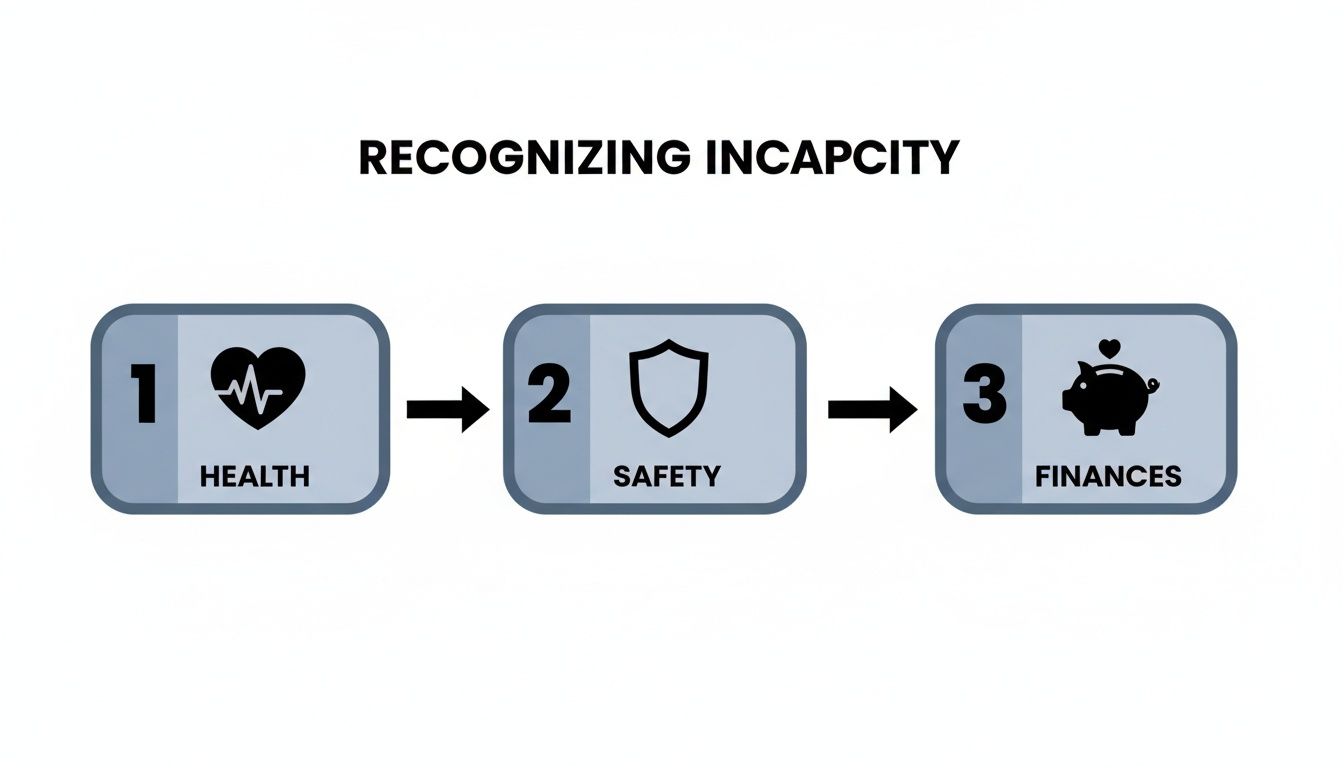
This shows that incapacity isn't just about one thing. It's about a breakdown across a person's health, safety, and financial stability that shows they simply can't manage on their own anymore.
Preparing for Your Day in Court
The process builds up to a court hearing where a judge will look at all the evidence and listen to testimony. You’ll have to be there to talk about your parent's condition and why you're ready and able to be their guardian. The attorney ad litem will also be there to share their report and recommendations with the judge.
The judge is focused on two main things:
- Is your parent legally incapacitated? The proof has to be clear and convincing.
- Is appointing you as guardian in your parent's best interest? They also need to be sure you're suitable for the role.
This isn't just a Texas issue; it's a national one. Roughly 1.3 million adults in the U.S. are under some form of guardianship. The process almost always requires legal help, medical evaluations, and court hearings that can take anywhere from 3-6 months and cost between $2,000 and $5,000.
Navigating the legal maze of guardianship is a significant undertaking. The table below breaks down the key stages you can expect in a typical Texas case, helping you see the path from filing to final order.
Key Stages of the Texas Guardianship Process
| Stage | Key Action | Required Documents/Evidence | Court-Appointed Professional |
|---|---|---|---|
| 1. Filing the Application | Submit the "Application for Appointment of Permanent Guardian" to the correct probate court. | Certificate of Medical Examination (CME) within 120 days, completed application form. | N/A |
| 2. Court Appointment & Investigation | The court appoints an independent attorney to represent the proposed ward's interests. | The court appoints an Attorney ad Litem from its approved list. | Attorney Ad Litem |
| 3. Ad Litem's Investigation | The Attorney ad Litem conducts interviews with the proposed ward, family, and doctors. | Ad litem reviews medical records, financial statements, and application details. | Attorney Ad Litem |
| 4. The Court Hearing | The judge reviews all evidence, hears testimony, and listens to the ad litem's report. | Your testimony, doctor's letter (CME), Ad Litem's report. | Attorney Ad Litem |
| 5. The Judge's Decision | The judge issues an order either granting or denying the guardianship. | Signed "Order Appointing Guardian." | N/A |
| 6. Qualifying as Guardian | If appointed, you must take an oath, post a bond, and file required paperwork. | Oath of Guardianship, Surety Bond, Letters of Guardianship. | N/A |
This table provides a bird's-eye view, but each step involves detailed legal requirements. Having an experienced attorney to guide you ensures you meet every deadline and are prepared for what the court expects.
The court's primary duty is protection. The judge's questions and the ad litem's investigation are all designed to ensure the proposed ward is not being exploited and that their fundamental rights are respected.
Successfully navigating these steps almost always requires an experienced legal guide. An attorney ensures your paperwork is filed correctly, you meet every deadline, and you are fully prepared for the court hearing. For a deeper dive, check out our guide on seeking guardianship for elderly parents in Texas. It can help you approach this with the confidence of knowing you’re doing the right thing for your loved one.
Is Guardianship The Only Option? Exploring Less Restrictive Alternatives in Texas
Going to court for guardianship is a profound step, and Texas law treats it as such. Because it involves taking away a person’s fundamental rights, a judge simply won’t grant a guardianship if there’s a less intrusive way to protect your parent. Before you even think about filing a petition, you are legally required to explore these other avenues.
Often, the best solutions are the ones your parent put in place years ago as part of a thoughtful estate planning strategy. If they had the foresight to execute certain documents while they still had full mental capacity, you might already have all the tools you need.

Powers of Attorney: The Foundation of Proactive Planning
Powers of attorney are the cornerstone of proactive life and asset protection planning. These are legal documents your parent would have signed, giving a trusted person—the "agent"—the power to make decisions for them. Unlike a court-imposed guardianship, these are completely voluntary.
You’ll typically see two kinds in Texas:
- Durable Power of Attorney (DPOA): This document is for financial matters. It gives an agent the authority to manage your parent’s finances, from paying bills and managing investments to handling property sales. The word "durable" is critical; it means the document remains in effect even if your parent becomes incapacitated.
- Medical Power of Attorney (MPOA): This appoints an agent to make healthcare decisions if your parent can't. Think of consenting to medical treatments, choosing doctors, or making end-of-life choices based on your parent's known wishes.
Imagine your mom, who is in the early stages of dementia. Five years ago, she signed a DPOA naming you as her agent. Now that she's starting to miss bill payments, you can use that document to access her bank accounts and ensure her mortgage gets paid—all without ever setting foot in a courtroom.
Supported Decision-Making and Other Tools
Beyond powers of attorney, Texas law recognizes other arrangements that provide support without stripping away someone's rights. One powerful tool is a supported decision-making agreement. This allows your parent to form a team of trusted advisors (like you, a sibling, or a close friend) to help them make their own choices, preserving their autonomy while creating a safety net.
Other practical tools include:
- Advance Directives (Living Wills): These spell out a person's wishes for end-of-life medical care, taking that gut-wrenching decision off the family's shoulders.
- Representative Payees: If your parent receives government benefits like Social Security, you can be appointed to manage just those funds for them.
- Joint Bank Accounts: While not without risks, a joint account can be a simple way for a child to help a parent with day-to-day bill paying.
The driving principle of the Texas Estates Code is to find the "least restrictive alternative" necessary to protect someone. A judge's very first question will always be, "Is there another way?"
It's crucial to understand this landscape of options. While a guardianship might seem similar to other arrangements, it's fundamentally different. To dig deeper, you can learn more about the difference between guardianship and conservatorship and how each applies here in Texas.
To make things clearer, let's compare the key differences between a court-ordered guardianship and a power of attorney. This side-by-side look can really help you figure out which path makes sense for your family's situation.
Guardianship vs. Power of Attorney: A Comparison
| Feature | Guardianship | Durable Power of Attorney |
|---|---|---|
| Origin | Court-ordered after a legal finding of incapacity. | Voluntarily created by the individual while they are still mentally competent. |
| Authority Source | The judge's order and the Texas Estates Code. | The specific powers granted within the document itself. |
| Oversight | Requires ongoing court supervision, including annual reports and accountings. | Generally operates without court involvement unless there is a dispute. |
| Flexibility | Can be difficult and costly to establish, modify, or terminate. | Can be easily revoked or changed by the principal as long as they have capacity. |
| Public Record | The court proceedings and appointment are a matter of public record. | A private document that does not need to be filed with a court. |
So, what's the bottom line? If your parent has valid powers of attorney in place and the agent is acting responsibly, a guardianship is almost always unnecessary. But if those documents don't exist, if the agent is abusing their power, or if your parent’s needs have grown beyond what these tools can handle, then guardianship might be the only responsible choice left to ensure they are safe.
Fiduciary Duties as a Guardian Under Texas Law
When a Texas court names you as a guardian for your parent, it's a profound moment. The judge's signature on that order officially changes your role. You're no longer just their concerned child; you are now their legal fiduciary.
This is a weighty responsibility. It means you are legally and ethically bound by the Texas Estates Code to act only in your parent's best interests. This is what's known as a fiduciary duty. It’s not just about making decisions; it's about managing their life and finances with the highest level of care, diligence, and complete transparency. As a fiduciary in Texas, you are now accountable not only to your parent but to the court that placed this trust in you.

Guardian of the Person vs. Guardian of the Estate
In Texas, guardianship is often split into two distinct areas of responsibility. While it's common for one person to handle both, it's critical to understand the difference in duties.
- Guardian of the Person: This is all about your parent's physical well-being. You’ll be the one making decisions about their healthcare, where they live, and their overall safety. This can mean consenting to medical procedures, choosing between home care or a facility, and making sure their daily needs—from food and clothing to comfort—are always met.
- Guardian of the Estate: This role is strictly financial. As Guardian of the Estate, you step into your parent's financial shoes. You're responsible for managing their property, bank accounts, and any income. This includes paying bills, filing taxes, and making smart, conservative decisions to protect and preserve their assets for their care.
Juggling these roles successfully comes down to meticulous organization and a deep commitment to honoring your parent's values and known wishes whenever you can.
Key Responsibilities and Court Reporting
The court hearing isn't the finish line—it's the starting block. From here on out, the court requires regular, detailed reporting to ensure you're upholding your fiduciary duties. If you don't comply, the court can, and will, remove you as guardian.
Here are some of the most important tasks you'll face right away:
- File an Inventory: You have just 30 days after your appointment to file a sworn "Inventory, Appraisement, and List of Claims." This is a comprehensive catalog of everything your parent owns—real estate, bank accounts, personal property—and any money owed to them.
- Post a Bond: For a Guardian of the Estate, the court will almost always require you to buy a surety bond. Think of it as an insurance policy that protects your parent's assets against any potential mismanagement on your part. The amount is based on the value of their estate.
- Submit Annual Accountings: Every single year, you must file a detailed financial report, the "Annual Accounting," with the court. This report has to show every dollar that came into and went out of your parent's estate over the past 12 months. Every single transaction needs to be backed up with receipts and bank statements.
The court's reporting requirements aren't just suggestions; they are legal mandates. Meticulous record-keeping is the single most important habit for any successful guardian. Keep every receipt, bank statement, and medical bill. Get organized and stay that way.
A Real-World Example of Fiduciary Duty
Let's make this real. Imagine your father, now under your guardianship, has donated to his favorite local animal shelter every year for the past two decades. As Guardian of the Estate, you see there are enough funds to continue this tradition without affecting his quality of care. Making that donation on his behalf isn't just a nice gesture; it's a perfect example of acting in his best interest by honoring his long-held values.
On the flip side, imagine you're short on cash and decide to "borrow" from his account, fully intending to pay it back. That would be a serious breach of your fiduciary duty. His money is for his benefit, and his alone.
Understanding these duties is the foundation of serving your parent well and honoring the court's trust. It can feel like a lot to handle, but with the right legal guidance from a Texas estate planning attorney, you can fulfill this crucial role with both confidence and compassion.
Preparing for Your Guardianship Court Hearing
The guardianship court hearing is the moment of truth. It’s where a judge will make the final, life-altering decision about your parent’s future. Walking into that courtroom can be incredibly intimidating, but solid preparation can turn that anxiety into quiet confidence. This is your chance to lay out a clear, compelling case for why guardianship is necessary and why you are the right person for the job.
Success in that hearing all comes down to the quality of your evidence. The judge needs to see clear and convincing proof that your parent is incapacitated, and that means going far beyond your own personal stories or observations. Your attorney is your partner in this, helping you weave all the pieces of evidence together into a coherent narrative that respectfully shows the need for the court's help.
Assembling Your Evidence
Your main goal is to paint a complete and honest picture of your parent's situation for the judge. This isn't about just one incident; it's about collecting documents and testimony that show a consistent pattern of decline—either cognitive or physical—that puts them at risk.
Think of it like building a case, piece by piece. Your evidence file should absolutely include:
- The Physician's Statement: This is the bedrock of your case, officially called the "Certificate of Medical Examination." It's the formal document where your parent's doctor states their diagnosis and professional opinion on their incapacity. It carries immense weight.
- Supporting Medical Records: Beyond that main certificate, other medical documents can add crucial context. Think about notes from specialists, hospital discharge papers, or even pharmacy records that might show a pattern of mismanaging medications.
- Witness Testimony: Hearing from others can be incredibly powerful. This could be a professional caregiver who can talk about daily struggles, a neighbor who has witnessed disoriented behavior, or even a financial advisor who has become alarmed by strange and uncharacteristic transactions.
Together, these elements must prove that your parent can no longer manage their own food, clothing, shelter, or health, or that they are unable to handle their own financial affairs.
Preparing to Testify
It's almost a guarantee that you will be asked to take the stand and testify. Both the judge and the attorney ad litem (the lawyer appointed to represent your parent's interests) will want to hear from you directly. Your testimony needs to be sharp and focused on two things: your parent's specific needs and your own fitness to serve as their guardian.
When you talk about your parent, get specific. Don't just say, "Mom is getting forgetful." A judge has heard that a thousand times. Instead, provide a concrete example: "Last Tuesday, my mother left the stove on for six hours after trying to heat up soup, and a neighbor had to call the fire department because of the smoke." See the difference?
When it's time to talk about yourself, the goal is to show you are responsible, organized, and have a solid plan in place for their care.
Your testimony is not the time to air old family grievances or complain about the situation. It's about providing factual, respectful, and compassionate information that helps the judge understand the reality of your parent's life and your genuine commitment to their well-being.
What the Judge Needs to Know
A judge in a guardianship hearing is performing a delicate balancing act. They have to weigh the need to protect a vulnerable person against the immense gravity of taking away their fundamental rights to make their own decisions. Every question you're asked is designed to get to the heart of that matter.
Be ready to answer questions that dig into the details:
- About Your Parent: "Can you describe a specific incident that made you believe your father could no longer manage his finances?" or "How has your mother's ability to care for her own hygiene changed in the last six months?"
- About Your Plan: "If you are appointed guardian, where will your parent live?" or "What is your plan for ensuring their medical appointments are kept and their bills are paid on time?"
- About Alternatives: "Did you and your family explore less restrictive options, like a Power of Attorney or a supported decision-making agreement? If so, why were those not enough to solve the problem?"
The attorney ad litem, whose job is to be your parent's advocate, will also ask tough questions to make sure guardianship is truly the only and best option. By thinking through these questions ahead of time and preparing honest, thoughtful answers, you present yourself as a capable and trustworthy person ready to take on this profound responsibility.
Your Top Questions About Texas Guardianship Answered
When you're thinking about guardianship for a parent, a million questions probably start swirling around. It’s a heavy topic, and the legal process can feel like a maze. But getting straight answers is the first real step you can take toward making the right call for your family. Let's tackle some of the most common questions we hear from folks walking this path.
Every family’s story is different, so no two journeys are exactly alike. Think of this as your foundational roadmap.
How Much Does It Cost to Get Guardianship of a Parent in Texas?
There’s really no one-size-fits-all price tag for a guardianship case in Texas; it all comes down to how complex your family’s situation is. That said, you can generally plan on a few core expenses:
- Court Filing Fees: These are the standard administrative fees just to get your case on the court's docket.
- Attorney Ad Litem Fees: The court is required to appoint an independent attorney to represent your parent’s best interests. Their fees are typically paid from your parent's estate, or sometimes by the person applying.
- Your Own Attorney's Fees: Let's be frank—you don't want to navigate this alone. Hiring a seasoned guardianship lawyer is your best bet, and their fees will be a major part of the overall cost.
If everyone is on the same page and the guardianship is uncontested, you might be looking at a few thousand dollars. But if things get contentious—say, a sibling objects—the costs can climb quickly because of the extra legal work and court time involved. We can give you a much clearer picture of potential costs during a free consultation.
Can I Get Temporary Guardianship in an Emergency?
Yes, absolutely. The Texas Estates Code has a provision for temporary guardianship for true crisis situations where your parent faces immediate, significant harm to their health or finances. This isn't for minor issues; we're talking about genuine emergencies. Think of a sudden medical event where someone needs to consent to a procedure, or you discover someone is actively draining their bank accounts.
A temporary guardianship is a fast-tracked process designed to put a stop to the immediate danger. It’s usually granted for a short period, typically just 60 days. To get one, you have to show the judge clear and convincing proof of the crisis. This is where an experienced attorney is non-negotiable—you need someone who can file the emergency paperwork correctly and get you in front of a judge, fast.
What Happens if a Sibling Contests the Guardianship?
Family disagreements can pour salt in an already open wound. When a sibling or another family member objects—either because they don't think a guardianship is needed or they don't think you should be the guardian—the case becomes "contested."
In a contested guardianship, the judge has one guiding star: the "best interest" of your parent. They will listen carefully to everyone's side of the story to figure out what outcome will best protect the person at the center of it all.
A contested case will, without a doubt, take longer and cost more. It demands a skilled lawyer who can manage the family dynamics, present a powerful case, and fiercely advocate for your parent’s well-being while navigating the conflict. Strong legal counsel is what keeps the focus right where it belongs: on protecting your mom or dad.
If you’re considering guardianship or need to plan your estate, contact The Law Office of Bryan Fagan, PLLC for a free consultation. Our attorneys provide trusted, Texas-based guidance for every step of the process. Visit us at https://texastrustadministration.com to get started.