Skip to content
Deciding to pursue guardianship for a parent is a profound step, one often born from the painful realization that they can no longer make safe decisions on their own. Managing a loved one's care can feel overwhelming, but with the right legal guidance, it doesn’t have to be. In Texas, guardianship is a formal legal process where a court finds a person to be legally incapacitated and appoints a qualified adult—often a child—to manage their personal, medical, or financial affairs.
Think of it as a legal safety net. As defined in the Texas Estates Code, this is a protective measure, not a punishment, designed to shield your parent when they are at their most vulnerable.
Knowing When Guardianship Is the Right Choice for Your Parent

This is one of the most emotionally charged decisions an adult child will ever face. It typically follows months or even years of worry, watching a slow decline or dealing with a sudden, life-altering event. Recognizing the signs that guardianship might be the only path forward is the first step in protecting a parent who can no longer protect themself.
Recognizing the Signs of Incapacity
In Texas, the legal standard for guardianship is "incapacity." This key term, defined under the Texas Estates Code, means a person is substantially unable to provide for their own basic needs (like food, clothing, and shelter) or manage their financial affairs due to a physical or mental condition. This is far more than occasional forgetfulness.
Here are a few real-world scenarios showing how these issues can arise in Texas:
- Financial Vulnerability: Your mother, who has early-stage dementia, starts giving large sums of money to telemarketers. You find stacks of unpaid bills on her kitchen table, even though you know she has funds in her bank account.
- Medical Neglect: Your father, recovering from a serious stroke, consistently forgets to take his essential heart medication. He may even refuse necessary medical care because he doesn't fully grasp the dire consequences.
- Safety Risks at Home: You stop by to find the stove was left on again. Perhaps your parent has started wandering from home and getting lost, or their house has become unsanitary and unsafe.
These are not minor signs of aging; they are red flags indicating your parent may lack the capacity to make sound judgments, putting their health, safety, and finances in serious jeopardy.
When Alternatives Are No Longer Enough
Guardianship should always be the last resort. Before petitioning a court, you must explore less restrictive alternatives. These are legal tools that can provide necessary protection without removing your parent's fundamental rights.
The most common alternatives include:
- Durable Power of Attorney: This document lets a trusted person (the "agent") manage financial affairs.
- Medical Power of Attorney: This designates someone to make healthcare decisions if a parent is unable to.
- Advance Directives (Living Will): This spells out a person's wishes for end-of-life medical care.
However, your parent must have had the mental capacity to understand and sign these documents before they became incapacitated. If they never put these in place, or if their cognitive decline is now too severe for them to make rational decisions, guardianship may be the only remaining option. Learning about a power of attorney for aging parents can help you understand why it's the first tool to consider.
Evaluating if your parent can get by with other support systems is also part of this process. It's important to figure out how to determine if your parents need assisted living versus needing a guardian to manage their affairs.
Guardianship vs. Alternatives in Texas
To make sense of these options, it helps to see them side-by-side. Guardianship is a court-supervised process, while alternatives like Powers of Attorney are private agreements.
| Feature | Guardianship | Durable Power of Attorney | Medical Power of Attorney |
|---|---|---|---|
| Court Involvement | Required. A judge must approve the appointment and oversee the guardian's actions. | None. This is a private legal document that does not require court involvement. | None. A private document that activates when a doctor certifies incapacity. |
| Authority | Broad. Can cover personal, medical, and financial decisions, as specified by the court. | Limited to financial matters. The agent can manage bank accounts, pay bills, sell property. | Limited to healthcare decisions. The agent can consent to medical treatments and care. |
| When It's Used | When a person is already incapacitated and never signed Powers of Attorney, or if there's evidence of abuse by an agent. | When a person is still competent and wants to plan for future incapacity. | When a person is still competent and wants to name a healthcare decision-maker. |
This table highlights the fundamental difference: Powers of Attorney are proactive tools for planning ahead, while guardianship is a reactive solution for a crisis that is already happening.
At its core, pursuing guardianship is an act of protection. It grants you the legal authority needed to ensure your parent receives proper medical care, lives in a safe environment, and is shielded from financial exploitation when they can no longer do those things for themselves.
First, A Crucial Reality Check: Exploring Less Restrictive Alternatives
Before stepping into a courtroom, you must understand a fundamental principle of Texas law: guardianship is a last resort. This isn't just a legal hoop to jump through; it's a compassionate approach that honors your parent's dignity and autonomy.
A guardianship is a court order that removes a person's basic rights to make their own choices. It is a drastic measure. That is why a judge will not consider it unless you can prove that every other, less intrusive option has been explored and found insufficient.
The Power of Planning Ahead: Power of Attorney Documents
The best way to avoid a guardianship is through foresight. The most common and effective tools are created through proactive estate planning, specifically the Durable Power of Attorney and the Medical Power of Attorney. These documents are your parent's voice, recorded in writing while they were still able to clearly state their wishes.
- Durable Power of Attorney (Financial): This is the workhorse for managing finances. It gives a trusted person (the "agent") the legal authority to handle your parent’s financial life—paying bills, managing bank accounts, filing taxes, and more. The "durable" part is key; it means the document remains valid even if your parent becomes incapacitated.
- Medical Power of Attorney (Healthcare): This appoints an agent to make healthcare decisions, but only after a doctor certifies your parent can no longer make those decisions themselves. This covers choosing doctors, consenting to treatments, and accessing medical records.
- Advance Directive (Living Will): This is a companion to the Medical Power of Attorney. It specifically details your parent's wishes for end-of-life care, such as their feelings on life support.
If your parent signed these documents while they were mentally competent, the person they chose can step in and help immediately, no court required. This is the best-case scenario, as it respects your parent's choices and avoids the cost and stress of a court proceeding.
What Happens When There's No Plan?
This is where things become difficult. The primary reason most families end up in court is when a parent becomes incapacitated without these documents in place.
Once they've lost capacity, it's too late. They can no longer legally sign a Power of Attorney. Suddenly, no one has the legal authority to act. Banks won't discuss their accounts. Doctors can't proceed with necessary treatments without proper consent. The family is in a difficult position.
When a parent can no longer manage their own affairs and there are no legal documents in place, guardianship becomes the only viable path. It is the tool of last resort for obtaining the legal authority you need to protect them.
Guardianship vs. Powers of Attorney: What's the Real Difference?
It’s easy to confuse these concepts, but they are worlds apart. Both grant someone the power to make decisions, but their creation and oversight could not be more different.
| Feature | Guardianship | Powers of Attorney (Durable & Medical) |
|---|---|---|
| Initiation | Court-ordered after a legal process proves incapacity. | Signed privately by the individual while they still have capacity. |
| Supervision | Involves constant court supervision, including annual reports. | Entirely private with no court oversight unless there's abuse. |
| Flexibility | The guardian’s powers are strictly limited by the court order. | The document can be customized to grant broad or very specific powers. |
| Revocation | Can only be ended by a judge's order. | Can be revoked by the person anytime, as long as they are competent. |
Grasping these distinctions is essential. If you’re at this crossroads, understanding the difference between a power of attorney and a legal guardian is one of the smartest first steps you can take. It’s all about making a compassionate, informed choice that truly serves your parent's best interests.
Getting Started with the Texas Guardianship Legal Process
The Texas guardianship process is a structured legal roadmap designed for one purpose: protecting your parent. The Texas Estates Code lays out every step of the journey, ensuring your parent’s rights remain front and center.
The process begins when you, the “applicant,” file a document called an Application for Appointment of Permanent Guardian. This is a formal legal petition filed with the court, usually in the county where your parent resides. This document is the foundation of your entire case.
Filing the Application and Gathering Your Proof
Your application must tell a clear story, explaining exactly why a guardianship is needed and detailing your parent’s condition. The single most important piece of evidence you will submit is a physician's certificate of medical examination.
This is a sworn statement from a doctor, and it must be recent—completed within the last 120 days.
Without this medical proof, a judge simply cannot grant a guardianship. The doctor's report must be specific, describing the nature and severity of your parent's condition and giving a professional opinion on their ability to make responsible decisions.
Getting this initial filing right is critical. Being precise and thorough here can save you significant time and stress down the road.
What Is an Attorney Ad Litem?
Once the paperwork is filed, the court’s first move is to protect your parent. The judge will immediately appoint an independent attorney, called an attorney ad litem, to represent your parent’s interests. This is a mandatory and vital step in Texas.
The ad litem’s job is to be your parent's dedicated advocate. They will:
- Meet with your parent to explain what's happening in an understandable way.
- Interview you, other family members, and the doctor who provided the medical certificate.
- Determine your parent's wishes and ensure they are heard in court.
- Investigate all facts to confirm that guardianship is truly the only option and that you are the right person for the job.
After this investigation, the ad litem submits a formal report to the judge with their findings and recommendations. This report carries significant weight in the final decision.
This visual below helps clarify where guardianship fits in with other, less restrictive options that a court will always consider first.
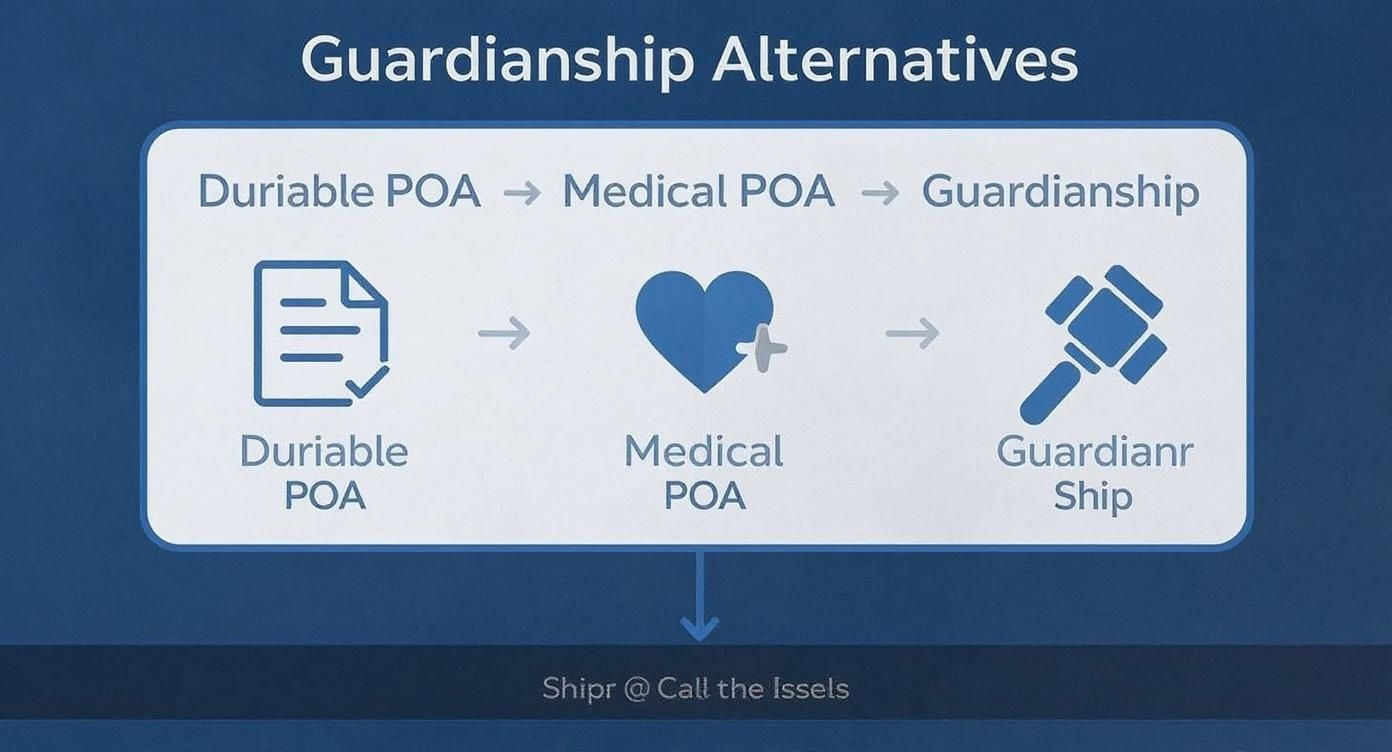
As you can see, moving from private documents like a Power of Attorney to a court-ordered guardianship shows an increasing level of intervention, usually because pre-planning wasn't possible.
Getting Ready for the Court Hearing
After the ad litem completes their work, the court sets a date for a hearing. The judge will listen to testimony, review all the evidence, and make a final decision. You will need to be there to testify about why you believe your parent is incapacitated and needs your help as a guardian.
The legal standard of proof is "clear and convincing evidence," which is a high bar. You must prove two things:
- That your parent is legally incapacitated.
- That appointing you as their guardian is in their best interest.
This is why attempting to navigate the process alone is so risky. Understanding the rules of evidence, knowing how to present your case, and answering a judge’s questions is what a skilled guardianship attorney does. For a closer look at finding the right legal help, take a look at our essential guide to family and estate lawyers in Texas.
This process reflects a nationwide need to protect vulnerable adults. Data from 36 states shows that, on average, 41.2% of adults with certain disabilities are under some form of guardianship. You can explore these numbers yourself in the full report on guardianship practices.
If the judge finds that you've met all legal requirements, they will sign an order appointing you as guardian. From there, you'll take an oath and post a bond before you can officially begin your duties.
What a Guardian in Texas Actually Does

Stepping into the role of a guardian is a significant legal and personal responsibility. The court is placing its trust in you to protect your parent. You are now a fiduciary, a legal term meaning you are bound by law to act solely in your parent’s best interests.
This fiduciary duty is the bedrock of guardianship in Texas. Every decision, from choosing a doctor to paying a bill, must be for their benefit—not yours or anyone else’s. It demands integrity and, just as importantly, transparent and meticulous record-keeping. The court will monitor your actions to ensure you uphold your responsibilities.
Guardian of the Person vs. Guardian of the Estate
Texas law splits guardianship into two main roles. Sometimes one person handles both, but a court can appoint two different people if it is in the parent's best interest.
Guardian of the Person
This role focuses on your parent's day-to-day well-being, both physical and emotional. Practical advice for this role includes:
- Healthcare Decisions: You will consent to medical treatments, select their doctors, and ensure they get the care they need.
- Living Arrangements: You decide where your parent will live, whether it be at home with aides, in an assisted living community, or a nursing home.
- Daily Needs: You are responsible for ensuring they have proper food, clean clothing, and opportunities for social engagement.
If your parent is dealing with cognitive decline, this role might also involve learning about specialized care for conditions like dementia to make better-informed decisions.
Guardian of the Estate
This job is strictly about managing your parent's finances and property. Duties include:
- Managing Finances: This covers paying monthly bills, managing bank accounts, and overseeing investments.
- Protecting Assets: Your job is to ensure their property is safe from loss, damage, or financial exploitation through sound asset protection strategies.
- Applying for Benefits: You will likely handle applications for Social Security, Medicare, Medicaid, or VA benefits.
The court order will spell out exactly what you can and cannot do. You must stay within the boundaries of the authority the judge grants you.
Your Legal Duties: Step-by-Step Guidance
Once appointed, you have several key legal tasks required by the Texas Estates Code. These are mandatory steps to protect your parent (who the court now calls the "ward") and maintain transparency.
At the end of the day, your North Star is this: always act in your parent's best interest. This single principle trumps everything else—your own convenience, what other family members want, everything.
The court expects you to be both diligent and prudent. Here are the immediate tasks you’ll need to tackle:
- Take an Oath and Post a Bond: Before you can act, you’ll sign a sworn oath promising to faithfully perform your duties. The court will almost always require you to post a bond, which is an insurance policy that protects your parent’s assets in case of mismanagement.
- File an Inventory: You have 90 days from your appointment to file a detailed, sworn inventory of all your parent's property with the court.
- File Annual Reports and Accountings: Every year, you must report back to the court. A Guardian of the Person files a "Report on the Condition and Well-Being of the Ward." A Guardian of the Estate files a formal "Annual Accounting," meticulously detailing every dollar that came in and every dollar that went out.
These reporting requirements are the court’s way of overseeing the guardianship and preventing abuse. The deadlines are firm. From day one, get in the habit of keeping perfect records.
When Guardianship Gets Messy: Handling Family Fights and Contested Cases
Even with the best intentions, raising the topic of guardianship can sometimes feel like kicking a hornet’s nest. It is an incredibly emotional process, and it’s not unusual for siblings or other family members to have different ideas about what is best for an aging parent. This is a real-world scenario where families often need guidance on dispute resolution.
What should be a straightforward legal matter can quickly spiral into a contested guardianship. Suddenly, you are not just dealing with the court; you are dealing with family drama, added stress, and mounting legal bills.
These disputes rarely come from a place of malice. Usually, they are born from different perspectives. One sibling, who sees the day-to-day decline, might feel guardianship is the only way to keep their mother safe. Another, who only calls on weekends and hears a cheerful voice, may see it as an unnecessary overreach that strips their parent of dignity. Both believe they are doing the right thing.
Why Families Fight Over Guardianship
Most family feuds in these cases boil down to a handful of core issues. Being aware of these can help you prepare for and handle potential conflict.
- Disagreement Over Incapacity: This is the big one. Is Mom really incapacitated? The sibling who lives across the country may not see the unpaid bills, missed appointments, or concerning weight loss that the local sibling witnesses daily.
- The "Who's in Charge?" Showdown: Sometimes everyone agrees a guardian is needed, but two or more siblings want the job. This can dredge up old rivalries and turn into a battle over who is best equipped to manage their parent’s finances or healthcare.
- Suspicions and Ulterior Motives: Unfortunately, this happens. A family member might worry that the person seeking guardianship is really after their parent’s money or trying to control the inheritance. These accusations can poison the well and make cooperation impossible.
When conflicts like these bring the process to a halt, your parent is the one left vulnerable. That's when Texas courts step in, guided by a single, powerful principle: the best interest of the proposed ward.
How Texas Courts Cut Through the Drama
In a contested guardianship, the judge’s role is paramount. Their job is to be a neutral fact-finder who looks past the arguments to determine what will truly protect your parent. The process becomes more formal, like a probate trial, where each side presents evidence.
The judge will sift through everything—conflicting doctor's reports, financial statements, and testimony from family members. The report from the attorney ad litem—the independent lawyer appointed to represent your parent—becomes especially critical. Their unbiased investigation and recommendation carry significant weight.
In a contested case, the court's sole objective is to protect the incapacitated person. A judge will listen to all sides but will ultimately make a decision based on what is safest and most beneficial for your parent, not what pleases the family members.
If the family feud is too toxic, the judge has other options. They might decide that no family member is a suitable choice and instead appoint a neutral, third-party professional guardian. This is often a certified guardian or an attorney who can manage your parent’s affairs without getting entangled in family baggage. While it can feel like a loss, it is sometimes the only way to get your parent the stable, objective protection they need. A skilled Texas guardianship attorney becomes your most valuable ally. They can help you build a clear, evidence-based case focused on your parent's well-being while trying to keep the emotional temperature from boiling over.
Your Questions About Texas Guardianship Answered
Navigating guardianship for a parent brings up many questions. It’s a legal path designed to protect, but from the outside, it can feel complex. Let's clear up some of the most common concerns we hear from families like yours.
How Much Does It Cost to Get Guardianship of a Parent in Texas?
The final cost for guardianship can vary widely, depending primarily on whether the case is contested. Every case has fixed costs, such as court filing fees and the fee for the attorney ad litem—the lawyer the court appoints to represent your parent. Then, you will have your own attorney's fees.
An uncontested guardianship, where everyone agrees, is the most affordable route. But if another family member objects, things get complicated. That means more hearings, more legal work, and higher costs. The best way to understand the potential cost is to consult with an experienced attorney who can assess your family's unique situation.
How Long Does the Texas Guardianship Process Take?
Be prepared for a timeline that can range from a few months to over a year. A straightforward, uncontested case where you have all the medical paperwork ready will be on the faster end.
Common causes for delays include:
- Court Backlogs: Some court dockets are busy, which can slow down scheduling.
- Getting Medical Evidence: It can sometimes be a challenge to get a doctor to complete the required physician's certificate quickly and thoroughly.
- A Contested Case: If your parent or another family member objects, the process stops and becomes a full court case, adding significant time.
A good Texas attorney knows how to anticipate these hurdles and can ensure everything is filed correctly from the start to avoid unnecessary delays.
Can I Be Appointed Guardian if I Live Out of State?
Yes, you can. Texas law allows an out-of-state resident to serve as a guardian for a parent who lives here. The main requirement is that you must appoint a resident agent in Texas. This is someone who agrees to be the official point of contact for any legal notices.
Keep in mind, the court will look very closely at your situation. The judge needs to be convinced that living out of state will not interfere with managing your parent's daily care and finances. The decision will always come down to what is in the best interest of the incapacitated person.
Even if you live outside of Texas, your ability to serve as guardian hinges on proving to the court that you can diligently and effectively fulfill your duties from a distance.
What Happens if My Parent Objects to the Guardianship?
An adult has a fundamental right to object to a guardianship, and the court takes that objection very seriously. This is precisely why an attorney ad litem is appointed—their job is to be your parent's voice and advocate for their wishes.
The moment your parent objects, the case becomes contested. This triggers a full hearing where the judge will weigh all the evidence. The core question becomes whether your parent is legally incapacitated and if guardianship is truly the least restrictive way to keep them safe. This is a scenario where having a skilled lawyer is non-negotiable; you'll need to present "clear and convincing" evidence to make your case.
If you’re managing a loved one's care or planning your estate, contact The Law Office of Bryan Fagan, PLLC for a free consultation. Our attorneys provide trusted, Texas-based guidance for every step of the process. You can learn more at https://texastrustadministration.com.