Skip to content
Life is constantly evolving, and your estate plan should evolve with it. If you've established a trust, you may find that circumstances have changed since it was created. Amending a trust is a normal—and necessary—part of keeping your affairs in order. It's not a sign you did something wrong the first time; it's a smart move to ensure your legal documents reflect your current wishes, whether you're working with a flexible revocable trust or a more permanent irrevocable one.
Managing a loved one’s trust or your own estate plan can feel overwhelming—but with the right legal guidance, it doesn’t have to be.
Knowing When It's Time to Tweak Your Texas Trust
Thinking about your estate plan can feel like trying to navigate a complex map, but updating a trust is a straightforward process when you know what to look for. Life never stands still. Families grow, finances fluctuate, and relationships change. Those are the very moments the ability to amend a trust was designed for—it keeps your plan from becoming outdated.
Your trust is a living document that should grow and change right along with you. For instance, a Houston business owner who set up a trust in her thirties will almost certainly need to make changes after a couple of decades of professional success. A couple in San Antonio might need to add a provision for a new grandchild or change the person they named as guardian for their children.
Key Triggers for a Trust Amendment
Some life events are clear signals that it’s time to review your trust documents. Being proactive now can save your family a world of confusion, arguments, and legal headaches down the road.
You should give your trust a careful review if any of these situations sound familiar:
- Family Shake-Ups: A marriage, divorce, the birth of a child or grandchild, or the death of a beneficiary or trustee are all significant reasons to update your plan.
- Big Money Moves: A substantial inheritance, the sale of a major asset, or a significant change in your net worth should trigger a review.
- New Scenery: Moving to another state can impact your estate plan, as every state has its own unique laws.
- Relationship Shifts: Sometimes, you simply change your mind. You might want to add or remove a beneficiary or choose a different person to serve as your successor trustee.
A trust amendment is your tool for staying in control of your legacy. It lets you adapt to whatever life throws your way, ensuring your goals for asset protection and distribution are always up-to-date and reflect what you want now, not what you wanted five years ago.
The numbers back this up. A recent study found that about 53% of trust amendments occurred because of family changes like births or divorces. Another 30% were prompted by shifts in tax or estate laws. This data underscores how critical it is to keep your documents current.
Ultimately, understanding when and why to amend a trust is fundamental to effective estate planning. A well-maintained trust provides peace of mind, allowing you to rest easy knowing your legacy will be handled exactly as you intend. For a deeper dive, learn more about updating your Texas estate plan and why it matters.
Choosing Your Method: Amendment vs. Restatement
Deciding your trust needs an update is the first step. The next is determining how to do it. Under the Texas Trust Code, you have two primary tools for changing a revocable living trust: an amendment or a restatement. Each serves a different purpose, and choosing the right one is key to keeping your estate plan clear and effective.
A trust amendment is like a surgical update. It’s a separate legal document that modifies a few specific parts of your original trust. It doesn't replace the entire document; instead, it adds, alters, or removes a particular provision.
A restatement, on the other hand, is a complete overhaul. It replaces the original trust document and all its previous amendments with one new, consolidated version. The benefit of a restatement is that it keeps the original name and date of the trust, which means you don't have to retitle your assets. It gives you a clean slate without the administrative headache.
When a Simple Amendment Makes Sense
An amendment is your best option for small, isolated changes. If your overall plan remains sound but just needs a few minor tweaks, an amendment is the most efficient and cost-effective approach.
Here are a few practical scenarios where an amendment is the perfect fit:
- Swapping Out a Fiduciary: Your chosen successor trustee has moved or is no longer able to serve. An amendment can name a new one.
- Adjusting a Specific Gift: You’ve decided to increase a cash gift to a charity or want a different grandchild to receive a family heirloom.
- Adding or Removing Someone: A new grandchild is born, and you want to add them as a beneficiary.
- Updating Basic Info: A beneficiary or trustee has moved, and you just need to update their address.
Think of amendments like patches. One or two are fine, but too many can create a confusing patchwork that makes it difficult for your successor trustee to understand your true intentions, leading to delays and family disputes.
When a Full Restatement Is the Wiser Path
While amendments are useful, a restatement is often the smarter choice when you're making significant changes or have already made several amendments over the years. A restatement consolidates everything into one clear, authoritative document, eliminating any potential confusion from old, conflicting terms.
A full restatement is recommended in these situations:
- Major Life Events: A divorce, remarriage, or the death of a spouse often requires a complete rethinking of your asset distribution. A restatement makes your new wishes unambiguous.
- Too Many Amendments: If you have two or three amendments attached to your trust, it’s time to consolidate. This prevents your trustee from having to piece together your wishes from multiple documents.
- Fundamental Changes to the Plan: If you’re changing the core of your trust—for example, switching from simple distributions to long-term asset protection trusts for your children—you need a restatement.
- Changes in the Law: Federal or Texas estate tax laws change over time. A restatement may be necessary to take advantage of new planning strategies or avoid new tax liabilities.
This decision tree gives you a simplified look at how life events should trigger a review of your trust.
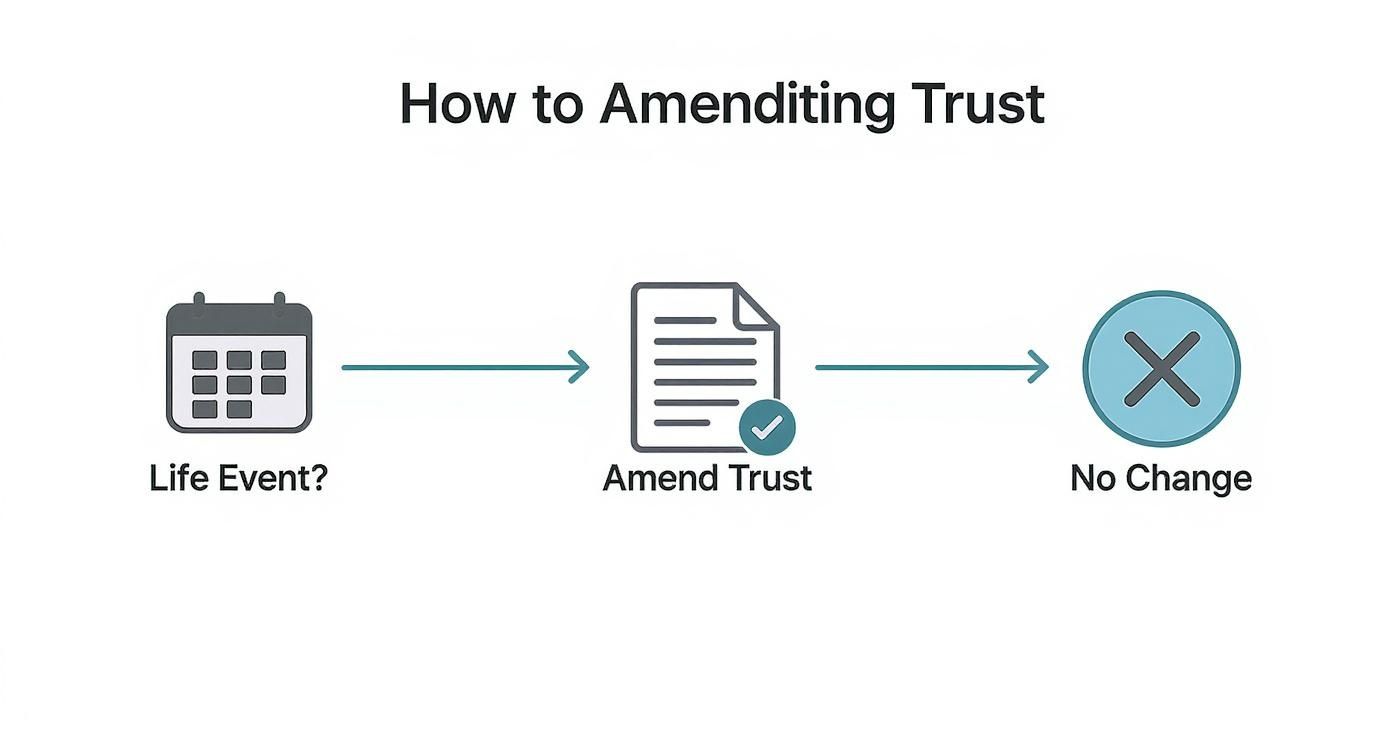
As the flowchart shows, any significant life change should be a signal to sit down with a Texas estate planning attorney. They can help you determine if a simple amendment will suffice or if a full restatement is the best move to protect your legacy and provide peace of mind.
To help you decide, here’s a quick comparison of the two approaches.
Trust Amendment vs. Trust Restatement: A Quick Comparison
Use this table to decide whether a simple amendment or a full restatement is right for your Texas trust.
| Consideration | Trust Amendment | Trust Restatement |
|---|---|---|
| Scope of Changes | Best for minor, specific changes (e.g., changing a trustee). | Ideal for major, comprehensive changes (e.g., new distribution plan). |
| Complexity | Simple, short document that modifies the original trust. | A completely new document that replaces the original and all prior amendments. |
| Clarity | Can become confusing if there are multiple amendments. | Creates a single, easy-to-understand document. |
| Cost | Generally less expensive and faster to draft. | More time-consuming and costly upfront, but can save money later. |
| Privacy | Only the changes are documented; original terms remain. | The entire new plan is stated, which can be useful for privacy. |
| When to Use | For one or two small updates to an otherwise solid plan. | After major life events, multiple prior amendments, or significant law changes. |
Ultimately, choosing between an amendment and a restatement is about maintaining clarity. The goal is to leave behind a plan that is easy for your loved ones and your trustee to understand and execute. When in doubt, consolidating everything into a fresh, restated trust is almost always the safest option.
The Process for Amending a Revocable Trust
Once you’ve decided an amendment is the right tool, the next step is to execute it correctly. In Texas, a trust amendment is a formal legal document that must meet specific requirements. Getting it right ensures your wishes are legally binding and prevents future confusion for your family.

The first rule of amending a trust is simple: review your original trust document. Most well-drafted trusts include a specific clause outlining the exact method for making changes. This provision is your instruction manual. If you deviate from it, you risk invalidating your amendment.
If your trust is silent on how to amend it, the Texas Trust Code provides the legal roadmap.
Drafting the Amendment Document
An amendment must be drafted with precision. The document should clearly state that it is an "Amendment" to your existing trust to eliminate ambiguity. It is also crucial to identify the original trust by its full name and the exact date it was created.
For instance, the introduction might read:
"This First Amendment to the John and Jane Doe Revocable Living Trust, dated January 15, 2020, is made by John Doe and Jane Doe, the Grantors of the Trust."
This level of detail leaves no doubt about which document is being changed. From there, the amendment must specify exactly which articles or sections of the original trust are being modified, removed, or replaced. Vague language is your enemy; the goal is to make your intentions crystal clear for your successor trustee.
A Real-World Scenario: Changing a Guardian
Let’s look at a common situation. A young couple, Mark and Sarah, set up a trust when their children were toddlers, naming Sarah’s sister as guardian. A decade later, her sister has moved abroad. They now want Mark's brother, who lives nearby and has a strong relationship with the children, to serve in that role.
To make this happen, they would draft an amendment that:
- Clearly identifies their original trust by its full name and date.
- References the specific article that names the guardian.
- Explicitly states that the provision naming Sarah's sister is revoked.
- Adds a new provision naming Mark's brother as the new guardian and also names a successor guardian as a backup.
This step-by-step process replaces old information with new, ensuring their wishes for their children's care are legally documented and reflect their current reality.
Required Formalities: Signature and Notarization
Under Texas law, how you sign the amendment is as important as what it says. To be valid, the amendment must be signed by the grantor—the person who created the trust.
However, a signature alone is not enough. Your signature must be acknowledged before a notary public. A notary serves as an impartial witness, verifying your identity and confirming you are signing the document of your own free will. This step adds a critical layer of legal protection against future claims of fraud or duress.
While witnesses aren't always legally required for a trust amendment in Texas (unless your trust document specifies otherwise), having them can provide an extra layer of security.
These rules apply to the most common type of trust used in estate planning. For more on this flexible tool, feel free to review our detailed guide on what a revocable trust is and how it functions.
The most reliable way to navigate this process is by partnering with an experienced Texas estate planning attorney. A legal professional ensures your amendment not only follows the instructions in your original trust and the Texas Trust Code but also that the language is precise and legally sound. This guidance provides peace of mind, knowing your amendment will stand up to scrutiny and achieve your objectives.
Modifying an Irrevocable Trust in Texas
While changing a revocable trust is relatively straightforward, the term "irrevocable" sounds permanent. However, Texas law recognizes that circumstances can change in ways a grantor could never have anticipated. Modifying an irrevocable trust is more complex than updating a revocable one, but it is not impossible. It requires following a careful legal path that honors the grantor's original wishes while adapting to modern realities.

Unlike a revocable trust where the grantor retains control, changing an irrevocable trust usually involves the beneficiaries—and sometimes the courts. The goal is to demonstrate that the proposed change is necessary and aligns with the trust’s core purpose, even if it alters specific terms.
Non-Judicial Settlement Agreements
One of the most efficient ways to amend a trust after it has become irrevocable is through a non-judicial settlement agreement (NJSA). As outlined in the Texas Trust Code, this method allows all beneficiaries to unanimously agree on a modification without going to court.
An NJSA is a practical tool for resolving issues that have universal agreement. For example, an NJSA is ideal for:
- Clarifying ambiguous terms in the trust document.
- Approving a trustee’s accounting or final report.
- Changing the trustee or establishing a resignation process.
- Moving the trust's primary place of administration to another state.
However, an NJSA cannot be used if the change would violate a material purpose of the trust. For instance, if a trust includes a spendthrift clause to protect a beneficiary from creditors, the beneficiaries cannot agree to remove it on their own.
When Court Intervention Is Necessary
If the beneficiaries cannot reach a unanimous agreement, or if the proposed change affects a material purpose of the trust, the next step is to seek a judicial modification from a court. A trustee or a beneficiary can petition a Texas court to approve changes under specific conditions.
The Texas Trust Code grants a court the power to order a modification if:
- The trust's purposes have been fulfilled or have become illegal or impossible to achieve.
- Circumstances not anticipated by the grantor have arisen, and the change will further the trust's goals.
- The modification is needed to meet the grantor's tax objectives.
A court’s primary duty is to protect the grantor's original intent. Any petition to modify the trust must make a compelling case that the change helps fulfill that vision, not just make things more convenient for the beneficiaries.
This process underscores the seriousness of a trustee’s fiduciary duties in Texas. A trustee must always act in the best interests of all beneficiaries. They may even have a duty to initiate the modification process if the trust's terms have become impractical or harmful due to unforeseen events.
A Real-World Scenario: Modifying for a Special Need
Consider this example: a trust was created by parents for their three adult children, with assets to be distributed equally upon their passing. Years later, one child suffers a severe accident, leaving them permanently disabled and reliant on government benefits like Medicaid.
A direct inheritance from the trust could disqualify them from receiving that critical assistance. The original trust, written long before the accident, did not account for this possibility.
In this situation, the family has options. With guidance from a Texas trust administration lawyer, the beneficiaries could use a non-judicial settlement agreement to modify the trust. They could agree to convert the disabled sibling’s share into a Special Needs Trust, allowing those funds to provide for supplemental care without jeopardizing their government aid.
If one sibling were to refuse, the other beneficiaries and the trustee could petition the court. They would argue that the accident was an unforeseen circumstance and that creating a special needs provision furthers the parents' original intent: to provide for the well-being of all their children.
Navigating the modification of an irrevocable trust requires a deep understanding of Texas law and fiduciary principles. Whether you're pursuing a private agreement or require court intervention, working with a skilled attorney is crucial to protect the trust, honor the grantor's legacy, and secure the beneficiaries' futures.
Avoid Costly Pitfalls After Amending Your Texas Trust
You’ve successfully drafted and signed your trust amendment. While it may feel like you’ve crossed the finish line, the process isn’t over yet. Making a change legally valid is only half the battle. The next critical step is ensuring the amendment is properly implemented so it functions as intended.
Overlooking these final follow-up actions can accidentally undermine your entire plan, creating the very confusion and family disputes you were trying to prevent.

Forgetting to Retitle Your Assets
This is one of the most common and costly mistakes. A trust only controls the assets it legally owns. If your amendment changes how an asset is handled—for example, removing it from the trust—you must update the legal title to reflect that change.
Suppose you amend your trust to remove a rental property so you can gift it directly to your son. The amendment itself does not transfer ownership. You must sign and record a new deed that moves the property from the trust's name into your son's name. If you skip this step, the property legally remains in the trust, and your amendment's instructions become ineffective.
Using Vague or Ambiguous Language
In legal documents, clarity is paramount. An amendment with imprecise language can create significant challenges for your successor trustee. Phrases like "a reasonable amount" or "my personal effects" are open to interpretation and can lead to beneficiary disputes.
A well-drafted amendment is specific. Instead of leaving "a portion of the estate" to a grandchild, state the exact percentage or dollar amount. This precision prevents arguments and allows your trustee to follow your instructions without guesswork.
Creating Conflicting Terms
When you add an amendment, you are layering new instructions onto an existing document. It is surprisingly easy to write a new provision that accidentally conflicts with an old one.
An amendment should always explicitly state which part of the original trust it is replacing or modifying. This direct language resolves potential contradictions before they can cause a legal battle, ensuring a seamless interpretation of your wishes.
This issue is increasingly common as financial lives become more complex, especially with digital assets like cryptocurrency and online investment accounts. Many older trusts do not account for these assets. It's projected that by 2025, around 40% of new trust amendments will need to include specific instructions for managing digital assets, highlighting how modern wealth has evolved.
Failing to Properly Execute the Document
Formalities matter. In Texas, a trust amendment must be signed and notarized to be valid. Simply writing down your wishes and signing them is not enough. Forgetting the notary stamp can invalidate the entire document, rendering your intended changes legally void.
Keeping Your Trustee in the Dark
Your successor trustee is the person legally responsible for carrying out your trust's instructions. A common oversight is amending a trust without informing the person who will one day manage it. This can lead to confusion and delays when they eventually step into their role.
While you aren't legally required to share every change with a future trustee, keeping them informed is a practical and considerate step. It helps them understand their future responsibilities and ensures they are aware of your most current wishes. To learn more about what is expected of them, you can review our guide on trustee duties and responsibilities in Texas.
Finally, having a Texas trust administration lawyer conduct a final review can help you avoid these pitfalls and safeguard your estate plan’s integrity.
Common Questions We Hear About Amending a Texas Trust
Making changes to your trust can feel complex. To provide clarity, we’ve answered some of the most common questions we receive from clients across Texas. This information can give you more confidence as you take the next steps.
Can I Just Amend My Trust Myself, Without a Lawyer?
It’s tempting to handle what seems like a simple change on your own. Legally, you can draft an amendment yourself, but we strongly advise against this DIY approach.
The Texas Trust Code has specific requirements for how these documents must be worded, signed, and witnessed. A small error—using incorrect legal phrasing, failing to properly reference the original trust, or making a mistake in the signing process—can render the entire amendment invalid.
Hiring a Texas estate planning attorney is the best way to ensure your changes are legally sound and achieve your goals. It’s a modest investment to prevent costly legal battles and confusion for your family later.
What's the Cost to Amend a Trust in Texas?
The cost depends on the complexity of the changes.
- A Simple Fix: For a straightforward change, like updating a successor trustee or a beneficiary's name, the cost will be relatively low.
- A Full Restatement: A complete overhaul of the trust will have a higher upfront cost. However, this often saves money and stress in the long run by creating a single, clear, and easy-to-understand document.
A reputable attorney will review your existing trust, discuss your objectives, and provide a clear, flat-fee quote before any work begins.
One of the biggest mistakes that leads to contentious court battles is an amendment that creates conflicting instructions with the original trust. A well-drafted amendment will be crystal clear about which parts of the old document are being changed or replaced. If there is ambiguity, a court may have to step in to interpret your intent—a stressful and expensive process for your loved ones. This is precisely why professional legal guidance is so important.
Do I Have to Tell My Beneficiaries I'm Changing My Revocable Trust?
For a standard revocable living trust, the answer is generally no. As long as you are alive and have legal capacity, you maintain full control. You can make changes privately without informing the beneficiaries.
The situation changes once the trust becomes irrevocable upon your passing. At that point, the successor trustee has a legal obligation under their fiduciary duties in Texas to provide a copy of the complete trust—including all amendments—to the qualified beneficiaries.
For legal professionals or anyone curious about the business side of estate law, it can be interesting to see how firms connect with clients needing these services. You can explore some common approaches in these Top Estate Planning Attorney Marketing Strategies.
If you’re managing a trust or planning your estate, contact The Law Office of Bryan Fagan, PLLC for a free consultation. Our attorneys provide trusted, Texas-based guidance for every step of the process. Learn more about us at https://texastrustadministration.com.