Thinking about a time when you might be unable to manage your own affairs can feel overwhelming, but preparing for that possibility now is one of the most compassionate and empowering things you can do for your family. A Power of Attorney (POA) is a legal document that allows you (the "principal") to appoint a trusted person (your "agent") to handle your financial or medical decisions if you become unable to do so. This isn't just for later in life; it’s a critical piece of any comprehensive Texas estate plan.
Why a Power of Attorney Is Your First Line of Defense

No one likes to dwell on the "what ifs" of incapacitation, but ignoring the possibility can create significant hardship for your loved ones. A Power of Attorney is your proactive plan, granting legal authority to someone you choose and ensuring your financial and healthcare decisions remain in hands you trust completely.
Without a valid POA in place, your family could be forced into a court-supervised guardianship. This process is often public, expensive, and emotionally draining—the last thing anyone needs during an already stressful time. A well-drafted POA is often the key to avoiding this difficult legal process.
At a Glance: Why You Need a Power of Attorney in Texas
To truly see the difference a POA can make, let's compare the outcomes. The contrast between having a plan and leaving things to chance is stark.
| Benefit with a Power of Attorney | Consequence Without a Power of Attorney |
|---|---|
| You choose who makes your decisions. | A court decides who manages your life. |
| Avoids a lengthy and costly guardianship process. | Your family faces public court proceedings and legal fees. |
| Your agent can act immediately when needed. | Decisions are delayed until a guardian is appointed. |
| Provides clear instructions, reducing family conflict. | Loved ones may argue over what you would have wanted. |
| Protects your financial stability without interruption. | Your assets may be frozen, leading to missed bills. |
Having a POA is about keeping control in your hands and making a difficult time as smooth as possible for the people you care about most. It's a simple document with a profound impact.
The Purpose of a POA in Texas
A well-crafted Power of Attorney is more than just a piece of paper; it’s a shield for your life's continuity. It gives your chosen agent the power to step in and handle essential tasks, preventing chaos and ensuring stability.
Here’s what it really accomplishes:
- Maintaining Control: You get to decide who is in charge, not a judge. This ensures your values and wishes are always front and center.
- Avoiding Guardianship: A valid POA is often the key to bypassing the need for a court-appointed guardian, saving your family precious time, money, and stress.
- Providing Clarity for Your Family: It removes the guesswork. There is no need for disputes among loved ones about who should be in charge or what you would have wanted.
- Ensuring Financial Stability: Your agent can pay your bills, manage your investments, and handle other financial matters without interruption, protecting everything you’ve worked for.
People are realizing just how critical this is. For instance, in 2023, the United Kingdom saw over 1.1 million Lasting Power of Attorney registrations, a 37% increase from the year before. This global trend shows a clear shift toward proactive planning, and the same logic applies right here with durable powers of attorney in Texas.
Choosing Your Agent Wisely
The person you name as your agent holds an incredible amount of responsibility. Under the Texas Estates Code, your agent has a fiduciary duty to act purely in your best interest. This is the highest standard of care recognized by law, demanding absolute loyalty and careful judgment.
When you're thinking about who to choose, consider their:
- Trustworthiness and integrity
- Financial sense and organizational skills
- Ability to stay calm under pressure
- Willingness to follow your wishes to the letter
It’s also crucial to understand how the authority you grant in a POA differs from that of a court-appointed guardian. To get a better handle on these distinct roles, check out our guide on the difference between a guardian and a power of attorney. The more you know, the more confident you'll be in your decision.
The Different Types of Texas Power of Attorney Documents
Not all power of attorney documents are created equal. In Texas, the law outlines several distinct types, each designed for a specific purpose within your overall estate plan. Selecting the right combination is crucial to ensure your wishes are followed precisely.
Think of it like building a toolkit for your future. You need the right tool for the right task. Understanding these different POAs allows you to create a protective shield that covers both your financial and personal well-being.
The Durable Power of Attorney for Financial Matters
The most common and arguably most important type is the Statutory Durable Power of Attorney. This is the document that lets you name an agent to manage your financial life—things like paying bills, handling investments, and dealing with real estate transactions.
The key word here is "durable," a term defined by the Texas Estates Code. It means the document remains in effect even if you later become incapacitated and can't make decisions for yourself. Without durability, a standard power of attorney would become useless right when your family needs it most.
A Durable Power of Attorney is your financial co-pilot, ready to take the controls if you're ever unable to steer. This ensures continuity and prevents your assets from being frozen while your family pursues authority from a court.
The Medical Power of Attorney for Healthcare Decisions
While the durable POA covers your finances, a Medical Power of Attorney protects your health. This document gives an agent the power to make critical healthcare decisions for you, but only if you cannot communicate your own wishes.
Your agent's authority is not immediate; it only begins after a physician certifies in writing that you are incompetent. From that point, their decisions must follow any instructions you have provided. If your wishes aren't known, they must act in what they believe is your best interest. This could include decisions about:
- Consenting to or refusing medical treatments.
- Choosing your doctors and care facilities.
- Accessing your medical records.
This document is a cornerstone of advance care planning, giving you a voice in your medical future and sparing your loved ones from making agonizing decisions without your guidance.
Limited or Special Power of Attorney for Specific Tasks
Sometimes, you only need to grant authority for a specific situation. A Limited or Special Power of Attorney is designed for a single purpose or a set period. It gives your agent very specific powers, and their authority automatically ends once the task is complete or a specific date passes.
Real-World Scenario: Imagine you’re traveling overseas for six months and need someone to finalize the sale of your home in Houston. You can sign a Special Power of Attorney that gives your sister the authority only to sign the closing documents on your behalf. The second the sale is complete, her power vanishes.
This type of POA is an incredibly practical tool for handling specific business or personal tasks when you are unavailable but still fully capable of managing your own affairs.
The Springing Power of Attorney: An Important Distinction
Finally, it’s important to understand the "springing" power of attorney. Unlike a POA that is effective the moment you sign it, a springing POA only activates—or "springs" into effect—upon the occurrence of a specific future event. That trigger is almost always a doctor's certification that you've become incapacitated.
Many people like the idea of a springing POA because it feels safer, keeping the agent's power on the shelf until it’s absolutely needed. While it's a valid option, it can create frustrating delays when your family needs to act quickly. Our experienced attorneys can help you weigh the pros and cons. To dive deeper into this topic, you can learn more about what a springing power of attorney is in our detailed article.
Each of these documents plays a unique role. A truly comprehensive estate plan almost always includes both a durable financial POA and a medical POA to cover all your bases, making sure you're protected no matter what life throws your way.
Understanding an Agent's Fiduciary Duties in Texas
Naming someone as your agent in a power of attorney is a significant act of trust. Texas law reinforces that trust by holding your agent to a strict legal standard known as a fiduciary duty. This is the highest standard of care recognized in the legal world.
This duty, outlined in the Texas Estates Code, legally requires your agent to act only in your best interest—never their own. Think of them as a sworn guardian of your assets and well-being. Every decision they make must be driven by loyalty and careful judgment on your behalf.
What Fiduciary Duty Means in Practice
So, what does this look like in the real world? An agent's fiduciary responsibilities are broad and non-negotiable. They must manage your affairs with the same attention and care they would give their own, but the benefits must always flow to you, the principal.
Violating this duty, even accidentally, can have serious legal consequences. An agent could be held personally liable for any financial losses you suffer because of their actions. It's critical for anyone naming an agent to understand these rules, and just as important for anyone who agrees to step into this role.
This infographic breaks down the common types of power of attorney documents in Texas, each giving an agent a specific set of powers.
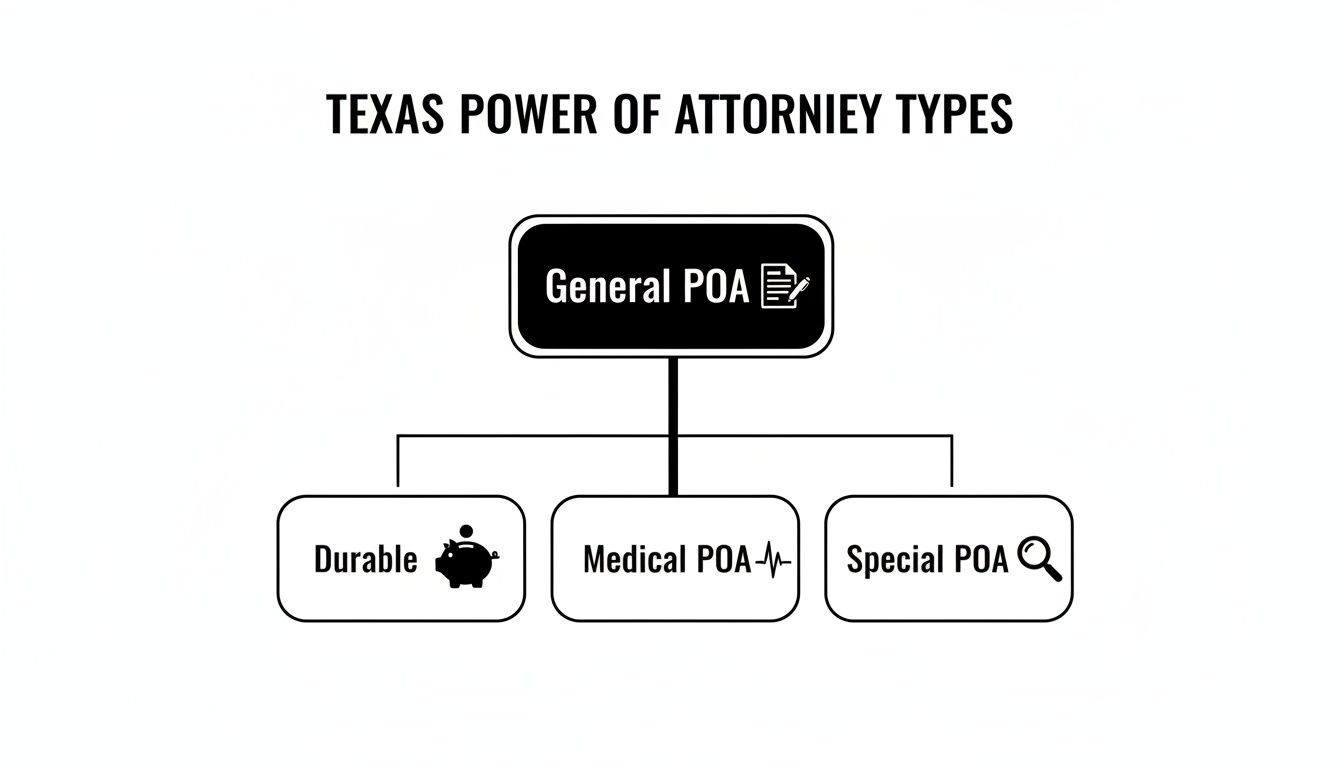
This visual shows how different documents are built to protect specific parts of your life, from your finances with a Durable POA to your health choices with a Medical POA.
Core Responsibilities of an Agent
The concept of a fiduciary duty comes with a clear, actionable checklist. In Texas, an agent must adhere to several key principles:
- Duty of Loyalty: The agent must be completely loyal to you. This means no conflicts of interest. An agent cannot use your money to give themselves a loan or buy your property for a bargain price.
- Duty of Care: The agent is responsible for managing your money and property prudently. This means making smart, informed decisions and protecting your assets from neglect or unreasonable risks.
- Duty to Keep Records: Your agent must keep a meticulous record of every transaction made on your behalf. This includes retaining receipts, bank statements, and a detailed log of all money coming in and going out.
- Duty to Avoid Self-Dealing: An agent cannot mix their personal funds with yours. Your assets must be kept completely separate to maintain clear accounting and prevent misuse.
Managing these duties can be a heavy lift. To keep things organized and cut down on the administrative headache, some agents look into advanced tools like Intelligent Document Processing to help them stay on top of their responsibilities.
Real-World Scenarios and Breach of Duty
Let's put this into a real-life situation. Imagine you've named your son as your agent, and he uses your Durable Power of Attorney to access your bank account.
Proper Conduct: He withdraws money to pay your mortgage, property taxes, and utility bills. He saves every receipt and logs each payment in a spreadsheet he created just for managing your finances. This is a textbook example of fulfilling the duty of care and keeping good records.
Now, let's look at the flip side.
Breach of Duty: He takes out $10,000 to "borrow" for his own business idea, fully intending to pay you back. His intentions are irrelevant; this is a clear-cut case of self-dealing and a breach of his fiduciary duty. He put his own interests first, which exposes him to serious legal liability.
The table below breaks down these core duties into practical, everyday actions, making it clear what's expected of a POA agent in Texas.
Key Fiduciary Duties of a POA Agent in Texas
| Duty | What It Means in Practice | Example of Compliance |
|---|---|---|
| Duty of Loyalty | Always act solely in the principal's best interest, avoiding any personal gain or conflict of interest. | Declining to invest the principal's funds in a family member's risky startup business. |
| Duty of Care | Manage the principal’s assets with prudence, diligence, and skill, just as a careful person would. | Researching and selecting a low-risk investment vehicle for the principal's savings instead of speculative stocks. |
| Duty to Keep Records | Maintain detailed, accurate records of all transactions, including receipts, invoices, and bank statements. | Keeping a dedicated spreadsheet or ledger that tracks every expense paid and all income received for the principal. |
| Duty to Segregate | Keep the principal's property and funds completely separate from the agent's own assets. No commingling. | Opening a separate checking account in the principal's name for managing their finances. |
| Duty to Inform | Communicate regularly with the principal and provide a full accounting of all actions when requested. | Providing quarterly summaries of financial activity to the principal or other designated family members. |
Upholding these duties is non-negotiable. They are the legal and ethical guardrails that ensure the agent acts as a true protector of the principal’s interests.
Choosing an agent is one of the most important decisions you'll make in your estate plan. It’s a decision that demands you carefully consider a person's character, their reliability, and their honest-to-goodness willingness to honor this sacred legal trust.
How to Create and Execute a Valid Texas POA
A Power of Attorney is a seriously powerful tool, but it is only effective if it is created correctly. A simple mistake can render the entire document invalid, leaving your family in the exact legal situation you were trying to avoid. Creating and executing power of attorney documents that hold up in Texas involves very specific steps that must be followed precisely.

This isn't just about signing on the dotted line. It's about making sure every single detail aligns with the Texas Estates Code. The final execution is the critical step that gives legal authority to your wishes.
The Dangers of DIY Forms
In an effort to save time or money, many people turn to generic, one-size-fits-all POA forms from the internet. This is one of the biggest risks you can take with your estate plan. These templates often fail to account for the nuances of Texas law, contain vague language, or omit the specific powers your agent will actually need.
A poorly drafted POA can be easily challenged in court and is often rejected by banks, investment firms, or hospitals. When that happens, the document is worthless. Your family may then have no other choice but to go through a draining and expensive guardianship proceeding—the very thing you were trying to prevent.
The Proper Signing Process in Texas
When it comes to a Durable Power of Attorney, Texas law is crystal clear on how it must be signed. The process itself isn't difficult, but it is incredibly strict. There are no shortcuts.
Here are the non-negotiable steps:
- Written Document: The Power of Attorney must be a physical, written document that clearly names you (the principal) and the person you're appointing (your agent).
- Your Signature: You must sign it yourself. If you're physically unable to do so, someone can sign on your behalf, but they must do it in your presence and at your direction.
- Notarization: Your signature must be acknowledged before a notary public. This means you sign it in the presence of the notary, who will confirm your identity and apply their official seal.
That notarization step is not optional. A Durable Power of Attorney in Texas is legally invalid without it. This formal process creates a strong legal presumption that you signed the document of your own free will and had the mental capacity to understand what you were doing.
Drafting Clear and Precise Language
Getting the document signed correctly is only half the battle. The other half is the language inside the document. Vague or overly broad powers can create confusion and might not give your agent the specific authority they need for certain tasks. A well-crafted POA should be tailored to your unique financial and personal situation.
For example, you might need to grant your agent specific powers to:
- Manage your real estate, including selling property.
- Handle your digital assets, like social media and online bank accounts.
- Make decisions about specific investment or retirement accounts.
- Run or sell your small business.
The process of creating and executing a valid Texas POA is full of small but critical legal details. For anyone looking for professional support to make sure it's done right, you might consider the option to hire paralegal services to assist with the technicalities. Ultimately, an experienced Texas estate planning attorney is your best resource for drafting a document with the precise language required to fully protect you.
After the Signing: Storing and Distributing Your POA
Once your POA is signed and notarized, your work is not quite finished. That original document is incredibly important. You need to keep it somewhere safe but accessible, such as a home fireproof safe or a bank's safe deposit box.
Most importantly, you must tell your agent where to find the original. They cannot act without it. It is also wise to give certified copies to your bank, your financial advisor, and—for a Medical POA—your primary doctor. Taking these steps ahead of time ensures that when your agent needs to step in, they can do so smoothly and without frustrating roadblocks.
When and How to Change or Revoke a Power of Attorney
Life is not static. Relationships change, circumstances evolve, and a plan that seemed perfect five years ago might not make sense today. Your Power of Attorney should be viewed the same way—it is not a document set in stone, but a living part of your estate plan.
As the person who created the POA (the principal), you are always in control. You hold the power to change or completely cancel it at any time, as long as you have the mental capacity to understand and make that decision. Keeping your power of attorney documents current is just as crucial as creating them in the first place, because an outdated agent can cause unintended problems and family friction down the road.
The Revocation Process in Texas
If you've decided it's time for a change, you cannot simply inform your old agent that their authority is terminated. Revoking a Power of Attorney in Texas is a formal process that requires clear, decisive action to be legally binding.
To officially end your old agent's authority, you must create a written document called a Notice of Revocation. This document should be precise, clearly stating your name, the date of the original Power of Attorney you are canceling, the name of the agent you are removing, and a straightforward statement of your intent to revoke their power. Just like the original POA, this revocation notice must be signed and notarized to be valid.
Getting the Word Out: Notifying All Relevant Parties
Drafting and signing the revocation is just step one. For it to be truly effective, everyone who knew about the old POA needs to know it's no longer valid.
- Notify Your Former Agent: This is non-negotiable. You must provide a copy of the signed and notarized revocation to the agent whose authority you're canceling. This is the official act that terminates their legal ability to make decisions for you.
- Inform Financial Institutions: Your bank, brokerage firm, financial advisor, and anyone else who had the old POA on file needs a copy of the revocation. This prevents your former agent from attempting to access your accounts.
- Record the Revocation (If Necessary): If your original Power of Attorney was recorded with the county land records—which is common if it gave the agent power over real estate—you must also record the Notice of Revocation in that same county.
Real-World Scenario: Imagine you named your brother as your agent years ago. After a disagreement, you now feel your daughter is a better fit. You cannot just tell her she is in charge. You must formally execute a revocation, send a notarized copy to your brother, and notify his bank. If you skip these steps, your brother could still legally access your accounts, directly contradicting your current wishes.
When a POA Ends on Its Own
Sometimes, a Power of Attorney terminates automatically without you having to take any action. Texas law outlines a few key events that bring an agent's authority to an end, which is critical knowledge for proper asset protection planning.
- Your Death: A Power of Attorney is for the living. The moment you pass away, the agent’s authority is extinguished. Your will or trust then takes over to guide the distribution of your estate.
- Divorce: If you appointed your spouse as your agent, their power is automatically terminated if you get a divorce. Even so, it's always a good practice to formally revoke the old POA and create a new one to prevent any confusion.
- Agent's Incapacity: If your agent becomes incapacitated or passes away, their authority ends immediately. This is precisely why it’s so important to name a successor agent in your original document—it creates a seamless backup plan.
Reviewing your Power of Attorney every few years ensures it still reflects your life and your wishes. For a more detailed walkthrough of the process, you can learn more about how to void a power of attorney in our comprehensive guide. Taking these simple, proactive steps is the best way to keep your financial and legal future securely in your own hands.
Taking Control of Your Future with Confidence
Navigating the details of a Texas power of attorney can feel complex, but understanding this tool is the first step toward protecting your legacy, your family, and your right to choose how your life is handled.
This process doesn't have to be overwhelming. You don't have to sort through it all on your own. Creating a legally sound power of attorney is one of the most proactive and compassionate steps you can take. It ensures your wishes are followed and lifts a massive weight of uncertainty from your family's shoulders during a potentially difficult time. Think of it as a key piece of your overall estate planning puzzle.
Take Control with a Trusted Guide
Whether you are creating your first Power of Attorney, updating an old one, or have been asked to serve as an agent and have questions about your responsibilities, our team is here to provide clarity. We offer practical, Texas-based legal advice to help you make decisions with confidence. A well-prepared POA is your best defense against a court-ordered guardianship, making sure the person you trust is the one in charge.
A well-drafted Power of Attorney is one of the most compassionate gifts you can give your family, providing clarity and peace of mind when they need it most.
If you are ready to secure your future, our experienced Texas estate planning attorneys can help you get the clarity you need to protect yourself and the people you love.
Your Top Questions About Texas POAs, Answered
As you begin the estate planning process, many questions can arise. When it comes to a power of attorney, getting clear answers is essential to feeling confident in your decisions. We've gathered some of the most common questions we hear from clients to help demystify how these documents work here in Texas.
When Does a Durable Power of Attorney Kick In?
This is a critical question, as the answer determines the exact moment your agent can begin acting for you. In Texas, you have two primary options for a financial POA.
The most common choice is a POA that becomes effective immediately upon signing. This does not mean you lose control of your own affairs. You can continue to manage everything just as before. It simply means your agent also has the authority to step in right away, which can be a lifesaver for convenience or in cases of gradual health decline.
Your other choice is a "springing" power of attorney. This type only "springs" to life after a specific event occurs—almost always, a physician certifying in writing that you have become incapacitated. While this may feel like a safer route, it can create delays when your family needs to act quickly, as obtaining that official medical certification can take precious time.
Can I Name More Than One Agent at the Same Time?
Yes, you can, but this is a decision that requires careful consideration. Texas law allows you to name co-agents to act together. You can require them to act jointly (meaning they must both agree on every decision) or severally (meaning either one can act independently).
While naming multiple children as co-agents may seem fair, requiring them to act jointly can create logistical challenges, especially if they live in different states or disagree on a course of action. A smoother approach is often to name one primary agent, then name one or two successor agents as backups. This creates a clear chain of command: if your first choice cannot serve, your backup is ready to step in without delay.
What if My Agent Isn't Acting in My Best Interests?
It is a deeply distressing scenario: discovering that the person you trusted is mismanaging your finances or abusing their power. Fortunately, the Texas Estates Code provides a way to protect yourself.
Your first and most decisive move, as long as you have mental capacity, is to revoke the Power of Attorney. This is done by signing a formal, notarized document called a "Notice of Revocation." The key is to then deliver a copy to your former agent and to every bank or institution they have been dealing with on your behalf.
If you are already incapacitated, an interested person (like another family member) can petition the court. A judge has the power to order the agent to provide a full accounting of every transaction. If the court finds the agent caused financial harm, they can be held personally liable. In serious cases of abuse, the court will remove the agent and may appoint a guardian to take over.
Do I Really Need a Lawyer to Draft a Power of Attorney?
While you can find POA forms online, using a generic template is a significant risk. These DIY documents often fail to comply with specific Texas laws, use vague language that banks may reject, or miss the specific powers you actually need. A single error in the wording or execution can render the entire document invalid.
An experienced Texas estate planning attorney does much more than fill in blanks on a form. They serve as your strategic advisor, helping you choose the right agent, defining their powers with precision, and ensuring the document is executed perfectly so it will be honored when you need it most.
Working with a qualified lawyer transforms your Power of Attorney into a rock-solid shield, not a future headache for your family. It is a small investment for significant peace of mind.
If you’re managing a trust or planning your estate, contact The Law Office of Bryan Fagan, PLLC for a free consultation. Our attorneys provide trusted, Texas-based guidance for every step of the process at https://texastrustadministration.com.