Skip to content
When a loved one passes away without a will, managing their final affairs can feel overwhelming—but with the right legal guidance, it doesn’t have to be. The term administrator of estate often comes up in this situation. This isn't just legal jargon; it's the title for the court-appointed person who will take the reins of the deceased's final financial affairs. Think of the administrator as the captain chosen to navigate the estate through the probate court, ensuring every move is made according to Texas law.
Understanding the Role of an Administrator of an Estate
Losing someone is hard enough. The added weight of legal duties can feel completely overwhelming. But getting a handle on what an administrator of estate does is the first step toward finding your footing and feeling secure in your next steps.
This is a formal legal role, appointed by a Texas probate court when someone dies “intestate”—that is, without a valid will.
More Than Just a Title: Your Fiduciary Duties in Texas
The administrator's primary responsibility is to act as a fiduciary. This is a legal term with serious gravity. It means you are bound by a duty of absolute good faith and loyalty, always putting the estate's best interests far ahead of your own. Your every action is guided by the Texas Estates Code, which lays out the rulebook for the entire process.
This role becomes essential in a few common scenarios:
- The person who passed away left no will.
- A will was left, but it fails to name an executor.
- The executor named in the will can't or won't take on the job.
In essence, the administrator steps in to do the work an executor would have, but their authority flows directly from the court, not from a will. This is a crucial distinction that shapes the entire journey. You can dive deeper into this in our article covering the differences between an administrator and an executor.
A Growing Need for Skilled Guidance
The need for capable estate administration is on the rise, both here in Texas and across the globe. The global market for these services, valued at $23.79 billion in 2026, is projected to grow substantially. This trend underscores just how complex modern estates have become and why professional guidance from a Texas trust administration lawyer is no longer a luxury, but a necessity. You can find more data on the growing demand for professional estate administration services on datainsightsmarket.com.
As an administrator, you are entrusted with marshalling a person’s final assets, settling their debts, and distributing what remains to their legal heirs. It is a position of great trust and responsibility, requiring careful attention to legal detail and transparent communication with all involved parties.
While the path might seem complicated, it is absolutely a manageable one with the right support. A Texas estate administration attorney can act as your guide, helping you meet every court requirement, fulfill your fiduciary duties, and shield you from personal liability. This partnership frees you up to focus on what matters most: honoring your loved one’s memory while ensuring their estate is settled correctly and respectfully.
The Court Appointment Process for an Administrator
When a loved one passes away without a will in Texas, the task of settling their estate falls to the probate court. This is where an administrator steps in. The court has to formally appoint someone to this crucial role, but don't worry—the process is a clear, manageable journey, especially with the right guidance.
The court's first job is figuring out who is the best person to take the reins and act in the estate's best interest.
Who Gets to Be in Charge?
Texas law doesn't leave this decision to chance. The Texas Estates Code sets out a clear pecking order for who has the priority to serve as an administrator. Think of it as a legal roadmap that prevents family arguments and ensures the people closest to the deceased are first in line.
The court considers applicants in this specific order:
- The surviving spouse
- The main heir named in a will (if one exists but the executor can't serve)
- Any other heir named in the will
- The next of kin, starting with the closest relatives
- A creditor of the person who passed away
- Any other person of good character who steps forward
This predictable structure gives family members the first shot at managing their loved one's final affairs.
This flowchart breaks down the basic path when there's no will, leading to the court appointing an administrator to manage the estate.
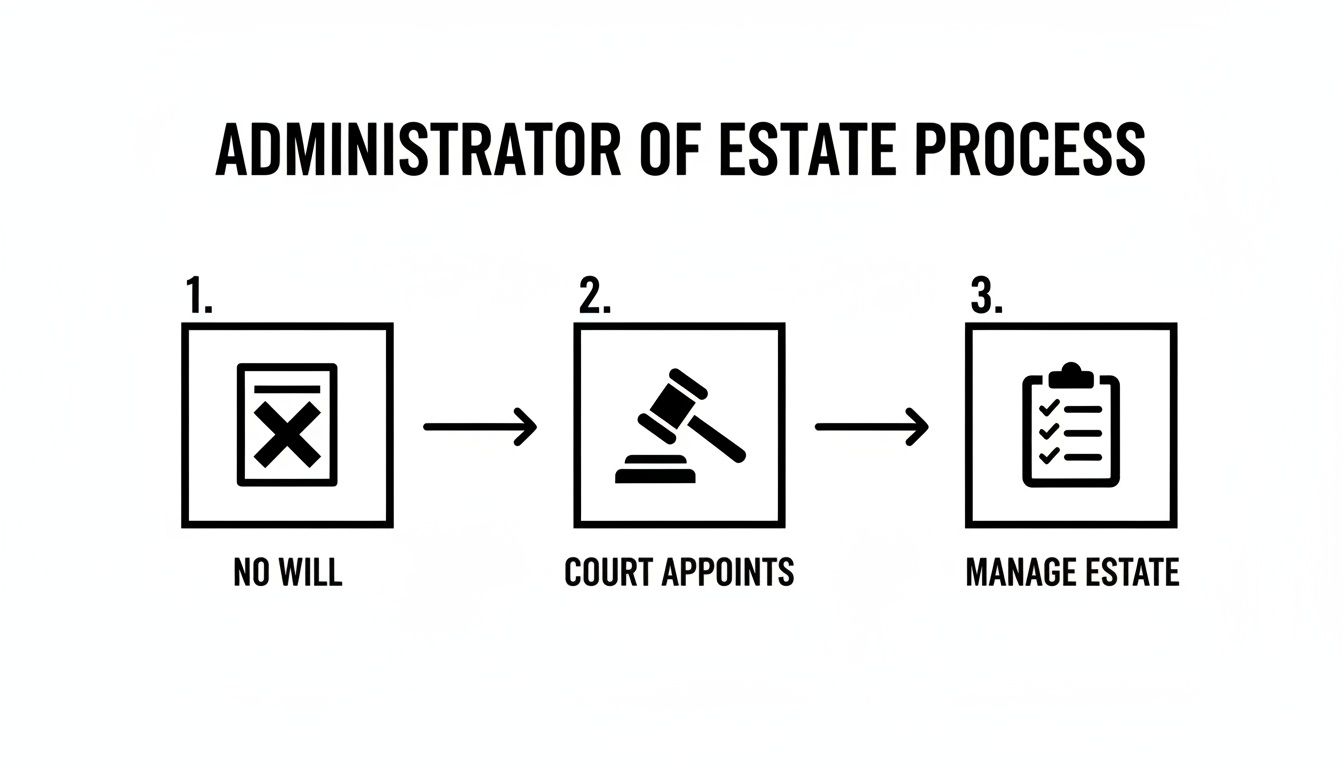
As you can see, it all starts with the absence of a will. From there, the court steps in to make an appointment, and the real work of managing the estate begins.
Key Milestones on the Path to Appointment
Once the right person is ready to step up, they must follow a few legal steps to get the court's official seal of approval. Having a Texas estate administration lawyer in your corner can make all the difference in hitting each milestone correctly.
First, you'll file an Application for Letters of Administration. This is the formal legal document that kicks off the probate case and asks the court to name you as the administrator. It lays out all the key details about the deceased, their family, and a rough estimate of what the estate is worth. You can dive deeper into this essential document in our guide on the Letter of Administration of Estate.
After filing, a court hearing is set. This is your chance to prove to the judge why an administration is needed and why you're the right person for the job. During this hearing, the court will also officially identify the legal heirs in what's known as an heirship proceeding.
Once the judge approves your application, you’ll have to take an oath of office, legally swearing to perform your duties faithfully. You will also usually be required to post a bond, which is basically an insurance policy that protects the estate's assets from any potential mistakes or mismanagement.
Navigating this legal framework is becoming more common for Texas families. The trust and estate administration field is projected to grow from $20 billion in 2026 to a staggering $35 billion by 2032. This trend shows just how complex family estates are becoming and why expert guidance is no longer a luxury—it's a necessity for things like asset protection.
A skilled attorney can help you steer clear of potential roadblocks, like someone contesting your application or the difficulty of tracking down every last heir, ensuring your appointment is as smooth and solid as possible.
The Administrator's Playbook: Key Duties and Responsibilities
Once a Texas probate court officially names you the administrator of an estate, you’re stepping into a position of significant legal trust. This isn't just a title; it’s a job with a very specific, legally-mandated set of tasks. The core principle guiding everything you do? Manage the estate with total fairness and diligence for the heirs and any creditors.
It's completely normal to feel a bit overwhelmed by the list of duties. Think of it as a detailed playbook. Every step has a purpose, and with the right guidance, you can run each play confidently and effectively.

Gathering and Inventorying Estate Assets
Your first major assignment is to track down and secure everything the deceased person owned. This isn't a quick once-over; it's a meticulous accounting that becomes the foundation for the entire process. You have a duty to find, collect, and protect all of the estate’s property.
This search can cover a lot of ground, including:
- Real Estate: The family home, any rental properties, or even just a plot of vacant land.
- Financial Accounts: Checking and savings accounts, investment portfolios, and retirement funds that don't have a named beneficiary.
- Personal Property: Cars, furniture, art, jewelry, and any other valuables.
- Business Interests: Ownership stakes in a company or partnership.
Within 90 days of your appointment, Texas law requires you to file a sworn document with the court called an "Inventory, Appraisement, and List of Claims." This is a formal list of every asset and its fair market value. Having an experienced Texas probate lawyer in your corner is critical here to ensure nothing gets missed and valuations are right on the money, which protects you from disputes down the road.
Notifying Creditors and Settling Valid Debts
Before any assets can be passed on to heirs, the estate has to settle its financial obligations. As administrator, you’re legally required to formally notify potential creditors about the death. The most common way to do this is by publishing a notice in a local newspaper.
Once notified, creditors have a set amount of time to submit claims against the estate. Your job is to sift through these claims, verify whether they are legitimate, and then pay the valid debts from the estate’s funds. This requires a sharp eye for detail and complete impartiality—paying a fake claim or ignoring a real one could make you personally liable.
Real-world scenario: Imagine a credit card bill you've never seen before shows up months later. You have to investigate whether it's a valid debt before cutting a check. You can't just decide to pay back a loan to a family member before you pay a formal claim from a hospital, either. This is a crucial part of dispute resolution.
Fulfilling your fiduciary duties means you are the neutral financial guardian of the estate. You must handle every single obligation, from the mortgage on the house to the final utility bills, with absolute precision and in the correct legal order.
Managing Estate Property and Filing Taxes
While the administration process unfolds, you’re in charge of managing and protecting the estate's property. This is an active, hands-on role. If there’s a house in the estate, you need to keep it insured, make sure property taxes are paid, and handle any maintenance needed to preserve its value.
This duty of "prudent management" also applies to financial assets. You must make sensible decisions with investments, steering clear of risky moves that could shrink the estate's value. Your role is a preserver, not a speculator.
On top of that, you are responsible for filing all the necessary tax returns for the deceased and the estate itself. This step-by-step guidance is key for proper tax planning:
- The deceased's final personal income tax return (Form 1040).
- The estate's income tax return (Form 1041) for any income it earns while being administered.
- Potentially, a federal estate tax return (Form 706), though this is only for very large estates.
Tax compliance is a minefield where one wrong step can be expensive. The smartest move is to work with a legal team that has tax professionals on speed dial to ensure every "i" is dotted and every "t" is crossed. If you're also handling an estate with a will, you can learn more about the similar responsibilities by exploring the duties of an executor of an estate in our detailed guide.
Distributing the Remaining Assets to Heirs
This is the final play. Only after every asset is accounted for, every valid debt is paid, and all tax matters are settled can you move to distribute what's left to the legal heirs. Since there is no will to follow, you must adhere strictly to the inheritance laws laid out in the Texas Estates Code, which the court will formalize in the heirship proceeding.
This final distribution needs to be done with complete accuracy and transparency. Getting signed receipts from each heir confirming they received their share is a crucial last step. It protects you from any future claims and allows you to formally close the estate, bringing your duties to a successful end.
Navigating Asset Distribution Without a Will
When someone passes away without a will, the administrator of estate faces a significant challenge: how to distribute property with no instructions to follow. This is what we call dying "intestate." In these situations, Texas doesn't leave you guessing. The state has its own default playbook known as the laws of intestate succession, which lays out exactly how assets are divided based on family ties.
Your job as administrator is to follow this playbook, not create your own. It all starts with correctly classifying every single asset. Getting this first step right is absolutely critical.
Community Property vs Separate Property
Under the Texas Estates Code, the entire distribution plan hinges on whether an asset is classified as community or separate property. It's a distinction that can easily trip up even the most diligent administrator.
-
Community Property: Think of this as everything the deceased and their spouse acquired during the marriage. In Texas, the law assumes most property a couple owns is community property unless you can prove it's not.
-
Separate Property: This bucket includes anything the deceased owned before getting married. It also covers property they received individually as a gift or an inheritance while they were married.
Mislabelling a major asset—like the family home, a retirement account, or a business—is a catastrophic mistake. It can lead to the wrong people inheriting property, sparking bitter family fights and even leaving the administrator personally liable for the error.
How Intestate Succession Works in Practice
Once all the property is correctly sorted into its proper bucket, the distribution follows a strict, mathematical formula. The final outcome is dictated entirely by which relatives survive the person who passed away.
Let's walk through a common, yet surprisingly complicated, real-world scenario:
Scenario: A person dies, leaving behind a spouse and children from a previous relationship. This is a common situation where families need guidance from a Texas estate planning attorney.
-
The Spouse’s Share: The surviving spouse automatically keeps their one-half of the community property. From the deceased's estate, they are also entitled to one-third of the separate personal property and a "life estate" in one-third of the separate real property (meaning they can use it for the rest of their life).
-
The Children’s Share: The children from the prior relationship inherit the deceased's other half of the community property. They also get the remaining two-thirds of the separate personal property and full ownership of the separate real estate after the spouse's life estate ends.
As you can see, the division gets complicated fast. The rules change completely if the children are from the current marriage, or if there's no spouse but the deceased's parents or siblings are still alive. This is precisely why having professional legal help is non-negotiable to ensure the distribution is done correctly.
The Importance of a Formal Heirship Proceeding
Before a single penny can be distributed, you must get the court's official stamp on who the legal heirs are. This is accomplished through a formal court process called a Proceeding to Determine Heirship.
In this proceeding, the court appoints an "attorney ad litem" to represent any unknown or missing heirs. This independent attorney conducts an investigation to ensure everyone entitled to inherit is identified and notified, protecting the integrity of the process and preventing future disputes.
This formal declaration from the court is what gives you, the administrator, the legal green light to start distributing assets. It acts as your legal shield, protecting you from any future claims from an overlooked relative. When real estate is involved, selling it is often necessary to divide the value among the heirs. You can find some helpful tips when selling estates to guide you through that specific process. Ultimately, the heirship proceeding creates order out of potential chaos, giving you the confidence to close the estate properly and legally.
Common Administrator Mistakes and How to Avoid Them
Stepping into the role of an estate administrator is a huge responsibility, and it’s easy to feel overwhelmed. You're navigating a legal process while likely grieving a loss. But knowing the common pitfalls is the best way to protect yourself and honor the estate you’re managing.
Let’s be honest, most people are thrown into this role without much warning. Recent surveys show that only 24% of people have a will, and a staggering 4% have other estate documents ready. This lack of planning is exactly why administrators are often needed, and it highlights just how careful you need to be. You can get a deeper look at these estate planning trends and what they mean for families by checking out insights from intelmarketresearch.com.
With that in mind, let’s walk through the most frequent mistakes we see and, more importantly, how to sidestep them completely with practical advice.

Mistake 1: Commingling Funds
This is the cardinal sin of estate administration. Commingling means mixing estate funds with your own personal money, and it’s a serious breach of your legal duties under fiduciary principles. Even if it’s just a small, accidental slip-up, it creates an accounting nightmare and can quickly lead to accusations of theft or mismanaging the estate.
- What it looks like: You pay your personal credit card bill from the estate's bank account or deposit a check made out to the estate into your own savings.
- The right way to do it: The very first thing you should do after being appointed is open a brand-new bank account in the name of the estate (for example, "The Estate of John Smith"). Every penny belonging to the estate goes into this account, and every single estate expense is paid from it. No exceptions.
Mistake 2: Paying Heirs Before Creditors
It’s natural to want to help the family and distribute their inheritance as soon as possible. But Texas law is crystal clear: creditors get paid first. If you start handing out money to heirs before all the estate’s debts are settled, you could find yourself personally liable for those unpaid bills.
- What it looks like: A beneficiary asks for an advance on their inheritance to buy a car, and you give it to them before the official period for creditors to make claims is over.
- The right way to do it: You have to follow the legal playbook. Notify creditors, and then wait out the required statutory period. Once that time is up, you’ll pay all the legitimate, approved debts from the estate’s account. Only after the creditors are paid can you start distributing what’s left to the heirs.
As an administrator, your loyalty is first to the estate as a whole, which includes its legal obligations. Adhering to the proper order of payments is not just a best practice—it is a legal requirement that protects both the estate and you.
Mistake 3: Failing to Communicate Transparently
Nothing breeds suspicion faster than silence. As the administrator, part of your job is keeping all the heirs in the loop about the estate's progress. This means giving them reasonable updates on assets you've gathered, debts you've paid, and a realistic timeline for when they can expect things to wrap up.
- What it looks like: You start dodging calls or emails from heirs because you're busy or don't have a solid answer yet. This makes them think something is being hidden.
- The right way to do it: Be proactive. A simple email update every 30 to 60 days can work wonders. A concise note about what's been done and what's next builds trust and keeps everyone on the same page, preventing frustration and suspicion from taking root.
Working with a Texas estate planning attorney is the ultimate safety net. A good lawyer ensures you sidestep these common landmines, hit every legal deadline, and fulfill all your duties correctly. It allows you to manage the estate confidently and with true peace of mind.
Frequently Asked Questions About Estate Administration
When you become an estate administrator, the questions start piling up fast. It’s a role most people don't ask for, and it often arrives during a difficult, emotional time. To cut through the confusion and give you some solid ground to stand on, we’ve put together answers to the questions we hear most often from folks just like you across Texas.
How Long Does Estate Administration Take in Texas?
This is the big one, the first question on everyone's mind. While we all wish there were a simple, quick answer, the reality is that every estate has its own clock. There’s no magic number.
A very straightforward estate, with easy-to-find assets and no family squabbles, might wrap up in as little as nine months. But honestly, it’s far more common for the process to take anywhere from one to two years.
Several things can stretch out that timeline:
- Complex Assets: An estate with a family business, multiple properties, or tricky-to-value investments will always take longer than one with just a few bank accounts.
- Creditor Claims: Notifying creditors and handling their claims is a required step with its own legal deadlines. If you have to dispute a claim, it can add months to the process.
- Identifying Heirs: When there’s no will, you have to legally prove who the heirs are. This can get complicated quickly if relatives are hard to find or if there are questions about family relationships, sometimes even requiring a guardianship for minor heirs.
- Family Fights: Sadly, disagreements among heirs are a major source of delay. Any conflict that needs a mediator or a judge to step in will bring the process to a halt.
Knowing what to expect from the beginning can save you a lot of stress. An experienced Texas estate administration lawyer can look at the specifics of the estate and give you a much more realistic timeline.
Can I Get Paid for Serving as an Administrator?
Yes, absolutely. Texas law understands that being an administrator is a serious job that involves a lot of your time, effort, and personal risk. You are entitled to be paid for that work. This isn't a gift from the estate; it’s compensation you’ve earned by performing your duties.
The Texas Estates Code sets a standard fee. Unless a judge rules differently, an administrator can receive a commission of 5% on all the money that comes into the estate and 5% on all the money paid out in cash for the estate.
It's vital to know this commission isn't automatic. You have to keep perfect records of every single transaction and formally ask the court to approve your payment. This fee is also taxable income, so you’ll need to report it on your personal tax return.
The rules for calculating this fee can be tricky. For instance, just moving money between the estate's own bank accounts or making the final distribution to heirs doesn't count. An attorney can make sure your compensation is calculated correctly and approved by the court without a hitch.
What If Heirs Disagree or Start Fighting?
Family conflict can turn a manageable process into a nightmare. Without a will to act as a clear roadmap, emotions can take over, and small disagreements about property can explode into serious legal battles.
As the administrator, your most important job is to stay neutral. Your fiduciary duties in Texas demand complete impartiality. You can't pick sides or do favors for one heir, even if they're a close relative. Your loyalty is to the estate itself, and every action you take must be fair to everyone.
Here’s our step-by-step guidance for dispute resolution:
- Over-Communicate: Be proactive. Send regular, clear updates so no one is left guessing. Transparency is your best defense against suspicion and misunderstanding.
- Document Everything: Create a paper trail for every decision, every inventoried item, and every penny spent. This objective record can shut down disputes before they even get started.
- Call for Backup: If tempers start flaring, don’t try to be the referee yourself. This is where a Texas estate planning attorney is your most valuable asset. Your lawyer can act as a neutral go-between, mediate the dispute, or, if it comes to it, represent the estate in court to get a final, legal resolution.
Can I Be Held Personally Liable for Mistakes?
Yes, and this is the single most important thing for any administrator to understand. When you take on this role, you also take on fiduciary liability. This is a legal term that means if you make a mistake that costs the estate money—even an honest mistake—you can be held personally responsible for paying back those losses.
This personal risk is exactly why you must follow the Texas Estates Code to the letter. Small errors can have huge consequences.
Mistakes that could put you on the hook personally include:
- Missing the deadline for paying estate taxes, leading to penalties.
- Selling a house or other property for way less than it’s worth.
- Distributing money to heirs before all creditor claims are paid off.
- Mixing estate funds with your own personal money.
The thought of being personally liable is scary, but it shouldn't stop you. Instead, let it be a reminder of why having professional legal guidance isn't a luxury—it's a necessity. A good attorney is your safety net, making sure every move you make is the right one and that your own assets are never on the line.
If you’re managing a trust or planning your estate, contact The Law Office of Bryan Fagan, PLLC for a free consultation. Our attorneys provide trusted, Texas-based guidance for every step of the estate administration process, giving you the confidence to carry out your duties and find peace of mind.