Discovering that a loved one's trust may not be handled correctly is a deeply unsettling experience. This unease can quickly turn to stress and a sense of betrayal when you are faced with potential trustee misconduct in Texas. This isn't just about assets on a spreadsheet; it's about honoring a legacy and protecting your family's future.
When a trustee fails to manage assets properly or, worse, acts against the beneficiaries' interests, it's easy to feel powerless. But you are not. You have rights, and the Texas Trust Code provides a clear path to hold a trustee accountable and protect your inheritance.
Understanding Your Role as a Beneficiary in a Texas Trust

When a person creates a trust, they are handing over the keys to their financial kingdom. They place immense faith in the trustee—the person or institution chosen to manage it all. This isn't just a handshake deal; it’s a relationship built on the highest legal standard of trust, known as a fiduciary duty.
A trustee is a legal guardian of the trust creator's legacy. Under the Texas Trust Code, they are bound by law to act with absolute honesty, loyalty, and care for the beneficiaries. When you suspect that a trustee is falling short, confusion and anxiety can take over. You’re left wondering who to turn to and what your first step should be. This guide is here to provide clarity in a difficult situation.
How This Guide Can Help You
We wrote this guide to help you understand your position and what you can do about it. Here’s what you’ll learn:
- The non-negotiable legal duties every trustee in Texas must uphold.
- The common red flags that may point to trustee misconduct.
- Actionable steps you can take to protect your family’s assets.
- How an experienced Texas trust administration lawyer can be your strongest ally.
You are not alone in this. Texas law includes specific protections for beneficiaries just in case a trustee fails in their duties. Understanding these protections is your first step toward securing your financial future and ensuring your loved one’s wishes are truly honored.
Whether you're being met with silence, seeing questionable financial moves, or suspecting outright self-dealing, there is a path forward. At The Law Office of Bryan Fagan, PLLC, we guide families through the complexities of trust and estate planning matters with both compassion and strength. Our goal is to empower you with the knowledge to hold a trustee accountable and protect what is rightfully yours.
What Constitutes Trustee Misconduct Under Texas Law?
When someone establishes a trust, they place a tremendous amount of faith in the person or institution they name as trustee. This individual is given the serious responsibility of managing assets for others—the beneficiaries. At the core of this arrangement is a legal promise known as a fiduciary duty.
Think of the trustee as the sworn protector of the trust's purpose, legally required to act only in the best interests of the beneficiaries. In Texas, this isn't just a recommendation; it’s a strict legal rule under the Texas Trust Code. Trustee misconduct occurs when that sacred promise is broken.
The Core Fiduciary Duties in Texas
The Texas Trust Code lays out several key responsibilities a trustee must follow. These duties are the legal benchmark for a trustee's performance. Knowing them is the first step to identifying potential misconduct.
The primary fiduciary duties in Texas include:
- Duty of Loyalty: The trustee must act exclusively for the beneficiaries. This means no self-dealing, such as selling trust property to themselves or investing trust funds into their own business.
- Duty of Prudence: The trustee must manage the trust’s assets as any careful, reasonable person would. This involves making sound investment choices to preserve the trust’s value, not taking reckless risks with other people's money.
- Duty of Impartiality: If there is more than one beneficiary, the trustee must treat everyone fairly according to the terms of the trust. They cannot play favorites unless the trust document explicitly allows it.
When a trustee violates any of these fundamental duties, they have committed a breach. Legally, that breach defines trustee misconduct in Texas.
A trustee's job is to put the beneficiaries first, period. Any action that prioritizes the trustee's own financial gain or recklessly jeopardizes trust assets likely crosses the line from an honest mistake into actionable misconduct.
From Simple Errors to Actionable Breaches
Not every mistake a trustee makes is grounds for a lawsuit. A minor administrative error can often be corrected without major conflict. However, a pattern of carelessness or intentional wrongdoing is a serious legal issue.
In Texas, trustee misconduct often centers on a breach of fiduciary duty as defined under Texas Property Code §111.004(25). This can range from misappropriating funds and self-dealing to simply failing to provide a proper accounting of the trust's finances. In fact, a trustee’s failure to account for their actions is one of the most common reasons beneficiaries file lawsuits.
For example, imagine a trustee "borrows" money from the trust for a personal vacation, intending to pay it back. Even with good intentions, this is a classic case of self-dealing and a direct breach of the duty of loyalty. The law doesn't care about the intent to repay; the act itself is the violation.
Understanding Your Rights as a Beneficiary
The Texas Trust Code empowers beneficiaries to hold trustees accountable. You have a legal right to receive information about the trust and how it’s being managed. If you have questions, the trustee is obligated to provide clear answers. A trustee who avoids questions or refuses to provide a requested accounting is a major red flag. It’s vital to remember you are not powerless. The law provides a path to demand transparency and, if necessary, take legal action to protect your inheritance. You can learn more about the specific trustee duties outlined in the Texas Trust Code in our detailed guide.
Common Red Flags of Trustee Misconduct

While the law clearly defines a trustee's duties, spotting a breach in the real world can be challenging. How can you tell if an issue is a genuine problem or just an honest mistake? Identifying trustee misconduct in Texas often begins with recognizing specific warning signs.
Think of these red flags as practical signals that something is amiss. They help you connect what’s happening on the ground to established legal standards. If any of these signs seem familiar, it’s time to pay closer attention.
A Pattern of Poor Communication
One of the most frequent—and telling—red flags is a lack of communication. A trustee doesn’t need to be in contact every day, but Texas law requires them to keep beneficiaries reasonably informed.
Signs of a communication breakdown include:
- Ignoring Emails and Calls: You send reasonable questions about the trust and receive no response. A responsible trustee makes it a priority to reply in a timely manner.
- Vague or Evasive Answers: When you do get a response, it’s confusing, avoids the actual question, or leaves you with more concerns.
- Refusing to Provide Information: The trustee denies your requests for a copy of the trust document or other key information that you have a right to see.
This isn’t just poor service; it’s a potential breach of their fiduciary duties. A transparent trustee has nothing to hide and knows that open communication builds trust and prevents misunderstandings.
Financial Irregularities and Secrecy
A trustee’s primary job is to manage the trust’s finances. Any unusual activity or secrecy surrounding the trust's money is a significant cause for concern.
A trustee unwilling to provide a clear financial picture may be hiding something. Under the Texas Trust Code, beneficiaries have a right to demand an accounting, and a trustee’s refusal is a major red flag.
To better understand what proper financial management entails, beneficiaries can learn about the systems designed to protect assets. For example, understanding internal controls can clarify expectations. You can also learn more about your right to financial transparency in our guide on what trust accounting entails.
Real-World Scenario
Consider a trust established for two siblings, Ben and Sarah. Their uncle, the trustee, is supposed to make quarterly distributions. When Sarah asks for a simple report of the trust’s expenses, her uncle becomes defensive and claims he’s "too busy." This secrecy is a major warning sign that he might not be managing the funds properly.
Questionable Decisions and Conflicts of Interest
A trustee must always act with prudence and loyalty. In plain English, this means making smart financial choices and never using their position for personal gain. Actions that benefit the trustee more than the beneficiaries are a textbook example of misconduct.
Watch for these behaviors:
- Using Trust Funds for Personal Expenses: This is one of the most blatant violations. A trustee using the trust's debit card for groceries or paying personal bills from the trust account is committing clear misconduct.
- Making Risky or Unsuitable Investments: A trustee’s role is to preserve and grow the trust's value, not to gamble with it. Investing a large portion of the trust into a high-risk startup, for instance, could violate the duty of prudence.
- Selling Trust Assets to Themselves or Family: If a trustee sells a trust-owned property to their spouse for a suspiciously low price, they have breached their duty of loyalty. This is a classic and prohibited conflict of interest.
Spotting the difference between a responsible trustee and one who might be crossing a line can be tough. This table breaks it down to give you a clearer picture.
Responsible Trustee Actions vs. Misconduct Red Flags
| Area of Responsibility | Responsible Trustee Action | Potential Misconduct Red Flag |
|---|---|---|
| Communication | Provides regular updates and responds to questions promptly. | Ignores calls and emails; refuses to provide accountings. |
| Financials | Keeps detailed, accurate records and provides clear reports. | Makes unexplained withdrawals; co-mingles trust and personal funds. |
| Investments | Manages assets prudently according to a diversified strategy. | Makes overly risky investments or gambles with trust assets. |
| Impartiality | Treats all beneficiaries fairly according to the trust terms. | Shows favoritism to one beneficiary over others without reason. |
| Loyalty | Acts solely in the best interest of the beneficiaries. | Engages in self-dealing, such as buying assets from the trust. |
A good trustee's actions are marked by transparency, fairness, and a clear focus on the beneficiaries' best interests. Anything that deviates from that standard is worth investigating.
Your Legal Options for Holding a Trustee Accountable
When you see red flags and suspect trustee misconduct in Texas, it can feel like your hands are tied. But discovering potential mismanagement doesn’t have to leave you feeling powerless. The law provides powerful tools to protect your rights and correct the situation.
These legal remedies are your roadmap out of uncertainty, transforming helplessness into a clear plan of action. These are practical, court-enforced tools designed to protect your inheritance and ensure the trust is managed as intended.
Demanding a Formal Accounting
Your most fundamental right as a beneficiary is the right to information. If your trustee has been secretive or vague about the trust’s finances, you can demand a formal accounting. This is a legal demand for a detailed report covering every transaction.
A proper accounting must clearly show:
- All assets currently held by the trust.
- All income the trust has received (e.g., dividends, interest, rent).
- All expenses and distributions paid out.
- Any debts or liabilities the trust owes.
This document provides a complete financial picture, making it easier to spot unusual transactions or unauthorized payments. A trustee’s refusal to provide a formal accounting upon request is a major red flag and powerful evidence in court.
Petitioning for Trustee Removal
When a trustee’s actions cause serious harm or create a hostile environment, you can ask a Texas court to remove them. Under Section 114.008 of the Texas Trust Code, a judge can fire a trustee who has materially violated the trust’s terms or breached their duties.
Think of it as firing a bad manager who is running the family business into the ground. Common reasons a court might grant a removal include:
- Clear proof of self-dealing or conflicts of interest.
- Gross mismanagement of trust assets leading to significant financial losses.
- A consistent pattern of ignoring communication or refusing to provide accountings.
- Extreme hostility toward beneficiaries that makes the relationship irreparable.
Successfully removing a trustee requires strong evidence. Our guide on how to remove a trustee explains this critical process in more detail.
Filing a Lawsuit for Damages (Surcharge Action)
If a trustee’s bad decisions or misconduct have cost the trust money, you can file a surcharge action. The purpose of this lawsuit is to force the trustee to personally repay the funds that were lost due to their actions.
A surcharge action is a direct way to make the trust whole again. The court "surcharges" the trustee for the amount of the damages they caused, ordering them to restore the funds from their own pocket.
For example, if a trustee improperly “borrowed” $50,000 from the trust for personal use, a successful surcharge action would result in a court order demanding they repay that $50,000 back into the trust’s account.
Seeking an Injunction
What if you discover the trustee is about to do something that will cause immediate and irreversible harm? In these urgent situations, you can ask the court for an injunction. This is a court order that acts as an emergency brake, either stopping a trustee from taking a specific action or forcing them to do something.
For instance, if you learn a trustee is about to sell a beloved family property to a friend for a suspiciously low price, an attorney can seek an injunction to halt the sale. This gives the court time to review the transaction before it's too late, protecting the trust’s assets.
That sinking feeling you get when you suspect a trustee is mishandling your family’s trust is difficult. It's easy to feel powerless, but this is the moment to act, not panic. A methodical game plan can help you take back control.
This chart provides a high-level view of your legal options, showing how you can escalate from a simple request to a lawsuit to hold a bad trustee accountable.
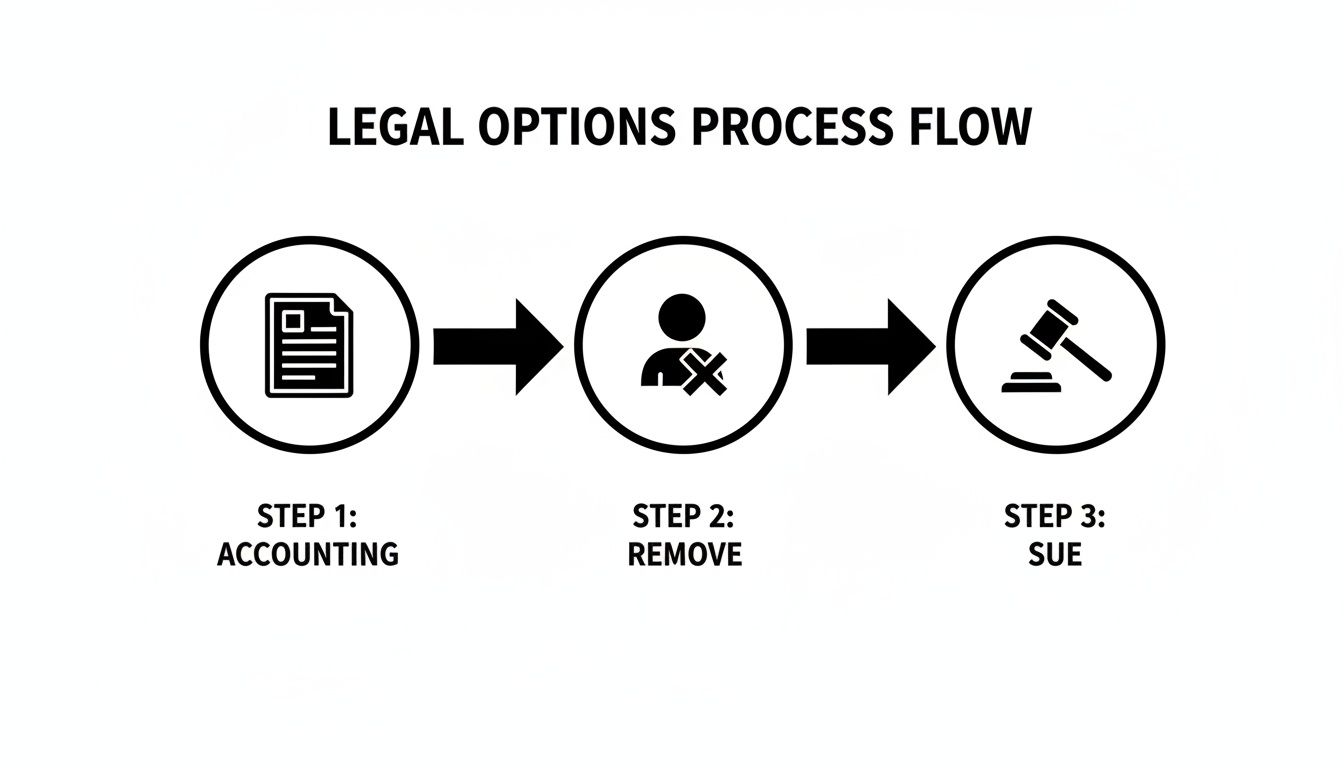
As you can see, you have a clear path forward, from demanding answers to removing the trustee and suing for damages.
Step-by-Step Guidance for Beneficiaries
- Document Everything: The moment you suspect something is wrong, start keeping meticulous records. Save every email, letter, and report. After phone calls, write a summary with the date and time. This documentation becomes your evidence.
- Review the Trust Document: The trust document is your rulebook. Read it carefully to understand the trustee's responsibilities, powers, and limitations, especially regarding distributions and reporting.
- Make a Formal Written Request for Information: If informal requests are ignored, send a formal request for an accounting via certified mail. This creates an official paper trail and demonstrates your attempt to resolve the issue directly.
- Understand the Statute of Limitations: In Texas, you generally have a four-year statute of limitations to sue for breach of fiduciary duty. This clock typically starts when you discovered—or reasonably should have discovered—the misconduct. Don’t wait; acting quickly is crucial.
- Consult an Experienced Texas Trust Attorney: Navigating trustee misconduct in Texas alone is complex. An attorney can review your evidence, explain your rights, and outline your best options. Often, a letter from an experienced Texas estate planning attorney is enough to get a trustee to cooperate. If not, your lawyer will be ready to advocate for you in court, including on related matters like guardianship or asset protection.
How a Texas Trust Attorney Can Protect Your Legacy
When you suspect a problem with a loved one’s trust, it can feel isolating. This isn't just about money; it’s a fight to protect a family legacy from trustee misconduct in Texas. The good news is you don’t have to do it alone. An experienced Texas trust attorney can be your staunchest ally, turning your worries into decisive action.
The path from suspicion to resolution requires a strategic partner who can enforce your rights. A knowledgeable lawyer serves as your guide and shield, ensuring your voice is heard and the trustee is held accountable under the Texas Trust Code.
Moving from Uncertainty to Empowerment
An attorney’s first role is to bring clarity to the chaos. They will meticulously analyze the trust document, review financial records, and measure the trustee's actions against their strict fiduciary duties in Texas. This initial investigation helps determine if you are dealing with a simple mistake or a serious breach requiring legal intervention.
Hiring a professional provides immediate leverage:
- Credibility and Authority: A formal letter from a law firm often motivates a previously unresponsive trustee to cooperate and provide necessary accountings.
- Evidence Gathering: Attorneys can use legal tools like subpoenas to obtain bank statements, investment records, and other crucial evidence that you cannot access on your own.
- Strategic Guidance: Your lawyer will explain your options—from demanding an accounting to filing for trustee removal or a surcharge action—and help you choose the most effective path.
Your Ally in Protecting Family Assets
The legal process for addressing trustee misconduct can be a maze of strict deadlines and formal procedures. A skilled Texas trust administration lawyer handles these complexities for you, allowing you to focus on your family. They build a powerful case based on facts, represent you in negotiations or in the courtroom, and relentlessly pursue every available remedy.
Whether it means recovering misappropriated funds, stopping a damaging transaction, or ensuring assets are properly managed for a probate or guardianship matter, your attorney’s sole goal is to make the trust whole again. They work to safeguard your inheritance and honor the wishes of the person who created the trust.
You have rights as a beneficiary, and Texas law is designed to protect you. With an expert on your side, you can confidently take the steps needed to secure your family's assets and honor your loved one's legacy.
If you’re managing a trust or planning your estate, contact The Law Office of Bryan Fagan, PLLC for a free consultation. Our attorneys provide trusted, Texas-based guidance for every step of the process.
Frequently Asked Questions About Trustee Misconduct
Grappling with a trust dispute can feel overwhelming. Concerns about trustee misconduct in Texas often raise many difficult questions. Getting clear, straightforward answers can provide the confidence you need to take the next step. Here are some of the most common concerns we hear from beneficiaries.
Can a Trustee Face Criminal Charges for Misconduct in Texas?
Yes, in serious cases, they can. While most disputes over fiduciary duties in Texas are civil matters—where you sue to recover money for the trust or remove the trustee—some actions are so severe they cross into criminal territory. Actions like embezzlement or intentional misuse of trust property are not just breaches of duty; they are crimes that can be prosecuted by a district attorney. Keep in mind that a criminal case is separate from the civil lawsuit you would file to protect the trust's assets.
What Does It Cost to Sue a Trustee in Texas?
The cost of suing a trustee can vary widely depending on the complexity of the case and whether it can be settled early or must go to trial. We understand that beneficiaries may not have funds readily available for a legal battle, which is why many trust litigation attorneys handle these cases on a contingency fee basis. This means the lawyer’s fee is a percentage of what is recovered for the trust, allowing you to pursue your rights without a significant upfront financial burden. We always offer a free consultation to discuss your specific situation and all potential costs transparently.
What Evidence Do I Need to Prove Trustee Misconduct?
A strong case is built on clear evidence. To prove a trustee has failed in their duties, you will need to gather documents that paint a clear picture of their actions or inaction.
Essential evidence includes:
- The trust document, which outlines the trustee’s responsibilities.
- Bank and investment statements showing the flow of money.
- Accounting reports from the trustee (or proof that you requested them and were denied).
- Emails, letters, and other written communication between you and the trustee.
- Records of questionable transactions, such as a trust property sold to a trustee's associate for below market value.
A good Texas trust administration lawyer has legal tools, like subpoenas, to help you obtain the critical evidence needed to build a powerful case.
Can I Remove a Trustee Without Going to Court?
Sometimes. The first place to check is the trust document itself, which might outline a specific process for removing a trustee, such as a majority vote by the beneficiaries. In other instances, a trustee may resign voluntarily when faced with a potential lawsuit. However, if the trustee refuses to step down and the trust document does not provide a non-judicial removal process, your only remaining option is to ask a judge to intervene and force their removal.
If you’re managing a trust or planning your estate, contact The Law Office of Bryan Fagan, PLLC for a free consultation. Our attorneys provide trusted, Texas-based guidance for every step of the process. Learn more at https://texastrustadministration.com.