Managing a loved one’s estate can feel overwhelming, especially when you're concerned about privacy. So let's address your most pressing question directly: No, in Texas, trusts are private documents by design. They are not part of the public record, and this confidentiality is one of the most powerful reasons people choose to create a trust instead of relying on a will.
With the right legal guidance, you can navigate this process with confidence and ensure your family’s affairs remain confidential.
Why Texas Trusts Are Kept Private
Estate planning often brings up serious privacy concerns. It's completely natural for families to worry about who can access their personal financial details after they're gone. The good news is, Texas law is built to protect this confidentiality, making trusts the go-to tool for private estate administration.

Think of a trust not as a public filing, but as a private agreement. It's a contract between the person creating it (the settlor), the person managing it (the trustee), and the people who will benefit from it (the beneficiaries). Because it's a private contract, it doesn't need a judge's stamp of approval to be valid, which is exactly what keeps it out of the public eye.
Here's a quick look at how trusts and wills differ when it comes to privacy in Texas.
Trusts vs Wills: A Quick Comparison of Public Access in Texas
| Feature | Revocable Living Trust | Last Will and Testament |
|---|---|---|
| Public Filing Requirement | No. Remains a private document. | Yes. Must be filed with the probate court. |
| Court Supervision | Not required for administration. | Required through the probate process. |
| Privacy of Assets | Asset details are kept confidential. | Asset inventory becomes public record. |
| Beneficiary Privacy | Beneficiary identities are private. | Beneficiary identities become public. |
| Terms of Distribution | Instructions remain confidential. | Distribution terms are part of the public will. |
As you can see, the difference is significant. A will's journey through the court system opens up your family's financial life for anyone to see, while a trust keeps that door firmly closed.
The Probate Process vs. Trust Administration
The real privacy gap opens up after someone passes away. A will must go through probate—a court-supervised process that confirms the will is valid and oversees how the assets get distributed. Every document filed in probate court is a public record.
A trust, on the other hand, completely sidesteps probate. The successor trustee simply follows the private instructions in the trust document to manage and distribute the assets. This process keeps all kinds of sensitive details confidential, including:
- The full extent and value of your assets.
- Who your beneficiaries are.
- The specific instructions for how and when assets are given out.
Understanding the Texas Trust Code
The legal framework in Texas is squarely on the side of privacy for trusts. The Texas Trust Code (Section 112.001 et seq.) doesn't require trusts to be registered or recorded publicly. The only exception is when a trust owns real estate. Even then, it's just the property deed that gets filed with the county, not the entire trust document with all its private details.
While the trust document itself is private, the fact that a trust owns a piece of property can sometimes be found. It can be useful to understand how to find property owners using public records just to see what kind of information is out there. Knowing this helps you truly appreciate the level of privacy a trust provides for everything else—all your non-deeded assets and personal instructions.
Why Trusts Are Built for Confidentiality
To fully appreciate why a trust is such a powerful tool for privacy, it helps to see it for what it is: a private contract. This confidential agreement is struck between three key players: the person setting up the trust (the settlor), the person or entity managing it (the trustee), and the people who will eventually benefit from it (the beneficiaries).
This private structure is the very foundation of its confidentiality. A will, on the other hand, is essentially an instruction manual for the court system. A trust is a self-contained legal vehicle designed to operate completely outside of court supervision. This keeps your family’s financial affairs exactly where they should be—within the family.
The Core Roles in a Private Trust Agreement
Once you understand the roles, the privacy aspect clicks into place. Each person involved has a distinct job defined by the trust document, and they all operate under a shield of confidentiality.
- The Settlor: This is the architect. The settlor drafts the rules, moves assets into the trust, and hand-picks the trustee and beneficiaries. Their instructions are meant to stay private.
- The Trustee: Think of the trustee as the manager. They are bound by a strict legal obligation called a fiduciary duty to manage the trust’s assets only for the good of the beneficiaries. A huge part of that duty is maintaining confidentiality.
- The Beneficiaries: These are the people or organizations who will ultimately benefit from the trust assets. While they have a right to information about the trust, that right doesn't extend to the public.
It's this private, contractual relationship that lets a trust sidestep the public probate process entirely, protecting your legacy from prying eyes.
How Different Trusts Protect Your Privacy
Whether you go with a revocable or irrevocable trust, that core benefit of privacy stays the same. Both are designed to avoid the public spectacle of probate court, but they fill different roles in your bigger estate plan. You can learn more about the specifics of living trusts in Texas in our detailed guide.
A revocable living trust gives you flexibility. You can make changes during your lifetime, all while keeping the details of your assets under wraps. An irrevocable trust is less flexible but offers powerhouse protection against creditors and can be a smart tool for tax planning—all while maintaining strict confidentiality.
This emphasis on privacy isn't some new legal trend; it has deep historical roots. The whole idea of a trust evolved over centuries to prioritize the creator's intent and keep things confidential. Today, 97% of U.S. states, including Texas, shield trust documents from public view unless they get dragged into a lawsuit. This modern legal framework is a direct result of lessons learned from high-profile probate cases that laid bare sensitive family finances for the world to see. Discover more insights about the evolution of trust in legal frameworks on ipsos.com.
The fundamental purpose of a trust is to carry out the settlor's wishes privately and efficiently. The Texas Trust Code is specifically designed to uphold this principle, giving families a reliable way to manage their legacies without public interference.
This commitment to privacy is invaluable in many common life scenarios where you just can't afford to have your affairs made public. For example, in a business succession, a trust allows for a seamless and private handover. Instead of business assets getting tied up in a public probate proceeding, a successor trustee can step in immediately, ensuring business continuity without tipping off competitors. Likewise, for families with unique dynamics, a trust makes sure those sensitive arrangements stay private, heading off potential conflicts. An experienced Texas estate planning attorney can help you structure a trust that meets these very specific, and very private, needs.
Exceptions That Can Make a Trust Public
While privacy is a primary benefit of a Texas trust, it’s not absolute. Certain events can pull a trust out of the shadows and into the public eye, at least partially. Knowing what these exceptions are is key to managing expectations and protecting your family’s information as much as possible.
Managing a loved one's estate can feel like you're navigating a minefield, but understanding when a trust’s privacy might be at risk allows you to prepare and handle these situations with confidence.
Trust Litigation and Court Filings
The single most common way a private trust document becomes public is when someone files a lawsuit. If a dispute arises that cannot be settled privately, it will proceed to court.
For instance, a beneficiary might sue the trustee for mismanaging funds, or a disinherited heir might challenge the trust's validity, arguing the settlor was under undue influence. You can get the full rundown on what it takes to challenge a trust by reading our guide on how a trust can be contested in Texas.
Once a lawsuit is in motion, the trust document itself usually becomes a key piece of evidence. Attorneys on both sides will likely file it with the court to build their cases. The moment it's filed, it technically becomes part of the public record for that specific lawsuit.
However, this doesn't mean your family's financial details are suddenly available for the world to see. While court records are public, they aren't easily accessible to a casual browser. More importantly, a skilled Texas trust administration lawyer can petition the court to seal the record or redact sensitive information—like account numbers or other personal details—to maintain as much privacy as possible.
This decision tree gives you a clear visual of how a trust’s status can change.
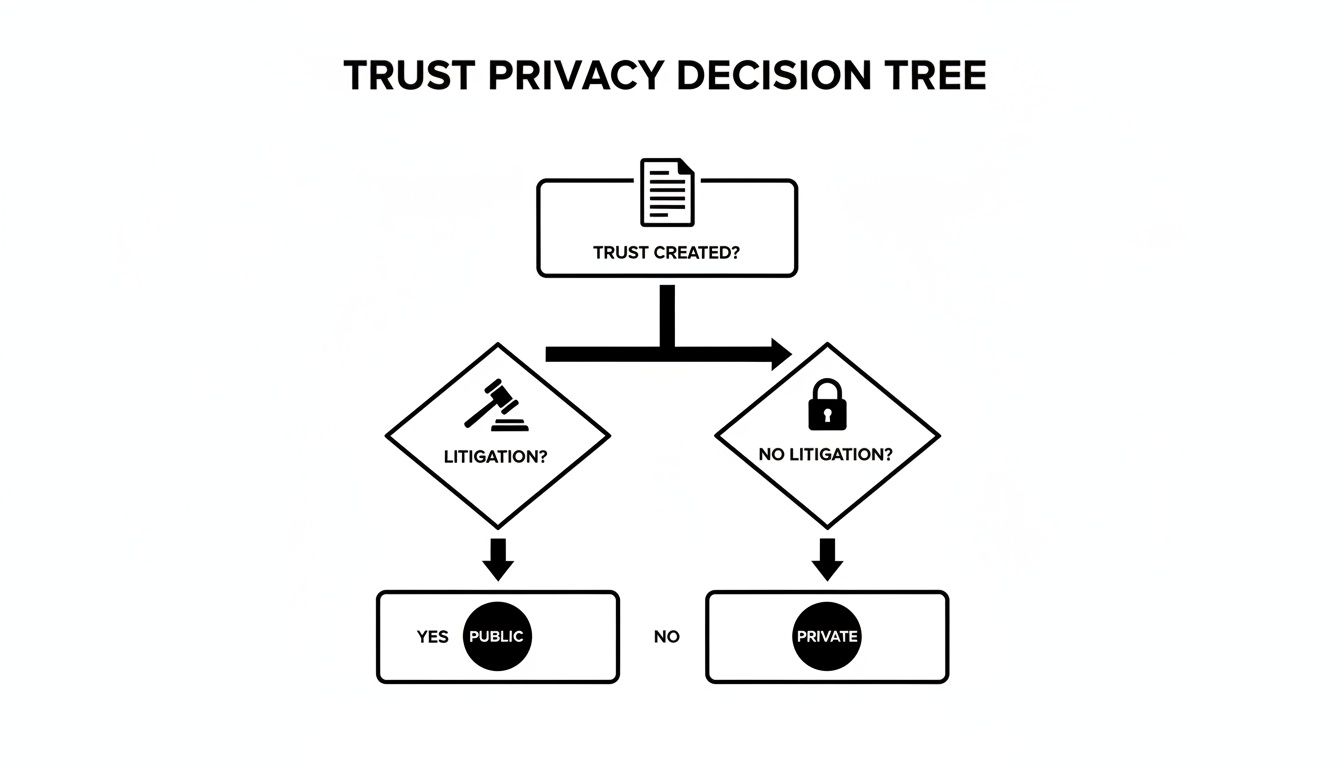
The main takeaway here? A trust’s default setting is private. It’s almost always litigation that flips the switch.
Real Estate Transactions Involving a Trust
Another common exception arises when a trust buys, sells, or transfers real estate. In Texas, these transactions must be recorded in the county’s public property records to maintain a clear chain of title.
Luckily, this doesn't mean you have to file the entire, lengthy trust agreement.
Texas law provides a practical solution: a Certificate of Trust (sometimes called a Memorandum of Trust). This is a summary document that proves the trust is legitimate and gives the trustee the authority to handle the property transaction.
This certificate typically includes just the basics:
- A statement confirming the trust exists.
- The name of the settlor and the current trustee.
- The specific powers the trustee has regarding real estate transactions.
By recording this summary instead of the full trust document, you fulfill all legal requirements without exposing private details. The names of your beneficiaries, the list of other assets, and your distribution plans stay completely confidential. An experienced Texas estate planning attorney will ensure these documents are drafted correctly to protect that confidentiality.
Trustee Responsibilities Under Texas Law: The Duty to Uphold Privacy
When you agree to be a trustee, you’re stepping into a role with serious legal weight. You’re not just managing assets; you’re taking on what the law calls fiduciary duties. At the heart of these duties is the obligation to protect the trust’s confidentiality. For anyone tasked with this role in Texas, understanding these responsibilities under the Texas Trust Code isn’t just good practice—it’s the law.
Serving as a trustee means you are legally bound to act only in the best interests of the beneficiaries. This goes far beyond just overseeing investments. It means guarding every piece of information about the trust, as disclosing sensitive details without a valid reason can lead to legal liability.
Core Fiduciary Duties Tied to Confidentiality
The Texas Trust Code outlines several key fiduciary duties in Texas that directly relate to keeping a trust and its assets private. These principles are the bedrock of trustworthy Texas trust administration.
- Duty of Loyalty: A trustee must act solely for the benefit of the beneficiaries, never for their own personal gain. This duty requires shielding the trust's information from anyone who might exploit it, such as creditors or opportunistic third parties.
- Duty of Prudence: You must manage the trust’s assets with the same care and skill that a reasonably prudent person would. Part of being prudent is preventing financial details from becoming public, which could put the assets at risk.
- Duty to Inform and Report: While this may seem counterintuitive to privacy, it’s about controlled communication. A trustee must keep beneficiaries reasonably informed about the trust's administration. However, this duty is owed only to the beneficiaries, not to the public.
Failing to uphold these duties can make a trustee personally liable. This is why it’s so critical to work with a Texas trust administration lawyer to ensure you’re complying with the law.
Real-World Scenario: Handling Beneficiary Requests
Imagine you're the trustee for your late aunt’s trust, established for her three adult children. One beneficiary emails you demanding a full copy of the trust, all financial statements, and a complete list of assets, stating he wants his financial advisor to review everything.
Your instinct might be to provide everything to maintain family harmony. However, your fiduciary duty requires a more measured approach.
A trustee’s job is to strike a delicate balance: provide a beneficiary with the information they are entitled to, while also protecting the trust's overall privacy and the interests of all beneficiaries. Unrestricted disclosure can create unintended problems.
Here is a step-by-step guide for handling that request professionally:
- Acknowledge the Request: Respond promptly and professionally, letting the beneficiary know you are reviewing his request.
- Consult the Trust Document: The trust agreement is your primary guide. It may contain specific rules about information sharing.
- Provide Required Information: Under Texas law, you must provide an accounting and relevant information to beneficiaries. You can send a copy of the trust document and recent financial statements.
- Protect Sensitive Data: Before sending, redact sensitive personal information that isn’t strictly necessary, like Social Security numbers or full account numbers.
- Decline Overreaching Requests Politely: You can reasonably decline to send confidential information to a third-party advisor without proper authorization. Explain that your duty is to protect the trust's confidentiality for the benefit of all beneficiaries.
This careful approach fulfills your legal duties without exposing the trust’s private affairs. It demonstrates competence and commitment to upholding the privacy the settlor intended.
Practical Steps to Keep Your Texas Trust Private
The privacy a trust offers isn’t automatic—it’s built through careful, deliberate planning from the start. While the Texas Trust Code provides a strong foundation for confidentiality, you must be proactive to truly keep your family's financial affairs private. Taking control of this process is how you build a secure and private legacy.
Think of these strategies as the building blocks for a truly private estate plan. By putting them into action, you're fortifying the trust against prying eyes and ensuring your wishes are carried out with the discretion you intended.

Choose Your Trustee Wisely
The single most important decision for your trust's privacy is selecting the right trustee. This person or institution holds the keys to your legacy, and their integrity is paramount. A trustworthy trustee is your first and best line of defense against information leaks and mismanagement.
When considering a trustee, evaluate their:
- Discretion: Do they have a solid track record of being responsible and keeping private matters private?
- Financial Acumen: Are they capable of managing assets wisely and fulfilling their fiduciary duties?
- Impartiality: Can they act fairly for all beneficiaries without letting personal feelings or conflicts of interest interfere?
While choosing a family member may seem natural, it can sometimes lead to family drama. A professional trustee, such as a bank's trust department or an experienced Texas trust administration lawyer, brings a priceless layer of impartiality and expertise, ensuring both privacy and fiduciary duties are handled professionally.
Define Information-Sharing Rules in the Trust Document
Your trust agreement is your rulebook. You have the power to specify exactly how and when information should be shared with beneficiaries and others. This is a critical step that is often overlooked.
For example, you can stipulate that beneficiaries are only entitled to see information directly related to their own share of the trust. You can also outline a formal process for a beneficiary's financial advisor to access information, requiring written authorization to prevent casual disclosure. A skilled Texas estate planning attorney can help you draft these clauses with precision.
A well-drafted trust document acts as a clear guide for the trustee, minimizing ambiguity and reinforcing the settlor's intent for confidentiality. It transforms privacy from a general goal into an enforceable directive.
Use a Certificate of Trust for Transactions
As mentioned earlier, you don't need to provide your entire trust document for every transaction. For these situations, there’s a much smarter tool: the Certificate of Trust.
This summary document confirms the trust exists and that the trustee has the authority to act, but it does so without revealing sensitive details, such as:
- The names of all your beneficiaries
- The total value of your trust's assets
- Your specific plans for distribution
Make it a habit to always use a Certificate of Trust for transactions. It gives financial institutions the proof they need while keeping your family’s private business out of their files.
Properly Title Assets in the Trust's Name
A trust only controls the assets that are legally titled in its name. Failing to properly "fund" the trust is one of the most common estate planning mistakes. If an asset remains in your individual name when you pass away, it will likely have to go through the very public probate process, defeating the purpose of having a private trust.
Properly funding your trust means retitling your assets—such as real estate deeds, bank accounts, and investment portfolios—into the name of the trust. For example, a property deed would be changed from "Jane Smith" to "Jane Smith, Trustee of the Jane Smith Revocable Trust." This meticulous process is the final, crucial step to ensuring your assets bypass public court proceedings and your estate plan stays private.
Partner with an Experienced Texas Trust Attorney
Navigating the complexities of Texas trust law can be daunting, but you don't have to do it alone. As we've discussed, trusts are excellent tools for privacy, but maintaining confidentiality requires deliberate planning and skilled administration.
Answering the question, "are trusts public record?" with a confident "no" comes down to having a solid strategy. Our team at The Law Office of Bryan Fagan, PLLC specializes in creating and managing trusts that protect not just your assets, but your family's privacy as well. We provide the calm, compassionate, and expert advice you need for genuine peace of mind.
Your Trusted Legal Partner
Whether you are creating an estate plan, serving as a trustee, or are a beneficiary with questions, professional legal guidance is key to protecting your interests. We are here to help with:
- Estate Planning: We will help you build a rock-solid plan using trusts to keep your personal affairs private and avoid the public process of probate.
- Trust Administration: If you are a trustee, we will provide clear, straightforward guidance on meeting your fiduciary duties, managing assets correctly, and communicating with beneficiaries while maintaining confidentiality.
- Asset Protection: Our strategies are designed to build a fortress around your legacy, shielding it from creditors and legal challenges so your wishes are carried out exactly as you planned—and privately.
Working with a skilled Texas trust attorney isn't just about drafting documents. It's about building a lasting shield that protects your family's privacy for generations to come. It transforms your desire for confidentiality into an enforceable legal reality.
Your family’s security is too important to leave to chance. A knowledgeable Texas estate planning attorney can help you anticipate challenges, from potential lawsuits to complex real estate deals, ensuring every action reinforces the private nature of your trust.
If you’re managing a trust or planning your estate, contact The Law Office of Bryan Fagan, PLLC for a free consultation. Our attorneys provide trusted, Texas-based guidance for every step of the process.
A Few More Questions About Trust Privacy in Texas
As you delve into the details of setting up and managing a trust, many practical questions arise. To help provide clarity, here are answers to some of the most common concerns we hear from Texas families.
Is an Irrevocable Trust More Private Than a Revocable One?
When it comes to keeping your affairs out of the public eye, no. Both revocable and irrevocable trusts are private documents by design. They are created to avoid the public process of probate court.
Under Texas law, neither type must be filed or registered with any public agency, so their level of confidentiality is identical. The key differences between them relate to control, tax planning, and asset protection during your lifetime, not their public visibility after you pass away.
If Someone Contests a Trust, Does the Whole Thing Go Public?
Not necessarily. It's true that if a lawsuit is filed to challenge a trust, the document will likely be submitted as evidence. Once it's part of the court file, it technically becomes a public record.
However, this doesn't mean it's easily accessible to just anyone. A good attorney will immediately take steps to protect your family's privacy. They can file a motion asking the judge to seal sensitive records or, at the very least, redact (black out) confidential details like account numbers, home addresses, and personal financial data before it is entered into the record.
While a court battle does create a risk of public exposure, it’s not a foregone conclusion. Taking proactive legal steps can keep a significant amount of your family’s business private, even in the middle of a dispute.
What Is a Certificate of Trust and How Does It Keep Things Private?
A Certificate of Trust is a condensed, legally recognized summary of your full trust document. It proves the trust exists and gives the trustee the authority to manage its assets—without revealing all the private details.
Instead of providing the entire trust agreement every time you conduct business, you can use this shorter certificate for banks, title companies, and other institutions. It's a simple but highly effective tool.
By using a Certificate of Trust, you keep the most sensitive parts of your plan confidential, including:
- Who your beneficiaries are.
- A complete list of every asset inside the trust.
- Your specific, personal instructions for how your legacy should be distributed.
This document is a cornerstone of maintaining privacy while administering a trust in Texas.
If you’re managing a trust or planning your estate, contact The Law Office of Bryan Fagan, PLLC for a free consultation. Our attorneys provide trusted, Texas-based guidance for every step of the process. You can learn more at https://texastrustadministration.com.