Planning for the future of your business can feel overwhelming, but with the right legal guidance, securing your legacy doesn’t have to be. A business succession plan is a detailed playbook for how your company's leadership and ownership will pass to new hands. Think of it as the roadmap that spells out the who, what, when, and how for your business's future. It’s the single most important document for ensuring a smooth transition when you decide to retire, step back, or if something unexpected like a disability or death occurs.
Why a Business Succession Plan Is Non-Negotiable in Texas

Thinking about the future of your business is a monumental task, but putting it off creates far bigger headaches for your family, partners, and employees down the road. For any Texas business owner, a formal succession plan is one of the most critical documents you'll ever create. It's the key to preserving the value you've spent a lifetime building and fulfilling your fiduciary duty to those who depend on you.
Without a documented plan, you’re leaving the future of your business to chance and immense uncertainty. The lack of clear instructions often leads to severe consequences that can unravel years of hard work, often in just a few months.
The Risks of Operating Without a Plan
Failing to plan is planning to fail. We have seen this happen time and again. Here are the most common risks Texas business owners face when they don't have a succession plan in place:
- Forced Liquidation: Without a designated buyer or successor ready to step in, your family might be forced to sell the business in a hurry. This almost always means selling at a steep discount just to cover debts or estate taxes, as dictated by the Texas Estates Code.
- Family Disputes: When several family members feel they have a stake, the absence of a clear plan is a recipe for disaster. It can ignite bitter fights over control and inheritance that often wind up in costly, relationship-destroying litigation.
- Loss of Key Talent: Your best people—the managers and employees who keep things running—may head for the exits if they see an unstable future for the company. Their departure can destabilize operations at the worst possible moment.
- Significant Tax Burdens: An unplanned transfer of business assets can trigger massive estate and capital gains taxes, chipping away at the wealth you worked so hard to build and pass on.
This isn't a niche problem; it's a widespread issue. A 2023 survey revealed that only about 30% of family businesses have a solid, written plan. That's a scary statistic, especially when you consider that over 50% of privately held businesses in the U.S. are owned by people over 55.
Before diving into the template, it helps to understand how all the pieces fit together. This table breaks down the core components every Texas business succession plan should include, touching on the legal framework that guides them.
Core Components of a Texas Business Succession Plan
| Component | Purpose and Key Considerations | Relevant Texas Legal Framework |
|---|---|---|
| Governance & Leadership Transition | Clearly identifies successors and outlines the training, timeline, and decision-making authority transfer. Who takes over day-to-day operations? | Texas Business Organizations Code (BOC) |
| Ownership Transfer & Buy-Sell Agreement | Defines the triggering events (death, disability, retirement) and mechanics for transferring ownership shares. Includes valuation methods and funding mechanisms. | Texas Business Organizations Code; Contract Law |
| Business Valuation Method | Establishes an agreed-upon formula or process for determining the business's value to prevent disputes and ensure a fair price. | Uniform Standards of Professional Appraisal Practice (USPAP); Case Law |
| Funding Strategy | Outlines how the buyout will be financed (e.g., life insurance, seller financing, bank loan). Ensures liquidity is available when needed. | Texas Insurance Code; Contract Law |
| Tax & Estate Planning Integration | Structures the plan to minimize estate, gift, and capital gains taxes for all parties involved. Often involves trusts and other estate planning tools. | Internal Revenue Code; Texas Estates Code; Texas Trust Code |
| Communication Plan | A strategy for communicating the transition to employees, clients, suppliers, and other stakeholders to maintain confidence and stability. | General Business & Employment Law |
Each of these elements is a critical gear in the machine. A failure in one area, like an unfunded buy-sell agreement, can cause the entire plan to grind to a halt.
A Real-World Texas Scenario
Let us share a real-world scenario. We once worked with a Houston-based construction company founded by two brothers. One brother died suddenly, leaving no succession plan. His 50% ownership stake passed to his widow under Texas intestacy law, and she knew nothing about the construction business.
The surviving brother was ready to keep the company going, but the widow needed cash immediately to support her family and wanted to sell her shares. They couldn't agree on a fair price, and the business was paralyzed, unable to bid on new projects. The entire situation ended up in probate court, draining the company's cash reserves and tarnishing its reputation in the industry.
A business succession plan would have prevented this entire crisis. A pre-negotiated buy-sell agreement, funded by a life insurance policy, could have provided the widow with immediate cash and given the surviving brother full control of the company, ensuring seamless continuity.
Viewing this process as a strategic transition—not just an ending—empowers you to protect your legacy. A succession plan is intertwined with broader business exit planning strategies, and it's your ultimate act of stewardship for the company you built and the people who rely on it.
Defining Governance and Identifying Successors

Once you've made the decision to build a succession plan, the next step is deciding who will steer the ship after you and exactly how decisions will be made. This is the bedrock of your entire plan—the governance framework that turns your vision into a concrete leadership structure.
This is more than just picking a name. You're defining roles, responsibilities, and the chain of command for the transition and for the years to come. A solid governance structure is your best defense against the power vacuums and operational chaos that can swallow a business whole when a founder steps away.
Establishing Objective Criteria for Your Successor
One of the biggest mistakes business owners make is choosing a successor based on emotion or a sense of obligation. To give your company the best chance of survival, the selection process must be guided by objective criteria. This isn't just good business; it's essential for minimizing conflict, especially when family is involved.
Take a professional services firm in Dallas. The founder, a brilliant architect, had two children working in the business, plus a senior project manager who was an exceptional leader. Instead of simply handing the keys to a family member, she created a scorecard with her Texas estate planning attorney to grade all three candidates on what actually mattered for the job.
Her scorecard was specific:
- Leadership and Management Skills: Can they motivate a team and juggle complex projects without dropping the ball?
- Financial Acumen: Do they truly understand a P&L statement, budgeting, and financial forecasting?
- Client Relationship Management: Have they proven they can keep key clients happy and bring new ones in the door?
- Strategic Vision: Can they see beyond next quarter and steer the firm toward future growth?
By using an objective framework like this, she made a choice based on merit, not just bloodlines. It was a decision she could defend logically, which protected both her family dynamics and the future of the company she’d spent her life building.
Identifying and Vetting Potential Successors
Your next leader could be a family member, a key employee, or an external buyer. Each path comes with its own set of opportunities and challenges. The key is to look for potential, not just past performance. The best candidates are adaptable, eager to learn, and ready to take on more responsibility.
- Family Members: This is the classic route, but it requires a brutally honest look at their skills and, just as importantly, their desire. Do they actually want the job, or are they just trying to please you?
- Key Employees: Promoting from within is a huge morale booster. These individuals already live and breathe your company culture, which can make for a much smoother handover.
- External Buyers: Sometimes, the smartest move is a clean sale to a third party. This often yields the biggest financial return but demands meticulous planning to ensure the business doesn’t fall apart during the transition.
A critical piece of the puzzle is defining not just who takes over, but the legal and operational mechanics of the transfer. The process of how to transfer business ownership is far more than a handshake agreement; it demands precise legal documentation to hold up under Texas law.
Ultimately, your goal here is to create a predictable and stable transition. By clearly outlining the governance and choosing your successor with objective criteria, you're aligning your personal legacy with the practical needs of the business. Get this foundation right, and every other step of the planning process becomes clearer and far more effective.
Putting a Price Tag on Your Legacy: Valuation and the Buy-Sell Agreement
Once you’ve identified your future leaders, it's time to tackle the valuation. A fair, mutually agreed-upon business valuation is the absolute cornerstone of a solid succession plan. Without it, even the most thoughtful plans can fall apart, leading to disputes and even litigation.
This isn’t just about picking a price. It’s about establishing a crystal-clear, legally sound method for how that price will be determined down the road. That kind of transparency is what keeps everyone on the same page and ensures the transition feels equitable.
How Much Is It All Worth? A Practical Look at Valuation
Figuring out what your business is worth might seem complex, but it boils down to a few common-sense approaches. An experienced Texas trust administration lawyer can walk you through which method—or even a blend of them—makes the most sense for your company and industry.
There's no single "right" way to do this. The real goal is to choose a method that everyone agrees is fair and then lock it into your succession plan.
- Asset-Based Valuation: This is a straightforward method where you calculate the company's value by subtracting its total liabilities from the total value of its assets. It’s a common go-to for businesses heavy on tangible assets, like manufacturing plants or real estate holdings.
- Market-Based Valuation: Think of this like a real estate appraisal for your business. It involves comparing your company to similar ones that have recently sold. This gives you a realistic value based on what the current market is actually willing to pay.
- Income-Based Valuation (or "Earnings-Based"): This one is all about future potential. It zeroes in on the business's ability to generate profit down the line. You'll often see formulas based on a multiple of EBITDA (Earnings Before Interest, Taxes, Depreciation, and Amortization), which is perfect for service-based businesses with predictable cash flow.
Key Takeaway: Whatever valuation method you land on, it needs to be formally documented in your buy-sell agreement. This simple step prevents arguments over the business’s worth during what is already a stressful time, making sure the process is clean and follows established fiduciary duties in Texas.
The Buy-Sell Agreement: Your Succession Plan's Engine
If valuation is the destination, the buy-sell agreement is the powerful engine that gets you there. This legally binding contract is, without a doubt, the single most important piece of your entire business succession plan. It lays out the exact rules for how and when ownership will transfer from you to your successors.
Think of it as a prenuptial agreement for your business partners. A well-drafted buy-sell provides a clear roadmap, protecting your family, your partners, and the company you built.
Must-Haves in a Texas Buy-Sell Agreement
This is one document where you can't afford to be vague. It needs to clearly spell out the "triggering events"—the specific circumstances that kick the buyout process into gear.
Some of the most common triggering events include:
- Death of an owner
- An owner's long-term disability
- An owner's retirement
- Voluntary departure or termination
- An owner filing for bankruptcy or divorce
For every one of these events, the agreement should specify the exact valuation method to be used and the precise terms of the sale, including how it will be paid for. This last part—the funding mechanism—is critical. A buy-sell agreement is just a piece of paper if the successors don’t have the money to actually buy the shares. Often, this is handled through life insurance policies, where the company or the other owners are named as beneficiaries, providing instant cash upon an owner's death.
For a deeper look into how to structure this vital document, we’ve put together a comprehensive guide on the buy-sell agreement template.
A San Antonio Manufacturing Scenario
Let's picture a family-owned manufacturing company right here in San Antonio. The founder is in his late 60s and wants his two most trusted managers to take the reins when he retires or passes away.
Working with their attorney, they draft a buy-sell agreement that sets the company's value at five times its average annual EBITDA. To fund it, they take out a life insurance policy on the founder, naming the two managers as beneficiaries.
When the founder unexpectedly passes away, the plan clicks into place perfectly. The life insurance payout gives the managers the exact amount of cash they need to buy the founder's shares from his estate, all at the pre-agreed price. His family receives fair market value for the business without any haggling or delay, and the managers take full ownership without missing a beat or drowning in debt. That’s the power of a well-built plan.
This kind of proactive planning is becoming more critical than ever, especially in professional services. For instance, a staggering 40% of law firm partners are expected to retire in the next decade, yet a surprising number of firms have no written succession plan.
Weaving Your Succession Plan into Texas Trust and Estate Law
Think of your business as the biggest piece in your financial puzzle. A succession plan, on its own, is like having just that one piece without the rest of the box. For any Texas business owner, a smooth transition means connecting that plan to your wider estate plan, all under the guidance of the Texas Estates Code and the Texas Trust Code.
If this integration is overlooked, you risk costly delays, unforeseen taxes, and family disputes. Your succession plan spells out the what and the who. Your estate plan is the legal engine that actually makes it all happen. This is where your template ideas become a rock-solid, legally binding reality that protects everything you've built.
Using Trusts to Protect Your Business
A trust is one of the most effective tools for integrating your business and estate plans. When you transfer ownership of your business interests into a well-crafted trust, you can achieve crucial goals that a simple will just can't handle.
- Avoid Probate: Assets held in a trust bypass the probate process entirely. This is a significant advantage. It means your handpicked successor trustee can act on your buy-sell agreement immediately, without waiting for a judge's permission. That saves considerable time and money.
- Asset Protection: Certain types of irrevocable trusts can act as a shield, protecting your business assets from the creditors of your beneficiaries. This helps ensure the company you poured your life into stays intact for the next generation.
- Reduce Tax Burdens: Advanced trust strategies are designed to help minimize federal estate and gift taxes, preserving more of your business's value for your family instead of the IRS.
- Plan for Incapacity: If you ever become incapacitated, a trust allows your successor trustee to step in and manage the business immediately. This avoids the need for a court to get involved and appoint a guardian.
For example, a business owner in Fort Worth places her company shares into a Revocable Living Trust. Her succession plan names her son to take over, with a clear buyout price funded by life insurance. When she passes away, the trustee can instantly use those insurance proceeds to finalize the sale spelled out in the buy-sell agreement. All of this happens without the months-long delay typical of a Texas probate court.
The Critical Roles of Executors and Trustees
Your business succession plan must be perfectly aligned with the legal duties of the fiduciaries you name in your will and trust. In Texas, your executor and trustee have a strict legal requirement—their fiduciary duty—to act in the best interests of the estate and its beneficiaries.
A well-written succession plan is their roadmap. It eliminates guesswork and gives them the clear authority they need to make decisions, like distributing assets or finalizing a sale. This clarity is their best defense if a beneficiary challenges their actions in court. Seeking guidance from a Texas trust administration lawyer is essential, a topic we explore in our guide on estate planning for small business owners.
The hard truth is that too many business owners overlook this crucial step. Less than half of American adults even have a will, and many who do fail to properly account for their business. With U.S. courts managing over 1.2 million probate cases each year, leaving your business plan disconnected from your estate plan invites unnecessary legal complications.
Getting the terminology right is also fundamental. For example, understanding the different beneficiary vs dependent roles in insurance, retirement, and estate planning prevents confusion and makes sure your assets—both personal and business—go to the right people. Aligning your succession plan with Texas law isn't just a good idea; it's the only way to guarantee your wishes are honored and your life's work is protected.
Communicating the Plan and Creating an Implementation Checklist
A business succession plan tucked away in a filing cabinet is about as useful as no plan at all. Once you've established the legal and financial frameworks, the final piece is communication. This is where you bring your carefully crafted template to life, transforming it from a static document into a living strategy that everyone can support.
Rolling out the plan to family members, key employees, and other stakeholders is a delicate process that demands both transparency and compassion. The goal is to manage expectations, build trust, and prevent misunderstandings that could escalate into disputes. These conversations are a vital part of your fiduciary duty to keep the company's future secure.
Leading the Conversation with Clarity and Empathy
Announcing a succession plan can stir a range of emotions, from excitement and relief to anxiety and uncertainty. Your role is to be a steady, reassuring guide, focusing on the stability and continuity the plan provides for everyone.
When you sit down with your stakeholders, be prepared to walk them through a few key points:
- The "Why": Start by explaining the purpose behind this effort—it's about protecting the business, its employees, and your family's legacy.
- The Timeline: Provide a clear, realistic timeline for the transition. Knowing what to expect and when can greatly reduce uncertainty.
- The Roles: Be crystal clear about the future roles of successors, any family members not involved in day-to-day operations, and your key employees.
- The Process: Briefly touch on how decisions were made. Highlighting the objective criteria you used to select successors can reinforce that this was a thoughtful, fair process.
Practical Advice: Document these meetings. A simple summary of who was present and what was discussed can be invaluable later. It demonstrates that you acted with transparency and fulfilled your duty to keep everyone informed.
This entire process is about connecting the dots between your business, your personal trust, and your overall estate.
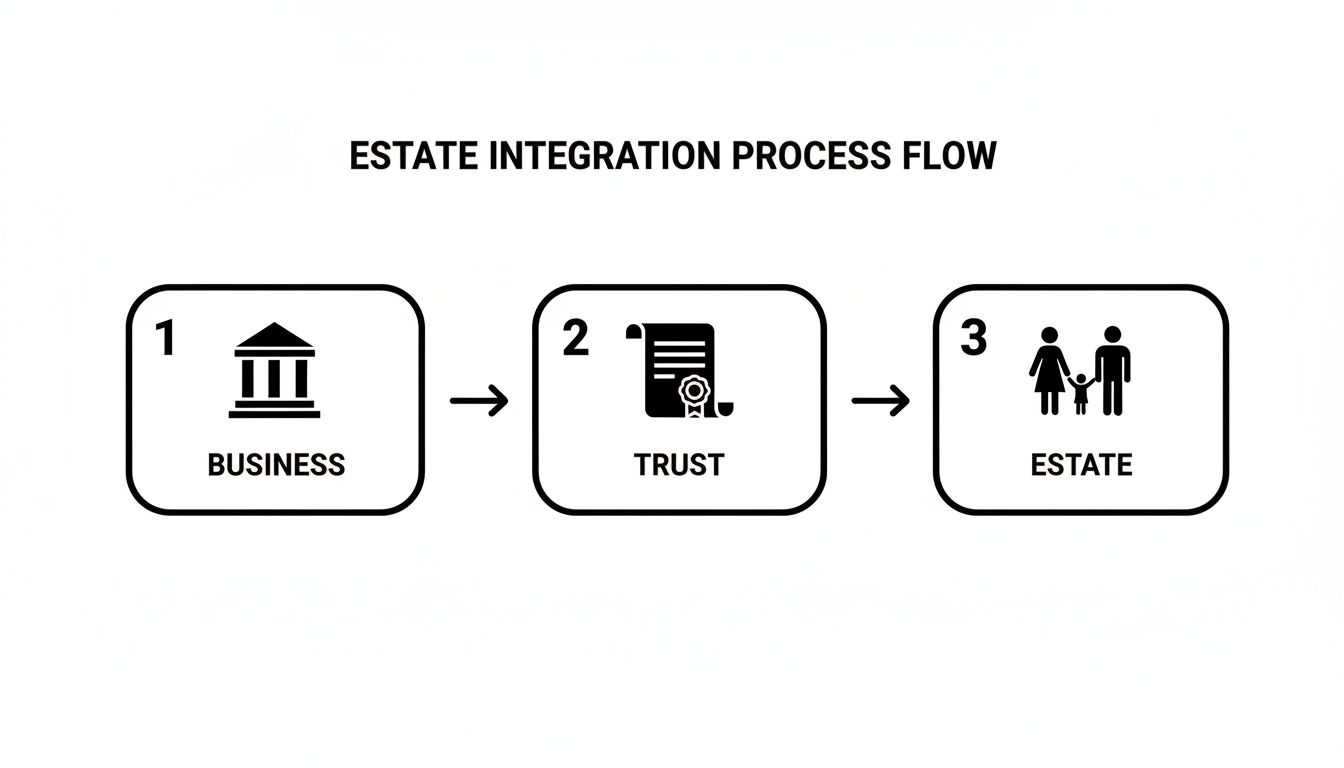
As you can see, a truly successful transition depends on integrating your business into your trust, which then flows seamlessly into your estate plan. It’s the best way to protect both your company and your family.
Your Actionable Implementation Checklist
With communication underway, it's time to shift from planning to doing. A step-by-step checklist ensures no critical detail gets lost as you execute the legal and financial moves. Think of it as the bridge between your plan on paper and its real-world execution.
Here is a practical, step-by-step guide to get you through the final steps:
- Execute Legal Documents:
- Get the final buy-sell agreement signed by all parties.
- Update your will and trust documents so they're perfectly aligned with the succession plan. This is a critical step for a Texas estate planning attorney to oversee.
- Sign any necessary corporate resolutions or amendments to the company agreement.
- Update Corporate and Financial Records:
- Formally update corporate records, like the stock ledger, to reflect any ownership changes.
- Notify your bank and other financial institutions about changes in leadership or signing authority.
- Secure Buyout Funding:
- Double-check that any life or disability insurance policies are in force and the premiums are paid up.
- If part of the plan, finalize any loan agreements or seller-financing notes.
- Notify Key Stakeholders:
- Inform your key clients, suppliers, and creditors about the leadership transition plan. Maintaining their confidence is crucial.
- Schedule Periodic Reviews:
- Set a recurring date on the calendar—at least annually—to review the plan. Business and life are constantly changing, and your plan needs to keep up. A shift in business valuation, a change in family circumstances, or new Texas laws could all require adjustments.
This checklist is what turns your plan from theory into reality. By ticking every legal box and preparing every stakeholder, you transform your business succession plan into a powerful tool for lasting stability and success.
Common Questions About Business Succession Planning in Texas
Starting the succession planning journey naturally brings up many questions. As a Texas business owner, you need to feel confident that the path you're choosing not only fits your vision but is also built on solid legal ground. Let's tackle some of the most common questions we hear from families and business owners like you.
What Happens If I Don't Have a Plan at All?
This is a critical question, and the answer is direct. Without a formal succession plan, the future of your business is left to chance and the Texas probate court system.
If you pass away without a will or succession agreement, your business ownership is subject to Texas intestacy laws. This means a judge who doesn't know you or your business decides who inherits. It's a process that can drag on for months, sometimes years, freezing business operations and sparking feuds among family members. More often than not, it ends in a forced sale for pennies on the dollar just to pay off heirs or estate taxes.
Simply put, having no plan is a plan for chaos. It jeopardizes the financial security of your family and the livelihoods of your employees, often undoing decades of hard work in a matter of months.
How Can We Handle Disagreements Among Successors?
Disagreements are common, especially when family is involved. The best approach is to address potential conflicts before they happen—which is exactly what a well-drafted business succession plan template is for.
Your plan needs to have specific dispute resolution mechanics built right in. This might be a clause requiring mediation before litigation, or it could designate a trusted, neutral third-party advisor to break operational deadlocks. Your most powerful tool here is the buy-sell agreement. By clearly defining the valuation method and buyout terms for an owner who wants out, you create a clear, unemotional exit ramp. This simple step can prevent a disagreement from escalating into a lawsuit that could drain the company's resources. A Texas estate planning attorney can help you structure these provisions to be both fair and legally sound.
How Often Should I Review and Update My Plan?
Think of your succession plan like a business plan—it's not a "set it and forget it" document. Your business, your family, and the laws are always changing. We advise our clients to review their plan at least every three to five years, or immediately after any major life or business event.
It's time for an update if any of these things happen:
- A significant change in business value: If you've had major growth or a tough downturn, your old valuation formula is likely outdated.
- Family dynamics change: A marriage, divorce, birth, or death involving you or a successor can completely change the plan's suitability.
- Key people come or go: If your chosen successor leaves the company or is no longer the right fit, you need to revisit the plan immediately.
- The laws change: New Texas or federal laws, especially around estate taxes or business entities, can create gaps in your strategy if not addressed.
Regular check-ups keep your plan relevant and ensure it's a living document that reflects your wishes and the current state of the business. This isn't just good practice; your fiduciary duties in Texas include keeping your affairs in order to protect your beneficiaries.
We often see business owners wrestling with these questions and more. To provide a bit more clarity, here are some other frequently asked questions we encounter.
| Question | Answer |
|---|---|
| Can I just use a generic template I found online? | While online templates can be a starting point, they are rarely sufficient. Texas has specific laws regarding business entities, community property, and probate that a generic document won't address. A one-size-fits-all approach often leads to unenforceable agreements and costly legal battles down the road. Customization with a Texas attorney is critical. |
| What's the difference between a succession plan and a will? | A will primarily deals with the distribution of your personal assets after you die. A succession plan is a much more comprehensive strategy focused specifically on the ownership and management transition of your business. It often includes a buy-sell agreement, management transition details, and funding mechanisms, which are things a will typically doesn't cover in the required detail. |
| How do we fund a buyout if a partner wants to exit or passes away? | Funding is a crucial component that's often overlooked. Common methods include using life insurance policies (where the company or partners are beneficiaries), setting up a sinking fund (saving over time), arranging for seller financing (the departing owner is paid out over several years), or securing a bank loan. The best method depends on your business's cash flow, value, and the partners' financial situations. |
These questions just scratch the surface, but they highlight the importance of being thorough and proactive. A well-thought-out plan is the best way to protect everything you've worked so hard to build.
If you’re managing a trust or planning your estate, contact The Law Office of Bryan Fagan, PLLC for a free consultation. Our attorneys provide trusted, Texas-based guidance for every step of the process. Learn more at https://texastrustadministration.com.