When a loved one passes, navigating their final wishes can feel overwhelming, especially when faced with complex legal processes. A common misconception is that a will automatically triggers a long and difficult court proceeding. The good news is that in Texas, this isn't always true.
The short answer is no, not all wills must go through the full probate process in Texas. Understanding what this means can provide peace of mind and a clear path forward for you and your family.
Demystifying Probate for Texas Wills

Losing someone is difficult enough without the added stress of managing their final affairs. The term "probate" can sound intimidating, but its purpose is straightforward: it is the court-supervised process for finalizing an estate.
Probate is how a will is officially validated, any outstanding debts are settled, and assets are legally transferred to the correct beneficiaries. While this formal process is essential for many estates, the Texas Estates Code provides several simpler, more efficient alternatives for situations that qualify. This guide will explain your options in plain English, empowering you to move forward with confidence and clarity.
Not Every Estate Needs Full Court Supervision
It often surprises families to learn how frequently formal probate can be simplified or avoided altogether. Research suggests that a significant number of estates, potentially 30% to 50%, bypass the traditional probate process using various legal strategies. You can find more insights on these estate planning statistics over at Growlaw.co.
This is possible because Texas law is designed to be practical. It acknowledges that a one-size-fits-all approach doesn't work for every family. Whether a will requires probate depends on a few key factors:
- The total value of the estate's assets.
- Whether the estate has any unpaid debts.
- How the assets are titled (e.g., joint ownership with right of survivorship or assets with named beneficiaries).
For instance, an estate with few assets and no debt may qualify for a much simpler procedure than a large, complex estate with multiple creditors. Our goal is to help you find the most direct and peaceful path to honor your loved one's wishes without unnecessary cost or delay. In the following sections, we will explore what these probate alternatives look like.
Understanding the Purpose of Probate in Texas
When you are grieving, probate can feel like an unnecessary bureaucratic burden. However, its true purpose is protection—for the deceased, their creditors, and most importantly, their family.
Think of probate as a court-supervised final accounting of a person's financial life. It is a structured, transparent process designed to prevent fraud, resolve disputes, and ensure a loved one's final wishes are carried out exactly as intended. Without this legal framework, estates could remain in limbo, leaving assets vulnerable to false claims or mismanagement.
The Core Functions of Probate
Under the Texas Estates Code, the probate process provides legal certainty and closure. The court's oversight ensures every step is handled correctly and in the proper order.
Here’s what probate accomplishes:
- Validating the Will: The court first confirms that the will is the authentic and final testament of the deceased. This crucial step prevents the use of fraudulent or outdated wills.
- Appointing the Executor: While a will names an executor, the court grants them the official authority to act. This authority, known as Letters Testamentary, empowers the executor to manage the estate's assets.
- Settling Debts and Taxes: Before heirs can receive their inheritance, all legitimate debts and taxes must be paid. Probate establishes a formal process for creditors to file claims and for the executor to settle these accounts with estate funds.
- Transferring Property Title: Finally, probate creates a clean and legal transfer of property from the deceased to their beneficiaries. This clear chain of title is essential, especially for real estate and other significant assets.
In essence, probate acts as a protective shield for the entire estate. It establishes a clear, legally recognized path for settling affairs, which safeguards the interests of both the family and any legitimate creditors.
Probate is a long-standing legal tradition, but its application varies. While statistics show that 24%-33% of adults in the U.S. have a will, probate is only required if the deceased owned assets solely in their name without naming beneficiaries. With an estimated 70% of property owners planning to pass on assets through inheritance, probate remains the official path for many who haven't set up other estate planning tools. You can see more on these estate planning market trends from recent industry analysis.
For families navigating this for the first time, our firm is here to offer clear guidance. You can read our detailed guide to better understand the journey ahead and learn more about understanding probate and what you need to know.
Texas Alternatives to Full Probate
When a loved one passes away, the last thing you want to deal with is a drawn-out, complicated court process. The thought of full probate can add a heavy layer of stress to an already painful time. Thankfully, Texas law isn't a one-size-fits-all beast; it offers a few practical, common-sense shortcuts designed to save families time, money, and a whole lot of heartache.
These are not secret loopholes; they are established legal paths in the Texas Estates Code designed for common situations. The key is determining if your loved one's estate qualifies for one of these more direct routes.
The infographic below provides a high-level view of this initial decision point.
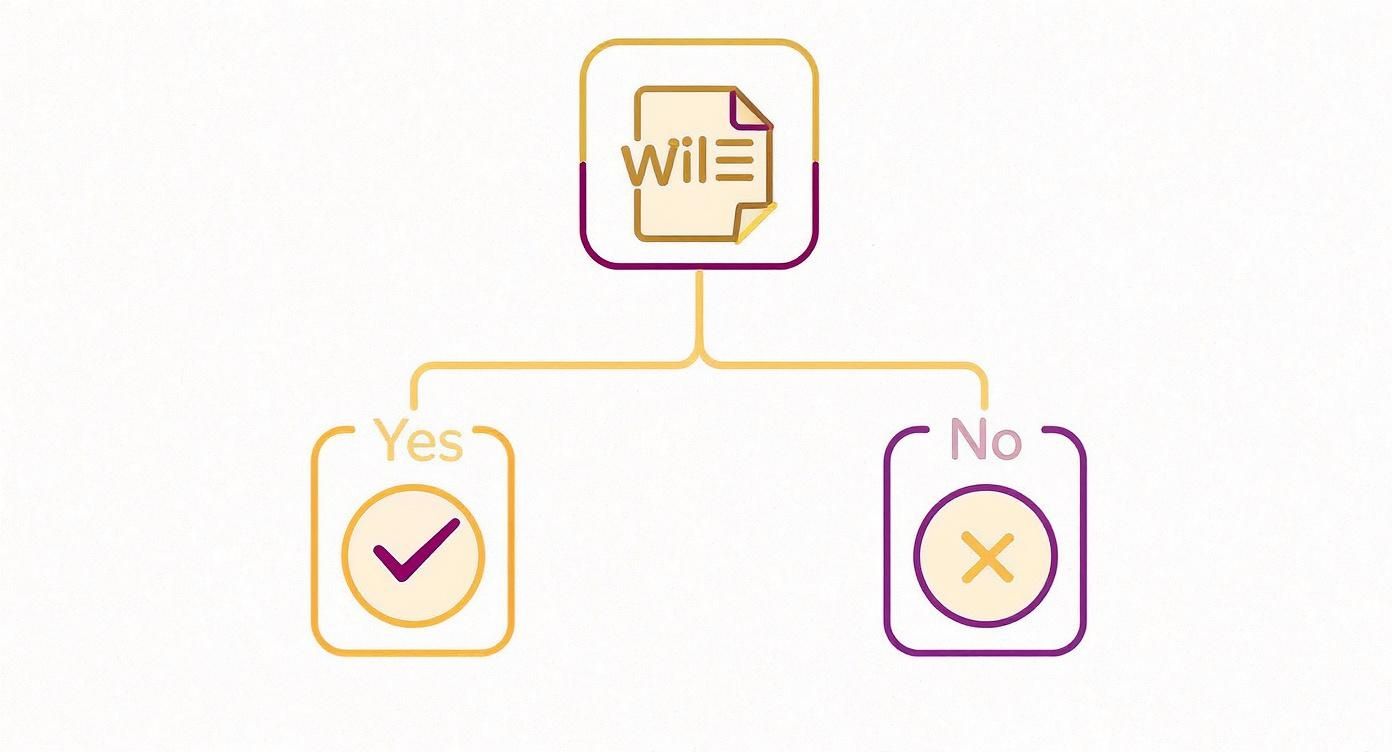
As you can see, having a will is just the starting point. It doesn't lock you into a single, rigid process.
Using a Small Estate Affidavit
For smaller, less complicated estates, the Small Estate Affidavit (SEA) is a game-changer. It allows heirs to collect and distribute a person’s assets without any formal court administration. It is faster, simpler, and far less expensive than traditional probate.
Of course, not every estate qualifies. To use a Small Estate Affidavit in Texas, a few key conditions must be met:
- The total value of the estate (excluding the homestead and other exempt property) cannot exceed $75,000.
- The deceased must have passed away without a will (this is known as dying "intestate").
- The estate's assets must be worth more than its liabilities.
- All heirs must agree on how the property will be divided and must sign the affidavit.
This affidavit is filed with the county court. Once a judge approves it, the affidavit becomes the legal document needed to access accounts and transfer assets to the proper heirs.
Probating a Will as a Muniment of Title
Another unique Texas shortcut is probating a will as a Muniment of Title. This process allows a court to officially recognize a will and transfer property to the named beneficiaries without appointing an executor or requiring a full administration.
Think of a Muniment of Title as a legal fast pass. It essentially transforms the will itself into a deed, creating a clean, official record that transfers title for real estate and other assets.
This option is ideal for estates with a valid will but no debts, other than those secured by real estate (like a mortgage). To use this process, you file an application with the probate court and attend a hearing to prove the will is legitimate. If the court agrees that no administration is necessary, it issues an order admitting the will as a muniment of title.
This streamlined method highlights the practical nature of Texas law, offering a way to honor a loved one's wishes with minimal court involvement. A knowledgeable Texas estate planning attorney can help determine if your situation qualifies for one of these more efficient paths. If you're dealing with more complex asset management, it's always wise to explore your options for asset protection.
How Your Assets Can Bypass Probate Entirely

A will only controls assets that were owned solely in the deceased's name. This simple distinction is a powerful concept in estate planning.
Many common assets are designed to transfer automatically upon death, completely bypassing the will and the probate court. These are known as "non-probate assets."
Understanding this difference is key to smart estate planning. By strategically titling your accounts and using the right legal tools, you can ensure that a significant portion—or even all—of your estate passes directly to your loved ones without the time, expense, and stress of probate. This is where proactive planning can transform a potential bureaucratic challenge into a smooth transition for your family.
Common Examples of Non-Probate Assets
You likely already own several non-probate assets without realizing it. These financial instruments have built-in instructions—beneficiary designations—that act as a direct order to the financial institution, telling them exactly who should receive the funds.
Here are a few of the most common types that skip probate entirely:
- Life Insurance Policies: The proceeds from a life insurance policy are paid directly to the beneficiaries named in the contract, regardless of what a will says.
- Retirement Accounts: Funds in accounts like 401(k)s, IRAs, and pensions transfer directly to the designated beneficiaries.
- Payable-on-Death (POD) Bank Accounts: You can easily add a POD designation to checking or savings accounts. This names a person who can claim the funds immediately upon your death with a death certificate.
- Transfer-on-Death (TOD) Deeds and Registrations: Texas law allows you to name a beneficiary for your real estate and vehicles, allowing them to pass outside of the probate process.
These tools are incredibly effective because they operate independently from the will. The key is to keep your beneficiary designations current. An outdated designation, such as an ex-spouse on a life insurance policy, can lead to unintended and painful consequences. For a deeper dive, check out our guide on probate and non-probate assets.
The Revocable Living Trust: The Ultimate Probate Avoidance Tool
While beneficiary designations are excellent for specific accounts, the Revocable Living Trust is the most comprehensive tool for probate avoidance.
When you create a living trust, you transfer ownership of your major assets—your home, investments, bank accounts—from your individual name into the name of the trust.
You remain in complete control. As the trustee, you manage everything just as you did before. Upon your death, a successor trustee you've chosen steps in to manage and distribute the assets according to your trust's instructions. This all happens privately, with no court involvement.
Despite the power of these tools, a surprising number of people have not taken these steps. As of 2025, only about 31% of adults in the U.S. have a will, and more than half have no estate planning documents at all. This is true even though 83% of Americans agree that having a plan is important. It shows a massive gap between what we know we should do and what we actually do. A skilled Texas estate planning attorney can help you structure your assets correctly, making sure your family is protected when it matters most.
Step-by-Step Guidance Through the Texas Probate Process
If you have determined that formal probate is necessary, it's normal to feel a bit overwhelmed. Serving as an executor is a significant responsibility, but you don't need to be a legal expert to handle it. The Texas Estates Code provides a clear roadmap, and with an experienced attorney as your guide, you can manage your duties with confidence.
Your first step is critical: locate the original, signed will. A copy is not sufficient for the court. Once you have the original document, the next step is to work with a probate attorney to file an Application for Probate in the correct Texas county.
Attending the Hearing and Getting Authority
After the application is filed, the court posts a public notice, which starts a brief waiting period before your hearing. At the hearing, you will need to "prove up" the will. This typically involves testifying that the will is valid and that you are qualified to serve as the executor.
The judge will then sign an order admitting the will to probate and officially appointing you. This leads to the most important document you will receive:
Letters Testamentary. This is the court's official certification giving you the legal authority to act on behalf of the estate. It is the key that allows you to access bank accounts, communicate with financial institutions, and manage the deceased’s property.
Managing and Preparing Estate Assets
With your Letters Testamentary in hand, your role as executor begins in earnest. You will start gathering—or "marshalling"—the estate's assets. This involves identifying, securing, and creating a detailed inventory of everything the deceased owned. When managing estate property, an executor in Texas might need to hire professional house clearance and rubbish removal services to prepare a property for sale or transfer.
This phase also involves key legal duties and fiduciary responsibilities. You must:
- Notify Beneficiaries: Send a formal notice to every beneficiary named in the will, informing them that the will has been probated.
- Notify Creditors: Publish a public notice to inform potential creditors of the death, giving them an opportunity to file claims against the estate.
- Inventory Assets: Prepare a comprehensive “Inventory, Appraisement, and List of Claims” to be filed with the court. This document catalogs all estate property and its value.
Completing these initial steps correctly creates a solid foundation for a smooth administration process. For more detailed guidance, see our article on navigating probate in Texas with tips for executors. Remember, your duty is to follow the instructions in the will and the law—not to make personal decisions. A probate lawyer will be your guide, ensuring every action you take is correct and compliant.
Common Questions We Hear About Texas Probate
When you're wading into the world of estate administration, it’s easy to feel like you’re in over your head. Legal processes can be confusing the first time around, and it's completely normal to have a lot of questions. We've gathered some of the most common ones we hear from Texas families to give you some clear, straightforward answers and help you feel more confident.
How Long Does Probate Take in Texas?
This is a very common question, and the answer is that the timeline for probate in Texas can vary significantly. For a simple, uncontested estate with a clear will, the process might take six to nine months.
However, complications can extend the timeline. Common causes for delays include:
- Will Contests: A family member challenges the validity of the will.
- Complex Assets: The estate includes a business, multiple properties, or other assets that are difficult to value.
- Creditor Claims: Resolving disputes over debts owed by the deceased can add months to the process.
- Court Schedules: Delays can sometimes be due to a busy local probate court docket.
A smooth process almost always begins with a well-drafted will and clear, open communication among all parties involved.
What Is the Difference Between an Executor and an Administrator?
While both roles involve managing an estate, the primary difference lies in how they are appointed.
An executor is the person specifically chosen by the deceased and named in their will to carry out their wishes. They are the designated representative.
An administrator is appointed by the probate court when someone dies without a will (or "intestate"). The court selects a suitable person—often the closest living relative—to finalize the estate according to state law. Regardless of the title, both have a strong fiduciary duty to act in the best interests of the estate and its beneficiaries.
Ultimately, whether you are an executor or an administrator, the core responsibility is the same: gather assets, pay debts, and distribute what remains to the rightful heirs. The only distinction is the source of their authority—the will or the court.
Can I Sell Property During the Probate Process?
Yes, but you must follow the rules outlined in the Texas Estates Code. The ability to sell property often depends on the type of authority the executor or administrator holds.
If the will grants the executor "independent administration"—a common practice in Texas—they can typically sell property without needing court permission for each transaction. This allows them to act more efficiently.
However, if the estate is under "dependent administration," the process is more restrictive. The executor must get court approval before selling assets, especially major ones like real estate. This involves filing applications, notifying heirs, and attending a hearing. A Texas trust administration lawyer is your best guide to ensure any sale is conducted properly.
No matter what questions arise, having an experienced legal guide can make all the difference.
If you’re managing a trust or planning your estate, contact The Law Office of Bryan Fagan, PLLC for a free consultation. Our attorneys provide trusted, Texas-based guidance for every step of the process. You can learn more at https://texastrustadministration.com.