Planning for the future is one of the most profound acts of care you can take for your family and your legacy. In Texas, a last will and testament is more than just a document; it's a legal instrument that must follow specific rules to be considered valid. To ensure your wishes are honored, your will must be in writing, signed by you (the "testator"), and witnessed by two credible individuals who also sign it in your presence.
These requirements, outlined in the Texas Estates Code, are not just legal formalities. They are essential safeguards that form the foundation of an estate plan that will stand strong when your family needs it most. Understanding them is the first step toward securing your legacy and providing your loved ones with a clear path forward.
Why Getting the Texas Will Requirements Right Is So Important
Think of your will as your final instruction manual—a personal message that directs what happens after you are gone. It's an act of love for those you leave behind, clearly stating who should receive your property, who you trust to be the guardian for your minor children, and who you want in charge of carrying out your final wishes.
What happens if you don't have a valid will? The State of Texas steps in and makes these critical decisions for you, following a rigid set of "intestacy" laws. The state's plan is impersonal and almost certainly won't align with what you would have wanted for your family.
This guide is here to demystify the will requirements in Texas, transforming complex legal concepts into clear, actionable steps. A properly executed will provides invaluable peace of mind, ensuring your final wishes are locked in and legally binding. When you understand these essential rules, you can create a document that will stand up in court and give your family clarity during an otherwise difficult time.
The Foundation of a Secure Estate Plan
A valid will is the cornerstone of any comprehensive estate plan, performing several critical jobs to protect both your assets and your family’s future.
Here’s a look at what a will really does:
- You Direct Who Gets What: You decide who inherits everything from your house to your grandfather's watch, preventing potential family disagreements before they can begin.
- You Appoint Your Executor: This is your opportunity to choose a person or institution you trust completely to manage your affairs and follow your instructions to the letter. This person has a fiduciary duty to act in the best interest of your estate.
- You Name Guardians for Your Children: For parents with minor children, this is arguably the most important function of a will. It is the only legal document where you can name the person you want to raise your children if you are no longer able to.
- You Can Minimize Probate Headaches: A clear, legally sound will can make the probate process much smoother, saving your loved ones significant time, money, and stress.
Navigating the Texas Estates Code can feel like a daunting task, but it doesn’t have to be. Our goal is to empower you with the knowledge needed to take control of your legacy. In the following sections, we'll break down every requirement—from who can serve as a witness to the different types of wills recognized in Texas—so you can move forward with confidence and security.
The Three Pillars of a Legally Binding Texas Will
To ensure your final wishes are honored, a formal Texas will must be built on three foundational pillars established in the Texas Estates Code. These are the absolute, non-negotiable rules that give your will its legal authority. Getting them right is the single most important step in creating a document that will hold up in probate court.
First, the will must be in writing. This is a simple but critical starting point. Texas law does not recognize oral or "he said, she said" wills; your intentions must be recorded on paper. This requirement prevents potential disputes and creates a clear, permanent record for the court to follow.
The second pillar is your signature. You, the person creating the will (known as the testator in legal terms), must sign it. If you are physically unable to sign, another person can sign on your behalf, but they must do so in your presence and under your direct instruction. Your signature is your personal seal of approval, demonstrating that the document reflects your final decisions.
The Critical Role of Credible Witnesses
The third and most detailed pillar is the attestation by witnesses. This is where many DIY wills fail, and it is absolutely essential for validating the document. The signing ceremony is not just for show; it's a formal legal event that confirms the will's authenticity.
Under the Texas Estates Code, your will must be signed in your presence by two credible witnesses. These individuals cannot just be anyone. To be considered "credible" by a court, they must meet specific criteria:
- They must be at least 14 years old.
- They must be of sound mind.
- Crucially, they cannot be beneficiaries in the will. If a witness stands to inherit property, it can create significant complications during the probate process and may void their gift.
The law is also very specific that the witnesses must sign the will in your presence. This means everyone should be in the same room, consciously aware that you are signing your will. This rule is strictly enforced to prevent fraud or coercion, ensuring the will you sign is truly your own.
The two-witness requirement is a cornerstone of Texas probate law. Texas courts have become increasingly strict about these formalities, where even a minor technical violation, like a witness stepping out of the room during the signing, could potentially invalidate an otherwise complete will.
Visualizing the Path to a Secure Legacy
Creating a will is a process of carefully distributing your assets, appointing people you trust, and then securing it all according to state law. This graphic provides a clear overview of these key steps in planning your legacy.
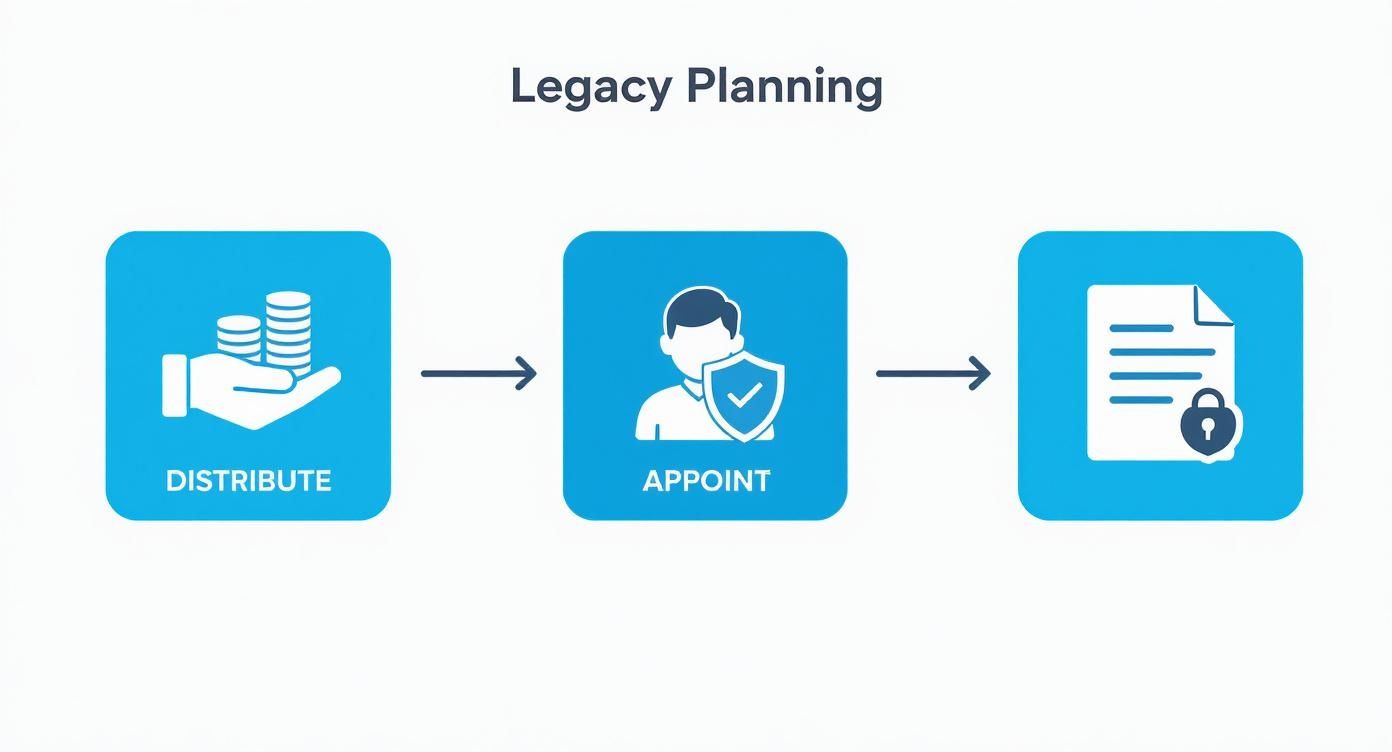
This process shows how each piece—from deciding who gets what to the final legal execution—builds on the last to create an estate plan that is secure and enforceable.
Mastering these three pillars—in writing, signed by you, and witnessed by two people in your presence—is everything. As Section 251.051 of the Texas Estates Code makes clear, these rules form the legal foundation of a valid will. If any of them are mishandled, your will could be thrown out, and the state's rigid intestacy laws will decide who receives your assets. You can learn more about these specific statutory requirements and how Texas courts interpret them. Read the full details about Texas will requirements and how to protect your estate.
Formal Wills vs. Holographic Wills in Texas
When it comes to creating a will in Texas, the law provides a couple of options. The safest, most reliable route is what’s known as a formal attested will. This is the type of will most people imagine: a typed document, properly structured, and then signed by you in front of two credible witnesses. It's the gold standard for a reason—it’s designed to withstand legal challenges and ensure your wishes are carried out precisely as you intended.
However, Texas law also recognizes a much less common alternative: the holographic will. This is a will written entirely in your own handwriting. It’s the legal equivalent of a detailed, handwritten note spelling out who gets what.

The biggest difference? A holographic will does not require witnesses. This exception was created for rare, emergency situations where someone might not have the opportunity to draft a formal will. But while it sounds simple, that simplicity is deceptive and often leads to costly family disputes.
The Dangers of a Holographic Will
While a holographic will can be legally valid, relying on one is often a recipe for family feuds and expensive probate court battles. The law is incredibly strict here: the entire document, from top to bottom, must be in your handwriting. If a single word is typed, or if a well-meaning friend writes in a sentence for you, a court will likely invalidate the entire will.
Here are just a few of the common pitfalls of a holographic will:
- Proving Authenticity: During probate, your executor must prove to the court that the handwriting is, without a doubt, yours. This usually involves finding witnesses familiar with your handwriting, which can be a significant challenge years later.
- Vague and Ambiguous Language: When people write wills by hand, especially in a hurry, they often use imprecise language. A simple phrase like "I want my kids to get everything" can ignite a massive legal firestorm. What does "everything" include? How should it be divided? The courts are left to guess your intent.
- Critical Omissions and Errors: Without legal guidance, it’s easy to leave out essential components of a will, like naming an executor to manage the estate or including a "residuary clause" to handle leftover assets. These gaps create legal problems that the court must resolve, often in ways you never would have intended.
A formal, attorney-drafted will is designed to be a fortress, built to withstand legal challenges. A holographic will, by contrast, is often a fragile structure that can easily crumble under the pressure of a probate court's scrutiny, leaving your family to deal with the fallout.
Why Oral Wills Are No Longer Valid in Texas
You might have heard stories about "deathbed wills" that were spoken instead of written. In the past, Texas law did allow for these nuncupative (or oral) wills under very specific, rare circumstances. However, the potential for fraud, misinterpretation, and disputes was enormous.
Recognizing these risks, Texas modernized its laws. On September 1, 2007, the state’s probate laws were updated, and this ancient practice was completely abolished. Today, all wills in Texas must be in writing to have any legal effect.
This change reflects a deep legal commitment to clarity, certainty, and proof in estate planning. A written document provides a stable, reliable record of your final wishes, protecting your legacy from the flaws of human memory and interpretation. While a holographic will technically meets the "in writing" rule, the safest path is always a formal will prepared with an experienced Texas estate planning attorney. If you want to see what a properly structured will looks like, you can explore our guide on the last will and testament form in Texas.
The Critical Role of Witnesses and Self-Proving Affidavits
Witnesses are the official guardians of your will. They are much more than just names on a signature line; their presence and signatures provide the legal reinforcement required by the Texas Estates Code.
When they sign, they are legally affirming two crucial facts: they watched you sign the document, and they believed you were of sound mind and not being pressured by anyone. This signing ceremony is designed to act as a shield, protecting your final wishes from future claims of fraud or undue influence.
Who Can Be a Credible Witness
Choosing the right witnesses is essential. Texas law specifies that they must be “credible” individuals. In legal terms, this means someone who is competent to testify in court and, most importantly, does not have a financial stake in your estate. In other words, they cannot be inheriting anything in your will.

To be a credible witness in Texas, a person must be at least 14 years old and mentally competent.
A common mistake is asking a beneficiary to also act as a witness. This can cause serious problems. While it might not invalidate the entire will, it can void the gift to that specific witness-beneficiary unless their testimony is corroborated by another disinterested person. The simplest solution is always to choose witnesses who are completely neutral. It helps avoid a world of potential legal issues.
Streamlining Probate with a Self-Proving Affidavit
While witnesses are non-negotiable for a formal will, Texas law provides an excellent—though optional—tool to make the probate process significantly smoother: the self-proving affidavit.
Think of it as getting your will pre-approved for court. It’s a separate statement attached to the will, signed by you and your witnesses in front of a notary public. In it, everyone swears under oath that all the legal formalities were followed correctly during the signing. It confirms that you declared it was your will, you signed it freely, and the witnesses signed it in your presence.
The benefit of this extra step is enormous. Without it, your executor might have to track down one of the original witnesses—sometimes years later—to testify in court. People move, memories fade, and witnesses can pass away, making that a difficult and stressful task.
A self-proving affidavit allows the court to accept the will as valid on its face, with no need for live witness testimony. This single document can save your executor and family an incredible amount of time, money, and stress during probate.
How a Self-Proving Affidavit Works
Adding a self-proving affidavit turns your will into a document that essentially speaks for itself in the courtroom. This simple, notarized statement gives the probate court all the proof it needs that the will was executed properly, checking off a major legal requirement right from the start.
Here’s a breakdown of why it's so valuable:
- Simplifies Probate: It is the single best way to fast-track the initial stages of getting your will accepted by the court.
- Reduces Costs: By eliminating the need to locate witnesses and pay for their time or testimony, it directly lowers the legal fees and court costs your estate must bear.
- Prevents Delays: It removes the risk of your case getting stalled because a witness has moved, passed away, or simply cannot be found.
- Strengthens Your Will: While not entirely immune to challenges, a self-proved will carries a strong presumption of validity, making it much more difficult to contest. You can learn more about the steps involved in preventing will contests by drafting airtight wills in our detailed guide.
Adding this affidavit is a simple action with profound benefits. It’s not just about meeting the minimum will requirements in Texas; it’s about proactively making the future easier and more secure for the people you love. An experienced Texas estate planning attorney will ensure this is drafted and executed correctly alongside your will.
Does the Will Truly Speak for You? A Look at Capacity and Intent
A valid will in Texas isn't just about getting the signatures and witnesses right. It must come from a clear mind and reflect your genuine wishes. The Texas Estates Code includes built-in safeguards to protect the integrity of your final instructions. Two of the most important are testamentary capacity and testamentary intent.
In plain English, these legal concepts ensure the will is truly yours. They confirm you understood what you were doing when you signed it and that you meant for that specific document to be your final plan. If either of these is missing, even a perfectly executed will can be invalidated by a probate court, throwing your family's future into uncertainty.
What “Sound Mind” Really Means in Texas
When lawyers talk about testamentary capacity, they are referring to being of "sound mind" at the very moment you sign your will. This doesn't mean you need to be in perfect health or have a flawless memory. The Texas standard is practical and focuses on your ability to understand a few key things:
- The Act Itself: You understand you are signing a document to distribute your property after you die.
- Your Property: You have a general idea of what you own—your house, bank accounts, investments. A detailed inventory isn't required, just a basic awareness.
- Your Family: You recognize your closest family members, like a spouse or children, who would naturally expect to inherit from you.
- The Plan: You can hold these ideas in your mind at the same time to make a sensible plan for who gets what.
Making Sure Your Will Is Your Final Wish
The second piece of the puzzle is testamentary intent. This is a legal term meaning you intended for the document you signed to actually be your will. It may sound obvious, but this rule prevents a random note or an early draft from being mistaken for your final, legally binding instructions.
You will almost always see clear language in a will to establish this, such as the classic phrase, "This is my last will and testament." This confirms you were not just brainstorming; you were signing the document with the full and clear intention of it being your definitive estate plan.
When a Will Gets Challenged
Disputes over a will often arise when a family member suspects the deceased was not mentally capable or was being manipulated. These are serious accusations that can lead to expensive and emotionally draining court battles.
Real-World Scenario: An elderly father, showing early signs of dementia, suddenly signs a new will. This new will completely cuts out his two daughters and leaves everything to a caregiver he has only known for a few months. The daughters would likely challenge the will, arguing their father lacked the testamentary capacity to understand the consequences of his actions. They might also claim the caregiver used undue influence—that she applied so much pressure that the will reflects her wishes, not his.
To win that challenge, the daughters would have to prove the caregiver's influence was so overwhelming that it destroyed their father's free will. This is why creating your will when you are healthy and clear-minded, free from anyone's pressure, is so important. Working with an experienced Texas estate planning attorney helps create a rock-solid record of your capacity and intent, protecting your legacy from being torn apart by future disputes.
How to Correctly Change or Revoke Your Will
Life is dynamic. Families grow, relationships evolve, and your financial situation changes over time. It is only natural that your will may need to be updated to reflect these shifts.
However, you cannot simply cross out a name or write a new instruction in the margins. In Texas, such informal edits are legally meaningless and can create significant confusion and legal problems for your loved ones.
To ensure your estate plan remains current and legally sound, you must follow the rules set out in the Texas Estates Code. You have two primary options: making a minor change with a "codicil," or revoking the old will and creating a new one. Knowing which path to take is a key part of meeting the overall will requirements in Texas.
Amending Your Will with a Codicil
If you only need to make a minor update, like changing your executor or adding a small gift for a new grandchild, a codicil is the right tool.
A codicil is a legal addendum to your original will. It is a separate, formal document that modifies, explains, or adds a new provision to what you have already written.
The critical point is that a codicil must be executed with the exact same legal formalities as a will. This means it must be:
- In writing.
- Signed by you (the testator).
- Witnessed by two credible, disinterested adults in your presence.
If any of these steps are missed, the codicil is invalid, and the court will ignore it, leaving your original will’s terms in effect. For a more detailed walkthrough, check out our article on updating wills in Texas.
How to Legally Revoke Your Will
Sometimes, a small amendment isn't enough. A major life event—like a marriage, divorce, or a significant change in your assets—usually means it’s time to revoke the old will entirely and draft a new one.
Texas law provides two valid ways to cancel a will:
- By a Subsequent Will: This is the cleanest and most common method. You create a new will that includes a clear, explicit statement revoking all previous wills and codicils. This "revocation clause" eliminates any confusion about which document represents your final wishes.
- By Physical Destruction: You can also revoke a will by physically destroying the original document—for example, by shredding, burning, or tearing it up. The key here is intent. You must intend to revoke the will by destroying it. Accidentally throwing it in the fire will not legally cancel it.
Once a will is created, it's a powerful legal document. This often leads to questions about who has the authority to make changes. Understanding the strict legal limits, such as whether an executor can change a will, is crucial for everyone involved. An executor’s job is to follow the will’s instructions to the letter, not to rewrite them.
Keeping your will updated is the only way to ensure your final wishes are both accurately reflected and legally binding. An experienced Texas estate planning attorney can help you determine if a simple codicil or a complete overhaul is the right choice for your situation.
Common Questions About Texas Will Requirements
Embarking on estate planning can feel overwhelming, and it's normal to have questions. To help you feel more informed and secure, we've answered some of the most common questions we hear about creating a will in Texas.
Does My Will Have to Be Notarized to Be Valid in Texas?
No, a will itself does not need to be notarized to be legally valid in Texas. The law is clear on the core requirements: it must be in writing, signed by you, and signed by two credible witnesses in your presence. That is all that is needed for validity.
However—and this is an important distinction—there is a separate document called a self-proving affidavit that is highly recommended, and this document does need to be notarized. Think of it as an express pass for the probate process. With a notarized affidavit, the court can accept your will as valid on its face without requiring your witnesses to testify. So, while a notary is not required for the will's validity, getting the affidavit notarized is a critical step for a smooth process later on.
What Happens If I Die Without a Will in Texas?
If you pass away without a will, you are said to have died "intestate." In this situation, the State of Texas has a default plan for your property. The law—not you—gets the final say on who inherits your assets. The state uses a rigid, one-size-fits-all formula based on your family tree to distribute everything among your spouse, children, parents, or other relatives.
This often leads to outcomes you never would have wanted. For example, your spouse could be forced to share community property with children from a prior marriage. The only way to ensure your assets go exactly where you want them to is to spell it out in a valid will.
Can I Disinherit Someone in My Texas Will?
Yes, you can. In Texas, you generally have the right to exclude a child or other relative from your will. However, you must do so deliberately and with absolute clarity.
Simply omitting someone's name from the will is not enough. This can open the door to a will contest, where the excluded person argues they were simply forgotten by mistake. To make a disinheritance legally effective, your will must contain direct, unambiguous language stating your specific intention to exclude that individual. This is an area where working with an experienced Texas estate planning attorney is crucial to ensure the wording is precise and legally sound.
Where Should I Store My Original Will?
Your original will is a vital legal document that must be kept in a place that is both safe from damage and accessible to your executor when the time comes. A copy will not be accepted by the probate court.
Good storage options include:
- A fireproof safe in your home.
- A safe deposit box at a bank.
- With the law firm that helped you draft it.
A quick note on the safe deposit box: ensure your executor has the legal authority to access it after your passing. Regardless of which option you choose, the most important step is to tell your executor exactly where the original will is located. Keeping it safe is half the battle; ensuring it can be found is the other half.
If you’re managing a trust or planning your estate, contact The Law Office of Bryan Fagan, PLLC for a free consultation. Our attorneys provide trusted, Texas-based guidance for every step of the process.