Being named the executor of a loved one's will is a profound sign of trust, but managing an estate can feel overwhelming—especially when you're also navigating a personal loss. With the right legal guidance, however, it doesn’t have to be.
This guide is designed to serve as your roadmap, breaking down the complex duties of an executor of an estate into clear, manageable steps. We will walk through the Texas probate process together, providing the clarity and confidence you need to honor your loved one's wishes and fulfill your legal obligations with compassion.
Your Role as an Executor in Navigating a Loved One's Estate
As an executor, you are more than just a manager of paperwork and assets; you are a trusted steward, legally bound to act in the best interests of the estate and its beneficiaries. This special relationship of trust is known in Texas law as a fiduciary duty, and it is the cornerstone of your entire role.
Understanding Your Fiduciary Responsibility in Texas
Under the Texas Estates Code, every action you take as an executor is held to a high legal standard. As a fiduciary, your core mission is to manage the estate with unwavering loyalty and care, always putting the interests of the beneficiaries ahead of your own.
This fundamental responsibility is guided by a few key principles:
- Duty of Loyalty: You must act exclusively for the benefit of the estate and its beneficiaries, avoiding any self-dealing or conflicts of interest.
- Duty of Care: You are required to manage the estate’s assets as a prudent, sensible person would manage their own property. This means no risky investments or careless handling of property.
- Duty of Impartiality: You cannot play favorites. Every beneficiary must be treated fairly and according to the specific instructions laid out in the will.
The Texas Estates Code provides a clear framework for your responsibilities. Your primary job is to honor the final wishes of the person who passed away with diligence and complete transparency, ensuring every move you make is by the book.
Let’s consider a real-world scenario. Imagine a will leaves a vintage car to one heir and a stock portfolio to another. Your duty of care prevents you from selling the car for a lowball price to a friend. Your duty of loyalty forbids making speculative trades with the stocks. And your duty of impartiality requires you to preserve the value of both assets until they can be legally distributed.
This guide will break down the entire process into logical steps, using plain English to explain your duties and empower you to move forward. Remember, you don't have to navigate this journey alone. An experienced Texas estate planning attorney can be an indispensable partner, transforming a complex legal duty into a clear, structured path.
The First Steps in Taking Charge of the Estate
Once you accept the role of executor, your initial actions are critical. These first moves lay the foundation for a smooth and legally sound estate administration. The immediate goals are to obtain legal authority and secure the assets you are now responsible for protecting.
Your journey begins by locating the original, signed will. A copy will not suffice; Texas probate courts require the original document to initiate the process. Once in hand, your next stop is the probate court in the county where the deceased resided.
Obtaining Legal Authority From The Court
Filing the will officially begins the probate process. This is the court-supervised procedure for validating a will and formally granting you, the executor, the legal authority to act on behalf of the estate. It is the system's way of ensuring everything is handled correctly under Texas law.
One of your first objectives in court is to obtain Letters Testamentary.
Think of Letters Testamentary as your official ID badge from the court. This document is your proof of authority, the key that lets you walk into a bank, talk to financial institutions, and manage property on behalf of the estate.
Without these letters, you have no legal standing to perform your duties. This step typically involves a court hearing where a judge formally appoints you and confirms your role.
Securing and Protecting Estate Property
The moment you are appointed, your duty to protect the estate's assets begins immediately. You must act as if you are placing a protective bubble around everything the deceased owned until it can be properly inventoried and distributed to the heirs.
Here are practical first steps to take right away:
- Secure Real Estate: Change the locks on any homes or other properties to prevent unauthorized access.
- Safeguard Valuables: Collect important personal items like jewelry, art, and critical documents and store them in a safe place.
- Notify Financial Institutions: Contact banks, credit unions, and brokerage firms. Inform them of the death and provide a copy of the death certificate. This helps freeze accounts to prevent fraudulent activity. As one of the first crucial steps, executors in Texas must prioritize understanding the Texas death certificate and its significance for estate administration.
This process can feel overwhelming, especially when you're also dealing with grief. It's a journey from an emotional state to a place of focused, dutiful clarity.
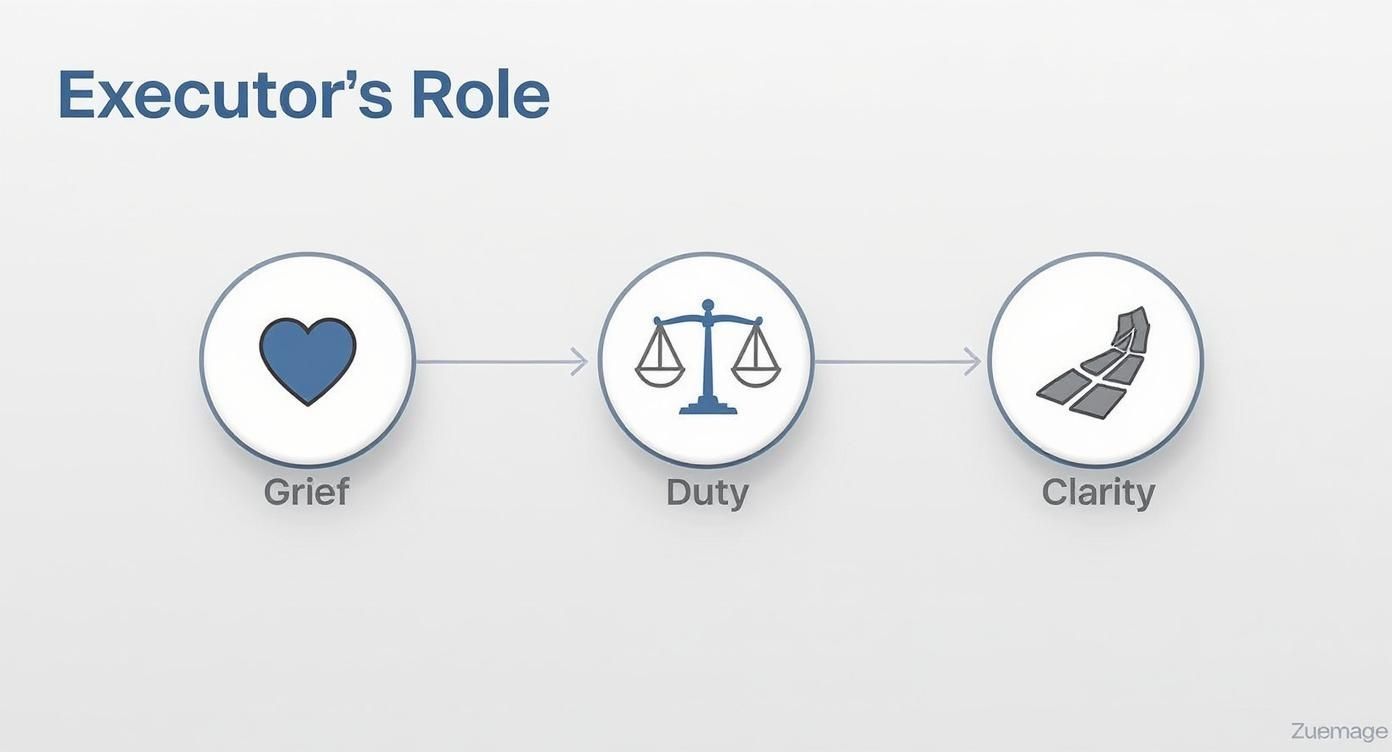
As the visual shows, navigating your duties successfully means shifting from personal grief to a mindset of organized, diligent action.
The checklist below breaks down these initial, critical tasks into manageable steps.
Executor's Initial Duties Checklist
This table outlines the immediate actions an executor should take to secure the estate and begin the Texas probate process.
| Task | Description | Relevant Texas Estates Code Concept |
|---|---|---|
| Locate the Original Will | Find the deceased's last will and testament. It must be the original signed document, not a copy. | Application for Probate (Sec. 256.051) |
| File with Probate Court | Submit the will to the probate court in the county where the deceased resided to start the process. | Venue for Probate of Wills (Sec. 33.001) |
| Obtain Death Certificates | Order multiple certified copies of the death certificate. You'll need them for nearly every task. | Proof Required for Issuance of Letters Testamentary (Sec. 301.052) |
| Secure All Property | Change locks on real estate and collect valuable personal property like jewelry, art, and vehicles. | Duty of Care (Sec. 351.101) |
| Notify Financial Institutions | Inform all banks, credit unions, and investment firms of the death to freeze accounts and prevent fraud. | Protection of Payers and Others (Sec. 113.151) |
| Apply for an EIN | Obtain an Employer Identification Number (EIN) from the IRS for the estate. This is the estate's tax ID. | Fiduciary Tax Responsibilities |
Following this checklist ensures you are building a strong, legally compliant foundation for the rest of the estate administration process.
Establishing Financial Transparency
A crucial part of your role is maintaining impeccable financial records. The best way to achieve this is by opening a dedicated bank account for the estate, using the estate's name and its unique tax ID number (the EIN obtained from the IRS).
All of the deceased's liquid assets should be consolidated into this account. From there, you will pay all the estate's bills and expenses. This strict separation prevents commingling funds—mixing estate money with your personal funds—which is a serious breach of your fiduciary duties and can lead to significant legal trouble. Our team has prepared a complete overview of how to settle an estate in Texas for more in-depth guidance.
Using a separate account creates a transparent paper trail for every transaction, ensuring total clarity for the beneficiaries and the court.
Inventorying and Safeguarding All Estate Assets

Once you are officially appointed executor, one of your most significant responsibilities is to create a complete inventory of what the deceased owned. This is a meticulous process of identifying, valuing, and protecting every asset until the estate is ready to be settled. This is where your fiduciary duty—your legal promise to act in the estate's best interest—is truly put to the test.
Think of yourself as the temporary caretaker of a person's life's work. Your job is to get a complete picture of everything, from large assets like real estate to less obvious ones like digital currency. Knowing how to create an inventory system can be a lifesaver, helping you keep everything organized and accounted for.
The Formal Inventory Requirement in Texas
In Texas, creating this inventory is not just a suggestion; it's a legal requirement. Under the Texas Estates Code, you have 90 days from receiving your Letters Testamentary to file a document with the probate court called an "Inventory, Appraisement, and List of Claims."
This is a sworn affidavit, meaning you are legally attesting to its accuracy. It must be a precise, detailed account of all property belonging to the estate, as it becomes the official record of the estate's value. The court, beneficiaries, and creditors will rely on this document, so accuracy is your best defense against future complications.
Identifying and Valuing a Wide Range of Assets
Assembling this inventory is like a large-scale scavenger hunt. You must methodically track down all types of assets and understand the crucial difference between what is part of the probate estate and what is not. To assist with this, our firm has created a guide on probate and non-probate assets that clarifies what to include on your court-filed inventory.
You'll be looking for common assets such as:
- Real Estate: This includes a primary home, vacation properties, or rental units. You will need property deeds and a professional appraisal to determine fair market value.
- Bank and Financial Accounts: Gather statements for all checking, savings, brokerage, and retirement accounts.
- Vehicles: Cars, boats, and RVs all require a valuation. Resources like Kelley Blue Book can be used for standard vehicles, but a professional appraiser may be needed for classic cars or other special items.
- Personal Property: This category includes everything else, from furniture and jewelry to artwork and collectibles. For unique or high-value items, hiring a professional appraiser is essential to establish a value that will hold up under scrutiny.
Your Ongoing Duty to Protect and Manage
Your responsibilities do not end once the inventory is filed. You have a continuous legal obligation to safeguard and manage all estate assets responsibly throughout the probate process. Essentially, you must prevent anything from being lost, damaged, or devalued on your watch.
This responsibility often involves practical steps like:
- Maintaining Property Insurance: Ensure homeowner's and auto insurance policies are paid and updated to list the estate as the owner.
- Managing Investments: Prudently manage stocks, bonds, and other investments, avoiding overly risky strategies that could diminish the estate's value.
- Overseeing Real Estate: This includes paying the mortgage and property taxes, handling routine maintenance, and ensuring the property is secure.
Neglecting these duties can have serious consequences. If an insurance policy lapses and the house burns down, or if a reckless investment loses significant value, the beneficiaries could hold you personally and financially responsible for the loss.
Managing Estate Debts, Taxes, and Creditor Claims
Before any assets can be distributed to beneficiaries, an executor must settle the estate’s final accounts. Think of yourself as the financial captain of a ship that has reached its final port; all port fees, crew wages, and supply bills must be paid before any cargo can be unloaded.
This phase of your duties demands a sharp eye for detail and a solid grasp of Texas law. You will be responsible for officially notifying creditors, carefully paying legitimate debts in the correct order, and handling all final tax matters for the deceased.
https://www.youtube.com/embed/OqYIyJxWfk8
Notifying Creditors and Handling Claims
Your first official step in settling the estate's finances is to notify potential creditors. The Texas Estates Code is very specific on this point: you must publish a "Notice to Creditors" in a local newspaper within the county where the probate is taking place.
This published notice is a legal announcement that starts a countdown for creditors to submit their claims. Skipping this step can cause significant delays and legal complications.
In addition to the public notice, you must also send a direct notice by certified mail to any secured creditors you are aware of, such as a mortgage company or auto lender. You have two months from receiving your Letters Testamentary to complete this task. For unsecured creditors, like credit card companies, there is more flexibility, but sending them notice is always the prudent choice.
An executor's duty is to protect the estate, which includes paying only what is legitimately owed. You are responsible for scrutinizing every single claim that comes in. If a claim is invalid, lacks documentation, or is filed after the legal deadline, it's your job to reject it.
The Hierarchy of Paying Debts
Not all debts are created equal under Texas law. There is a specific priority order for paying claims, and you must follow it precisely.
Here is the general priority list:
- Funeral Expenses and Costs of Last Illness: These are paid first, up to a certain legal limit.
- Administration Expenses: This includes the costs of the probate process, such as court fees, your executor compensation, and attorney's fees.
- Secured Debts: These are debts like mortgages and car loans, paid from the property that secures them.
- Child Support Arrears: Any past-due child support is a high-priority claim.
- State Taxes: Any taxes owed to the State of Texas.
- Other Claims: This is the final category for general unsecured debts, such as credit card balances and other medical bills.
Following this order is non-negotiable. If you pay a lower-priority debt (like a credit card) before handling a higher-priority one, you could be held personally liable if the estate lacks sufficient funds to cover its obligations.
Navigating Complex Tax Responsibilities
Filing the estate’s taxes is often the most daunting task for an executor. You are responsible for several different tax filings, and a mistake can lead to significant financial penalties for the estate and for you personally.
The primary tax duties you will likely encounter include:
- Final Personal Income Tax Return (Form 1040): You must file a final 1040 for the deceased, covering their income from January 1st up to their date of death.
- Estate Income Tax Return (Form 1041): The estate itself is a separate taxpayer. If the estate earns more than $600 in income during the year (from interest, dividends, or rent), you must file a Form 1041.
- Federal Estate Tax Return (Form 706): This return is only required for very large estates. With the federal exemption set at over $13 million per person in 2024, the vast majority of estates in Texas will not need to file it.
Each of these filings has strict deadlines and requires meticulous record-keeping. The IRS can hold an executor personally liable for unpaid taxes if assets are distributed to beneficiaries before all tax debts are settled.
Given the high stakes, this is not a do-it-yourself project. Working closely with a probate attorney and a qualified CPA is an essential part of fulfilling your duties. An expert in probate law can guide you, ensuring every financial loose end is tied up correctly and legally.
Distributing Assets and Closing the Estate
After the diligent work of inventorying assets and settling debts, you have reached the final major phase of your journey: distributing the remaining property to the rightful heirs. This is the moment the will’s promises are fulfilled, but this final stage must be handled with legal precision to protect everyone involved—especially you.

Before any asset changes hands, you must prepare a final accounting. This is a comprehensive financial report detailing every dollar that came into the estate and every dollar that went out. In this role, transparency is your greatest asset; it prevents disputes and proves you have upheld your fiduciary duties in Texas.
The Final Accounting and Legal Handoffs
This final accounting should be shared with all beneficiaries for their review and approval. The document serves as the ultimate summary of your stewardship, showing exactly how you managed the estate’s finances and settled its obligations. It is a powerful tool for building trust and creating a clear record.
Once all beneficiaries approve the accounting, you can begin the legal process of transferring property. The method depends on the asset type:
- Real Estate: To transfer a house or land, you will prepare and file a new deed, often called a "Distribution Deed." This is filed with the county clerk to officially change the property's title from the estate to the beneficiary.
- Vehicles: For cars or boats, you will sign over the title to the heir, who then registers it in their name with the appropriate Texas agency.
- Financial Accounts: This involves working with banks and brokerage firms to close the estate's accounts and transfer the funds or investments to the beneficiaries as directed by the will.
Every transfer must be meticulously documented. This is not just about organization; it is a crucial part of your legal responsibility.
Using Receipts and Releases to Cover Your Bases
A vital tool that can prevent future complications is the Receipt and Release form. This is a legal document that each beneficiary should sign before receiving their inheritance.
By signing a Receipt and Release, the beneficiary formally acknowledges two things: they have received their rightful share of the inheritance, and they release you, the executor, from any further legal liability concerning their portion of the estate.
This simple document is your shield. It serves as concrete proof that you distributed the assets correctly and protects you from future claims or lawsuits. It is a non-negotiable step for a clean and final closing.
Officially Closing the Books
With all assets distributed and signed releases collected, your final step is to formally close the estate with the probate court. This typically involves filing a final report or a sworn statement confirming that you have completed all your duties according to the will and the Texas Estates Code.
Successfully completing this last phase officially concludes your role as executor. It is the finish line that confirms you have honored the trust placed in you, met all your legal obligations, and brought the process to a successful close. Navigating these final steps with an experienced probate attorney ensures no detail is overlooked, providing peace of mind for both you and the beneficiaries.
Executor Compensation and Potential Liabilities
Serving as an executor is a serious commitment that requires significant time, attention to detail, and responsibility. Texas law recognizes this effort and provides a method for you to be fairly compensated. However, it is crucial to understand both how you are paid and the personal risks you assume.
Under the Texas Estates Code, the default rule allows an executor a commission of five percent (5%) on all money that flows into the estate and all money that flows out. This is the standard fee unless the will specifies a different compensation structure.
How Compensation Works in Practice
Let’s consider a real-world scenario. As executor, you collect a $100,000 life insurance policy, sell the decedent's car for $20,000, and deposit a final $5,000 paycheck. On the expense side, you pay $25,000 in final medical bills and $10,000 in credit card debt.
Your commission is calculated on the total cash flow, reflecting the work involved in managing the estate's finances. While Texas sets this clear baseline, executor fees usually reflect the workload involved, which can vary as administration often spans from one to three years.
The Serious Nature of Executor Liability
While you are entitled to compensation, you are also stepping into a role with significant personal risk. As a fiduciary, you are legally and financially responsible for any mistakes or mismanagement. Your primary duty is to protect the estate's assets, and any failure to do so can have severe consequences.
Beneficiaries have the right to take you to court if they believe you have breached your fiduciary duty. If they can prove your actions caused the estate to lose money, they can sue you to recover those losses—personally.
An executor's best defense against personal liability is an unwavering commitment to their fiduciary duties of loyalty, care, and impartiality. Keeping detailed records and communicating openly with everyone involved aren't just good ideas; they are your essential armor.
Common pitfalls that can lead to executor liability include:
- Mismanaging Assets: Making risky investments with estate funds or allowing real estate to fall into disrepair.
- Failing to Pay Taxes: Missing tax deadlines or filing incorrect returns can result in penalties that you may be personally liable for.
- Ignoring the Will's Instructions: Deviating from the decedent’s clear instructions is a major breach of duty.
- Self-Dealing: Using your position for personal gain, such as selling an estate asset to yourself or a friend for a below-market price.
These situations can escalate into messy and expensive legal battles. Understanding the executor's role in resolving estate disputes is critical for navigating conflicts and protecting yourself.
Given the potential for personal liability, engaging a legal professional is not an indulgence—it is a smart, protective measure to ensure you fulfill your duties correctly and shield yourself from risk.
Common Executor Risks and How to Mitigate Them
Executors face a minefield of potential liabilities. Below is a table outlining some of the most common risks and, more importantly, how you can steer clear of them.
| Potential Risk | Description | Mitigation Strategy |
|---|---|---|
| Breach of Fiduciary Duty | Failing to act in the best interests of the estate and its beneficiaries, such as through negligence or self-dealing. | Always prioritize the estate's interests. Maintain transparency with beneficiaries and document every decision. |
| Asset Mismanagement | Making poor investment choices, failing to protect property, or not properly insuring valuable assets. | Obtain professional appraisals for significant assets. Secure and insure all property. Adopt a conservative investment strategy. |
| Improper Distributions | Paying beneficiaries incorrectly, ignoring the will's instructions, or failing to pay creditors before beneficiaries. | Create a detailed distribution plan based strictly on the will. Verify all debts and pay them before distributing any assets. |
| Tax Errors | Missing tax filing deadlines for the estate or making errors on the returns, leading to penalties and interest. | Hire a CPA or tax professional experienced in estate taxes to prepare and file all necessary returns accurately and on time. |
| Inadequate Record-Keeping | Failing to maintain meticulous records of all financial transactions, communications, and decisions made for the estate. | Keep a detailed ledger of all income and expenses. Save every receipt, invoice, and bank statement. Document communications. |
Ultimately, the best way to navigate these risks is with caution, transparency, and a healthy respect for the rules. By staying organized and seeking expert advice when needed, you can fulfill your duties effectively while protecting yourself from personal liability.
Got Questions? Let's Talk About Being an Executor in Texas
Stepping into the role of an executor can feel like navigating a maze. It’s only natural for questions to pop up. Here are some straightforward answers to the most common concerns we hear, grounded in the realities of the Texas Estates Code.
How Long Does This Whole Thing Take?
The honest answer is: it depends. For a simple estate with clear assets, no major debts, and agreeable beneficiaries, the process could be completed in six to twelve months.
However, complications like a family business, significant debts, or beneficiary disputes can extend the timeline significantly, often to two years or longer. Court schedules and the need to file a federal estate tax return can also add delays.
Can I Just Sell Mom's House Without Asking Anyone?
This depends entirely on the will. If the will names you as an "Independent Executor" and grants you the power of sale, you generally have the authority to sell property without court approval, usually to pay estate debts and expenses.
However, if the will is silent on this power or if there is no will, you will almost certainly need a court order before selling real estate. Regardless of your authority, any sale must be for fair market value to benefit the estate as a whole.
Even when you have the power to sell, a little communication goes a long way. Keeping the beneficiaries in the loop about your plans can head off a world of suspicion and potential legal headaches down the road. Acting transparently is one of the most important parts of the job.
What if One of the Beneficiaries Starts Causing Trouble?
It happens. Beneficiaries have the right to question your management of the estate. If they suspect wrongdoing, they can petition the court for a formal accounting or even request your removal as executor.
Your best defense is a good offense: be relentlessly transparent, maintain immaculate records, and make decisions that are fair to everyone. If a conflict arises, do not let it escalate. Seeking immediate advice from a Texas trust administration lawyer is the smartest move to protect yourself and honor your duty to the estate.
If you’re managing an estate or planning your own, contact The Law Office of Bryan Fagan, PLLC for a free consultation. Our attorneys provide trusted, Texas-based guidance for every step of the process.