Skip to content
Managing a loved one’s trust or your own estate plan can feel overwhelming—but with the right legal guidance, it doesn’t have to be. Your estate plan isn't something you create once and then file away forever. Think of it more like a living blueprint for your legacy, one that needs to adapt as your own life changes. Amending a trust isn’t about fixing a mistake; it’s a necessary and responsible part of keeping that blueprint accurate. Most revocable trusts in Texas are designed to be flexible, giving you, the creator, the power to make changes as your life evolves.
Failing to keep your trust updated can lead to instructions that are completely out of sync with your real wishes, which can cause confusion and conflict for your loved ones down the road. This guide will walk you through the process, explaining how to modify a trust in Texas with clarity and confidence.
Recognizing When Your Trust Needs an Update

Life is what happens when you’re busy making other plans. A trust you drafted in Houston ten years ago might not make sense for your family's reality today. For instance, if your original trust leaves assets to your two children, what happens when a third child—or a grandchild you want to include—comes along? That’s a classic signal that it's time for an update.
Life events are almost always the main triggers for a trust review. These are the moments that can fundamentally change your financial picture, your family structure, or your personal relationships.
Common Triggers for a Trust Amendment
Key life events often require you to update your trust to ensure it reflects your current wishes. Keeping your documents current ensures your assets are protected and distributed exactly as you intend, preventing headaches and potential disputes later.
| Trigger Event | Reason for Amendment | Example Scenario |
|---|---|---|
| Family Changes | Marriage, divorce, birth or adoption of a child, or the death of a beneficiary or trustee. | After a divorce, you'll need to remove your ex-spouse as a beneficiary and from any decision-making roles like trustee. |
| Financial Shifts | A large inheritance, selling a business, or buying new real estate. | If you sell your primary residence and buy a vacation home, the trust needs to be updated to reflect the new property. |
| Evolving Relationships | The person you chose as a successor trustee may no longer be the best fit. | Your brother, who you named as trustee, moves overseas. You may want to choose someone who lives closer. |
| Changes in the Law | Texas and federal laws related to estates and taxes can change. | New tax laws could impact how assets are passed to beneficiaries, requiring a structural change to your trust for better efficiency. |
Staying on top of these milestones is key to a robust and effective estate planning strategy.
Amendment vs. Restatement: Which Path is Right for You?
So, how do you actually make these changes? You have two main options: an amendment or a restatement. Your choice really hinges on how big the changes are.
A trust amendment is a formal, written document that modifies specific provisions of your original trust. In contrast, a trust restatement is a complete rewrite of the entire trust, incorporating all previous amendments and new changes into one clean document.
For a small tweak, like naming a new successor trustee, a simple one-page amendment is usually the most efficient and cost-effective route. It's quick and gets the job done.
However, if you're making a bunch of changes, or if your trust hasn't been touched in years, a full restatement is often the smarter move. It consolidates everything into a single, easy-to-read document. This clarity is a huge gift to your future trustee, as it reduces any chance of ambiguity or confusion.
The ability to make these changes is a cornerstone of modern estate planning. In fact, revocable trusts are so popular precisely because they can be changed. A 2021 survey found that around 60-70% of estate planning trusts created in the U.S. were revocable, showing just how much people value this adaptability. You can dive deeper into the importance of trust in today's world by checking out the 2025 Edelman Trust Barometer. When you're unsure which path is best, a knowledgeable Texas estate planning attorney can help you make the right call.
Revocable vs. Irrevocable: Can You Actually Change Your Trust?
When it comes to updating your trust, the most important question is a simple one: is it revocable or irrevocable? Your ability to make changes hinges almost entirely on that single word. Under the Texas Trust Code, these two trust types are worlds apart, and understanding the difference is your first step to successfully tweaking your estate plan.
For most folks, the go-to tool is a revocable trust, often called a "living trust." The name says it all—this document is meant to be flexible. You, the person who created it (the grantor), can change it, add to it, or even tear it up completely as long as you're alive and well.
Think of it as the financial blueprint for your life, one you can edit whenever circumstances change. You're holding the pen. This adaptability is exactly why so many Texans rely on this type of trust to manage their assets and plan for the future.
Amending a Revocable Trust: The Straightforward Path
Changing a revocable trust in Texas is a pretty direct process. Since you’re still in the driver's seat, you can update beneficiaries, tweak how assets are distributed, or swap out a successor trustee whenever you see fit. You just need to create a formal, written amendment.
This document isn’t complicated, but it has to be precise. It must clearly identify:
- The name of the original trust and the date it was created.
- The specific article or section you're changing.
- The new language that will either replace or be added to the old terms.
Here’s the critical part: you have to sign and notarize the amendment with the same level of formality you used for the original trust. This isn't just a suggestion; it's what makes the change legally binding and prevents someone from challenging it down the road. You can get a deeper dive into these powerful documents in our guide on what is a revocable trust.
The Stricter World of Irrevocable Trusts
Irrevocable trusts are a completely different ballgame. By their very nature, they are designed to be permanent. Once you've moved assets into an irrevocable trust, you've legally given up your right to take them back or change the rules. This rigidity isn't a flaw; it's a feature, often used for sophisticated goals like advanced tax planning or shielding assets from creditors as part of a comprehensive asset protection plan.
But "irrevocable" doesn't always mean set in stone forever. While you, as the grantor, can't just wake up one day and decide to change it, the Texas Trust Code does open a few doors for modification when life throws a curveball. The law gets that circumstances change in ways no one could have predicted.
This modern flexibility has evolved over time. Early trust law, which we inherited from English common law, treated these trusts as ironclad promises. But legal thinking has shifted, and Texas law now allows for necessary changes under very specific, controlled conditions.
A Real-World Scenario: Picture an Austin family who set up an irrevocable trust to provide for their son's future. Years later, their son is diagnosed with a disability and qualifies for essential government benefits. The original trust's payout terms could accidentally disqualify him from that aid. Here, the family could go to court to modify the trust into a "Special Needs Trust," making sure he gets his inheritance without losing his benefits.
Legal Pathways for Changing an Irrevocable Trust
If an irrevocable trust needs a change, you can't just draft an amendment on your own. This is where you'll need a Texas trust administration lawyer to help you pursue one of the legally recognized options.
How It's Done:
- Beneficiary Consent: If every single beneficiary is on board, they can petition a Texas court to approve a change, as long as it doesn't fundamentally defeat the trust's original purpose.
- Court Order: A court has the power to modify a trust if there's been a major, unforeseen change in circumstances and the modification is needed to achieve what the grantor wanted in the first place. The special needs example above is a classic case for this.
- A Trust Protector: Some modern trusts name a "trust protector." This is an independent third party who is given specific powers in the trust document itself, which can include the power to amend the trust under certain conditions.
Trying to navigate these paths requires a solid grasp of Texas fiduciary duties and the intricacies of the Texas Trust Code. Because this process involves the court system and protecting everyone's interests, working with an experienced Texas estate planning attorney isn't just a good idea—it's essential to get it done right.
How to Properly Execute a Texas Trust Amendment
So, you've decided to amend your trust. Now comes the most critical part: making sure the changes are legally bulletproof. It's a common and costly mistake to think the hard work is over once the new terms are written down. A small slip-up in how you sign and formalize the amendment can render the entire effort worthless, leaving your old, unwanted instructions in charge.
Executing a trust amendment in Texas isn't just about what you write. It's about meticulously following the legal steps required by both your trust agreement and state law.
First things first, pull out your original trust document. A well-drafted Texas trust will have a specific section spelling out exactly how to make changes. This isn't a suggestion—it's a command. If your trust says you need two witnesses and a notary, that's precisely what you have to do for the amendment to hold up. Following these rules is your best defense against future legal challenges.
This visual guide breaks down the different paths for amending revocable versus irrevocable trusts.
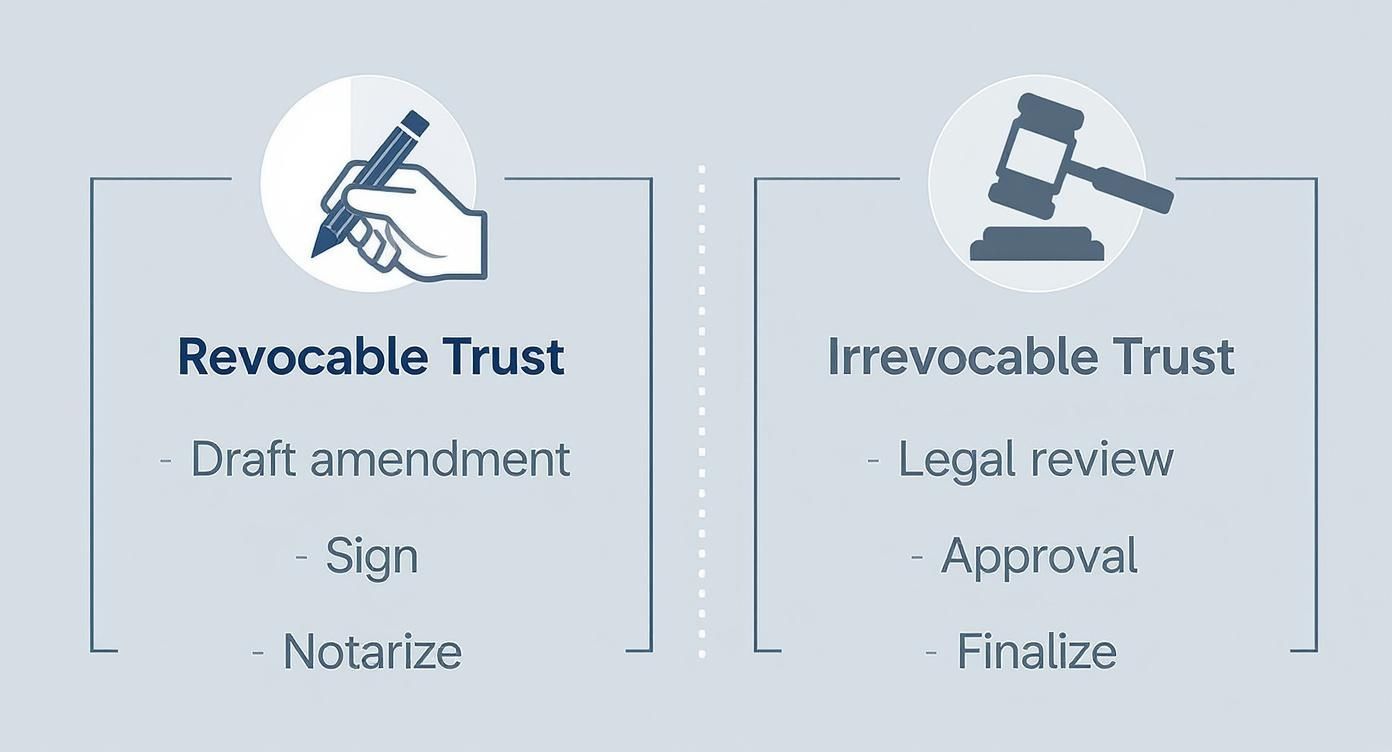
As you can see, the big difference is control. While the grantor of a revocable trust can typically make changes directly, altering an irrevocable trust nearly always brings other people into the picture, like beneficiaries or even a judge.
The Anatomy of a Valid Amendment Document
A trust amendment is a formal legal document, and it needs to be crystal clear. There should be absolutely no room for misinterpretation. While the exact phrasing will shift based on your specific changes, every solid amendment needs a few core elements to be taken seriously.
Think of it as creating a clean, easy-to-follow paper trail. You want your successor trustee to be able to pick it up and know exactly what you intended, without any guesswork.
Here are the non-negotiables:
- Clear Identification: The document must name the original trust and its creation date. For example, "This is the First Amendment to the John and Jane Doe Revocable Living Trust dated January 15, 2018."
- Pinpoint the Change: You have to be specific about which part of the trust you're changing. Vague language like "updating beneficiary shares" won't cut it. Instead, name the exact section: "Article III, Section 2 is hereby deleted in its entirety."
- State the New Language: The amendment must clearly spell out the new text that's being added or that's replacing the old language. Precision here is key to avoiding accidental conflicts with other parts of your trust.
Signatures, Witnesses, and Notarization Requirements
In Texas, the formalities for signing an amendment are generally the same as those for creating the trust in the first place. This consistency acts as a safeguard against fraud or someone pressuring you into making changes. While the Texas Trust Code sets the baseline, your own trust document might require even more stringent steps.
Typically, you (the grantor) will need to sign the amendment in front of a notary public. The notary's job is to verify your identity and confirm that you're signing the document of your own free will.
While Texas law doesn't always mandate witnesses for a trust amendment, many attorneys—myself included—consider it an essential best practice.
Having two disinterested witnesses—people who have nothing to gain from your trust—adds a powerful layer of legal armor. Their signatures provide extra proof that you were of sound mind and not under duress when you made the changes.
Skipping these formalities can have disastrous consequences. An improperly executed amendment can be challenged in court and thrown out, meaning your intended updates are completely ignored. This is one of the most common—and heartbreaking—pitfalls of DIY estate planning.
An experienced Texas estate planning attorney makes sure every detail is handled correctly, making your amendment ironclad. As we cover in our guide on the importance of updating your Texas estate plan, regular reviews and proper execution are the keys to keeping your plan effective.
Choosing Between a Trust Amendment and a Full Restatement
Life doesn’t stand still, and neither should your trust. As your circumstances shift, your trust needs to keep pace. The big question is whether you need a quick touch-up or a complete remodel. In the world of Texas trust administration, this is the core difference between an amendment and a restatement, and picking the right one is key to keeping your wishes clear and legally solid.
Think of a trust amendment as a quick edit. It’s a separate legal document that modifies just one specific part of your original trust. For simple, isolated changes, it’s the perfect tool.
A trust restatement, on the other hand, is a complete rewrite. It replaces your original trust—and all the little amendments tacked on over the years—with a single, clean, comprehensive document. It’s more involved, but a restatement is often the best way to prevent confusion down the road.
When a Simple Amendment Makes Sense
For minor tweaks, an amendment is almost always the most efficient and cost-effective route. It’s like using a scalpel instead of a sledgehammer, targeting a single issue without having to redo the entire document.
An amendment is often the right call if you just need to:
- Swap out a key player. A common scenario is naming a new successor trustee because your original choice moved away or is no longer up to the task.
- Adjust a specific gift. Maybe you want to increase a cash gift to a charity or a grandchild without changing how the rest of your assets are divided.
- Update a beneficiary's name. If a beneficiary gets married and changes their last name, a quick amendment can set the record straight.
The idea is to make a clean, straightforward change that doesn't disrupt the rest of the trust's structure. It's fast, clear, and gets the immediate job done.
Why a Full Restatement Is Often the Smarter Choice
While amendments are great for small fixes, they can become a real headache if you start collecting too many of them. Imagine trying to follow a recipe with five different sticky notes attached, each one scratching out a previous instruction. That’s the mess a trustee has to sort through when a trust has a pile of amendments.
A full restatement often becomes the best path forward. It consolidates all your wishes into one cohesive document, which dramatically cuts down on the risk of misinterpretation or conflicting terms.
A restatement is especially wise if it’s been years since your trust was first created. Laws change, family dynamics evolve, and your financial picture looks different. A restatement gives your Texas estate planning attorney a chance to refresh your trust with modern language and ensure it complies with the latest Texas Trust Code.
It's a common move. While many trusts get updated, a surprising number go through this deeper revision. Data suggests that while 20-30% of revocable trusts are amended at least once, roughly 15% are fully restated. This approach provides a comprehensive update, often to align with new tax laws or changing family needs. You can explore more about this in global trust trends and consumer insights on Forrester.com.
A restatement is usually the way to go when you’re making major structural changes, like overhauling your entire distribution plan or adding complex asset protection clauses. It gives you a clean slate, ensuring your instructions are crystal clear.
If you’re just starting your estate planning journey, you can get the basics by reading our guide on how to create a living trust in Texas.
Amendment vs Restatement: Which is Right for You?
Deciding between these two powerful tools requires a hard look at your immediate needs and long-term goals. Here’s a quick comparison to help you think it through.
| Consideration | Trust Amendment | Trust Restatement |
|---|---|---|
| Type of Change | Minor, specific, and isolated (e.g., changing a name, updating a trustee). | Major, structural, or multiple changes (e.g., altering distributions). |
| Complexity | Simple and straightforward. A short, separate document. | More involved. A complete rewrite of the entire trust document. |
| Clarity | Can create confusion if multiple amendments exist. | Creates a single, clear, and consolidated document. Easy for everyone to read. |
| Cost & Time | Generally less expensive and faster to prepare. | More costly and time-consuming upfront, but can save money and hassle later. |
| When It's Best | You have one or two small changes to make to a relatively new trust. | Your trust is old, you have many previous amendments, or you're overhauling it. |
| Legal Compliance | Doesn't update the trust to reflect new laws. | Ensures the entire trust is current with the latest laws and legal language. |
Ultimately, the goal is to have a plan that is easy to understand and execute when the time comes. Whether that’s through a simple amendment or a comprehensive restatement, making the right choice now prevents headaches for your loved ones later.
Common Mistakes to Avoid When Amending Your Trust

Amending a trust feels like it should be simple, but the path is littered with potential missteps. I've seen it happen time and again—a small oversight blossoms into lasting headaches for your loved ones, sparking family disputes, voiding your intended changes, or even triggering costly legal fights.
Knowing the common pitfalls ahead of time is half the battle. This isn't just about paperwork; it's about making sure your wishes are followed to the letter, without leaving a legacy of confusion for your family to sort out. Getting this right is a huge part of responsible asset protection and thoughtful estate planning.
Using Ambiguous or Imprecise Language
One of the most frequent errors I encounter is language that's just too vague. Your instructions need to be airtight to stop disagreements before they start.
Think about this: an amendment says, "I want to add my new grandchild, Sarah, to the trust." Simple, right? But what does that really mean? Should Sarah get an equal share, which waters down everyone else's portion? Or is she supposed to get a specific dollar amount? That ambiguity forces your trustee to guess, and a guess is something that can easily be challenged in court.
Cautionary Scenario: A client's father in The Woodlands amended his trust to "leave a fair share" to his caregiver. After he passed, his kids and the caregiver spent months locked in a legal battle over the definition of "fair," draining trust assets and tearing the family apart.
Precise, unambiguous language is your best defense against conflict. A well-drafted amendment would specify the exact percentage or dollar amount, leaving zero room for debate.
Forgetting to Properly Fund the Trust
An amendment is only as good as the assets it governs. It's shockingly common for people to acquire a major new asset—like a vacation home in Galveston or a new investment account—and completely forget to title it in the name of the trust.
If an asset isn't formally owned by the trust, your trust's rules don't apply to it. Plain and simple. That means an unfunded asset will probably have to go through the public and often painful probate process, which is the very thing most people create a trust to avoid. Make it a habit to review your assets and ensure they're correctly titled. It's just as crucial as updating the document itself.
Disregarding the Original Trust’s Formalities
Every properly drafted trust has a specific section detailing exactly how to make amendments. Some require two witnesses, others just a notarized signature. Ignoring these instructions is a fatal flaw.
If your trust document says an amendment needs two witnesses and you only get it notarized, a disgruntled heir could later argue that the amendment is invalid. Don't assume Texas courts will be lenient; they often strictly enforce the procedures the grantor originally laid out.
- Review Your Document: Always start by finding and rereading the amendment clause in your original trust.
- Follow It Exactly: Do not cut corners on signatures, witnesses, or notarization.
- Consult an Attorney: A Texas trust administration lawyer can make sure every legal formality is met, making your amendment ironclad.
Failing to Notify the Trustee of Changes
While you aren't always legally required to tell your trustee about every change to a revocable trust, keeping them in the dark is a recipe for disaster. A trustee who doesn't know about an amendment might act on outdated instructions, leading to incorrect distributions or other serious errors.
Give your current trustee a copy of any new amendment. It's a simple act of communication that helps them properly fulfill their fiduciary duties in Texas and ensures a much smoother administration process when the time comes.
If you're navigating the complexities of amending a trust or need guidance on any aspect of estate planning, contact The Law Office of Bryan Fagan, PLLC for a free consultation. Our experienced attorneys provide trusted, Texas-based guidance for every step of the process.
Common Questions About Changing a Texas Trust
When it comes to tweaking a trust, it’s natural for questions to pop up. We get them all the time from Texas families just like yours. Let’s clear the air and tackle some of the most common ones we hear.
What’s the Price Tag for Amending a Trust in Texas?
Honestly, there’s no one-size-fits-all answer here. The cost to amend a trust really hinges on how complex your changes are.
Think of it this way: a simple, one-page amendment to swap out a successor trustee might only run a few hundred dollars. It's a quick fix that doesn’t require a ton of legal heavy lifting.
But if you’re looking at a full restatement of a complicated trust—one with multiple properties, detailed distribution rules, and maybe some sophisticated tax planning—that’s a different story. The price will reflect the number of changes, the legal brainpower needed for tax strategy, and the overall intricacy of your estate. At The Law Office of Bryan Fagan, PLLC, we always start with a free consultation to hear you out and give you a clear, upfront estimate.
Can I Amend My Trust Without a Lawyer?
Legally speaking, Texas law doesn't force you to hire an attorney. But from a practical standpoint, it's highly recommended.
The Texas Trust Code is loaded with very specific rules for creating, changing, and managing trusts. Those DIY forms you find online? They often miss the mark, failing to account for Texas-specific nuances. That can lead to an amendment that’s completely invalid or, worse, creates a mess of unintended problems down the road.
An experienced Texas estate planning attorney does way more than just fill in blanks. They make sure your changes are ironclad, worded precisely to prevent any confusion, and woven seamlessly into your broader estate plan. That professional oversight is your best defense against future family fights and ensures your final wishes are actually carried out.
Can a Trustee or Beneficiary Change the Trust?
This is a huge point of confusion, and the answer is almost always no. Generally, only the grantor—the person who set up the trust in the first place—has the power to amend a revocable trust.
A trustee's job is to follow the rules, not rewrite them. Their fiduciary duties in Texas demand that they carry out the grantor's instructions to the letter.
For an irrevocable trust, the rules are even tighter. In some rare cases, beneficiaries can team up and ask a court to approve a change, but only if everyone agrees and the modification doesn't stray from the trust's original purpose. They absolutely cannot make changes on their own. The grantor’s intent is king.
What if I Have a Stack of Different Amendments?
Having multiple amendments attached to your original trust is technically legal, but it can be a real headache. Over the years, that stack of papers can get confusing, and you might even have conflicting instructions buried in there. This forces your successor trustee to play detective, piecing everything together and praying they get it right. It’s a recipe for mistakes.
If you've made a few changes over time, your best bet is to do a "Restatement of Trust." This neat process rolls up all your old amendments and new wishes into one single, clean, up-to-date document.
A restatement isn't just about tidying up; it's about providing absolute clarity for your trustee and family. It becomes the one and only playbook, simplifying everything for the people you’re counting on to manage your legacy. Smart asset protection and solid planning to avoid probate or guardianship battles start with clear, unambiguous documents.
If you’re managing a trust or planning your estate, contact The Law Office of Bryan Fagan, PLLC for a free consultation. Our attorneys provide trusted, Texas-based guidance for every step of the process.