Losing a loved one is tough enough without the legal maze that often follows. Managing a loved one’s estate can feel overwhelming—but with the right legal guidance, it doesn’t have to be. One of the first questions we always get is, "So, how long is this probate thing going to take in Texas?" While every family's situation is different, a straightforward case here in the Lone Star State usually wraps up in about six to twelve months.
But that's just a ballpark. The timeline can shrink or stretch out quite a bit, depending on how complex the estate is and which legal path you have to take. This guide will provide clear explanations and practical advice to help you feel informed and secure in your next steps.
Your Texas Probate Timeline: A Straight Answer
When someone passes away, their estate has to go through probate. Think of it as the official process for closing out someone's financial life. A court steps in to validate their will, make sure all their debts get paid, and then distribute what's left to the right people. This entire process is guided by the Texas Estates Code.
The whole point is to create a clear, legal transfer of everything they owned. Without probate, bank accounts would be frozen, real estate couldn't change hands, and all those assets would be stuck in a legal no-man's-land.
Different Paths Mean Different Timelines
How long probate takes really boils down to which route the estate has to follow. Is there a valid will? How big is the estate? Are all the beneficiaries on the same page? These are the kinds of questions that determine the path forward and set the pace.
To give you a clearer picture of what to expect, we've put together a simple table outlining the common probate scenarios in Texas and their typical timelines.
Estimated Probate Timelines in Texas
| Probate Scenario | Estimated Timeline | Key Characteristics |
|---|---|---|
| Independent Administration | 6-12 Months | Most common and efficient. The executor, as a fiduciary, works with minimal court supervision. Ideal when there's a will and no major disputes. |
| Dependent Administration | 1-2+ Years | Slow and costly. Requires a judge's approval for almost every action. Used when heirs are fighting, there's no will, or the will requires it. |
| Muniment of Title | 2-4 Months | A quick way to transfer property. Only works if there's a will and no debts (besides a home mortgage). |
| Small Estate Affidavit | 1-3 Months | The fastest option. Bypasses formal probate entirely for estates under $75,000 (excluding the homestead and other exempt property). |
As you can see, the path you take makes all the difference. Understanding these options is the first step in setting realistic expectations for everyone involved.
Here's a quick rundown of what those scenarios mean:
- Independent Administration: This is the one we aim for. It’s the most common and efficient type of probate in Texas, letting the executor manage things with very little court babysitting. It saves a ton of time and money.
- Dependent Administration: This is the slow, expensive route. The court has to sign off on pretty much everything the executor does. It’s a legal slog, usually reserved for messy situations where beneficiaries can't agree.
- Muniment of Title: Think of this as an express lane for simple estates. If there's a will and the only major debt is the mortgage, this process can be used to quickly transfer property titles to the beneficiaries.
- Small Estate Affidavit: For smaller estates valued under $75,000 (not counting the primary home and certain other exempt property), this procedure avoids formal probate altogether. It’s the quickest option available by far.
Each path has its own map and its own pace, which is why there's no one-size-fits-all answer to the "how long?" question. If you want to dive deeper, you can explore the complete Texas estate settlement timeline in our guide. Working with an experienced probate attorney from the start is the best way to make sure you're on the most efficient track for your family's situation.
What Shapes the Probate Timeline?
Think of probate like a complex piece of machinery. When every part is well-oiled and works together, the machine runs like a dream. But if one component is rusty or out of place, the whole thing can grind to a halt.
While we can talk about general timeframes, the unique details of each estate are what really set the pace. Understanding these variables will help you see potential bumps in the road and appreciate why having a knowledgeable Texas estate planning attorney in your corner is so valuable.
The Estate's Size and Complexity
The kind and value of the assets involved play a massive role in how long probate will take. A straightforward estate—maybe a house, a bank account, and a car—can often be wrapped up pretty quickly.
But things get more complicated, and naturally take more time, when the estate includes:
- Diverse Assets: An estate holding a family business, several real estate properties, intellectual property rights, or a sprawling investment portfolio demands detailed valuations and very careful handling.
- Out-of-State Property: If the person who passed away owned property in another state, a whole separate probate process called ancillary probate has to be opened there. That adds another layer of legal procedure and time.
- Ongoing Business Operations: Keeping a business running during probate is no small feat. It means making payroll, managing contracts, and making operational decisions, all of which stretch out the timeline.
Figuring out which assets have to go through court and which can skip it is also a critical step. For a deeper dive into what's what, you can learn more about the differences between probate and non-probate assets in our detailed guide.
The Clarity of the Will and Estate Plan
A clear, legally solid will is one of the best tools you can have for a smooth probate process. When a will is well-drafted, it acts as a precise roadmap for the executor and the court, leaving very little room for arguments or confusion.
On the flip side, a will that's vague, outdated, or wasn't signed correctly can become a major roadblock. If someone challenges the will's validity—a process known as a will contest—probate can be frozen for months, or even years, while the dispute is sorted out in court. And if there's no will at all (dying intestate), the court has to follow a rigid legal formula to find and identify heirs, which can be a long and complicated chore.
While Texas probate can be efficient, the national picture is quite different. Across the U.S., the average probate process stretches to about 20 months. A comprehensive study found that only 2% of Americans knew it took that long, with most severely underestimating the duration. You can discover more insights from the probate study on Trust & Will's website.
Family Dynamics and Cooperation
Unfortunately, family relationships can be the biggest wildcard in the probate timeline. When beneficiaries are on the same page, communicate openly, and trust the executor, things tend to move forward without a hitch. Everyone is working toward the same goal.
But when conflict erupts, it can cause serious delays. The common friction points often involve:
- Arguments over how assets are valued or divided up.
- Challenges to the executor's decisions or actions.
- Deep-seated family rivalries that bubble to the surface during a stressful time.
Even a seemingly small disagreement can escalate, dragging everyone into court and adding significant time and expense to the process. This is where an experienced attorney can be invaluable, often acting as a neutral mediator to help resolve issues before they completely derail the estate administration.
A Step-by-Step Guide Through the Texas Probate Process
Navigating the probate process can feel like you've been handed a complex piece of furniture to assemble, but the instructions are missing. It’s confusing, frustrating, and full of unfamiliar parts. But it doesn’t have to be that way.
Think of this step-by-step guidance as your instruction manual for the Texas probate journey. We’ll walk through each major milestone, translating the legal jargon into plain English and pointing out the key deadlines you absolutely need to know.
Stage 1: Filing the Will and Kicking Off Probate
The whole process gets rolling when an interested party—usually the person named as the executor in the will—files an Application to Probate Will with the right court. This has to be done in the county where the person who passed away lived.
It's important to know that under the Texas Estates Code, there's a four-year statute of limitations for probating a will. If you wait more than four years from the date of death, the will generally can't be probated. The estate would then be handled as if no will ever existed.
Once the application is filed, the county clerk posts a notice at the courthouse, which is a public announcement that probate has begun. Texas law requires a mandatory waiting period of at least 10 days after this posting before any hearing can take place. Most courts will schedule the hearing two to four weeks out from the initial filing.
Stage 2: The Court Hearing and Executor Appointment
The first court appearance is usually a pretty straightforward, administrative hearing. The judge’s main goals are to officially validate the will and appoint an executor to manage the estate.
During the hearing, the person applying must provide evidence that the will is valid. This often involves testimony from one of the witnesses who originally signed the will. However, if the will is "self-proved"—meaning it includes a special affidavit signed by the testator and witnesses in front of a notary—this step is often waived, which really simplifies the hearing.
If the judge is satisfied, they will sign a court order that admits the will to probate. The judge also formally appoints the executor, who then has to take an oath of office, promising to carry out their duties faithfully under the will and Texas law.
Stage 3: Getting Your Hands on Letters Testamentary
After the executor takes their oath, the court issues a critical document called Letters Testamentary. Think of this one-page certificate as the executor's golden ticket—it grants them the legal authority to act for the estate.
With Letters Testamentary, the executor can finally get to work:
- Access and manage the deceased's bank accounts.
- Talk to financial institutions and government agencies.
- Sell property and other assets if necessary.
- Pay the estate's debts and expenses.
Basically, no one will recognize your authority as executor without this official court document. It’s the key that unlocks your ability to handle all the estate's business.
The infographic below shows how the core factors—the estate, the will, and family dynamics—shape the timeline for each probate stage.
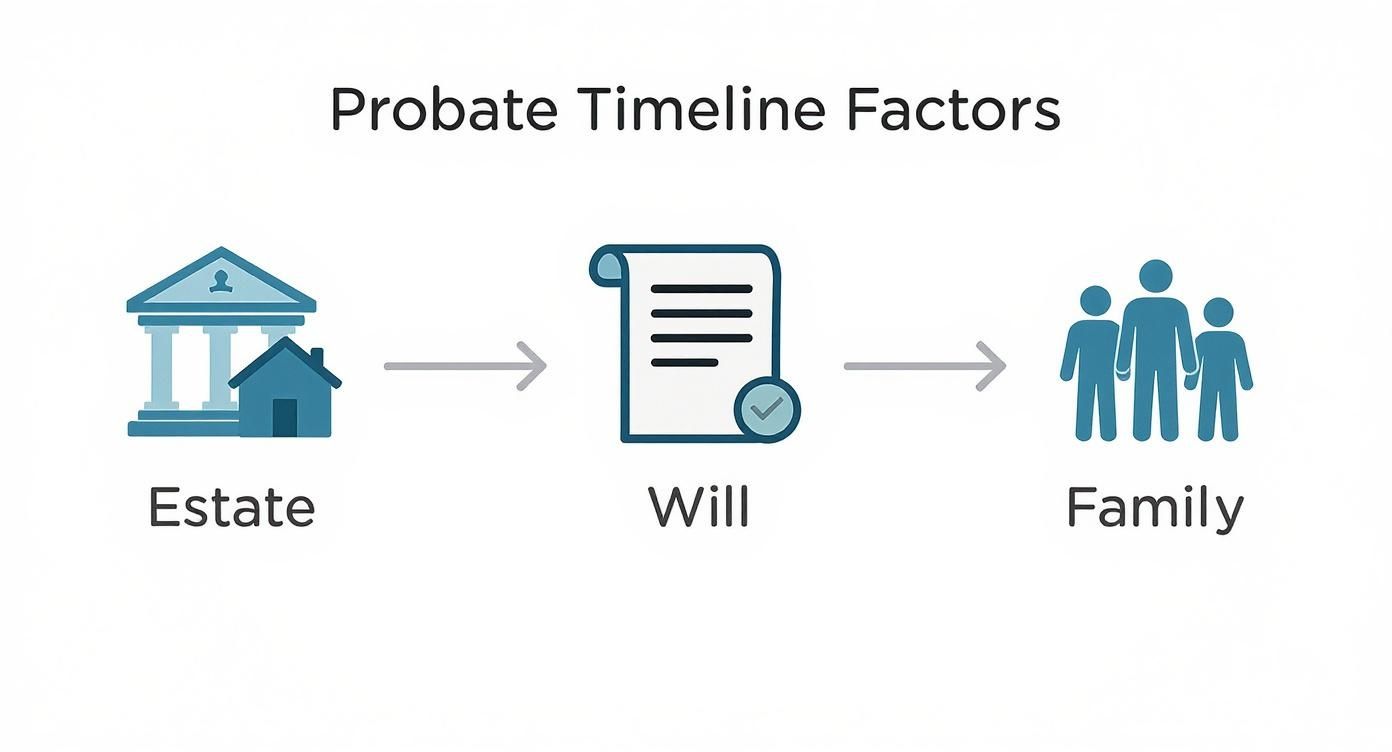
This visual makes it clear how asset complexity, the will's clarity, and family cooperation can directly speed up or slow down the probate process.
Stage 4: Notifying Creditors and Gathering Assets
One of the executor's most important legal duties is to notify potential creditors. Within 30 days of being appointed, the executor has to publish a notice in a local newspaper to let creditors know the estate is open.
On top of that, the executor must send a specific notice via certified mail to any known secured creditors, like a mortgage lender, within 60 days. This step ensures everyone with a potential claim against the estate is properly informed.
Fiduciary Principle: The executor has a legal duty to act in the best interests of the estate and its beneficiaries. This is a core fiduciary principle in Texas, meaning the executor must responsibly manage assets, pay legitimate debts, and distribute property exactly as the will directs.
As part of managing the estate, you’ll need to handle various types of assets. For valuable items, it can be helpful to learn more about selling inherited estate jewelry.
Stage 5: The Inventory and Final Distribution
Within 90 days of their appointment, the executor must file a detailed Inventory, Appraisement, and List of Claims with the court. This is a comprehensive list of every piece of property the person owned at their death, along with its fair market value.
Once the inventory is approved and all creditor claims have been settled, the executor can start the final steps. This involves paying any last administration expenses (like attorney fees and court costs) and then distributing what's left to the beneficiaries, just as the will lays out.
After all assets are handed out and all duties are complete, the executor can take the final steps to formally close the estate. While each step has its own timeline, having the right legal guidance makes the entire journey much more predictable.
Independent Versus Dependent Administration
In Texas, the single biggest factor that dictates how long probate drags on is the type of administration the estate falls under. Think of it like a road trip. You can either take the direct, streamlined toll road or the winding local route with a stoplight at every corner. Both get you to the same destination, but the journey—and the time it takes—is worlds apart.
The Texas Estates Code lays out two primary paths: independent administration and dependent administration. Getting a handle on the difference is the first step for any executor or beneficiary trying to set a realistic timeline.
The Preferred Path: Independent Administration
For most estates in Texas, especially those with a well-drafted will, independent administration is the gold standard. It’s designed to be efficient, cost-effective, and straightforward, letting the executor manage the estate's affairs with very little court oversight.
Once an executor is appointed and receives their Letters Testamentary, they’re largely free to get to work. They can pay debts, sell property, and hand out assets to beneficiaries without needing to ask the court for permission at every single turn. It’s a system built on trust—the court trusts the executor to act as a fiduciary in the best interest of the estate.
This process is so much faster because it cuts out the court as a constant middleman. The executor can make decisions and act on them, which keeps the whole process moving and helps wrap things up in that typical six-to-twelve-month timeframe.
The Slower Route: Dependent Administration
Dependent administration is the exact opposite. It's a closely supervised, court-managed slog. As the name suggests, the administrator is dependent on the court for approval to take just about any action.
This is the path you're typically forced down when someone dies without a will, or if the will fails to specifically call for an independent administration. It’s also the default when beneficiaries are fighting and can’t agree on anything.
Every little task, from paying the electric bill to selling a used car, requires filing a formal application, waiting for a court hearing, and getting a judge’s signature on an order. This turns simple chores into lengthy, expensive legal procedures. That constant need for court approval creates a cycle of delays and racks up attorney's fees, draining money from the estate that should have gone to the heirs.
Probate courts have been swamped in recent years, dealing with pandemic backlogs and staff shortages. What used to take months can now easily stretch to a year or more, creating a financial and emotional nightmare for families. You can discover more insights about these probate delays on SavingAdvice.com.
A Real-World Scenario: Selling a House
Let's look at a practical, real-world scenario to really drive the point home. Say the estate needs to sell the deceased’s house.
In an Independent Administration: The executor lists the house with a realtor, accepts a fair market offer, and signs the closing paperwork. The whole thing might take a few weeks, just like a normal real estate sale. Quick and simple.
In a Dependent Administration: The process is a bureaucratic nightmare. The administrator has to file an application with the court just to get permission to sell. The court might demand an independent appraisal. Then a hearing is scheduled, and all the heirs have to be notified. Only after a judge finally signs an order can the sale move forward. This alone can easily add two to three months, if not more, to the timeline.
This stark difference is exactly why a thoughtfully prepared will that specifically requests independent administration is such a powerful tool in any Texas estate planning attorney's toolkit. It is one of the single most effective ways to make sure your estate gets settled quickly and efficiently, saving your loved ones from a world of unnecessary stress and expense.
Will Contests From Unhappy Heirs
Nothing slams the brakes on probate faster than a will contest. This is what happens when an heir, or someone who thought they’d be an heir, decides to challenge the will's validity. When this occurs, the entire probate process often grinds to a halt while the court sorts out the dispute. This can tack on months, and in some cases, even years to the timeline.
In Texas, will contests usually pop up for a few common reasons:
- Lack of Testamentary Capacity: The argument here is that the person who made the will (we call them the testator) wasn't of sound mind when they signed on the dotted line.
- Undue Influence: An heir might claim that the testator was pressured or manipulated by someone else into creating or changing the will against their true wishes.
- Improper Execution: The will wasn't signed and witnessed according to the very specific, strict rules laid out in the Texas Estates Code.
How to Sidestep This: Your best defense is a rock-solid will drafted with the help of a skilled estate planning attorney. A professionally prepared will, especially one that includes a "self-proving affidavit," is significantly tougher to challenge. It also doesn't hurt to have open conversations with family about your estate plan while you're alive. Managing expectations can go a long way in preventing arguments later.
The Scavenger Hunt for Beneficiaries or Heirs
Sometimes, the delay isn’t about conflict at all—it’s just a matter of logistics. If the will names a beneficiary who has since moved, changed their name, or simply fallen off the grid, the process can stall. The executor has a legal duty to make a real, diligent effort to find every single person named in the will.
This headache gets even bigger when someone dies without a will (what’s legally known as dying intestate). The court then has to figure out who all the legal heirs are based on a rigid formula set by law. This can turn into a full-blown genealogical investigation to track down distant relatives, a process that burns through both time and money.
How to Sidestep This: Make a habit of updating your estate plan every few years to ensure beneficiary contact information is current. If you know one of your heirs might be a bit of a wanderer, include as much identifying information as you can in your planning documents—think full name, last known address, maybe even a date of birth.
Squabbles Over What Things Are Worth
Putting a dollar value on estate property is a fundamental part of probate, but it’s also a huge source of friction. Family members often have sentimental attachments or wildly different opinions on the value of unique assets like the family business, antique furniture, or a piece of real estate.
An executor has a fiduciary duty to manage and value estate assets accurately and impartially. A detailed and professionally supported inventory is the best way to fulfill this obligation and prevent disputes over who gets what and how much it's worth. Fiduciary duties in Texas are taken very seriously by the courts.
For instance, one heir might see a painting as a priceless family heirloom, while another just sees an old picture for the garage. These kinds of disagreements can spiral into needing costly formal appraisals and even courtroom battles, stopping everything until a value is legally nailed down. A detailed inventory and transparent communication can head off many of these arguments before they start. Good asset protection strategies can also help clarify ownership and value long before probate is even on the horizon.
How to Avoid the Probate Process in Texas

After walking through the probate timeline and seeing all the potential roadblocks, you might be thinking there's a better way. And you'd be right. The fastest probate is almost always no probate.
By planning ahead, you can use powerful legal tools to pass your legacy directly to your loved ones, steering clear of the courthouse entirely. This move alone saves them from the time, cost, and emotional weight that often comes with the probate process.
The workhorse for many probate-avoidance plans is the Revocable Living Trust. Think of it as a private legal container you create for your assets. While you're alive, you're in complete control—you can manage, use, and enjoy everything in the trust just like you do now.
When you pass away, the person you named as your successor trustee simply steps in and follows your instructions to distribute the assets to your beneficiaries. It all happens privately and efficiently, with no court filings or public records.
Powerful Tools for Bypassing Probate
A living trust is a fantastic foundation, but Texas law offers other incredibly effective ways to transfer specific assets outside of probate. Taking a comprehensive approach, similar to what you’d see in high net worth estate planning, can give you the strategies to minimize or completely sidestep the court system.
These tools are designed for a seamless transition of ownership:
- Beneficiary Designations: For things like life insurance policies, retirement accounts (401(k)s, IRAs), and bank accounts, you can name a beneficiary. These are often called Payable on Death (POD) or Transfer on Death (TOD) accounts. When you pass, the asset goes directly to that person. All they typically need is a death certificate and their ID. It's that simple.
- Transfer on Death Deeds (TODDs): Got real estate? A TODD is a straightforward but powerful tool that lets you name a beneficiary to automatically inherit your property upon your death. This avoids the entire probate process just for transferring the title to your home.
A well-built estate plan is about so much more than just who gets what. It's about delivering peace of mind. By using tools like trusts and beneficiary designations, you're not just protecting your legacy—you're protecting your family from unnecessary legal headaches during an already difficult time.
The Benefits of Proactive Planning
When you structure your estate to avoid court intervention, you're giving your family three incredible gifts: privacy, speed, and simplicity. Assets held in a trust can often be distributed in a matter of weeks, not the months or years probate can take.
If you're interested in a deeper dive into these strategies, check out our guide on how to avoid probate in Texas.
A skilled Texas estate planning attorney can help you find the perfect mix of tools for your situation. Whether it's a trust, TODDs, or other strategies, the goal is always the same: create a plan that fits your life and protects your family's future.
Frequently Asked Questions About Texas Probate
When you're navigating probate, questions are bound to pop up. Getting clear, straightforward answers can bring a whole lot of peace of mind. Let's tackle some of the most common questions we hear from executors and beneficiaries about the Texas probate process, so you can feel more prepared for the road ahead.
What Is the Mandatory Waiting Period for a Probate Hearing in Texas?
Once an application for probate is filed, Texas law says you can't just walk into court the next day. The Texas Estates Code requires the application to be publicly posted for at least 10 days before any hearing can happen. Think of it as a public heads-up.
In practice, getting on the court's calendar usually takes a bit longer. You can typically expect a hearing to be set somewhere between two to four weeks after the initial filing.
How Long Does an Executor Have to File the Inventory of the Estate?
In Texas, the person in charge—the executor or administrator—has a big homework assignment: filing a detailed Inventory, Appraisement, and List of Claims with the court. This document is a complete rundown of everything the person owned.
The deadline for this is 90 days from the date they are officially appointed and get their Letters Testamentary. If the estate has unique or hard-to-value assets (like a classic car or a business), the executor can ask the court for an extension.
Fulfilling fiduciary duties like filing a timely and accurate inventory is not just a legal requirement; it's an act of transparency that builds trust with beneficiaries and prevents disputes.
Can I Sell the Deceased's House Before Probate Is Finished?
This is a classic "it depends" situation, and it all hinges on the type of administration. If you're dealing with an independent administration, the executor generally has the power to sell property without asking the court for permission once they have Letters Testamentary. This makes things much quicker.
On the other hand, a dependent administration is a different ballgame. The process is much longer and more involved. The executor has to get a specific court order to sell the house, which means getting appraisals, filing formal applications, waiting through a notice period, and having a court hearing before the sale can even move forward.
If you’re managing an estate or planning your own, contact The Law Office of Bryan Fagan, PLLC for a free consultation. Our attorneys provide trusted, Texas-based guidance for every step of the probate and guardianship process.