Skip to content
Planning for the future of your estate can feel overwhelming, but understanding your options is the first step toward securing your family's financial well-being. When comparing a living trust vs. a will, the key difference is straightforward: a living trust is a private tool that manages your assets during your lifetime and after you're gone, completely avoiding the probate process. In contrast, a will is a public document that only takes effect after you pass away and must go through probate court.
Navigating these choices is a profound act of care for your loved ones. With the right legal guidance, you can create a plan that brings you and your family peace of mind.
An Overview of Wills and Trusts in Texas
Planning for your family’s future is one of the most significant things you will ever do. Yet, a surprising number of people—a staggering 55% of Americans—don't have any estate planning documents in place. This can leave their families facing a complicated and stressful court process while they are already grieving.

Here in Texas, both wills and living trusts are designed to pass on your assets, but they operate differently under the Texas Estates Code and the Texas Trust Code. Choosing the right one for your situation means understanding what sets them apart. You can learn more about the factors to consider when choosing between a will and a trust in our detailed guide.
To begin, let's look at a side-by-side comparison to see these key differences in action.
Living Trust vs. Will: Key Differences at a Glance
Sometimes, a clear chart is the best way to grasp the essentials. This table cuts through the legal jargon and highlights the most important distinctions between a living trust and a will.
| Attribute | Living Trust | Will |
|---|---|---|
| Probate | Avoids the public probate process for all assets held within the trust. | Must go through the public, court-supervised probate process. |
| Effective Date | Becomes effective immediately upon creation and funding. | Only becomes effective after your death. |
| Privacy | A private document; asset distribution is not part of the public record. | A public document once filed with the probate court. |
| Incapacity Planning | Allows a successor trustee to manage assets if you become incapacitated. | Offers no protection or management during your incapacity. |
As you can see, the choice isn't just about what happens after you're gone. It’s also about managing your assets and protecting your family during your lifetime, especially if you ever become unable to make decisions for yourself.
Getting to Grips with the Legal Landscape in Texas
To make an informed choice between a living trust and a will, you must understand the legal ground these documents stand on in Texas. This decision shapes your family's experience, privacy, and costs during an already difficult time.
The most significant difference boils down to one simple fact: when each document becomes active. A living trust is operational while you're alive, but a will only comes to life after you've passed away. This distinction is the key to determining which one fits your family's situation best. Think of a will as your instruction manual for the probate court, while a trust is more like a private company you set up to manage your assets.
The Texas Estates Code vs. The Texas Trust Code
Here in the Lone Star State, these two powerful tools are governed by different sets of laws that dictate how they function.
- The Texas Estates Code is the rulebook for wills and the probate system. It outlines the strict requirements for a valid will, the duties of an executor, and the court-supervised steps required to transfer assets to your heirs.
- The Texas Trust Code governs the creation, management, and termination of trusts. It details the responsibilities of the person creating the trust (the grantor), the person in charge of it (the trustee), and the rights of those who will benefit from it (the beneficiaries).
Because a trust operates without court supervision, the Texas Trust Code holds trustees to a very high standard. They have a fiduciary duty to act solely in the best interests of the beneficiaries. This is a core fiduciary principle that ensures your wishes are honored with integrity.
The bottom line is this: The Texas Estates Code places a judge in the driver's seat of your estate, making the process public. The Texas Trust Code, on the other hand, lets you hand the keys to your chosen trustee to handle everything privately, exactly as you intended.
So, What's This Texas Probate Process Everyone Talks About?
Probate is the official, court-supervised legal process required to validate a will and transfer your assets to the people you named. Many people establish a living trust for the sole purpose of avoiding this process.
Probate involves filing the will with the court, appointing an executor, notifying creditors, inventorying all your assets, and finally, distributing the assets. It can be time-consuming, expensive, and it makes your family’s finances a matter of public record. For many families, the privacy and efficiency of a trust is a significant advantage. Understanding the difference between probate and non-probate assets is an excellent first step in your estate planning.
The Key Players in Your Estate Plan
Knowing the "who's who" for both wills and trusts makes it easier to see how they function in the real world.
- Executor vs. Trustee: An executor is the person you name in your will to carry out your wishes, but they must be officially appointed by the probate court. A successor trustee, however, is the person you name in your trust to take over managing the assets if you become incapacitated or pass away. They can step in immediately, without court approval.
- Beneficiaries: These are the people or organizations who will inherit your assets. The term is the same for both documents, but a trust offers far more control. A trustee can manage distributions over many years—for example, paying for a grandchild's college tuition or holding an inheritance until a child is mature enough to manage it responsibly.
Ultimately, Texas law offers two very different paths for your legacy. A will relies on the public court system, which can be slow and bureaucratic. A trust, however, creates a private roadmap for managing and transferring your assets, giving you more control and keeping your family's affairs out of the public eye.
Digging Deeper: A Head-to-Head Comparison of Your Estate Planning Tools
Going beyond definitions is where things get interesting. It’s one thing to know what a will and a living trust are, but it's another to understand how they perform when your family is counting on them. Getting to the heart of these practical differences is the only way to answer the "what is living trust vs will" question for your life. Let's put them side-by-side to see how they stack up against real-world challenges.
This decision tree gives you a quick visual of when each document kicks into gear.
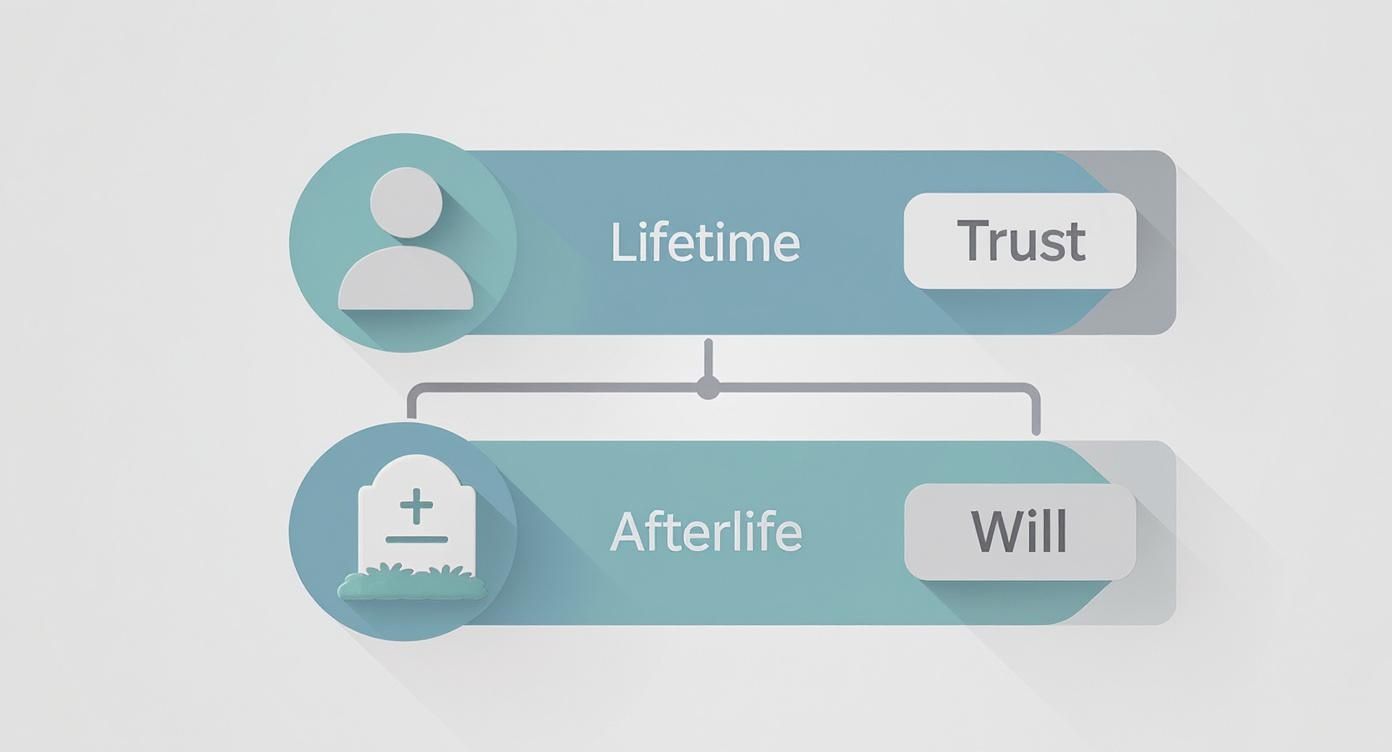
As you can see, a trust is built to manage your affairs both during your lifetime and after you're gone. A will, on the other hand, is a document that only gains legal authority after you pass away.
Probate Avoidance and Privacy
The most significant distinction between a trust and a will comes down to their relationship with the Texas probate courts. It’s a game-changer for many families.
A properly funded living trust is designed to completely bypass the probate process for every asset it holds. This is a huge benefit. It means your successor trustee can step in and begin managing and distributing your assets almost immediately, without the delays and public exposure of court proceedings.
A will, in stark contrast, must go through probate to be validated by the court. This entire process is a matter of public record. That means the details of your estate—your assets, your debts, and who inherits what—are open for anyone to see. For families who value their privacy or want to avoid a potentially lengthy and expensive court process, a trust offers an undeniable advantage.
Planning for Incapacity
Life is unpredictable, and a solid estate plan must account for the possibility that you might become unable to manage your own affairs. This is another area where trusts and wills are worlds apart.
A living trust is a powerful tool for incapacity planning. If you become ill or seriously injured, your designated successor trustee can immediately step in to manage the trust's assets on your behalf. They can pay your bills, handle investments, and keep your financial life running smoothly without needing to involve a court.
A will offers zero protection in this scenario. It only activates upon your death, leaving a massive gap if you become incapacitated. In that situation, your family would likely have to go to court to establish a guardianship—a public, often costly, and emotionally draining legal proceeding just to get the authority to assist you.
A living trust is a dynamic tool that protects you during your lifetime and after. A will is a static document that only speaks after you are gone, leaving your family to navigate the court system for both incapacity and asset distribution.
Control Over Your Assets and Legacy
Both documents allow you to decide who inherits your property. However, a trust gives you far more granular control over how and when they receive it.
With a will, your assets are typically distributed to your beneficiaries in a lump sum once probate is complete. If you have young adult children or beneficiaries who might not be ready to handle a large inheritance, this can be a real source of anxiety.
A trust, on the other hand, lets you set specific conditions for distributions. Your trustee can be instructed to manage assets for a beneficiary until they reach a certain age, graduate from college, or meet other milestones you define. This is an essential feature for protecting a family business or ensuring your legacy is preserved for generations. A skilled Texas trust administration lawyer can help you craft these provisions.
Upfront vs. Long-Term Costs
Let's discuss the financial investment, as it's a practical concern for every family. Drafting a traditional will is typically less expensive upfront, generally running between $150 to $1,000. Living trusts require a higher initial investment, often from $1,000 to $10,000.
However, it's crucial to look at the bigger picture. The long-term savings from avoiding a complex or multi-state probate can easily make a trust the more economical choice for families with significant assets. You can learn more about the differences between a will and a living trust from other legal experts.
Ultimately, the right choice involves balancing the upfront cost against the potential for significant long-term savings and protections for your family. A Texas estate planning attorney can help you weigh these factors based on your unique financial situation and goals.
Making the Right Choice with Real-World Texas Scenarios
Legal theory is one thing, but seeing how these tools work for actual Texas families is where the true value becomes clear. Understanding the difference between a living trust and a will often just means picturing them in action. Let's explore two different family scenarios to see how their unique lives shape their estate planning choices.
These stories highlight that factors like the complexity of your assets, where your property is located, and your family structure are what truly drive the decision.
Scenario One: The Houston Family with Diverse Assets
Meet the Garcia family from Houston. They own their home in Harris County, a vacation property on the Galveston coast, and a small portfolio of rental properties in Austin. Their assets are spread across multiple Texas counties, a common situation for successful families.
If the Garcias only had a will, their passing would trigger a legal headache. Their executor would face separate ancillary probate proceedings in both Galveston and Travis counties, in addition to the main probate in Harris County.
This means hiring multiple lawyers, paying court fees in three different jurisdictions, and managing three separate court timelines. It’s a recipe for high costs, long delays, and significant frustration before the heirs receive their inheritance.
By establishing a revocable living trust, the Garcias can bring all their properties under a single, private umbrella. Their successor trustee can manage everything—the Houston home, the Galveston beach house, and the Austin rentals—without ever needing to deal with a probate judge.
For a family like the Garcias, this approach is a clear winner:
- Avoids Multiple Probates: It completely sidesteps the nightmare of redundant, expensive court cases in different counties.
- Ensures Privacy: The details of their properties and their value remain within the family, not filed as public records.
- Provides Immediate Control: Their chosen trustee can start managing the rentals and paying property taxes right away, without waiting for court permission.
For the Garcias, the upfront cost of setting up and funding a living trust is a smart investment. It’s a streamlined, private, and efficient way to pass on their legacy. A knowledgeable Texas estate planning attorney is key to ensuring all properties are correctly titled in the trust's name.
Scenario Two: The Young Couple with Minor Children
Now, let's consider the Martinez family, a young couple in their early 30s in a Dallas suburb with two children, ages four and six. Their primary asset is their family home, which has a mortgage. Their top priority isn't managing complex assets; it's ensuring their children are raised by the right people if the unthinkable were to happen.
For the Martinez family, a will is absolutely essential. According to the Texas Estates Code, a will is the only legal document parents can use to officially name a guardian for their minor children. Without one, a judge who has never met them or their children would decide who raises them.
A living trust is excellent for managing money for the children, but it has no power to appoint a guardian. The will is the star player here. It gives them the legal authority to nominate trusted family members, ensuring their children are raised with their values.
They will likely pair their will with other tools, like life insurance policies that name beneficiaries directly, to provide financial stability. As their assets grow, they might add a living trust to their plan. But right now, the will's unique power to protect their children is paramount. Their situation is a perfect example of how the most direct tool is often the most powerful one.
How to Create Your Will or Living Trust in Texas
Deciding between a will and a living trust is a major first step. The next practical question is: how do you create these crucial documents? The path for each is guided by different sections of Texas law, and both demand meticulous attention to detail to ensure they are legally sound and achieve your goals.
This isn’t just about signing forms; it’s about laying a solid legal foundation for your family’s future. The surest way to get it right is to work with an experienced Texas estate planning attorney.
Creating a Texas Living Trust
Putting together a living trust is more involved on the front end, but the payoff—privacy and probate avoidance—is substantial. The process unfolds in three key stages. While you might find helpful templates for various legal documents, including those for personal needs, a generic form is no substitute for a document customized to comply with Texas law and your unique situation.
Here is a step-by-step guide:
- Drafting the Trust Document: This is the core of your trust. This legal instrument names you as the grantor (creator) and initial trustee (manager). It also appoints your successor trustee and lists your beneficiaries. Critically, it contains all instructions for how your assets should be managed during your life and distributed after you're gone.
- Selecting a Successor Trustee: This is a major decision. Your successor trustee is the person or institution that will manage your assets if you can no longer do so. The Texas Trust Code holds them to a high standard of fiduciary duty, so choose someone responsible, trustworthy, and financially savvy.
- Funding the Trust: This is the most critical step and the one most often overlooked. A trust only controls assets that are legally titled in its name. You must actively transfer ownership of your property—retitling real estate deeds, bank accounts, and investment portfolios—from your individual name into the name of the trust. An unfunded trust is just an empty box.
Many people think that simply signing the trust document is enough. But without proper funding, the trust is effectively useless, and your assets will be dragged into the public probate process anyway.
For a deeper look into this vital process, you can learn more about how to create a living trust in Texas in our detailed guide.
Creating a Texas Will
The process for creating a will is defined in the Texas Estates Code, which specifies what is needed to make the document valid. It's a simpler process than creating a trust, but the rules must be followed precisely.
Here are the essential steps:
- Appointing an Executor: Your executor is the person responsible for guiding your estate through the probate process. Like a trustee, this should be someone you trust completely to carry out your final wishes.
- Detailing Your Bequests: This is where you specify who gets what. You can make specific bequests (e.g., "My vintage Mustang goes to my nephew, Mark") or general bequests (e.g., "My entire estate is to be split equally among my three children").
- Naming Guardians for Minor Children: If you have young children, this is arguably the most important function of your will. A will is the only place you can legally nominate a guardian to raise them.
- Executing the Will: Under Texas law, a formal will must be in writing and signed by you. It also must be attested to by two credible witnesses who are at least 14 years old. The key part: they must sign the will in your presence.
Whether you’re setting up a private trust to manage assets or drafting a will to protect your children, getting these steps right with professional legal guidance ensures your plan will hold up when it counts.
Here’s a quick side-by-side look at what’s involved in bringing each one to life in Texas.
Creation Process for Your Will and Living Trust
| Step | Living Trust Process | Will Process |
|---|---|---|
| 1. Primary Document | Draft the comprehensive trust agreement, naming trustees and beneficiaries. | Draft the will, detailing asset distribution and other final wishes. |
| 2. Key Appointment | Select a Successor Trustee to manage the trust if you're incapacitated or pass away. | Appoint an Executor to manage the estate through the probate process. |
| 3. Guardian Nomination | Cannot be done within the trust itself; requires a separate will. | Name a guardian for any minor children—a critical function of a will. |
| 4. Asset Management | Fund the trust by retitling assets (real estate, accounts) into the trust's name. | Assets remain in your name; the will directs their transfer after your death. |
| 5. Formal Execution | Sign the trust document, typically in front of a notary public. | Sign the will in the presence of two credible witnesses, who must also sign. |
As you can see, the "how" is just as important as the "what." A trust's power comes from proper funding, while a will's validity hinges on strict execution formalities. Both paths lead to protecting your legacy, but they require different actions to get there successfully.
Avoiding Common Pitfalls in Estate Planning
Creating a will or a living trust is a profound act of love for your family. But even the best intentions can be undermined by common, avoidable mistakes. Knowing these pitfalls is the first step to ensuring your plan works exactly as you intended when your family needs it most.
One of the most frequent and heartbreaking errors is failing to properly fund a living trust. Signing the trust document is only the beginning. If you don't actually transfer your assets—your house, bank accounts, investments—into the trust's name, the trust is little more than an empty box. Anything left outside of it will be subject to the public probate process, defeating a primary purpose of creating the trust.
Another significant risk is using generic, do-it-yourself online forms. While tempting, these templates rarely account for the specific nuances of the Texas Trust Code and Texas Estates Code. A small oversight can render the entire document invalid, creating disputes and legal challenges down the road.
The True Cost of an Ineffective Plan
When you’re weighing a "living trust vs will," you have to look beyond the initial cost. A cheap will might feel like a win today, but it could cost your heirs tens of thousands of dollars in probate and legal fees later. Similarly, an unfunded trust provides a false sense of security, leading your family directly into the courthouse you tried so hard to avoid.
The true cost of an estate plan isn't what you pay upfront. It's what your family might pay later—in time, money, and emotional turmoil—if the plan fails. A professionally drafted plan isn't an expense; it's an investment in your family's peace of mind.
A poorly executed estate plan is often worse than no plan at all. It can create confusion, spark family disputes, and lead to unintended legal consequences that go directly against your wishes.
Ensuring Your Plan Works as Intended
Avoiding these mistakes means being proactive and treating your plan as the living document it is. Here is some practical advice for Texas families:
- Fund Your Trust—Completely: Sit down with your Texas estate planning attorney and make a detailed checklist of every asset. Systematically retitle deeds, brokerage accounts, and bank accounts to ensure the trust owns them. This is a critical step in trust administration.
- Avoid DIY Legal Forms: Your family's future is too important to risk on a generic template. Professional legal advice ensures your documents are tailored to your unique situation, your family dynamics, and Texas law. It's the only way to be sure your plan is legally sound.
- Schedule Regular Reviews: Life changes, and your estate plan needs to keep up. Review your will or trust with your lawyer every three to five years, and especially after any major life event—a marriage, a new baby, a divorce, or a significant financial shift.
An estate plan is not a "set it and forget it" task. It’s a dynamic shield that protects you and your loved ones. Partnering with a knowledgeable attorney is the best way to ensure it remains strong enough to protect your legacy.
Answering Your Top Questions About Texas Estate Plans
As you delve into estate planning, practical questions naturally arise. To help you better understand the "living trust vs. will" debate, we’ve compiled some of the most common questions we hear from Texas families, with clear answers based on state law.
Can I Have Both a Living Trust and a Will in Texas?
Not only can you, but you absolutely should. Many people mistakenly believe it's an either-or decision. In reality, a will and a living trust are designed to work together to create a comprehensive safety net for your family.
Even with a well-drafted living trust managing your assets and avoiding probate, you still need a specific kind of will called a pour-over will. This document performs two critical jobs that a trust cannot handle:
- Naming Guardians for Minor Children: Under the Texas Estates Code, a will is the only legal tool for nominating who should raise your children if you are not around. A trust has no authority in this matter.
- Catching Overlooked Assets: It's easy to forget to move an asset into your trust. The pour-over will acts as a backup, "catching" any assets you forgot to fund into the trust and "pouring" them in after you pass away. While these assets will have to go through probate first, the will ensures they ultimately end up under the trust's management as you intended.
What Happens if I Forget to Fund My Texas Living Trust?
This is perhaps the most common and critical mistake in estate planning. If an asset—whether it's your house, a bank account, or an investment—is not officially retitled into the name of your trust, the trust cannot control it.
This means that upon your death, the unfunded asset is not governed by your trust's instructions. It is left "outside," which almost guarantees it will have to go through the public, often slow, and expensive Texas probate process. This completely defeats one of the main reasons for setting up the trust. Your pour-over will can eventually get the asset into the trust, but only after it has gone through probate.
Is a Will or a Trust Better for Avoiding Family Disputes?
While no document can prevent all family disagreements, a living trust is generally a much stronger tool for avoiding disputes. A will must be filed with a public probate court, which creates a public forum where any unhappy heir can easily file a legal challenge. This is a common source of dispute resolution issues.
A living trust, on the other hand, is managed privately by the successor trustee you selected. There is no automatic court process, which makes it significantly harder for someone to contest your wishes. That privacy and the lack of a built-in court battle make trusts a much more powerful tool for minimizing family conflicts.
A sharp Texas estate planning attorney can help you structure your plan with specific provisions designed to head off potential disputes before they ever start.
If you’re managing a trust or planning your estate, contact The Law Office of Bryan Fagan, PLLC for a free consultation. Our attorneys provide trusted, Texas-based guidance for every step of the process. You can reach us at https://texastrustadministration.com.