Planning for the future is about ensuring your hard-earned assets go to your loved ones, not to Medicaid estate recovery in Texas. This often involves smart legal strategies to move assets outside of what's known as your probate estate. With the right tools, like a Lady Bird Deed or a specific kind of irrevocable trust, you can create a clear path for your property to go directly to your family, sidestepping the state’s claim for reimbursement entirely. Managing a loved one's estate can feel overwhelming—but with the right legal guidance, it doesn’t have to be.
What Is Medicaid Estate Recovery in Texas?
When you begin exploring long-term care options, you'll encounter a maze of complex terms, and the Medicaid Estate Recovery Program (MERP) is a significant one. It is a common source of anxiety for Texas families who are rightfully concerned about protecting the legacy they've worked so hard to build.
So, what is it? MERP is a federally mandated program that allows the state of Texas to recover the funds it paid for certain long-term care services from the estate of the person who received them.
While it sounds intimidating, understanding how it works is the key to navigating it successfully. MERP doesn’t apply to every person on Medicaid or every dollar spent. Once you know the rules, you can create a proactive plan to protect your assets.
Who Is Subject to MERP?
The program is specific about who it targets. Federal law requires states to seek reimbursement for nursing facility services, home and community-based care, and related hospital and prescription drug expenses.
This generally applies to individuals who were:
- 55 years of age or older when they received these specific Medicaid benefits.
- Any age, but were permanently residing in an institution like a nursing home.
It's also important to note that not all Medicaid benefits are subject to recovery. For instance, if you received assistance with your Medicare premiums through a Medicare Savings Program, MERP cannot seek repayment for those funds.
What Assets Are at Risk?
Here is the most critical fact to remember: in Texas, MERP can only seek recovery from assets that pass through the probate process. Your probate estate consists of any property titled solely in your name at the time of your death that does not have a designated beneficiary to inherit it directly. This legal distinction is the foundation of every effective asset protection strategy.
For most families, the largest asset at risk is their home, as it is often the most valuable part of the probate estate. However, other assets can also be targeted, including:
- Bank accounts without a payable-on-death (POD) designation.
- Vehicles titled only in the deceased's name.
- Any real estate owned individually.
- Life insurance policies where the estate itself is named as the beneficiary.
Understanding the difference between assets that must go through court-supervised probate and those that don't is crucial. Our firm provides detailed guidance on probate and non-probate assets in Texas.
To make it clearer, here’s a breakdown of what the state can typically pursue versus what is usually safe.
Assets at Risk vs. Exempt Assets Under Texas MERP
| Asset Type | Subject to Recovery? | Reason |
|---|---|---|
| Home (Sole Ownership) | Yes | If owned solely by the decedent, it becomes part of the probate estate. |
| Bank Accounts (No POD) | Yes | Funds without a designated beneficiary must pass through probate. |
| Life Insurance (Estate) | Yes | If the estate is the beneficiary, the payout is considered a probate asset. |
| Home in a Lady Bird Deed | No | The property transfers automatically to the named beneficiary upon death, completely avoiding probate. |
| Assets in a Trust | No | Assets properly funded into a trust are non-probate assets, passing outside the reach of MERP. |
| Jointly Owned Property | No | Property owned with rights of survivorship passes directly to the surviving co-owner. |
| IRA/401(k) with Beneficiary | No | These retirement accounts have designated beneficiaries and are not part of the probate estate. |
This table highlights the power of proactive planning. By structuring your assets to avoid probate, you can effectively and legally shield them from MERP.
The Financial Reality of Long-Term Care
The costs associated with long-term care are staggering. A sound plan requires understanding senior care costs, which can deplete a lifetime of savings in just a few years. That is why so many Texans turn to Medicaid for assistance.
Think of the state's recovery effort as a reimbursement system. Medicaid provides a crucial financial safety net, and MERP is the mechanism that allows the state to be repaid from any remaining probate assets, helping to fund the program for others in need.
However, this "repayment" can be devastating for families who were counting on inheriting property. The good news is that you have options. With foresight and the right legal tools, you can legally and ethically protect what’s yours. The key is to act before you need the care, as many of these strategies have time-sensitive rules that must be followed.
Proactive planning isn't just about giving yourself peace of mind; it's about preserving your legacy for the people you love.
Legal Strategies to Protect Your Home and Assets
For many Texas families, their home is more than just an asset; it's the heart of their legacy and a keeper of cherished memories. The thought of losing it to the Medicaid Estate Recovery Program (MERP) can be deeply unsettling. Thankfully, this is a fear you can address directly with proper legal planning.
Protecting your home and other key assets from MERP isn't about hiding anything. It’s about using legal instruments specifically designed to move property outside of your probate estate. This is the core principle: if an asset is not in your probate estate when you pass away, it transfers directly to your loved ones without state interference.
Let's walk through two of the most powerful and common strategies used in Texas: the Lady Bird Deed and the Medicaid Asset Protection Trust.
The Power of a Lady Bird Deed
One of the most effective and straightforward tools available to Texans is the Enhanced Life Estate Deed, more commonly known as a Lady Bird Deed. This special deed is brilliant in its simplicity—it allows you to retain complete control over your property during your lifetime while naming a beneficiary to inherit it automatically upon your death.
While you're alive, the property remains yours with no strings attached. You can sell it, mortgage it, rent it out, or change the beneficiary at any time. This flexibility is a significant part of its appeal.
The real magic happens upon your death. Ownership instantly transfers to the person you named, completely bypassing the probate process. Since the property is never part of your probate estate, it is legally beyond the reach of a MERP claim.
Real-World Scenario: The Garcia Family
Consider Maria, a widow in her late 70s who owns her home outright. Her two adult children hope to inherit the house one day. Concerned about future long-term care costs, Maria consults with an estate planning attorney. She signs and records a Lady Bird Deed, naming her children as the remainder beneficiaries.
A few years later, Maria requires nursing home care and qualifies for Medicaid. After she passes away, the state sends a MERP notice, as expected. However, because the Lady Bird Deed was in place, her home never became part of her probate estate. Ownership had already transferred to her children, rendering the state's claim legally powerless over the property. The deed perfectly preserved the family home for the next generation.
Using a Medicaid Asset Protection Trust (MAPT)
For families seeking a more comprehensive and robust protection strategy, a Medicaid Asset Protection Trust (MAPT) is an excellent option. This is a specific type of irrevocable trust created with one primary goal: to shield your assets from both long-term care costs and MERP.
When you transfer your home or other assets into a MAPT, you are legally moving them out of your name. You appoint a trustee who then manages those assets according to the rules you set forth in the trust document. Since you no longer technically own the assets, they are not counted for Medicaid eligibility purposes (after a waiting period) and are not part of your estate upon death.
This infographic gives a simple overview of how an estate recovery claim works, which is exactly what these strategies help you sidestep.
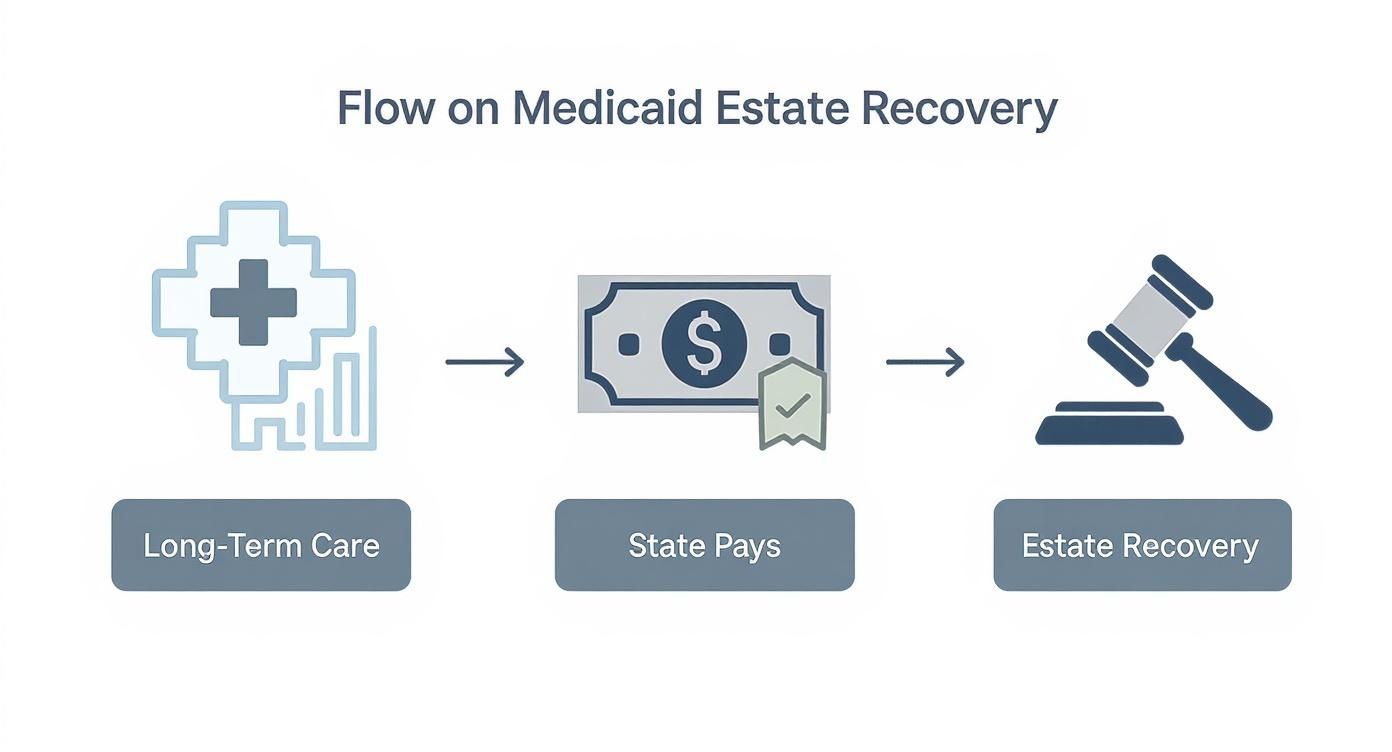
As you can see, recovery only happens after the state has paid for care. This underscores why it’s so critical to legally separate your assets from your estate before you ever need that care.
Key Consideration: The Five-Year Look-Back Period
The most critical piece of the puzzle when considering a MAPT is the five-year look-back period. This is a Medicaid rule designed to prevent individuals from simply giving away all their assets right before applying for benefits.
Any non-exempt assets transferred into the trust within five years of applying for Medicaid can trigger a penalty period, delaying your eligibility for benefits. This means creating and funding a MAPT is a strategy that demands foresight. It must be done well in advance of needing long-term care.
While a MAPT offers powerful protection, it's not the only specialized trust. For a deeper dive into another tool used to protect a primary residence, you might want to learn more about a Qualified Personal Residence Trust in our detailed guide.
Deciding between a Lady Bird Deed and a MAPT depends on your unique financial situation, family dynamics, and timeline. Both are powerful tools, but choosing the correct one requires careful consideration and professional legal advice from a Texas estate planning attorney to ensure your legacy is truly secure.
Using Irrevocable Trusts for Maximum Protection
When it comes to creating a firewall between your assets and MERP, an Irrevocable Trust is often the strongest available tool. For Texas families seeking the highest level of protection, a specific type known as the Medicaid Asset Protection Trust (MAPT) is a powerful legal strategy designed to shield your legacy from high long-term care costs and future recovery claims.

Here's how it works: When you move assets—like your home or investment accounts—into a MAPT, you are formally relinquishing direct ownership and control. This is not a mere technicality; it is the core of the strategy. From Medicaid's perspective, assets held inside a correctly drafted irrevocable trust no longer belong to you. This change in ownership places them safely beyond the grasp of the Medicaid Estate Recovery Program.
The Critical Five-Year Look-Back Rule
However, there’s a crucial timing element. Medicaid enforces a strict five-year look-back period to prevent applicants from giving away their assets right before applying for benefits. Any non-exempt assets you transfer into the trust within the five years preceding your Medicaid application can trigger a penalty period that delays your eligibility.
This rule is precisely why planning ahead is non-negotiable. An irrevocable trust is not a last-minute solution. It is a proactive, forward-thinking strategy that must be implemented well before you anticipate needing long-term care.
Real-World Scenario: The Impact of Timing
Let’s compare two families to see how this plays out. The Jacksons meet with a Texas trust administration lawyer and move their home and savings into a MAPT six years before Mr. Jackson needs to enter a nursing home. Because the transfer occurred outside the look-back window, those assets are completely protected, and he qualifies for Medicaid without issue.
Now, consider the Smiths. They wait until Mrs. Smith has a sudden health crisis and rush to transfer her house into a trust just two years before applying for Medicaid. That transfer falls squarely within the look-back period, resulting in a significant penalty. They are forced to pay for her care out-of-pocket for a long, financially devastating period.
Choosing and Guiding Your Trustee
Setting up the trust is only the first step; selecting the right person to manage it is equally important. When you create an irrevocable trust, you must name a trustee—the person or institution responsible for managing the trust’s assets according to the rules you’ve established.
Under the Texas Trust Code, a trustee has serious legal obligations known as fiduciary duties. This is the highest standard of care recognized by law, demanding absolute loyalty and good faith.
Key fiduciary duties in Texas include:
- Duty of Loyalty: The trustee must act solely in the best interests of the trust’s beneficiaries, avoiding all self-dealing or conflicts of interest.
- Duty of Prudence: They must manage the trust’s property as a reasonably prudent person would, which involves making sound investments and protecting the assets from loss.
- Duty to Account: The trustee is required to keep meticulous records of all transactions and provide regular accountings to the beneficiaries.
Choosing your trustee requires careful thought. Whether it’s an adult child, a trusted friend, or a professional corporate trustee, this individual must be responsible, financially competent, and able to navigate complex family dynamics impartially. While your trust document is their instruction manual, their personal integrity is what truly brings your wishes to life. It’s also worth noting that these trusts can offer other advantages; understanding the full range of irrevocable trust tax benefits is a key part of the planning conversation.
Ultimately, a MAPT offers a formidable defense against Medicaid estate recovery, but its success depends on early action and a firm grasp of Texas trust law. Partnering with a skilled Texas estate planning attorney is essential to ensure the trust is drafted correctly, funded properly, and managed in full compliance with the law, giving your family the peace of mind you deserve.
Understanding MERP Exemptions and Hardship Waivers
Receiving a notice from the Medicaid Estate Recovery Program (MERP) after a loved one passes away can be a shock, especially if prior planning wasn't possible. It can feel like a final, unchangeable demand, but that is not always the case.
Protections exist. Texas law includes specific exemptions and waivers designed to shield vulnerable families from losing critical assets like the family home.
Even without a pre-existing trust or special deed, MERP does not automatically win. The state is prohibited from pursuing recovery in certain situations. These are not loopholes; they are deliberate safeguards designed to protect families.
Automatic Protections: MERP Exemptions
In Texas, a few key situations act as an automatic stop sign for MERP. If any of the following apply, the state must cease its recovery efforts immediately.
The estate is automatically protected if:
- There is a surviving spouse. The state cannot pursue the estate as long as the deceased person's spouse is still living.
- There is a surviving child under 21 years of age. This protects minor children who are still financially dependent.
- There is a surviving child of any age who is blind or permanently and totally disabled. The law recognizes that a disabled heir has ongoing needs that the estate may need to support.
These exemptions are rooted in the Texas Estates Code and are designed to prevent surviving family members from being pushed into poverty. If you receive a MERP notice and one of these situations applies to your family, you must inform the state's recovery contractor immediately.
When Recovery Causes More Harm: Applying for an Undue Hardship Waiver
What if your situation doesn’t fit into one of those automatic exemptions? You still have a powerful tool available: the undue hardship waiver.
This is a formal request to the state, asking them to forgive the claim because seizing the property would create an unfair and significant burden on the heirs. The responsibility falls on the heirs to prove the extent of that hardship. While every case is unique, the state is often willing to consider a waiver if you can show that the property meets certain criteria.
A common foundation for a hardship claim is demonstrating that the estate property is the only thing producing income for the heirs, and losing it would force them to seek public assistance themselves.
For instance, if an heir lives in the home and their income is below a certain threshold, or if the property is a family farm that provides the family's sole livelihood, you can build a very strong case. National discussions around estate recovery often highlight how these policies can disproportionately affect families with modest means. For this reason, many states have created clear protections for lower-income heirs, and the hardship waiver process embodies that principle. You can learn more about strategies states use to mitigate harm from organizations that track these policies.
A Real-Life Example: The Jones Siblings' Success
A case that illustrates this perfectly involved the Jones siblings. They lost their mother after she had received Medicaid benefits to pay for her nursing home. She left them the modest family home she had lived in for 40 years.
Neither sibling earned much money, and one of them was living in the home as their primary residence. When the MERP notice arrived demanding repayment from the value of the house, they were terrified they’d be forced to sell it.
We worked with them to file a hardship waiver. We gathered their financial statements, proof of residency for one sibling, and documents showing their limited income. The application clearly demonstrated that seizing the home would leave one sibling homeless and push both into severe financial distress.
After reviewing the evidence, the state agreed that forcing recovery would create an undue hardship. They waived their entire claim, and the Jones family was able to keep their home.
Facing a MERP claim without a plan is daunting, but it is far from a hopeless situation. Understanding these exemptions and the waiver process can provide the critical line of defense needed to protect your family's legacy.
Common Mistakes and Misconceptions About MERP
Navigating the world of Medicaid can feel like walking through a legal minefield. Too often, well-meaning families make devastating mistakes based on "advice" from a neighbor or outdated information found online. These errors can lead to irreversible financial damage.
Let's address these myths head-on. The goal of any solid asset protection strategy is to safeguard your property from creditors, including the state. However, one misstep can unravel a lifetime of hard work. It is crucial to dispel the most dangerous misconceptions.

Myth 1: "I Can Just Give My House to My Kids"
This is perhaps the most common—and most damaging—misconception. Many people believe they can simply sign their house over to their children to protect it just before they need Medicaid. In reality, this is a direct violation of Medicaid’s five-year look-back rule.
Medicaid will scrutinize every asset transfer made in the 60 months prior to your application. Gifting a major asset like a home during that window triggers a severe penalty. You will be declared ineligible for benefits for a period of time calculated based on the home's value, often forcing your family to pay for nursing care out-of-pocket and depleting the very legacy you were trying to protect.
Cautionary Tale: A Costly Gift
A client once came to our office in a panic. His mother, Martha, had transferred her home to him three years before she needed nursing home care. Believing they had done the right thing, they applied for Medicaid. The transfer was immediately flagged. Martha was penalized with a multi-year ineligibility period, and the family had to drain their own savings to cover the astronomical costs of her care.
Myth 2: "Jointly Owned Property Is Automatically Safe"
This is another popular but flawed strategy. Many people think that adding a child’s name to the deed of their house or a bank account is enough to protect it. While joint ownership with rights of survivorship can help an asset avoid probate, it is a risky gamble for Medicaid planning.
This assumption is dangerous for several reasons:
- Exposure to Your Child's Creditors: The moment you add your child's name to your deed, your home becomes partially theirs. This means it is vulnerable if they get into financial trouble, go through a divorce, face a lawsuit, or declare bankruptcy.
- Loss of Control: You no longer have the sole authority to make decisions about your property. You cannot sell it or take out a mortgage without their signature.
- Unintended Tax Consequences: This "gift" of partial ownership can create significant capital gains tax problems for your child when they eventually sell the property.
While MERP primarily targets the probate estate, Medicaid can still view the act of adding a joint owner as a gift, which could trigger look-back penalties. Relying on joint ownership is a weak strategy that often creates more problems than it solves.
Myth 3: "I Don't Have Enough to Worry About MERP"
Some believe that estate recovery is a problem only for the wealthy. Nothing could be further from the truth. In fact, MERP often hits families with modest estates the hardest—families for whom the home is the only significant asset they have.
The state is persistent. In fiscal year 2019 alone, Medicaid programs across the country collected about $733.4 million from the estates of deceased recipients. While that is a fraction of total long-term care spending, it proves these are not empty threats. You can discover more insights about Medicaid estate recovery data directly from the source.
The key takeaway is that the tangled web of Texas estate law and federal Medicaid rules is no place for do-it-yourself planning. The risks of getting it wrong are simply too high. Working with a qualified Texas estate planning attorney is not a luxury—it is the only way to ensure your protection plan is legally sound and truly works for your family's unique situation.
Answering Your Lingering Questions About Texas Medicaid Estate Recovery
Navigating the Texas Medicaid Estate Recovery Program (MERP) can feel like solving a complex puzzle. It is natural to have questions. Here, we clarify some of the most common points of confusion to give you the confidence to move forward.
What’s the Difference Between Medicaid Eligibility and MERP?
This distinction is critical, as confusing the two can lead to costly planning errors.
Think of it this way: Medicaid eligibility is the process of getting in the door. It involves the strict income and asset tests a person must pass to qualify for benefits. This is where the five-year look-back period is a major factor during the application process.
MERP, on the other hand, is what happens after a Medicaid recipient passes away. It is the state's process for seeking reimbursement for the funds it paid for care. The key to remember is that recovery is limited to assets left in the deceased's probate estate. A comprehensive plan must address both the "front door" (eligibility) and the "back door" (MERP).
Does MERP Target All Medicaid Services?
No, the state does not attempt to recover every dollar it spends. MERP is specifically authorized to recover costs for long-term services and supports.
In Texas, this primarily includes:
- Care received in a nursing facility
- Services from a Home and Community-Based Services (HCBS) waiver program
- Hospital stays and prescription drugs related to those periods of long-term care
Benefits from other programs, such as the Medicare Savings Program that helps with Medicare premiums, are not subject to estate recovery.
Can the State Put a Lien on My Home While I’m Still Alive?
This is a common fear, but in almost all situations, the answer is no. Texas law prevents the state from placing a lien on your property for Medicaid expenses while you are living.
There are a few rare exceptions, such as if it's proven you are permanently institutionalized with no intent to return home, but these are not the norm. Recovery efforts almost always begin after the recipient's death. This is why tools like the Lady Bird Deed are so powerful—they transfer the home at the exact moment of death, keeping it out of the probate estate and away from MERP's reach.
Can I Just Sell My House to My Kids for a Dollar?
While it may seem like a simple solution, this is a classic misstep that can cause significant problems. Selling your home to a family member for a price below its fair market value is treated as a gift by Medicaid. The difference between what your children paid and the home's actual worth is considered a "transfer for less than fair value."
If you make this type of transfer within the five-year look-back period, it will trigger a significant penalty. This penalty will make you ineligible for Medicaid benefits for a calculated period, leaving you to pay for expensive care out of pocket. It is a strategy that almost always creates more problems than it solves.
For a wider perspective on topics relevant to seniors and their families, you might explore other top elderly care blogs. These resources can offer additional context on the many aspects of planning for long-term care. Ultimately, working with a skilled Texas estate planning attorney is the only way to ensure your strategy is sound, legal, and tailored to your family's unique situation.
If you’re managing a trust or planning your estate, contact The Law Office of Bryan Fagan, PLLC for a free consultation. Our attorneys provide trusted, Texas-based guidance for every step of the process at https://texastrustadministration.com.