Skip to content
When a loved one can no longer make decisions for themselves, stepping into the Texas legal system can feel overwhelming. You're faced with complex legal terms like "conservator" and "guardian" during an already emotional time. The good news is that with the right legal guidance, it doesn’t have to be.
In Texas, the law makes a clear distinction between these roles. A guardian (officially a Guardian of the Person) is appointed by a court to handle personal and healthcare decisions for an incapacitated person, known as the "ward." Think of them as the protector of the person. On the other hand, a conservator (known in Texas as a Guardian of the Estate) is appointed to manage the ward's financial life—their property, assets, and investments.
Understanding the difference is the first critical step in protecting your family member's well-being and legacy.
Defining the Core Roles in Texas Law
When someone loses the capacity to manage their own affairs due to illness, injury, or age, Texas law provides a framework to protect them. These court-appointed roles are not one-size-fits-all; they are specifically designed to address two very different parts of a person's life: their personal welfare and their financial stability.
The Texas Estates Code draws a clear line between the duties of each role. A guardian’s authority is centered on personal well-being, while a conservator's power is strictly financial. While it is possible for one person to serve in both capacities, the court treats the responsibilities as legally distinct to ensure a clear line of accountability for every decision made on the ward's behalf. This separation is a cornerstone of fiduciary principles in Texas.
This infographic breaks down the separate responsibilities in a straightforward way.
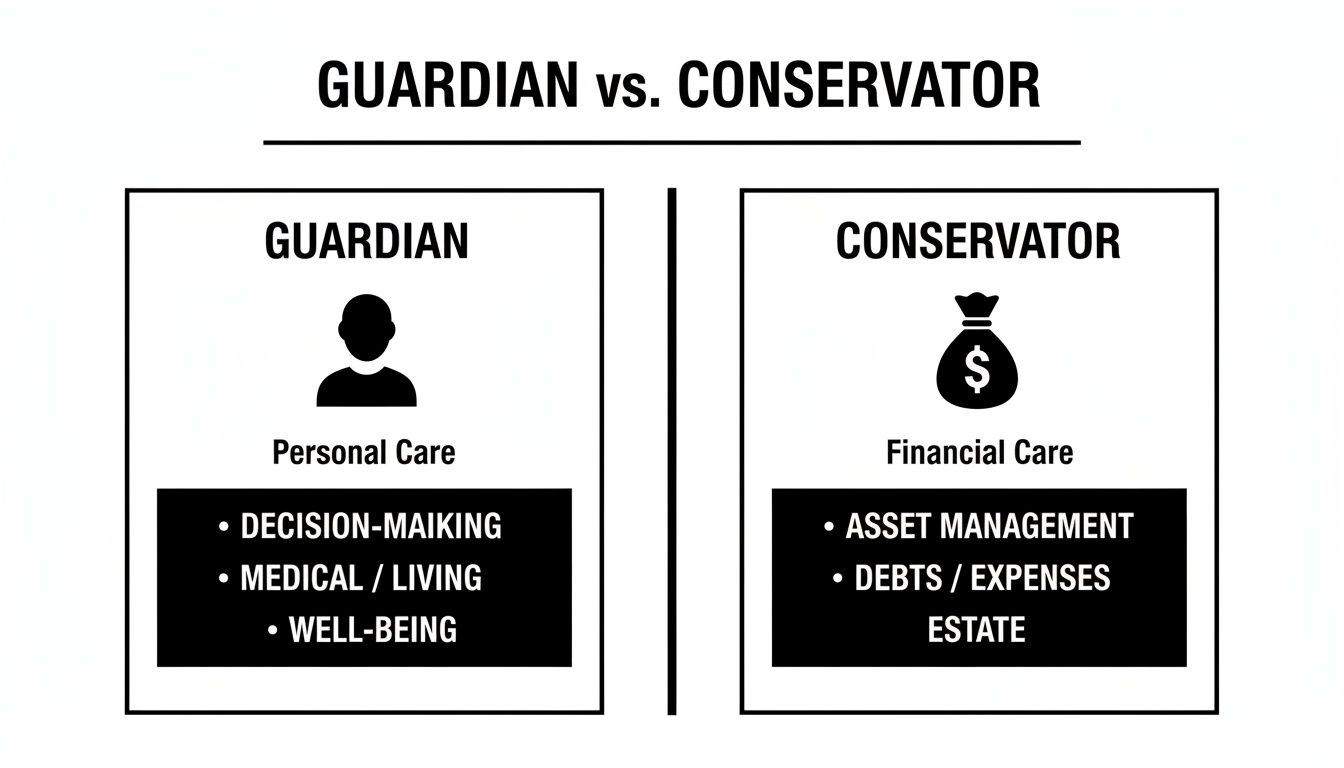
As you can see, the roles are cleanly divided between personal care and financial management. This separation creates a natural system of checks and balances to protect the ward from all angles.
At a Glance: Key Distinctions in Texas Law
To make it even clearer, let’s put the primary functions side-by-side. It’s also important to remember that these court-appointed roles are very different from the powers you might grant in your own estate planning documents. You can learn more about that in our guide on the difference between power of attorney and guardianship.
This table sums up the core differences you need to know.
| Area of Responsibility | Guardian of the Person | Guardian of the Estate (Conservator) |
|---|---|---|
| Primary Focus | Personal well-being, healthcare decisions, and daily living arrangements. | Financial matters, including property, bank accounts, assets, and investments. |
| Key Decisions | Consenting to medical treatments, choosing where the ward lives, and managing care. | Paying bills, managing bank accounts, filing tax returns, and protecting property. |
| Legal Authority | Comes from the court to make non-financial, personal life decisions for the ward. | Comes from the court to make all financial decisions and manage the ward's estate. |
| Governing Law | Primarily governed by the Texas Estates Code, with a focus on the ward's welfare. | Also governed by the Texas Estates Code, but with a strict focus on fiduciary duties. |
Ultimately, one role is about the person's health and safety, while the other is about protecting their life's savings and property. Both are vital, but they operate in completely different spheres.
The Guardian's Role: Protecting Personal Well-Being
When a Texas court appoints a Guardian of the Person, it entrusts them with a profound responsibility: caring for a loved one’s physical and personal welfare. This role isn't about managing money or property. It’s about the human side of care, making sure the person—legally called the "ward"—is safe, healthy, and living with dignity.
Essentially, the guardian steps into the ward's shoes to make the critical life decisions they can no longer handle themselves. This authority, granted under the Texas Estates Code, is a mix of compassionate duty and legally defined power, demanding a deep commitment to the ward's best interests.

Core Duties of a Guardian of the Person
A guardian's job revolves around the ward's day-to-day well-being. These duties aren't a simple checklist; they require constant, careful attention as the ward’s needs and preferences evolve.
Here are the key responsibilities:
- Medical and Healthcare Decisions: The guardian has the legal authority to approve medical treatments, select doctors, and make crucial decisions about surgeries, medications, and even end-of-life care, unless the court has set specific limits.
- Living Arrangements: A guardian decides where the ward lives. This could mean hiring in-home caregivers, finding the right assisted living community, or choosing a nursing home that offers the necessary level of support.
- Daily Care and Supervision: This is the practical side of care—making sure the ward has proper food, clothing, and a safe place to live. The guardian also manages any caregivers and ensures the ward's personal and social needs are met.
- Psychological and Social Well-being: It's not just about physical health. A guardian must also look out for the ward’s emotional and mental state, arranging for therapy, social outings, or other activities that boost their quality of life.
This role is absolutely critical because people under guardianship can easily become isolated. In fact, research shows that individuals under guardianship are 50% more likely to lack community connections, which makes the guardian's job of fostering social engagement even more important. You can discover more insights about these findings on PMC.
A Real-World Scenario in Texas
Let’s picture a situation here in Texas. Sarah, a Houston resident, is worried about her elderly mother, Mary, who has advancing dementia. Mary has started wandering away from home, forgetting to take her critical heart medication, and can no longer cook or clean for herself safely. Sarah has tried to help, but Mary refuses to accept assistance or move from her home.
This is where Sarah might petition a Texas court for guardianship. If the court appoints Sarah as Guardian of the Person after a thorough legal process, she would then have the legal power to provide step-by-step guidance for Mary's care:
- Arrange for 24-hour in-home care to keep Mary safe and ensure she gets her medication on time.
- Consent to a new medication plan from Mary's neurologist to help manage her dementia symptoms.
- Eventually, make the difficult decision to move Mary into a memory care facility when her needs become too great for in-home care.
Every one of these actions falls squarely within a guardian's duty to protect Mary's personal well-being.
A Guiding Principle: The Least Restrictive Alternative
The Texas Estates Code requires a guardian to always follow the principle of the "least restrictive alternative." This means the guardian must encourage the ward to participate in decisions and act for themselves as much as possible. The goal is to protect the ward while preserving their independence and autonomy to the greatest extent possible.
This principle keeps guardianship from becoming an all-or-nothing power grab. If a ward can still make certain choices, like what to wear or what to have for lunch, the guardian should honor that ability. It’s a compassionate approach that respects the person's dignity. Balancing this legal authority with empathy is a delicate act, which is why getting professional legal advice from a guardianship attorney can be invaluable.
The Conservator's Role: Safeguarding Financial Assets
While a guardian protects the person, a conservator—known in Texas as the Guardian of the Estate—is appointed by the court to protect their financial legacy. This role is a significant fiduciary responsibility, demanding meticulous management of a ward’s assets, property, and financial obligations, all under the strict supervision of the Texas court system.
This isn't just about paying a few bills. The Guardian of the Estate steps into a complex role, becoming the legal steward of everything the ward has worked for their entire life. Their actions are governed by the Texas Estates Code and require a high level of financial diligence and ethical responsibility, reflecting the core of fiduciary duties in Texas.

Core Duties of a Guardian of the Estate
The responsibilities are comprehensive and require careful, organized management. A Guardian of the Estate must act solely in the ward's best financial interests, preserving and protecting the estate from loss or mismanagement.
Key fiduciary duties include:
- Creating a Detailed Inventory: Within 30 days of being appointed, the guardian has to file a sworn inventory of all the ward's property with the court. This includes real estate, bank accounts, stocks, vehicles, and personal belongings.
- Managing Assets and Investments: This involves safeguarding property from neglect, managing investment portfolios, and making prudent financial decisions to preserve the estate's value.
- Handling Income and Expenses: The guardian is responsible for collecting all incoming money, like Social Security benefits or investment dividends, and then using those funds to pay the ward's bills and expenses.
- Filing Taxes: They must file annual federal income tax returns for the ward, ensuring every legal tax obligation is met on time.
- Providing Annual Accountings: The guardian must submit a detailed annual accounting to the court, documenting every single transaction—every dollar in and every dollar out.
The difference between a conservator and guardian really boils down to this: one handles the money, the other handles the person. While guardians make decisions about medical care and housing, the Guardian of the Estate is laser-focused on the ward's assets, from tracking property values to submitting incredibly detailed annual reports.
A Real-World Texas Scenario
Let’s imagine a successful business owner from The Woodlands who suffers a traumatic brain injury in a car wreck. He’s left incapacitated and unable to run his company, manage his extensive investment portfolio, or even pay his own mortgage. His family is completely overwhelmed, and his business is on the brink of collapse.
In this situation, his wife could petition a Texas court to be appointed as the Guardian of his Estate. Once the court approves, her practical advice and duties would immediately include:
- Making payroll and managing the day-to-day finances of his business to keep it afloat.
- Working with a financial advisor to oversee his complicated investment accounts.
- Paying his household bills, property taxes, and mounting medical expenses from his existing assets.
- Filing a detailed annual report with the court showing exactly how she managed every penny of his funds.
These actions require more than just good intentions; they demand a solid understanding of financial management and legal compliance.
The Weight of Fiduciary Duty and Court Oversight
In Texas, a Guardian of the Estate is a fiduciary held to the highest legal standard. Every financial decision is subject to court scrutiny. Mismanaging funds, even unintentionally, can lead to serious legal consequences, including being ordered to repay the estate from personal funds and potential removal from the role.
This strict court oversight is there for a reason: to protect the ward from financial exploitation or simple neglect. Because the stakes are so incredibly high, keeping meticulous records isn't just a good idea—it's a legal requirement. These financial reports share many principles with formal trust accounting, which demands absolute transparency and accuracy. For anyone taking on these complex financial duties, understanding what is involved in trust accounting can offer valuable insight into the level of detail the court expects.
The role of a Guardian of the Estate is absolutely crucial for protecting a vulnerable person's financial security. It's a demanding position that mixes financial know-how with a deep sense of responsibility, all performed under the watchful eye of the Texas courts.
Navigating the Texas Appointment Process
Securing a guardianship or conservatorship in Texas isn't a casual family agreement; it's a formal court proceeding designed to protect a potentially vulnerable person. Knowing the path forward can make a deeply stressful time feel much more manageable. Here is some step-by-step guidance on what to expect.
The journey begins when a concerned person, usually a family member, files an Application for Appointment of Guardian with the appropriate Texas court. This document explains why they believe the individual (the "proposed ward") can no longer manage their personal or financial affairs. This filing officially asks the court to intervene.
Once the application is filed, the case moves into a crucial evidence-gathering phase. This is how the court obtains the information it needs to make a life-altering decision.
The Certificate of Medical Examination
One of the most critical pieces of evidence is the Certificate of Medical Examination (CME). Under the Texas Estates Code, this form must be completed by a physician who has examined the proposed ward within the last 120 days.
The CME provides the court with a clear, professional opinion on:
- The exact nature and severity of the person's incapacity.
- Their ability to handle daily tasks and make sound decisions.
- Whether the condition is likely temporary or permanent.
Without a current and detailed CME, the court is unlikely to move forward with appointing a guardian.
Protecting the Ward’s Rights
To ensure the proposed ward's rights are protected, the court takes two important steps. First, it assigns a court investigator to meet with the proposed ward, explain the process in plain English, and assess their situation. This provides the judge with an impartial, third-party report on the person's living conditions and desires.
Second, the court appoints an attorney ad litem. This is an independent lawyer whose only client is the proposed ward. Their job is to fiercely advocate for the ward's best interests and wishes. The ad litem will interview everyone involved—the proposed ward, family, and doctors—to present a complete picture to the judge.
A key part of the attorney ad litem’s role is ensuring the proposed ward’s voice is heard. They will always argue for the "least restrictive alternative." For example, if someone only needs help with finances, the ad litem will push for just a Guardian of the Estate, leaving their personal freedoms intact.
The Court Hearing and Final Decision
Everything culminates in a court hearing where a judge reviews all the evidence. This includes the CME, the investigator's report, and testimony from the applicant, the proposed ward (if they can attend), and the attorney ad litem. The judge must find by clear and convincing evidence that the person is incapacitated and that a guardianship is the necessary solution.
The evidence presented directly shapes what kind of appointment is made.
- For a Guardian of the Person: The judge needs to see proof that the person cannot provide for their own food, clothing, shelter, or medical needs.
- For a Guardian of the Estate (conservator): The focus shifts to proving they cannot manage their finances or protect their assets from fraud.
Navigating these court requirements demands precision and a deep understanding of Texas law. Having an experienced guardianship attorney to guide you through each step can provide the confidence and clarity you need.
When One Person Wears Both Hats
In many Texas guardianship cases, it makes sense for a court to appoint one trusted individual to be both Guardian of the Person and Guardian of the Estate. This often happens when a spouse cares for their incapacitated partner or an adult child steps in to manage all aspects of an aging parent's life. The court’s guiding principle is always the ward’s best interest, and sometimes, a single fiduciary is the most efficient and compassionate solution.
This unified appointment can streamline decision-making, as one person has a complete view of the ward’s needs and their financial reality. However, it also creates a delicate balancing act. Even though one person holds them, the two roles remain legally separate under the Texas Estates Code, each with its own set of duties. The appointee must be prepared to wear two different hats and justify their decisions from two different perspectives.
Navigating Potential Conflicts of Interest
The biggest challenge in a joint appointment is managing the inherent tension between personal care choices and financial responsibilities. What feels best for the ward’s comfort might not align with the strict duty to preserve the estate’s assets for the long term.
Consider this common real-world scenario:
- As Guardian of the Person, you believe your mother would be happiest and receive the best care in her own home with around-the-clock skilled nurses. This choice prioritizes her emotional well-being.
- But as Guardian of the Estate, you must face the financial reality. That premium in-home care costs $15,000 per month, which could deplete her life savings much faster than a more affordable, yet still high-quality, memory care facility.
This is a classic conflict. The duty to ensure personal well-being pushes you toward the expensive option, while the fiduciary duty to prudently manage the estate urges caution. A guardian wearing both hats must meticulously document their decision-making process, proving to the court they weighed all options and chose a path that reasonably balanced both duties.
When a Joint Appointment Is Challenged
Courts do not grant these powers lightly, and a joint appointment can be denied if it is more restrictive than necessary. The guiding principle is always the "least restrictive alternative." Someone might need help with their daily care but still be perfectly capable of managing their own money.
A powerful real-world case involved an 85-year-old veteran whose family sought a joint guardianship. However, evidence, including cognitive tests showing he still had average scores, proved he was fully capable of handling his own finances. The court correctly limited the guardianship to his person, protecting his financial independence.
This is exactly why understanding the difference between conservator and guardian is so crucial for families. Appointing the correct role based on proven need—not just convenience—prevents legal overreach and honors the ward's remaining autonomy. This is a key element of dispute resolution in estate matters.
Respecting this distinction is vital for staying on the right side of Texas law. For fiduciaries and families in The Woodlands or Austin, our firm, a trusted Texas trust administration lawyer, offers free consultations to bring clarity to these roles. We help you avoid the devastating outcomes seen in cases of guardianship abuse. Learn more about the findings in a recent public guardianship report.
Proactive Alternatives to Court Intervention
The most effective way to address potential future incapacity is to plan for it before it becomes an issue. Proactive estate planning can help you and your family avoid a public, expensive, and stressful court process altogether. By putting the right legal tools in place now, you can designate trusted individuals to make decisions for you later, ensuring your wishes are followed without a judge ever needing to get involved.
This forward-thinking approach keeps control where it belongs: with you and your family.

Powers of Attorney: The First Line of Defense
Powers of Attorney are a cornerstone of any solid estate plan. These documents give legal authority to a person you choose—your "agent"—to act on your behalf. When planning for incapacity in Texas, two types are absolutely critical.
- Durable Power of Attorney: This document authorizes your agent to manage your financial life—paying bills, handling bank accounts, managing investments, and dealing with real estate. The word "durable" is crucial; it means the document remains effective even if you become incapacitated.
- Medical Power of Attorney: This document empowers your agent to make healthcare decisions for you if you are unable to. This includes consenting to treatments, choosing doctors, and accessing your medical records.
Putting these documents in place can completely eliminate the need for a court to appoint a Guardian of the Person or Guardian of the Estate. To see how these can be particularly helpful, check out our guide on setting up a power of attorney for aging parents.
Revocable Living Trusts for Seamless Asset Management
Another powerful tool for avoiding court intervention is a Revocable Living Trust. This involves creating a trust and transferring your assets—like your home, investments, and bank accounts—into it. You typically serve as the initial trustee, managing everything for your own benefit as you do now.
The real benefit of a living trust becomes clear if you become incapacitated. Your trust document will name a successor trustee who automatically steps in to manage the trust's assets if you're no longer able to.
A Revocable Living Trust provides a private and seamless transition of control over your finances. Unlike a guardianship, which requires a public court proceeding, the successor trustee can begin managing your assets immediately and privately, according to the instructions you already laid out in the trust.
This setup ensures your financial life continues without interruption and without needing a judge to appoint a Guardian of the Estate. When you combine a living trust with durable and medical powers of attorney, you create a comprehensive plan that protects your independence, provides for your care, and keeps your family out of court. This is what effective asset protection and thoughtful estate planning are all about.
Answering Your Texas Guardianship Questions
As you navigate the responsibilities of a guardian or conservator, specific questions are bound to arise. Let's address some of the most common ones we hear from Texas families, providing clear, straightforward answers to help you better understand the legal landscape.
Can the Same Person Wear Both Hats as Guardian and Conservator?
Yes, this is quite common. In Texas, a court can appoint one person—often a dedicated spouse or adult child—to serve as both Guardian of the Person and Guardian of the Estate. (Remember, "Guardian of the Estate" is the Texas term for what other states call a conservator.) Having one person in charge can streamline decision-making.
However, the court's primary duty is to protect the ward. The judge will always consider what is in the ward’s best interest. If there is a potential conflict of interest, or if managing finances and personal care require two different skill sets, the court may appoint two separate individuals.
How Long Does a Guardianship Last?
A Texas guardianship should be viewed as a long-term commitment. It is designed for lasting protection and remains under court supervision indefinitely. The arrangement typically only ends when one of three things happens:
- The ward passes away.
- The ward legally regains their capacity (which is rare).
- The estate’s funds are depleted, and the court closes the case.
Throughout this period, the guardian has an ongoing legal duty to the court. This includes filing annual reports on the ward’s well-being and providing detailed accountings for every dollar that goes in or out of the estate.
What is the Difference Between a Conservator and a Trustee?
This is an excellent question that gets to the heart of estate planning. While both roles are fiduciaries tasked with managing assets, the source of their authority is completely different.
A conservator (or Guardian of the Estate) is appointed by a court. Their authority is granted by a judge, and they are directly accountable to that court. They must follow a strict set of rules outlined in the Texas Estates Code, including all reporting requirements.
By contrast, a trustee is named in a private document—a trust—created by an individual (the grantor). A trustee's power comes directly from the trust agreement, not a court order. This setup offers significantly more privacy, flexibility, and efficiency, often allowing you to avoid the public and cumbersome guardianship process entirely. A Texas estate planning attorney can provide practical advice on which path is right for your family.
Understanding this distinction is fundamental to smart estate planning and asset protection.
If you’re managing an estate or planning for your family’s future, contact The Law Office of Bryan Fagan, PLLC for a free consultation. Our attorneys provide trusted, Texas-based guidance for every step of the process.