Skip to content
Planning for the future after you are gone is a deeply personal process, but creating a Last Will and Testament is one of the most powerful and caring things you can do for your family in Texas. This isn't some complex legal document reserved for the wealthy; it's a fundamental tool for every adult to ensure their wishes are followed and their loved ones are protected.
Why a Texas Will Is Your First Line of Defense

A Last Will and Testament is the legal powerhouse that lets you dictate where your assets go, who you trust to manage your affairs as your executor, and—critically—who will raise your minor children. This is your voice after you are gone, providing clear instructions for your family and the courts.
If you pass away without a valid will, the State of Texas makes those decisions for you. The state's "intestate succession" laws, detailed in the Texas Estates Code, will determine how your property is divided. This rigid, one-size-fits-all formula rarely matches what you would have wanted, leaving your family's future to chance.
The Consequences of Not Having a Will
When the state intervenes, it can create significant emotional and financial turmoil for your family. The court follows a legal formula that knows nothing about your relationships, your promises, or your family's unique needs.
For example, consider a blended family. If you pass away without a will, your current spouse might be legally forced to split community property with children from a previous relationship. This could require selling the family home or other cherished assets just to satisfy the law—a heartbreaking scenario for a grieving family.
A properly executed will prevents this kind of chaos. It provides your executor and the courts with a clear, undeniable roadmap, drastically reducing the potential for family disputes during an already painful time.
A will ensures your intentions are heard and honored, preventing the state's impersonal laws from making critical decisions for your family.
Protecting Your Loved Ones with a Clear Plan
The hard truth is that most Texans have not taken this vital step. A recent 2025 Caring.com Wills and Estate Planning Study revealed that a shocking 76% of adults in Texas do not have a will. This leaves a vast majority of families and their estates exposed to the state's default inheritance rules.
Having a will in place offers so much more than just deciding who gets what:
- Appointing an Executor: You can handpick a person or institution you trust to carry out your wishes, rather than leaving the appointment to a court.
- Nominating Guardians: For parents of young children, this is arguably the most important function. You—and only you—get to decide who will raise your kids.
- Streamlining Probate: While a will does not avoid the probate process, a clear, well-drafted one can make it dramatically faster, less expensive, and less stressful for your family to navigate.
Ultimately, preparing a last will and testament form in Texas is about taking control. It provides peace of mind today and shields the people you love from uncertainty and legal headaches tomorrow. If you're still considering your options, our guide on the necessity of a will can offer more insight. It's the first and most important line of defense for your legacy.
Getting to Know Your Texas Will Form
A Texas last will and testament form can seem intimidating at first, filled with legal terms and specific sections. However, once you understand the purpose of each part, the document becomes a clear and manageable blueprint for your legacy. Every clause is a specific instruction for the person you choose to wrap up your affairs.
The document begins with a simple declaration. This is a straightforward statement where you identify yourself as the testator (the legal term for the person making the will), state that this document is your final will, and formally revoke any previous wills. This initial step is critical—it wipes the slate clean and directs the court to follow only these new instructions.
Choosing Your Executor (And a Trusty Backup)
One of your most important decisions is naming an executor. This is the person—or institution, like a bank's trust department—you entrust to see your will's instructions through to completion. Under the Texas Estates Code, an executor has serious fiduciary duties, meaning they are legally required to act in the absolute best interest of your estate and its beneficiaries.
Their responsibilities are extensive: they will gather your assets, pay your final debts and taxes, and distribute the remaining property to the people you've named. This role demands integrity, organization, and patience.
That is why you absolutely must name an alternate or successor executor.
- Here's a real-world scenario: Imagine you name your older sister as your executor. What happens if, when the time comes, she is dealing with her own health issues or has passed away? Without a named backup, the court must appoint an administrator—often a stranger who will manage your estate, which is likely not what you intended.
By selecting a successor, you maintain control and ensure someone you trust is always next in line.
Making Specific Gifts: The Devil is in the Details
After appointing your executor, you can make specific bequests—gifts of particular items or set amounts of cash to specific people or charities. Clarity here is crucial to prevent confusion or disputes among your loved ones.
For example, writing "I leave my grandmother's ring to my niece" is a recipe for conflict if you have three nieces or multiple rings from your grandmother.
A well-written bequest leaves no room for doubt. For example: "I give my 14-karat gold engagement ring with a one-carat round diamond, originally owned by my grandmother, Eleanor Smith, to my niece, Jane Doe, if she survives me."
This level of detail makes misinterpretation nearly impossible. The same principle applies to any asset, whether it's real estate, a vehicle, or a specific financial account. Your goal is to create an undeniable record of your intentions.
To help you understand the key sections, here is a breakdown of the essential clauses you will encounter.
Decoding Your Texas Will: Essential Clauses
| Clause | Purpose | Key Consideration |
|---|---|---|
| Declaration & Revocation | Identifies you as the testator and cancels all prior wills. | This is your opening statement. Ensure it clearly states this document is your last will to avoid old versions causing confusion. |
| Executor Appointment | Names the person or institution to manage your estate. | Always name a backup! This ensures your affairs are handled by someone you trust if your first choice can't serve. |
| Specific Bequests | Designates particular assets (like jewelry, art, or cash) to specific people. | Be incredibly detailed. Use descriptions, account numbers, and full names to eliminate any ambiguity. |
| Residuary Clause | Dictates who gets the "rest and residue" of your estate—everything not specifically gifted. | This is your safety net. Without it, leftover assets are divided by state law, not your wishes. |
| Guardianship Clause | (If you have minor children) Names the person you want to raise your kids. | This is arguably the most important clause for parents. Discuss this with your chosen guardian beforehand. |
| Self-Proving Affidavit | A separate statement signed by you and your witnesses before a notary. | While not part of the will itself, this makes probate faster and easier for your executor by "proving" the will's validity upfront. |
Getting familiar with these components turns a daunting task into a series of manageable decisions.
The Most Important Part: The Residuary Clause
So, what happens to everything else? Your home, primary bank accounts, investments, and personal property not specifically gifted away—all of this makes up your residuary estate.
The residuary clause may be the single most critical piece of your will. It’s the provision that says who gets everything left over. Think of it as a giant safety net that catches all assets not mentioned elsewhere. If you forget this clause, any property you didn't specifically name gets divided according to Texas intestacy laws, which defeats the purpose of making a will. You can learn more about the fundamentals of crafting your last testament in our detailed guide.
Many people leave their entire residuary estate to one person, like a spouse, or divide it equally among their children. If your situation is more complex—for instance, if you need to provide for a loved one with special needs—this clause can direct assets into a protective trust. Understanding these key pieces empowers you to complete your will with confidence, knowing it truly reflects your wishes for the future.
How to Properly Execute Your Will in Texas
Drafting a will is a major accomplishment, but the document has no legal authority until it is properly “executed.” This is a formal process with strict rules outlined in the Texas Estates Code. An error in execution can invalidate your entire will, undoing all your careful planning.
The core requirements may seem simple, but the details are critical. According to Texas Estates Code §251.051, a will must be:
- In writing: Verbal or recorded wishes are not legally binding. It must be a physical document.
- Signed by you (the testator): Or signed by another person on your behalf, in your presence, and under your direction.
- Attested by two credible witnesses: These witnesses must be at least 14 years old, cannot be beneficiaries in the will, and—most importantly—they must sign the will in your presence.
That phrase, "in your presence," is where many DIY wills fail. It means the witnesses must physically watch you sign, and you must watch them sign.
The Critical Role of Witnesses
Choosing the right witnesses is essential for a valid last will and testament form in Texas. They do not need to read the will or know its contents. Their sole purpose is to affirm that you signed it willingly and appeared to be of sound mind.
A common and costly mistake is asking a beneficiary to also serve as a witness. While convenient, Texas law is clear on this point. Although the will itself might remain valid, that beneficiary could be forced to forfeit their inheritance beyond what they would have received if you had died without a will. This rule exists to prevent any hint of coercion or undue influence.
A Real-World Scenario: A Small Mistake with Big Consequences
Let's imagine a man named Robert. He carefully drafts his will, leaving his classic car to his nephew and the rest of his estate to his two children. He signs it at his kitchen table. His two neighbors, both credible witnesses, wait in the living room. Robert then brings the already-signed will to them, and they add their signatures.
Years later, when Robert’s will is presented to the probate court, it is challenged. The problem? Because the witnesses did not actually see Robert sign the document, they did not technically sign "in his presence" as required by law. The court has no choice but to invalidate the will. As a result, Robert's estate is divided according to Texas intestacy laws, and his nephew never receives the car Robert wanted him to have.
This infographic breaks down the core pieces of a Texas will that a proper execution is meant to protect.
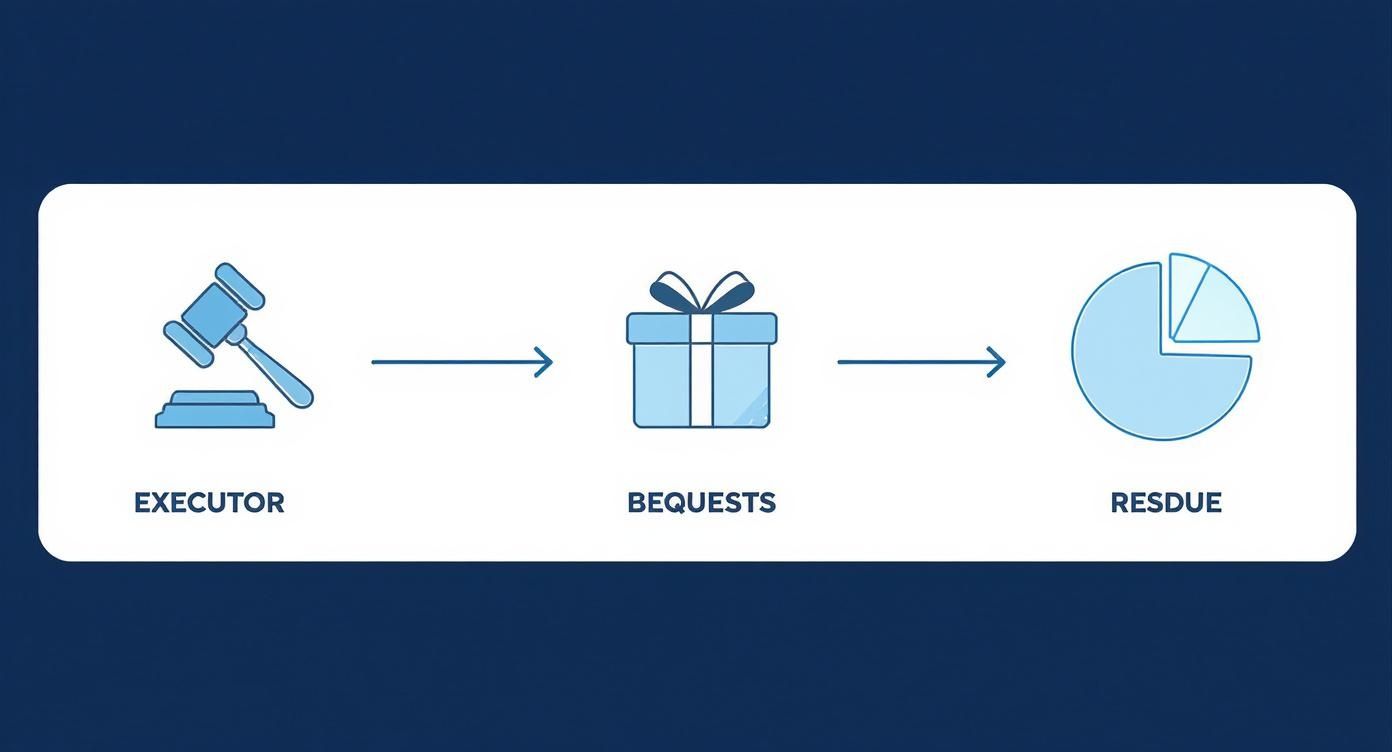
As you can see, the executor appointment, specific gifts, and the residuary clause all depend on the will being legally sound to ensure your wishes are carried out exactly as you planned.
Streamlining Probate with a Self-Proving Affidavit
Fortunately, Texas law provides an excellent tool to make the probate process easier for your loved ones: the self-proving affidavit. This is a separate statement attached to your will, signed by you and your witnesses in front of a notary public.
This affidavit acts as pre-validation of your will for the court. When the time comes, the court can accept the will without needing to locate the original witnesses to testify, saving your executor significant time, money, and stress.
The formal execution requirements in Texas are not mere technicalities; they are vital safeguards. A 2025 study revealed that roughly 15% of wills submitted for probate in Texas faced challenges due to execution errors like improper witnessing.
This is where an experienced Texas estate planning attorney provides immense value. We ensure every signature is correctly placed, witnessed, and notarized, giving your will the legal strength it needs to stand up in court and protect your legacy.
If you’re managing a trust or planning your estate, contact The Law Office of Bryan Fagan, PLLC for a free consultation. Our attorneys provide trusted, Texas-based guidance for every step of the process.
Common Mistakes People Make with DIY Will Forms
A downloadable last will and testament form for Texas can seem like a simple, cost-effective solution for your estate plan. However, this DIY approach often leads to serious legal and emotional challenges for the very family you intend to protect. These templates cannot ask clarifying questions or adapt to your unique family situation, which is where costly mistakes can occur.
One of the most frequent and damaging errors is ambiguous language. A generic form might prompt you to leave an asset "to my children," but what happens if one of your children passes away before you? Does their share go to their own children (your grandchildren), or is it divided among your surviving children? The Texas Estates Code has default rules for this, but they may not align with your wishes. Vague wording can easily lead to a legal battle among grieving relatives.
Forgetting About Certain Assets
Another significant pitfall is unintentionally creating a partial intestacy—a situation where your will doesn't cover all of your property. You might have carefully listed your house, car, and primary bank account, but what about an old savings bond, inherited mineral rights, or a surprise inheritance you receive after signing your will?
If your will lacks a strong residuary clause—a safety net that catches all unlisted assets—any property not specifically mentioned is distributed according to Texas state law, not your wishes. This can result in an unintended heir receiving a large portion of your estate, while your chosen beneficiaries are left with less than you planned.
One-Size-Fits-All Forms Don't Work for Complex Families
Generic will forms are particularly ill-equipped to handle modern family dynamics. They cannot provide the nuanced, personalized guidance needed for situations such as:
- Blended Families: How do you provide for your current spouse while also protecting the inheritance of children from a previous marriage? A simple template cannot effectively navigate these competing interests and requires careful planning.
- Beneficiaries with Special Needs: Leaving a direct inheritance to a loved one who relies on government benefits like Medicaid or SSI can disqualify them from that essential aid. A specialized tool, such as a special needs trust, is the proper way to provide for them without jeopardizing their eligibility.
- Disinheritance: If you intend to disinherit a child, Texas law requires clear, unmistakable language. Simply omitting their name is not enough. A court could interpret that as an accidental oversight, opening the door for a will contest.
A will isn't just a document; it's a precise legal instrument. Using a generic template for a unique family is like trying to use a map of Dallas to find your way around Houston—you're guaranteed to end up in the wrong place.
Many of these common errors can be reduced by leveraging legal document automation, which helps ensure consistency and cut down on simple slip-ups. But even the smartest software is no substitute for the strategic advice of an experienced Texas estate planning attorney who takes the time to understand your family’s story and your goals.
An attorney can spot potential conflicts, address complex assets, and ensure the duties of your fiduciary (your executor) are crystal clear. That professional guidance transforms a simple form into a powerful legal strategy, providing true asset protection and peace of mind for you and your loved ones.
Storing and Updating Your Texas Will

Once your will is signed, witnessed, and notarized, your work isn’t quite done. A perfectly drafted will is useless if your family cannot find it when they need it most.
Proper storage and regular reviews are the final, crucial steps in ensuring your wishes are carried out. Getting this right can make all the difference for your loved ones by smoothing out the probate process down the road.
Smart Storage Solutions for Your Will
Choosing where to keep your will is a balance between security and accessibility. The original document must be protected from disasters like fire or flood, but your executor must be able to retrieve it without unnecessary hurdles.
A safe deposit box at a bank offers excellent security, but it can be too secure. After you pass away, your executor may need a court order just to open the box, leading to frustrating delays.
A home fireproof safe is another option. It keeps the will accessible, but you must ensure your executor knows its location and has the combination. One of the best solutions is to leave the original with your Texas estate planning attorney. Law firms are equipped for secure document storage, and it gives your executor a clear starting point when it's time to begin the probate process.
The most important rule of storage is communication. No matter where you keep your will, your executor and at least one other trusted family member must know its exact location and how to access it. A lost will is the same as having no will at all.
Why Your Will is Not a "Set It and Forget It" Document
Think of your will as a snapshot of your life at the moment you signed it. But life is always changing, and your will should reflect that. Failing to update it after a major life event can lead to unintended outcomes and create confusion for your family.
It is wise to review your will every three to five years, or immediately after certain life changes. This proactive approach is a cornerstone of smart estate management. It ensures your will remains a true reflection of your intentions, which ultimately simplifies the process for those you leave behind. For a deeper dive, we offer more guidance on the importance of updating wills in Texas in another article.
Key Life Events That Should Trigger a Will Review
Certain life events should serve as an automatic trigger to review your will with your attorney. Staying current with these updates is key to ensuring your estate is handled correctly.
It's time for a review after:
- Marriage or Divorce: In Texas, a divorce automatically nullifies any provisions in your will that benefit your ex-spouse. A new marriage grants your new spouse certain rights to your property. Both events require a comprehensive update to your will.
- Birth or Adoption of a Child: This is a major life event. You will need to name a guardian for your new child and add them as a beneficiary in your estate plan.
- Death of a Beneficiary or Executor: If someone named in your will passes away, you must adjust your bequests and appoint a new executor or guardian to prevent serious complications during probate.
- Significant Financial Changes: A large inheritance, the sale of a business, or a major investment can alter the landscape of your estate and may require new tax planning strategies.
The Texas probate process operates on a strict timeline, including a four-year deadline to probate a will after a person's death. While about 80% of Texas cases are handled through a streamlined process called independent administration, an outdated or confusing will can bring everything to a halt. Regularly updating your will keeps it a clear, powerful tool for your executor.
Common Questions About Texas Wills
As you delve into the details of a Texas will, questions are bound to arise. This is completely normal. Here are some of the most common inquiries we receive from clients who are taking responsible steps to protect their families.
Can I Just Write My Will by Hand in Texas?
Yes, you can create what Texas law calls a “holographic” will. However, there is a critical requirement: the entire document must be written wholly in your own handwriting. No typed sections are permitted, not even the date.
While legally an option, we rarely recommend it. Holographic wills are notorious for ending up in court. Family members may dispute the handwriting, or the language used could be vague enough to spark a legal battle over your true intentions. These conflicts can be emotionally and financially draining for your loved ones.
To ensure your final wishes are crystal clear and to spare your family that stress, a formal, typed will that is properly witnessed is always the safer and more reliable choice.
What if I Want My Sister in Florida to Be My Executor?
Naming an out-of-state executor is permissible, but it adds procedural hurdles to the probate process in Texas. The Texas Estates Code requires that person to formally appoint a Texas resident to serve as a resident agent for legal notices related to the estate.
Beyond the legal paperwork, consider the practical challenges. Managing an estate from afar can be a significant burden, often requiring numerous flights for court hearings and creating logistical difficulties when dealing with local banks, real estate agents, and other professionals. It is often smoother to name a Texas resident or consider a professional corporate trustee.
Does Having a Will Let My Family Skip Probate in Texas?
This is one of the biggest misconceptions about wills. A will does not avoid probate; its primary function is to guide the probate process. Probate is the court-supervised procedure that validates your will, grants your executor the authority to act, and ensures your assets are distributed according to your instructions.
However, a well-drafted will, especially one with a self-proving affidavit, can make probate significantly faster, cheaper, and less stressful. It provides the court with a clear set of instructions, dramatically reducing the likelihood of disputes.
If your primary goal is to avoid probate entirely, you should explore other estate planning tools, such as a revocable living trust. A Texas estate planning attorney can help you determine if that is the right strategy for your situation.
How Much Is This Going to Cost? Is an Attorney Really Worth It?
The cost of an attorney-drafted will in Texas varies depending on the complexity of your circumstances. A simple will for an individual with a straightforward financial picture might cost a few hundred dollars. In contrast, a plan for a business owner, a member of a blended family, or someone with significant assets will require more detailed work, and the investment will reflect that.
While a DIY form may seem cheaper upfront, it is often a shortsighted view. The potential cost of resolving issues from a vague, incomplete, or legally flawed will can be astronomical. A will contest in court can easily drain tens of thousands of dollars from the estate—far more than the initial cost of professional legal advice.
At The Law Office of Bryan Fagan, PLLC, we begin with a free consultation to discuss your needs and goals. This allows you to get a clear understanding of the process and the investment required to create a solid, personalized plan that protects your legacy and provides true peace of mind.
If you’re managing a trust or planning your estate, contact The Law Office of Bryan Fagan, PLLC for a free consultation. Our attorneys provide trusted, Texas-based guidance for every step of the process. Schedule your consultation today.