Planning for the future can feel overwhelming, but understanding your options is the first step toward securing your family’s well-being. While Texas law does not legally require you to have a will, creating one is the only way to ensure your wishes are followed after you're gone. Without a will, you are effectively letting the state's rigid formulas make critical decisions for you, handing over control of your legacy.
The Consequences of Dying Without a Will in Texas

Thinking about what happens after you pass is a sensitive topic, but it’s one of the most important things you can do to protect your family. When someone in Texas dies without a valid will, they have died “intestate.” In that scenario, the Texas Estates Code lays out a strict, one-size-fits-all roadmap for dividing your property.
This process completely removes your personal wishes from the equation. The court won't know you wanted your nephew to get your classic car or that you planned to leave a portion of your savings to a dear friend. Instead, the law simply follows the family tree, deciding who gets what based purely on their legal relationship to you.
How State Control Can Disrupt Your Wishes
Dying intestate can trigger a cascade of unintended—and often painful—outcomes for the people you love. The state’s predetermined rules rarely match a family's unique dynamics or what you truly wanted to happen.
Here are just a few real-world scenarios that can arise:
- Your spouse might not inherit everything. It's a common myth that a surviving spouse automatically gets 100% of the assets. In Texas, this is often not the case, especially if you have children from a previous relationship.
- Unwanted co-ownership of property. Imagine your spouse suddenly co-owning your family home with your children. This can create a tangled mess of financial and emotional challenges, potentially forcing a sale of the property.
- The court manages your minor children’s inheritance. If you have young children, the court will appoint someone to control any assets they inherit. That person may not be who you would have trusted with such a critical responsibility, and the court's management can be costly and restrictive.
To give you a better sense of how things can diverge, here's a quick look at the two paths your estate could take.
Will vs. No Will in Texas: A Quick Comparison
| Scenario | With a Will (Testate) | Without a Will (Intestate) |
|---|---|---|
| Asset Distribution | You decide exactly who gets your property. | The Texas Estates Code dictates distribution based on kinship. |
| Executor of Estate | You choose a trusted executor to manage your final affairs. | The court appoints an administrator, who may be a stranger. |
| Minor Children's Guardian | You nominate a guardian you trust to care for your children. | The court decides who will be the guardian, without your input. |
| Process Control | You maintain control, minimizing potential family conflicts. | You have no control, often leading to family disputes and stress. |
As you can see, a will puts you in the driver's seat, while dying intestate means the state takes the wheel.
You're not alone if you've been putting this off. Statistics show that around 60% of adults in the United States don't have a will, leaving their families to sort through a complicated legal maze. This court-supervised process is called probate, and understanding the basics of probate in Texas is a crucial first step for any family dealing with an estate. For those facing the sale of a property, knowing the legal steps for selling a house in probate is another critical piece of the puzzle.
Taking Control of Your Legacy with a Texas Will
A will is more than just a legal document—it’s your final word on what matters most to you. It is your opportunity to provide clear instructions for your family, based on the framework of the Texas Estates Code. When people ask, "Do I really have to have a will?" the answer becomes clear once you understand the control it provides. You are swapping uncertainty for authority, ensuring your final wishes are respected.
Appointing a Trusted Executor
One of the most powerful actions you can take in your will is to name your executor. This is the person or institution you trust to manage your final affairs. This individual has a fiduciary duty to act in the best interest of your estate, from paying final bills to distributing assets to your named beneficiaries. Without a will, the court appoints an administrator who has no personal connection to you or your family.
By choosing your own executor, you place this responsibility in the hands of someone who understands your values and will handle your estate with the care it deserves. This single choice can prevent significant stress and potential conflicts for your loved ones.
Designating Guardians for Your Children
For parents of minor children, a will is absolutely essential. It is the primary legal tool you have to nominate a guardian—the person you want to raise your children if you are no longer able to. This is perhaps the single most important decision you will make in your estate plan.
Without your written nomination in a will, a judge must decide who receives custody. While the court will act in the best interest of the children, its choice may not align with who you would have trusted with their upbringing, well-being, and future.
Directing Your Asset Distribution
At its core, a will is your personal roadmap for distributing your property. It allows you to be as specific as you wish, ensuring your hard-earned assets and sentimental possessions go to the people and causes you care about.
A properly drafted will allows you to:
- Leave specific items to specific people, like ensuring your grandfather's watch goes to your oldest son.
- Provide for a partner to whom you are not legally married, ensuring they are not unintentionally left out.
- Donate to a charity or other organization that is important to you.
- Disinherit someone, if that is your clear and firm intention.
These are deeply personal choices that only you can make. A Texas estate planning attorney can help you create a will that is legally sound, leaves no room for ambiguity, and provides clarity and peace of mind for everyone involved.
Understanding Texas Intestacy and Property Division
When you pass away without a will, you hand control of your assets over to the State of Texas. The government does not guess what you might have wanted. Instead, it follows a rigid, predetermined set of rules known as intestacy laws to divide your property.
This legal framework, outlined in the Texas Estates Code, is a default solution that rarely reflects a family's unique circumstances or emotional bonds. It operates strictly on legal definitions of kinship, which can lead to surprising and often undesirable outcomes.
The Critical Difference Between Property Types
To understand how intestacy works, you must first know how Texas law categorizes your assets. Everything you own is sorted into two distinct types, and this distinction dramatically impacts who inherits what.
- Community Property: This generally includes all property acquired by you and your spouse during your marriage. Examples include the family home, joint bank accounts, and shared investments. Under the law, it belongs to the marital "community."
- Separate Property: This category includes anything you owned before you were married. It also covers assets you received during the marriage as a gift or inheritance specifically intended for you alone.
Without a will, the court’s first task is to classify your estate into these two categories. Only then does it apply the rigid intestacy formula, which often creates complicated co-ownership situations that most people would never choose.
This infographic helps illustrate the choice you are making about your legacy.
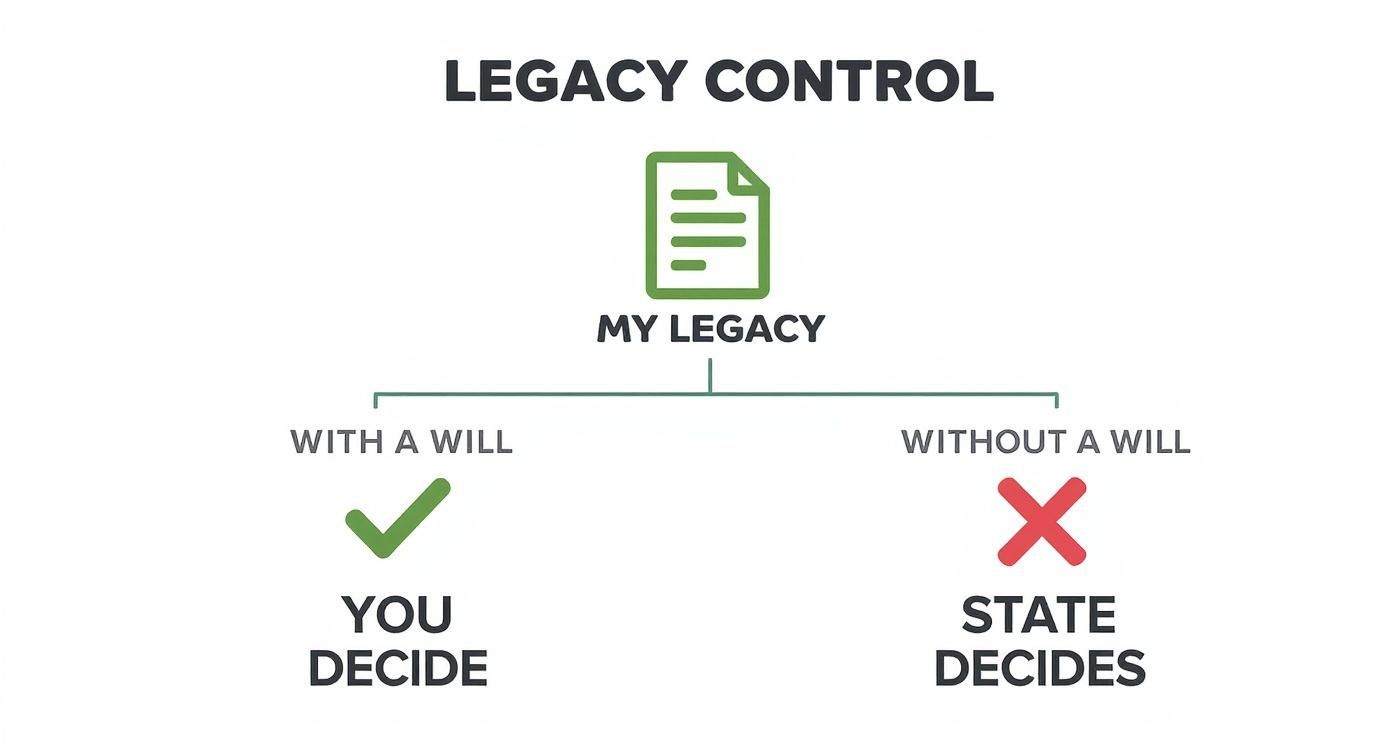
The visual makes it crystal clear: a will puts you in the driver's seat. No will means the state takes the wheel.
How Texas Distributes Property Without a Will
The specific rules for distribution depend entirely on which family members survive you. Let's walk through the state's playbook for a few common scenarios.
This table breaks down how the Texas intestacy rules divide your estate based on your family situation.
How Texas Distributes Property Without a Will
| Family Situation | Distribution of Community Property | Distribution of Separate Property |
|---|---|---|
| Married with children (all from your current spouse) | Your spouse inherits your 1/2 share. They now own 100%. | Your spouse inherits 1/3 of your personal property. Your children inherit the other 2/3. For real estate, your spouse gets a "life estate" in 1/3, and your children inherit the rest outright. |
| Married with children (from a prior relationship) | Your spouse keeps their 1/2. Your children from the prior relationship inherit your 1/2 share. | Same as above: Spouse gets 1/3 of personal property and a life estate in 1/3 of real property. Your children get the rest. |
| Married with no children | Your spouse inherits your 1/2 share. They now own 100%. | Your spouse inherits all your separate personal property. For real estate, your spouse gets 1/2, and your parents inherit the other 1/2. |
| Single with children | N/A | Your children inherit everything, divided equally. |
| Single with no children | N/A | Your parents inherit everything, divided equally. If only one parent is alive, they get 1/2, and your siblings get the other 1/2. If no parents, your siblings inherit everything. |
As you can see, the outcomes can be messy and counterintuitive, especially for blended families.
One of the most common and painful surprises happens in blended families. Many people assume their current spouse will inherit everything, but under Texas law, children from a prior relationship have a direct claim to the community property you shared with your new spouse.
This can force your surviving spouse to co-own the family home with your children—a situation that's practically guaranteed to cause conflict.
If you're single with no children, your property goes to your parents. If they’re no longer living, your estate is divided among your siblings. And if you have no siblings, the court will keep moving further out on the family tree to find distant relatives to inherit your property.
These rigid formulas all point to one critical truth: the state’s plan is not your plan. The only way to replace these default rules with your own is to work with a Texas estate planning attorney and create a valid will.
It’s a common challenge—we all know we should have a will, but it’s easy to postpone the task. Much of this hesitation stems from common misconceptions about how the process works in Texas. Let’s clarify these myths so you can move forward with confidence.
Myth 1: My Estate Is Too Small to Need a Will
This is one of the most damaging myths in estate planning. The truth is, a will isn't just for those with significant wealth. It’s for anyone who wants to decide who receives their property—regardless of its monetary value.
Often, the most meaningful assets aren't the most valuable. Sentimental items like family heirlooms, photo collections, or a favorite piece of art can carry immense emotional weight. A will allows you to designate who receives these treasured items, preventing painful disputes and ensuring your belongings go to those who will cherish them most.
Myth 2: My Spouse Will Automatically Get Everything
Many married couples in Texas assume that when one spouse passes away, the survivor automatically inherits all assets. This is not always true, and the reality can be a painful surprise. As we've discussed, Texas law distinguishes between community and separate property.
Here’s a real-world example: if you have children from a previous relationship, they have a legal claim to your half of the community property. This could mean your surviving spouse is forced to co-own the family home with your children—a situation that is both emotionally difficult and financially complex.
A will is your only tool to override these default state rules and ensure your spouse is cared for exactly as you intend.
Myth 3: Wills Are Too Expensive and Complicated
The idea of a long, confusing, and costly legal process prevents many people from starting their estate plan. While a will is a formal legal document, creating one with an experienced Texas estate planning attorney is a straightforward and empowering process.
Consider the cost of drafting a will as a small, one-time investment in your family's future peace of mind. It is minimal compared to the potential legal fees, court costs, and emotional turmoil that can arise when you die without a plan.
It's a strange paradox: a recent survey found that 83% of Americans believe estate planning is important, yet only 31% have actually made a will. That gap is often due to these very fears. To learn more about these estate planning findings, you’ll see just how common this is. A well-drafted will provides priceless peace of mind, both for you and for the people you love.
Building a Comprehensive Texas Estate Plan
While asking "do I have to have a will?" is the right place to start, a will is the foundation of a solid estate plan. For true peace of mind, it's wise to consider the bigger picture. A comprehensive plan protects you during your lifetime just as much as it provides for your loved ones after you're gone.
This is where other essential legal tools come into play. They work together with your will to create a protective shield around your assets, your health, and your family’s future. It's about being prepared for life's uncertainties.
Beyond the Will: Key Planning Documents
A complete estate plan is a collection of documents, each designed to handle situations a will cannot. Each serves a distinct, vital purpose.
- Trusts: A trust is a powerful tool for managing and distributing assets. A properly funded trust, governed by the Texas Trust Code, can help your family avoid the public and often time-consuming probate process. This means quicker access to assets and enhanced privacy.
- Durable Power of Attorney: This document is your lifeline for financial matters. It lets you appoint someone you trust to manage your finances if you become incapacitated and cannot do so yourself.
- Medical Power of Attorney: Similar to the durable power of attorney, this designates a trusted agent to make healthcare decisions for you if you become unable to communicate your wishes.
- Living Will (Directive to Physicians): This document clearly outlines your preferences for end-of-life medical care. It is an incredible gift to your family, removing the burden of making agonizing decisions during an already emotional time.
By integrating these instruments, your plan transforms from a simple set of instructions into a robust strategy that protects both you and your loved ones.
The Strategic Advantage of a Trust
Among these tools, a trust offers unique benefits that a will alone cannot provide. While a will provides instructions to the court after you pass, a trust is a private agreement that can manage and distribute assets during your life and after—often without any court involvement.
A key advantage is control. With a trust, you can dictate not just who inherits your assets, but how and when they receive them. For example, you can arrange for a young beneficiary to receive funds in stages, protecting their inheritance until they are mature enough to handle it responsibly.
This level of control is invaluable for blended families, for protecting minor children, or for providing long-term care for a loved one with special needs.
To learn more, our firm offers detailed guidance on strategies for avoiding probate in Texas to help ensure a smooth transition of your assets. Taking control of your legacy also extends to your final wishes and care preferences. For a complete picture, you can explore a guide to end-of-life care planning.
Your First Steps to Creating a Texas Will

Creating a will can feel like a daunting task, but it is best viewed as a series of manageable steps. The most difficult part is often just getting started. With a clear roadmap, you can take control of your legacy and ensure your loved ones are protected. The first step is to gather some key information. A little preparation before meeting with an attorney can make the process smoother and more efficient.
Step-by-Step Guidance for Getting Started
Before you do anything else, take some time to organize your thoughts and information.
- List Your Assets: Create a general inventory of what you own. This should include real estate, bank accounts, retirement funds, vehicles, and any personal items of significant monetary or sentimental value.
- Choose Your People: Identify the key individuals in your will. You will need to name your beneficiaries (the people who will inherit your assets) and your executor (the person you trust to carry out your will's instructions).
- Consider a Guardian: If you have minor children, this is arguably the most critical decision in your will. You need to decide who you would want to step in as their guardian to care for them.
Understanding the Legal Requirements in Texas
For a will to be valid in a Texas court, it must follow specific rules outlined in the Texas Estates Code. If these requirements are not met, the entire document could be invalidated, leaving the state to divide your property according to intestacy laws.
A valid Texas will must be in writing, signed by you (the testator), and witnessed in your presence by two credible individuals who are at least 14 years old.
It's no secret that do-it-yourself legal services are popular. The global market for online will services is expected to hit $2.96 billion by 2034, showing how many people are turning to these solutions. You can discover more about this market trend if you're curious.
However, while these online templates may seem convenient, they are a one-size-fits-all solution for a situation that is deeply personal and legally complex. They cannot provide the tailored advice needed to navigate the nuances of Texas law or address unique family situations.
The most reliable way to create a legally sound will that truly protects your family is to work with a Texas estate planning attorney. For a deeper dive into the specifics, check out our guide on crafting your last testament.
Your Top Questions About Texas Wills, Answered
When it comes to estate planning, it's natural to have questions. We have gathered some of the most common inquiries we receive from Texas families to provide you with clear, straightforward answers.
How Much Does It Cost To Make a Will in Texas?
The cost of a will depends on the complexity of your financial and family situation. While inexpensive online templates may seem tempting, they often represent a case of "you get what you pay for." They lack a lawyer's review, which means a small mistake now could create a significant and costly legal issue for your family later.
Working with an attorney is an investment in ensuring your wishes are legally protected. We provide a clear understanding of the costs involved after discussing your specific needs during a free consultation.
Can I Write My Own Will in Texas?
Technically, yes. Texas law recognizes a holographic will, which is a will written entirely in your own handwriting. However—and this is a critical point—these wills are very easy to challenge in court.
Handwritten wills often fail to meet the strict legal requirements to be considered valid. The irony is that in trying to simplify the process, you may inadvertently create the very family disputes and legal complications you were hoping to avoid.
When Should I Update My Will?
A will is not a "set it and forget it" document. It should be treated as a living document that evolves with your life. It is crucial to review and potentially update it after any major life event.
Did you get married or divorced? Welcome a new child? Receive an inheritance or sell a major asset? These are all opportune times to update your will. As a general rule, it is wise to review your will with your attorney every three to five years to ensure it remains current and accurately reflects your wishes.
If you’re managing a trust or planning your estate, contact The Law Office of Bryan Fagan, PLLC for a free consultation. Our attorneys provide trusted, Texas-based guidance for every step of the process. Reach out for a free consultation today.