When a loved one passes away without a will, the path forward can feel overwhelming. You're already navigating grief, and now you must sort through the complexities of their final affairs. With the right legal guidance, however, it doesn’t have to be an overwhelming process. Texas law offers a practical tool that can often help families sidestep a long and costly probate process.
It's called the Affidavit of Heirship, a straightforward legal document designed to officially identify who the rightful heirs are when there is no will.

What Is the Main Purpose of an Affidavit of Heirship?
At its heart, an Affidavit of Heirship is a sworn statement. It creates a clear record of the deceased person’s family history, names all the legal heirs, and is signed by someone who knew the family well—plus two witnesses who have no financial stake in the estate. Its primary purpose? To establish a clean chain of title for real property, like the family home or a piece of land.
This document becomes incredibly useful when someone passes away intestate, which is the legal term for dying without a valid will. Without that crucial roadmap, there’s no executor and no instructions for distributing assets. The affidavit steps in to fill that void, creating a legal record that county clerks and title companies can rely on. If you're wondering about the consequences of not having a will, you can learn more in our guide on what happens if you die without a will in Texas.
To give you a quick overview, here's a simple breakdown of what an Affidavit of Heirship is all about.
Affidavit of Heirship at a Glance
This table simplifies the core elements of this important Texas legal document.
| Component | Purpose | Key Requirement |
|---|---|---|
| Sworn Statement | To formally declare the family history and identify heirs under oath. | Must be signed before a notary public. |
| Family History | To establish a clear lineage of spouses, children, and other relatives. | A complete list of all heirs is required. |
| Disinterested Witnesses | To provide objective confirmation of the family history. | Two witnesses who won't inherit from the estate must sign. |
| Real Property Transfer | To create a legal record for transferring title of real estate. | Primarily used for real property; not for bank accounts or other assets. |
Think of it as creating an official family tree for legal purposes, making sure everyone is accounted for correctly and compassionately.
When Is It the Right Tool for the Job?
While the Affidavit of Heirship is a powerful document, it isn't a one-size-fits-all solution. It works best under very specific circumstances, especially when:
- The deceased person’s estate consists primarily of real property (like a house or land).
- All the heirs have been identified and are in complete agreement about the property.
- There are no outstanding debts against the estate, aside from something like a mortgage on the property itself.
By understanding what this affidavit does—and what it doesn't do—you can make an informed choice about whether it's the right path for settling your family’s affairs with clarity and peace of mind.
The Legal Foundation: The Texas Estates Code
An Affidavit of Heirship isn't an informal family agreement; it's a serious legal tool with real authority, backed by Texas law. Its power flows directly from the Texas Estates Code, which lays out the exact framework allowing this document to serve as an alternative to probate when the situation is right. Knowing this legal foundation is in place should give your family confidence that you're using a reliable, state-approved method to settle a loved one’s estate.
The specific statute that gives the affidavit its legal muscle is Section 203.001 of the Texas Estates Code. This is the part of the law that says a properly executed affidavit can serve as prima facie evidence of who the heirs are.
What Is Prima Facie Evidence?
Think of "prima facie evidence" as the legal equivalent of "accepted as true until proven otherwise." It establishes a rebuttable presumption. On its face, the information laid out in the affidavit is presumed to be correct unless someone steps forward with solid proof to dispute it.
This presumption gets even stronger over time. Once an affidavit has been filed in the county’s real property records for five years or more, it’s no longer just a presumption—it becomes conclusive proof of the facts it states. This is what gives title companies the confidence to use the affidavit to transfer property ownership, creating a clean and insurable chain of title. Without this legal backing from the Texas Estates Code, an affidavit would be just a piece of paper.
The Code in Action: A Real-World Scenario
Let's imagine a real-world scenario. A father in Houston passes away without a will. His only significant asset is the family home, and his three adult children are his only heirs. They are all on good terms and want to sell the house to take care of his final expenses.
- The Challenge: With no will, there's no named executor to handle the sale. A full probate process could drag on for months and accumulate significant legal fees, putting everything on hold.
- The Solution: The siblings hire a Texas estate planning attorney to prepare an Affidavit of Heirship. They identify two old family friends who knew their father for decades and are willing to act as disinterested witnesses.
- The Process: The affidavit is drafted, then signed by one of the children and both witnesses in front of a notary. It's then filed with the Harris County real property records. When the title company for the home sale reviews the records, they see the filed affidavit and, because of the authority granted by the Texas Estates Code, accept it as proof of heirship.
Just like that, the children can sell the home, settle their father's affairs, and move forward without getting bogged down in a lengthy court process.
"The Texas Estates Code provides a practical and efficient pathway for families. By establishing the Affidavit of Heirship as prima facie evidence, the law acknowledges that not every estate requires the full oversight of a probate court, saving families time, money, and stress during a difficult period."
In practice, the Texas affidavit of heirship proves its worth time and again, letting families sidestep probate court when there’s no will or when a will wasn't probated within four years of death. It's especially useful for transferring real estate when heirs need to sell inherited property without delay. Since the Estates Code was updated, affidavits have made title transfers much smoother. Land title associations estimated that over 15,000 of these documents were being filed each year across Texas's 254 counties. You can dive deeper into how this works at Lone Star Land Law.
By grounding the affidavit process in clear, straightforward law, Texas offers a compassionate and sensible solution for many estates. This legal backing ensures families can handle their loved one's affairs with dignity and certainty.
Key Requirements for a Valid Texas Affidavit of Heirship
For an Affidavit of Heirship to be legally effective in Texas, it must follow specific, non-negotiable rules outlined in the Texas Estates Code. Think of it as a detailed legal resume for the deceased's family—every fact must be accurate, verified, and presented correctly. Otherwise, you can expect pushback from title companies, county clerks, and potentially the courts.

Successfully navigating what is an affidavit of heirship is all about attention to detail. Missing one required piece of information or making a procedural error can cause the document to be rejected. That means delays, extra costs, and added stress. Let’s walk through exactly what makes this document legally sound.
The Core Components of the Affidavit
A valid affidavit must paint a complete and truthful picture of the deceased person’s life and family tree. It’s not enough to just list the heirs; the document has to build a logical case for why they are the heirs, based on verifiable facts.
Here’s a breakdown of the must-have elements:
- Detailed Decedent Information: This includes the person's full legal name, the date and place of death, and their last known address. This officially identifies the person the affidavit concerns.
- Comprehensive Family History: This is the heart of the document. It must list all marriages and divorces, with dates and locations. It also must list all children (biological and adopted), noting if they are alive or deceased.
- Identification of All Heirs: The affidavit must clearly name every legal heir according to Texas's intestacy laws. For each heir, you need their current address and their exact relationship to the decedent (e.g., son, daughter, surviving spouse).
- Statement Regarding a Will: The document must state that the person died without leaving a will. If a will exists but was never probated, that needs to be mentioned, though this can complicate matters.
- Description of the Property: You must include the full legal description of the real estate in question, not just the street address. This is the formal description found on the property's deed.
- Confirmation of Estate Debts: The affidavit should confirm that all of the estate's known debts, like funeral costs or final medical bills, have been paid. If any outstanding debts exist, they must be clearly described.
Getting these details right is the crucial first step. Even a small mistake, like a misspelled name or an incorrect property description, can create major headaches.
The Crucial Role of Disinterested Witnesses
Perhaps the most important part of validating an Affidavit of Heirship is the sworn statements from disinterested witnesses. These individuals provide the third-party verification that gives the document its credibility. Their role is to swear under oath that the family history and other facts in the affidavit are true to the best of their knowledge.
Under Texas law, a disinterested witness must meet two key criteria:
- They must have known the deceased personally for a significant period. While not set in stone, title companies generally prefer witnesses who knew the family for 10 years or more.
- They cannot be an heir or stand to inherit anything from the estate. This is the "disinterested" part—their testimony must be free of any financial motive or conflict of interest.
Good examples of disinterested witnesses are often longtime family friends, neighbors, co-workers, or fellow members of the deceased’s church. Their sworn statements prove that the information isn't just a self-serving claim but a factual account backed by neutral parties. The legal weight of an affidavit is built on these strict requirements. As noted in some guidance from Texas legal experts, the document relies on two disinterested parties who knew the deceased for 10-30 years to confirm the family history and the absence of a will.
Without credible, disinterested witnesses, an Affidavit of Heirship is merely a statement of belief. With them, it becomes a powerful piece of evidence that can stand up to legal scrutiny and facilitate the smooth transfer of real property.
Final Execution and Notarization
Finally, to make the affidavit legally binding, it must be signed by the person making the statement (the affiant, usually an heir) and both disinterested witnesses. Critically, all these signatures must be made in the presence of a notary public. The notary's seal is the official confirmation that the signatures are authentic and that everyone signed under oath, acknowledging the penalties for perjury if they provide false information. This formal execution makes the document ready for filing in the county property records.
Affidavit of Heirship Versus Formal Probate
Choosing the right legal path after a loved one passes away can feel like standing at a crossroads. In Texas, when someone dies without a will, you're often looking at two main routes: an Affidavit of Heirship or formal probate. Both are designed to settle an estate, but they travel down very different roads.
The Affidavit of Heirship is often the faster, more direct route. It bypasses the courthouse, making it significantly less expensive and quicker. Probate, on the other hand, offers something the affidavit can't: a definitive, court-ordered conclusion to the estate. Understanding these differences is key to making a calm, informed decision that honors your family’s needs.
Speed and Simplicity
The biggest advantage of an Affidavit of Heirship is its efficiency. The process involves gathering information, locating two disinterested witnesses who knew the family, and filing a single, sworn document in the county property records. For straightforward situations, this can often be completed in a matter of weeks. This allows families to move forward with selling or transferring a house without a long, drawn-out delay.
Formal probate is a different process entirely. As a court-supervised procedure, it is inherently more complex and time-consuming. It involves a multi-step journey that includes:
- Filing an application with the probate court.
- Attending a court hearing to have an administrator appointed.
- Publishing a legal notice to potential creditors.
- A mandatory waiting period for creditors to file claims.
- Filing a detailed inventory of all estate assets.
- Obtaining a judge's final approval to distribute the assets.
This process can easily take six months to a year, even if everything goes smoothly. For families who need to act quickly, the affidavit is often the much more practical choice.
Cost and Financial Impact
The financial difference between these two paths is substantial. An Affidavit of Heirship typically involves a flat legal fee for drafting the document and modest county filing fees. Because you are not paying for court appearances or extensive administrative tasks, the overall cost is kept to a minimum.
Formal probate, however, is a much larger financial commitment. The costs can include court filing fees, attorney’s fees for representing the estate in court, the cost of publishing creditor notices, and sometimes a bond for the administrator. All of these expenses are paid from the estate's assets, which reduces the value passed on to the heirs.
For estates where the only significant asset is a home and all heirs are in agreement, the cost savings of an Affidavit of Heirship can easily amount to thousands of dollars. That's more of your loved one's legacy preserved for the family.
Legal Finality and Asset Scope
This is where formal probate has a distinct advantage. A probate court issues a final order that legally settles heirship and resolves all creditor claims. That court order is legally binding and provides absolute certainty for everyone involved.
An Affidavit of Heirship, while powerful, does not offer that same level of finality. It creates a legal presumption of heirship that third parties, like title companies, can rely on. However, that presumption only becomes legally conclusive after it has been on file for five years.
More importantly, the affidavit's scope is limited. It works wonderfully for transferring the title to real estate. But if you try to use one to access a savings account, you will almost certainly be turned away. Financial institutions and brokerage firms require the legal authority granted by a court through probate—called Letters of Administration—to release funds. You can learn more about this crucial distinction in our article covering probate and non-probate assets in Texas. Simply put, probate is a comprehensive solution for all estate assets, not just the house.
To make the choice clearer, let's break it down side-by-side.
Affidavit of Heirship vs. Formal Probate in Texas
| Factor | Affidavit of Heirship | Formal Probate |
|---|---|---|
| Process | File a sworn document in county records. No court involvement. | Court-supervised legal process with hearings and deadlines. |
| Timeline | Typically a few weeks. | 6-12+ months, depending on complexity. |
| Cost | Lower cost. Mostly legal drafting and filing fees. | Significantly higher. Includes court costs, attorney fees, etc. |
| Legal Finality | Creates a strong presumption of heirship; conclusive after 5 years. | Provides a final, binding court order determining heirship. |
| Asset Scope | Primarily effective for transferring real estate. | Covers all estate assets, including bank accounts and investments. |
| Creditor Claims | Does not formally cut off creditor claims. | Formally resolves all known and unknown creditor claims. |
Seeing the key differences laid out highlights the trade-offs you're making. It's about weighing your specific needs.
When to Choose Each Path
So, how do you decide? It comes down to a careful look at your family’s specific situation.
An Affidavit of Heirship is often the best choice when:
- The only major asset left behind is real estate.
- All the heirs are known, can be found, and are in complete agreement.
- The estate has no debts, other than perhaps a mortgage on the house.
- The family wants a quick, low-cost resolution to move on.
Formal probate becomes necessary when:
- The estate includes bank accounts, stocks, investments, or other financial assets.
- There are disagreements or potential conflicts among the heirs.
- The decedent had significant debts that need to be formally settled.
- You need a definitive court order to clear up complex ownership issues.
Ultimately, the choice is about balancing speed and cost against legal finality and the scope of the assets you need to handle.
A Step-by-Step Guide to Filing an Affidavit of Heirship
Knowing what an Affidavit of Heirship is and when to use it is the first step. Now, let’s walk through the process of preparing and filing this crucial document in Texas. This step-by-step guidance breaks down what can feel like a complicated legal task into clear, manageable actions.
Following this roadmap carefully will help you create a solid legal record to settle your loved one's estate with confidence.
Step 1: Gather Essential Information
Before drafting the affidavit, you need to collect all the necessary facts. Think of yourself as a family historian, piecing together the details needed to create an accurate and complete picture.
You'll need to gather:
- The Decedent's Information: Their full legal name, date and place of death, and last known address. A copy of the death certificate is essential.
- Complete Family History: A comprehensive list of all marriages and divorces with dates. You must also list every child—biological and adopted—along with their birth dates and current addresses.
- Property Details: The full legal description of the real estate in question, which you can find on the property deed.
Step 2: Identify Disinterested Witnesses
This step is non-negotiable for the affidavit to be valid. You must find two disinterested witnesses. As mentioned earlier, these are people who knew the deceased for a long time—often 10 years or more—but who will not inherit anything from the estate.
Their role is to swear under oath that the family history you've outlined in the affidavit is true. Longtime friends, trusted neighbors, or even former co-workers often make ideal witnesses.
Step 3: Draft the Affidavit
With all your information gathered and witnesses identified, it's time to draft the affidavit. While online templates exist, the risk of a legal mistake is high. This is where professional legal help from a Texas trust administration lawyer is invaluable.
An experienced attorney will ensure the document:
- Meets all requirements of the Texas Estates Code.
- Uses precise and correct legal language.
- Is customized to your family’s unique situation.
A professionally drafted affidavit drastically reduces the risk of it being rejected by a title company or challenged in the future. It's an investment in peace of mind and the security of your family's property rights.
Step 4: Sign Before a Notary Public
Once the affidavit is drafted, it must be signed by the affiant (usually an heir with thorough knowledge of the family history) and both disinterested witnesses. Critically, all signatures must be made in the presence of a notary public.
The notary's seal makes it official, verifying the identities of the signers and confirming they signed under oath, acknowledging the legal penalties for providing false information.
This infographic lays out the difference between the faster, more affordable affidavit process and the slower, more expensive road of formal probate.
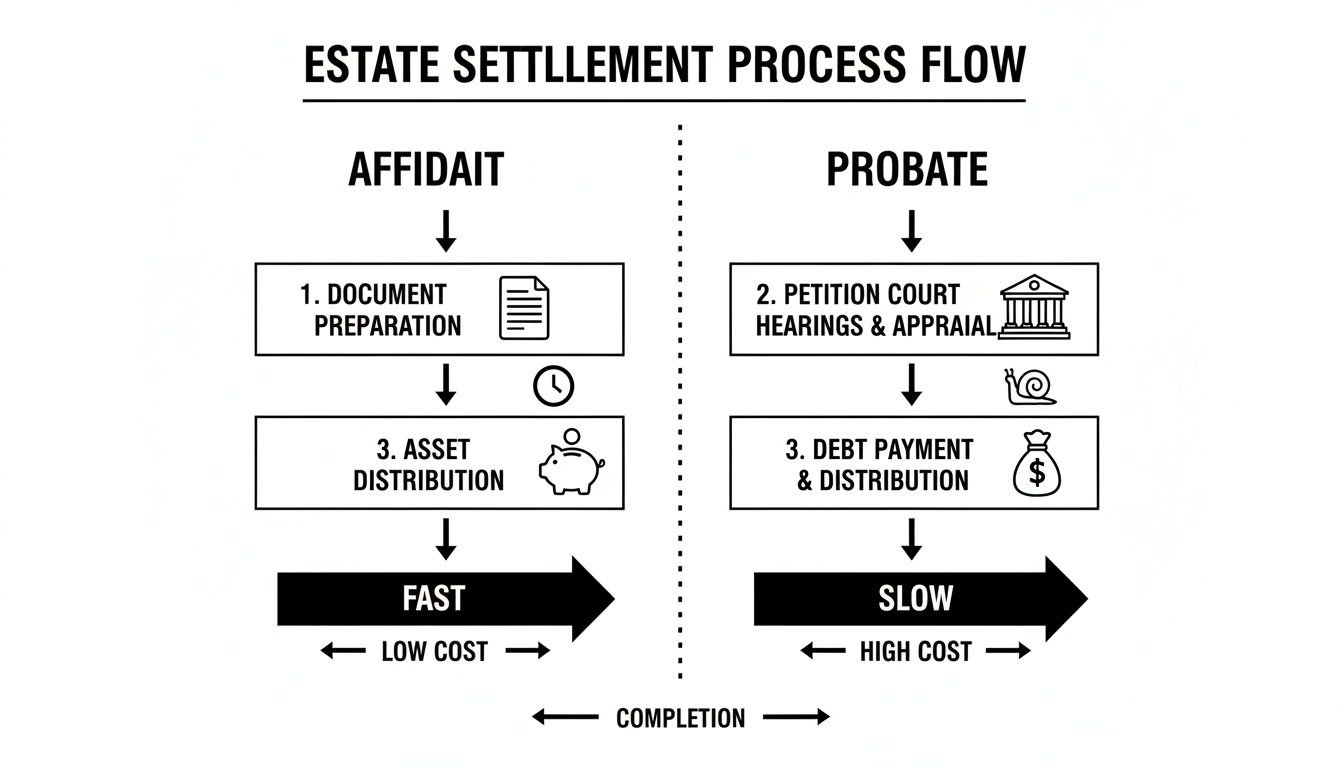
As you can see, the affidavit acts as a streamlined alternative for transferring real estate, letting you sidestep the time and expense of going through the court system.
Step 5: File the Affidavit in the County Records
The final step is to take the original, signed, and notarized Affidavit of Heirship and file it with the county clerk where the property is located. Filing it makes it part of the official public records, creating a clear chain of title.
You will need to pay a filing fee, which varies by county. Once filed, the affidavit becomes a permanent part of the real property records, putting the public, title companies, and potential buyers on notice about the change in ownership. For a deeper dive into the entire process, check out our complete guide on how to settle an estate in Texas. This final action ensures the property transfer is officially recognized.
Common Mistakes to Avoid and When to Seek Legal Help
An Affidavit of Heirship can be an efficient tool, but it's not a DIY project you want to get wrong. A single mistake in its preparation or filing can create title issues, leading to frustrating delays, unexpected costs, and family stress.
These mistakes often don't surface for years, typically appearing at the worst possible time—when the family is trying to sell the property and a title company raises a red flag. This can stop a sale dead in its tracks and force everyone back to square one, sometimes requiring a more expensive probate process to clean up the mess.
Pitfalls That Can Invalidate Your Affidavit
When it comes to an Affidavit of Heirship, accuracy is everything. The document's legal power is built on being complete and truthful.
Here are some of the most critical—and common—errors we see:
- Failing to Identify All Heirs: This is a major error. It is absolutely crucial to list every single legal heir. This includes not just immediate children but also children from a previous marriage, estranged relatives, or adopted children. Missing even one person can render the affidavit defective.
- Using Interested Witnesses: The law is clear on this. The two witnesses who sign the affidavit cannot be heirs or stand to gain anything from the estate. Using a child, a spouse, or anyone who will inherit is an automatic red flag for title companies.
- Providing an Inaccurate Property Description: You need more than the street address. The affidavit must include the full, correct legal description of the property, matching the property deed exactly.
- Overlooking Outstanding Debts: The affidavit must address the decedent’s debts. Ignoring old hospital bills or a potential Medicaid Estate Recovery Program (MERP) lien is a recipe for disaster and can lead to legal battles.
Knowing the Affidavit’s Limitations
It’s also vital to understand that an Affidavit of Heirship isn't a solution for all estate assets. Its primary function is to transfer the title to real estate.
Most financial institutions, like banks and credit unions, will not accept an Affidavit of Heirship to transfer funds from bank accounts, investment portfolios, or other cash assets. For those, they almost always require Letters of Administration issued by a probate court.
This limitation is a perfect example of why professional guidance is so important. An experienced attorney can assess the entire estate—not just the house—and map out the correct legal path. This prevents families from filing an affidavit only to realize they still have to go through probate to access the remaining assets.
When the stakes are this high, legal counsel is essential. A Texas estate planning attorney can ensure every detail is handled correctly, protecting your family’s interests and preventing small issues from becoming massive problems. If your family situation is complex, if heirs are difficult to locate, or if there are debts to resolve, professional legal guidance is the surest way to navigate the process smoothly. For help with all aspects of estate administration, from probate and guardianship to asset protection, our team is here to help.
Your Top Questions About Texas Affidavits of Heirship, Answered
When you're dealing with an estate, many questions arise. We've compiled some of the most common ones we hear from families about using an Affidavit of Heirship in Texas. Consider this your quick-reference guide for clear, straightforward answers.
Can I Use an Affidavit of Heirship for Mom’s Bank Account?
This is a frequently asked question, and the answer is typically no. Banks, credit unions, and other financial institutions have strict protocols and generally will not accept an Affidavit of Heirship to release funds.
This document is designed to handle the title transfer for real property—like a home or land. To access financial accounts, you will almost always need to go through a formal probate process or determine if the estate qualifies for a Small Estate Affidavit.
What if a Will Shows Up After We’ve Filed the Affidavit?
It happens more often than you might think. If a valid will is discovered and filed for probate after an affidavit is already on record, the will takes precedence. The instructions in the will legally override the statements in the affidavit.
This means the probate court's decisions will determine who the rightful owners of the property are. Any transfers that occurred based on the affidavit could be undone.
How Long Does the Affidavit Need to Be on File to Be Official?
The Texas Estates Code specifies that for an Affidavit of Heirship to be considered conclusive proof of heirship, it must be on file in the county deed records for five years.
However, in practice, most title companies don't require you to wait that long. If the affidavit is drafted correctly and the circumstances are straightforward, they will often accept it as sufficient evidence to issue title insurance shortly after it's filed.
Do All the Heirs Have to Sign the Affidavit?
No, not every heir needs to physically sign the affidavit itself. The document is signed by at least one heir who has personal knowledge of the family history, along with two disinterested witnesses who can also attest to the family facts.
However, the most important thing is that all heirs are in agreement. Unanimous consent is critical to prevent legal disputes down the road.
If you’re managing an estate or planning for your own, contact The Law Office of Bryan Fagan, PLLC for a free consultation. Our attorneys provide trusted, Texas-based guidance for every step of the process.