Managing a loved one’s estate can feel overwhelming, but with the right legal guidance, it doesn’t have to be. The thought of taxes often adds a layer of stress to an already difficult time. Let’s start with the reassuring news: Texas does not have an inheritance tax or a state-level estate tax. This means that for most families, neither the person receiving the inheritance nor the estate itself will owe taxes to the State of Texas.
Understanding Texas’s Favorable Tax Landscape
Navigating the financial responsibilities after a loved one passes is a significant challenge. Fortunately, Texas law provides families with clarity and relief on the tax front. The absence of a state “death tax” simplifies the administration process, allowing you to focus on honoring your loved one’s memory instead of deciphering complex state tax regulations.

This favorable tax environment resulted from changes in federal law. In 2005, a federal credit that allowed states to receive a portion of federal estate taxes was eliminated. Since this credit was the basis for Texas’s estate tax, its repeal effectively ended the tax in our state. You can learn more about the history of Texas estate tax laws for a deeper historical context. While this is welcome news, it is crucial to remember that this applies only at the state level. The federal government has its own set of rules.
To provide a clear snapshot of where things stand, here’s a simple breakdown of the tax situation for estates and inheritances in Texas.
Texas Inheritance and Estate Tax at a Glance
| Tax Type | Applicable in Texas? | Key Takeaway |
|---|---|---|
| Inheritance Tax | No | Beneficiaries do not pay Texas state tax on assets they inherit. |
| State Estate Tax | No | The deceased person’s estate does not owe any tax to the State of Texas. |
| Federal Estate Tax | Yes | Applies only to very large estates, with a high exemption threshold. |
The key takeaways are:
- No Inheritance Tax: If you inherit property as a Texas resident from a Texas estate, you will not owe state taxes on it.
- No State Estate Tax: The estate itself is not subject to a Texas tax bill.
- Federal Rules Still Apply: This is the most important distinction. The IRS has its own regulations, and a federal estate tax may apply to very high-value estates.
This state-versus-federal difference is a critical piece of the puzzle. It underscores why a well-crafted estate planning strategy remains the cornerstone of protecting your family’s legacy and ensuring a smooth transition of assets.
Understanding Inheritance Tax vs. Estate Tax
The terms “inheritance tax” and “estate tax” are often used interchangeably, but they are fundamentally different. Understanding this distinction is the first step for any family looking to manage their wealth, even in tax-friendly Texas.
Imagine a loved one’s entire estate as a pie.
An estate tax is a tax levied on the entire pie before any slices are distributed. The estate itself, through its executor, is responsible for paying this tax based on the total net value of the assets.
An inheritance tax, on the other hand, is a tax on each individual slice after it has been served. This tax is the responsibility of the beneficiary—the person who receives the inheritance.
Who Pays the Tax?
The primary difference lies in who is responsible for paying the tax, a detail that can have significant implications, especially when family members live in different states.
- Estate Tax: The deceased’s estate pays this tax before assets are distributed to the heirs.
- Inheritance Tax: The individual beneficiary pays this tax after receiving their inheritance.
You might wonder why this matters if Texas has neither tax. The answer lies in multi-state situations.
Here is a practical, real-world scenario we often see: a resident of Houston inherits property from an uncle who lived his entire life in Maryland. Since Maryland has an inheritance tax, the Houston-based beneficiary may owe tax to the State of Maryland, even though they live in Texas.
This example illustrates why understanding both concepts is vital. A comprehensive estate planning strategy considers not only where you reside but also where your assets are located and where your beneficiaries live.
How the Federal Estate Tax Affects Texans
While Texas provides a welcome break from state-level death taxes, the federal government has its own system. The federal estate tax applies nationwide, but due to a very high exemption amount, it impacts only a small fraction of families.
Think of the exemption as a financial threshold. If an estate’s total value is below this amount, it owes zero federal estate tax. This exemption is adjusted annually for inflation and can be changed by new legislation.
Understanding the Federal Exemption
The federal exemption has changed dramatically over the years. In 2003, for instance, the exemption was just $1 million per person. Following the Tax Cuts and Jobs Act of 2017, that figure has increased significantly. For 2024, the federal estate tax exemption is a substantial $13.61 million per individual. You can review the history of these tax rates to appreciate the scale of this change.
This high exemption means that only the wealthiest estates in the country are subject to this tax. For married couples, the protection is even greater thanks to a provision known as “portability.”
The Power of Portability for Married Couples
Portability is a powerful tool in federal tax law that allows a surviving spouse to use any of their deceased spouse’s unused estate tax exemption. In simple terms, if the first spouse to pass away does not use their full $13.61 million exemption, the remaining portion can be transferred to the surviving spouse.
This effectively allows a married couple to shield up to a combined $27.22 million from federal estate taxes. However, this is not automatic. An estate tax return (Form 706) must be filed for the first spouse to die to officially “elect” and claim portability for the survivor.
Properly electing portability is a critical component of strategic asset protection for high-net-worth families. You can find a complete explanation in our detailed guide on portability and what it means for estate tax.
For anyone whose assets approach these federal limits, proactive planning with a knowledgeable Texas estate planning attorney is not just advisable—it’s essential to preserve your legacy.
Comparing Texas Tax Laws with Other States
Stating that Texas has favorable tax laws becomes even more meaningful when compared to other states. While Texans are free from state-level estate and inheritance taxes, residents elsewhere may face an additional layer of financial complexity when settling an estate. This contrast is a significant reason why Texas is often considered an ideal state for building and transferring wealth.
This is particularly relevant for individuals relocating from Florida to Texas or other states, as understanding the new tax landscape is crucial.
The Impact of State-Level Taxes
Unlike Texas, several states levy their own estate or inheritance taxes. These taxes typically affect only very large estates—fewer than 3% of estates nationwide owe any state-level tax. However, when they do apply, the impact can be significant.
For example, in fiscal year 2022, Massachusetts taxed 493 estates, New York taxed 1,058, and Illinois taxed 345. These families faced a tax obligation that Texans do not have at the state level.
A critical piece of practical advice: It’s not just about where you live, but where your beneficiaries reside. If your heir lives in a state with an inheritance tax, they could be responsible for a tax bill, even if your estate is based in Texas.
This infographic highlights the dramatic increase in the federal estate tax exemption over the last two decades, from $1 million in 2003 to over $12 million by 2023.
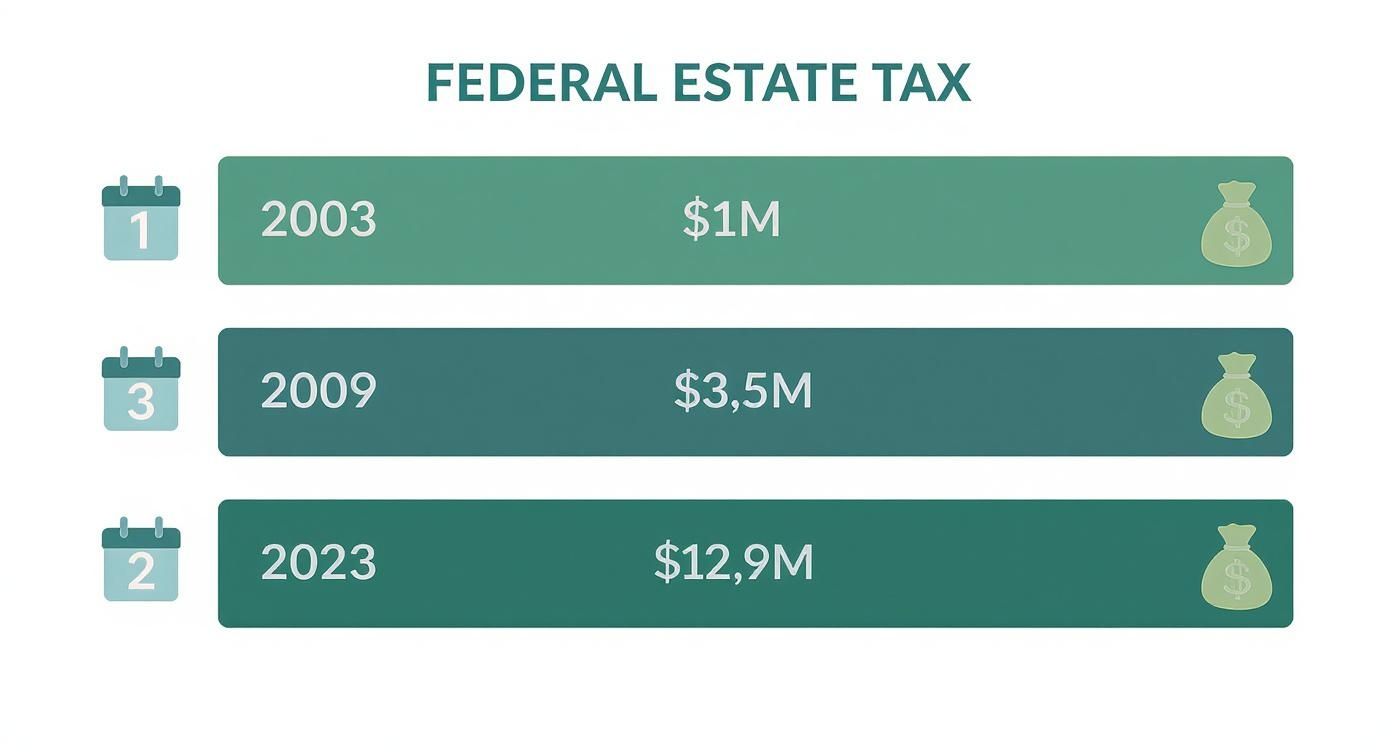
This trend shows that federal policy has made the estate tax a non-issue for most American families. Consequently, it is vital to understand the impact of state estate taxes on your estate plan, as state laws can impose taxes at much lower thresholds than the federal government.
State-Level Estate and Inheritance Taxes: A Snapshot Comparison
To provide a clearer picture, let’s compare how a few other states handle these taxes compared to Texas.
| State | Type of Tax | Tax Exemption Threshold (Example) |
|---|---|---|
| Texas | None | N/A |
| Massachusetts | Estate Tax | $2 Million |
| Oregon | Estate Tax | $1 Million |
| Iowa | Inheritance Tax | Phased out in 2025 (taxed based on relationship to decedent) |
| Maryland | Both Estate & Inheritance Tax | $5 Million (Estate), taxed based on relationship (Inheritance) |
As this table shows, the rules vary significantly from state to state. An estate that would pass entirely tax-free in Texas might face a substantial tax liability in Oregon or Massachusetts. These differences highlight why planning must account for your location and your beneficiaries’ locations. An experienced Texas estate planning attorney can provide invaluable guidance in navigating these multi-state complexities.
Proactive Estate Planning: Protecting Your Texas Legacy
The fact that Texas has no inheritance tax is a significant advantage, but it does not eliminate the need for careful estate planning. In fact, it makes proactive planning even more critical to protect what you have built and prevent your family from facing unnecessary stress, delays, and costs.

Without a plan, your estate will be distributed according to Texas intestacy laws through the probate court system. This process can be slow, public, and expensive. By creating a plan, you remain in control, determining who receives your assets, when, and how.
The Essential Tools in Your Texas Planning Toolkit
Effective planning involves using the right legal instruments for your specific goals. A Texas estate planning attorney can explain your options and help you design a plan that aligns with your family’s needs. This typically includes several key documents:
- Wills: A will is the foundational document of an estate plan. It provides clear instructions for distributing your assets, names guardians for minor children, and appoints an executor to manage the process.
- Trusts: Trusts are powerful tools for managing assets and, crucially, for avoiding the probate process. In a trust, you place assets to be managed by a trustee for your beneficiaries. Revocable living trusts offer flexibility during your lifetime, while irrevocable trusts can provide significant asset protection benefits.
Properly structuring these documents helps you avoid common legal hurdles. For guidance on specific situations, you can find helpful information on topics like selling a house in a trust after death.
Ultimately, estate planning provides peace of mind. It creates a clear roadmap that protects your loved ones and preserves your legacy according to your wishes, not the default rules of the state.
A well-designed plan ensures your assets are transferred efficiently and privately. You can learn more about utilizing trusts for tax efficiency in estate planning in our detailed guide. Working with a legal professional ensures every detail complies with the Texas Estates Code and is tailored to your unique family situation.
Answering Your Texas Inheritance Law Questions
Once the basics are understood, practical “what if” questions often arise. This is perfectly normal. Here, we address some of the most common issues that families encounter when managing a Texas estate.
What If I Inherit from Someone in a State That Does Have an Inheritance Tax?
This is a common point of confusion. As a Texas resident, you are not subject to a Texas inheritance tax. However, the controlling law is that of the state where the deceased person resided.
For example, if you inherit from a relative who lived in Pennsylvania (one of the few states with an inheritance tax), you will likely be subject to Pennsylvania’s tax laws on that inheritance. This highlights the complexities that arise when state lines are crossed. A qualified attorney can help you understand and meet the requirements of the other state.
How Does the Federal Gift Tax Work?
The federal gift tax and the estate tax are two parts of a unified system designed to tax significant transfers of wealth. The gift tax applies to transfers made during your lifetime.
Each year, you can give up to a certain amount to any individual without tax consequences. This is the annual exclusion. If you give more than that amount in a single year, you generally must file a gift tax return. However, you likely will not owe tax immediately. Instead, the excess amount reduces your lifetime estate tax exemption. This system prevents individuals from avoiding estate tax by giving away all their assets right before death. A Texas estate planning attorney can show you how to use gifting as a smart strategy for asset protection without creating tax complications.
Does a Small Estate Still Need to Go Through Probate in Texas?
In most cases, yes. The absence of a state estate tax in Texas does not mean you can bypass the probate process. Probate is the formal court procedure that validates a will, settles the estate’s debts, and authorizes the legal transfer of assets to the beneficiaries.
For very small and simple estates, the Texas Estates Code provides alternatives like a Small Estate Affidavit. However, for most situations, especially those involving real estate, formal probate is necessary to ensure a clean and legal transfer of title.
An executor’s role extends far beyond taxes. Under the Texas Estates Code, they have a fiduciary duty to manage the entire estate, a significant legal responsibility.
What Does a Texas Executor Do If There Are No Taxes to File?
Filing tax returns is often just one piece of an executor’s extensive duties. An executor’s role is defined by the Texas Estates Code, which imposes a “fiduciary duty.” This legal standard requires the executor to act in the best interests of the estate with the highest degree of integrity and prudence.
Here is a step-by-step look at an executor’s responsibilities:
- Marshalling assets: The executor must identify, inventory, and secure all assets owned by the deceased.
- Notifying creditors: They are required to provide notice to potential creditors and pay all valid debts of the estate.
- Managing property: This includes maintaining real estate, managing investment accounts, and protecting tangible personal property.
- Distributing assets: Once all debts and expenses are paid, the executor distributes the remaining assets to the beneficiaries according to the terms of the will.
This is a serious legal responsibility. Seeking guidance from a probate lawyer is the best way for an executor to ensure they are fulfilling their duties correctly and protecting themselves from personal liability.
If you’re managing a trust or planning your estate, contact The Law Office of Bryan Fagan, PLLC for a free consultation. Our attorneys provide trusted, Texas-based guidance for every step of the process. Learn more at https://texastrustadministration.com.