A parent dies. A sibling steps in as trustee. Months pass, then longer. You hear that the trust owns a house, an investment account, maybe some cash, but no one shows you records. You do not know what came in, what went out, or whether the trust is being handled the way your parent intended.
That situation is painful because it mixes grief, family tension, and money. Many beneficiaries worry that asking questions will make things worse. Many trustees feel defensive because they are already carrying a heavy load.
A trust accounting helps both sides. In plain language, it is a written report that shows what property the trust holds, what money came in, what money went out, and how the trust changed over a period of time. It is one of the clearest ways to protect the grantor’s wishes, reduce confusion, and prevent conflict before it grows.
If you are searching for how to get trust accounting texas, start with this reassurance. Asking for an accounting is not an accusation. It is a normal part of trust administration. If you are a trustee, providing one is not just a courtesy. It is part of acting with the care and openness Texas law expects from a fiduciary.
An Introduction to Trust Accounting in Texas
Families often come to this issue through a simple question. “Can someone just show me what is happening with the trust?”
That question matters because trusts are supposed to create order, not secrecy. A trustee holds legal control over trust property, but that control is not personal ownership. The trustee manages the property for the benefit of others and must follow the trust terms and Texas law.
What trust accounting means in everyday terms
A trust accounting is a written explanation of the trust’s finances. It typically helps answer questions like these:
- What property is in the trust: Real estate, bank accounts, brokerage accounts, business interests, or personal property.
- What money came in: Rent, dividends, interest, sale proceeds, refunds, or other receipts.
- What money went out: Taxes, insurance, repairs, investment fees, legal fees, or distributions to beneficiaries.
- What changed over time: Increases or decreases in value, new assets, sold assets, and unpaid debts.
For a beneficiary, that report can replace suspicion with facts. For a trustee, it creates a record that shows careful administration.
Why this issue gets emotional so quickly
Trust disputes rarely start with a spreadsheet. They usually start with silence.
One beneficiary may think the trustee is hiding something. The trustee may think the beneficiary is impatient or mistrustful. In reality, both people may need a clearer process. That is why trust accounting matters so much in Texas trust administration. It turns vague concerns into specific, answerable questions.
A good accounting does not create conflict. It often exposes where conflict already existed and gives the family a more orderly way to address it.
Your Fundamental Right to Information Under Texas Law
Texas law does not leave beneficiaries to guess. It gives them a defined right to ask for financial information about the trust.

What fiduciary duty means
A trustee owes fiduciary duties in Texas. That phrase sounds technical, but the idea is straightforward. The trustee must act for the benefit of the beneficiaries, not for personal convenience or personal gain.
In practice, fiduciary duty usually means the trustee should:
- Follow the trust document: The trustee cannot make up new rules because they seem easier.
- Protect trust property: Assets should be preserved and managed prudently.
- Keep proper records: The trustee should be able to explain what happened to trust funds and property.
- Avoid self-dealing: The trustee should not use trust assets for personal benefit unless the trust and law clearly allow it.
- Communicate when required: Beneficiaries should receive information needed to understand the trust’s status.
A trustee does not have to be perfect. But the trustee does have to be honest, organized, and prepared to account for decisions.
The Texas rule that gives beneficiaries access
Under the Texas Trust Code, specifically Section 113.151 of the Texas Property Code, beneficiaries of a trust in Texas have a statutory right to request a written statement of accounts from the trustee. This right is generally limited to one request every 12 months, a rule designed to ensure transparency while preventing trustees from being burdened by excessive demands, as explained in this discussion of Texas beneficiary rights and accounting access.
This is a powerful point. You do not have to rely on family goodwill alone. Texas law recognizes that beneficiaries need real information to protect their interests.
What the accounting must generally cover
The accounting is not supposed to be vague. The verified guidance tied to Section 113.151 states that the written statement should include:
- Trust property not previously listed: Property that has come to the trustee’s knowledge or possession.
- A complete account of receipts and disbursements: Money in and money out during the accounting period.
- Changes in value: Information showing how trust property changed in value during that period.
- Other relevant information: Enough context to help the beneficiary understand the trust’s financial status.
This is why a proper accounting is much more than a bank balance. It should help a beneficiary understand the trust as a working financial arrangement.
Who can ask and when confusion starts
Beneficiaries often get stuck on one question. “Am I entitled to ask?”
That depends on your status and interest under the trust, but many beneficiaries with a present or recognized beneficial interest do have rights to information. Confusion also arises when a family member says, “You’ll get your share later, so you do not need records now.” That is not always a safe assumption. Rights can depend on the trust language, the nature of your interest, and the trustee’s current duties.
Trustees get confused too. Some believe they only need to respond if a court orders them to do so. That is not the right starting point. A trustee should treat a proper request seriously and review the trust instrument and applicable law before deciding what to provide.
Why this right protects everyone
The accounting right helps beneficiaries spot problems early. It also helps trustees prove they have done the job correctly.
A trustee who keeps a ledger, bank records, receipts, and supporting documents is in a stronger position if questions arise later. A beneficiary who receives timely information is less likely to assume the worst. In many families, transparency is the difference between an orderly administration and a prolonged dispute.
If you are a beneficiary, your request for information is not a personal attack. If you are a trustee, a clear accounting is one of the best ways to show you are honoring the trust.
The Practical Steps to Requesting a Trust Accounting
Knowing you have a right is one thing. Using that right well is something else.
The best approach usually starts calmly. Many trust accounting disputes become larger than necessary because the first communication sounds like a threat. You can ask firmly without sounding hostile.
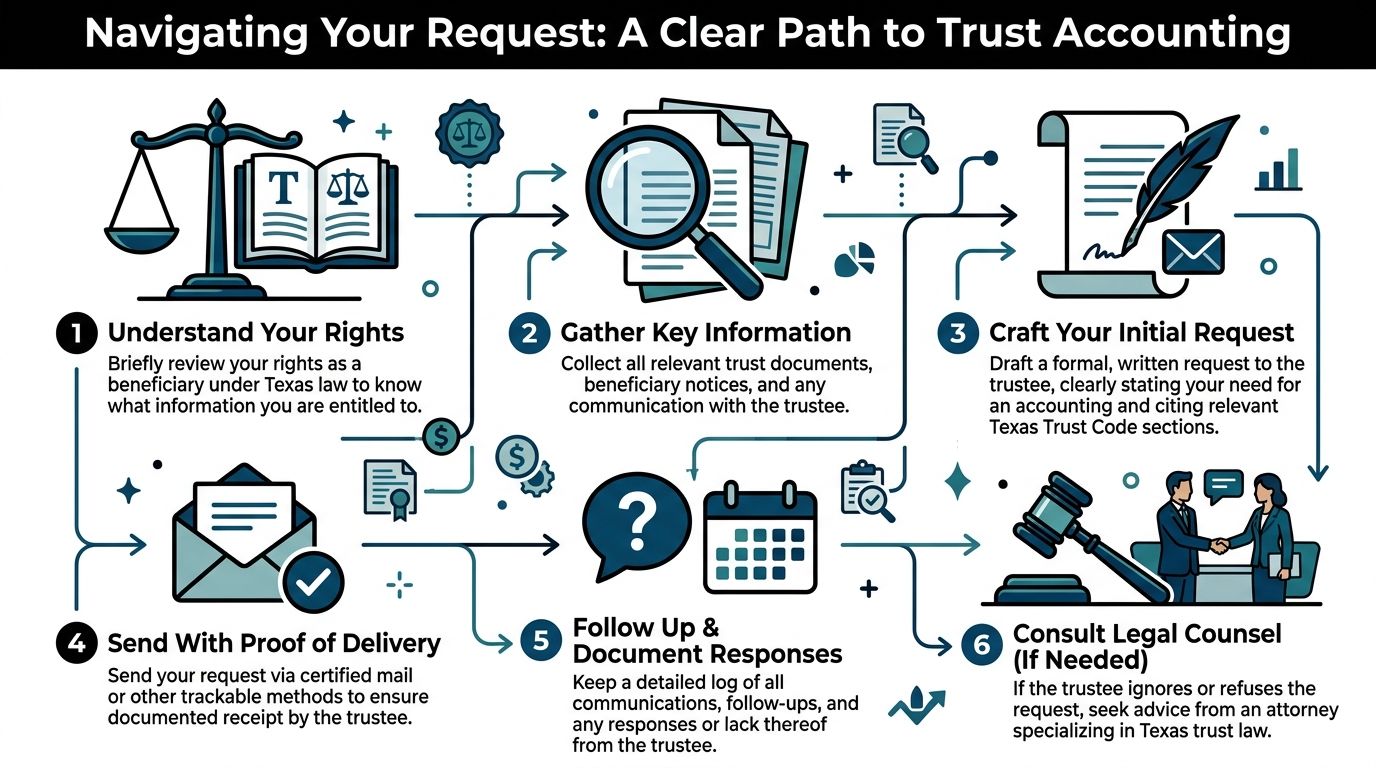
Early in the process, this visual summary can help you stay organized.
Start with a respectful direct request
If family dynamics allow it, begin with a straightforward written message or conversation. Keep it short. Ask for a written trust accounting for a defined period and request copies of any routine trust statements the trustee already has.
That first request can be collaborative. For example, you might say you are trying to understand the trust’s administration and want a clear picture of assets, income, expenses, and distributions. That wording often lowers the temperature.
A trustee reading that kind of message should not panic. A beneficiary is often looking for clarity, not a fight.
Gather your documents before you press harder
Before sending a formal demand, collect what you already have. That may include:
- The trust agreement or excerpts: Especially the sections naming the trustee and describing your interest.
- Letters or emails from the trustee: Any messages about distributions, property sales, expenses, or delays.
- Past statements: Bank, brokerage, or property information if you have received any.
- Notices from related proceedings: Probate filings, estate notices, or tax correspondence tied to trust assets.
These records help you make a more precise request. They also matter if the issue later reaches court.
Move to a formal written demand
If informal requests go nowhere, send a formal written demand. Use a method that creates proof of delivery, such as certified mail or another trackable option. Keep a copy of what you sent, the mailing receipt, and any response.
Your letter should identify the trust, identify yourself as a beneficiary, and request a written accounting. Stay factual. Avoid accusations unless you already have solid evidence.
Here is sample language you can adapt:
Dear Trustee,
I am a beneficiary of the [name of trust]. I am requesting a written trust accounting for the relevant accounting period under Texas law. Please include the trust assets, receipts, disbursements, distributions, liabilities, and any changes in trust property during that period, along with supporting information sufficient to understand the trust’s financial status. Please provide the accounting in writing by a reasonable date and preserve all trust records related to this request.
Sincerely,
[Your Name]
That language is simple on purpose. It asks for the substance without unnecessary argument.
Keep a paper trail from the start
Documentation matters more than many people realize. If the trustee later says, “I never got the request,” your records may answer that immediately.
Create a small file that includes:
- The date you first asked
- How you asked
- Who responded
- What was promised
- Whether any documents arrived
- Any follow-up messages
A beneficiary who keeps good records looks credible. A trustee who keeps good records looks responsible. That matters in and out of court.
After you send the request, it can help to hear a practical explanation of the process from a Texas trust perspective.
What trustees should do when they receive the request
If you are the trustee, do not ignore the letter while you “figure things out.” Silence creates risk.
A better response looks like this:
- Acknowledge receipt promptly: Let the beneficiary know you received the request.
- Review the trust terms: Some trusts add guidance on reports and timing.
- Collect the records: Bank statements, brokerage statements, deeds, tax records, invoices, receipts, and prior accountings.
- Prepare a readable summary: The goal is not to bury the beneficiary in paper. It is to provide a clear accounting supported by records.
- Get legal help if needed: If the trust is complex, there is family conflict, or the records are incomplete, a Texas trust administration lawyer can help prepare a compliant response.
When the request needs legal backup
Some situations need counsel sooner rather than later. That includes cases where:
- the trustee has sold property and not explained where proceeds went
- beneficiaries are receiving inconsistent answers
- trust and estate assets appear to be mixed together
- a trustee may have paid personal expenses from trust funds
- one beneficiary is getting information while another is shut out
In those situations, a lawyer can help frame the request in a way that is firm, complete, and strategically sound.
The strongest demand letters are usually calm, specific, and well documented. Angry letters often feel satisfying in the moment, but they rarely improve the response.
What a Proper Texas Trust Accounting Must Include
Getting a packet in the mail is not the end of the problem. The next question is whether the accounting is complete.
Some trustees send a few statements and assume that is enough. Sometimes it is. Often it is not. A proper accounting should let a beneficiary understand the trust’s financial story, not force them to guess at it.
The core pieces of a usable accounting
The verified guidance tied to Texas trust accounting explains that the accounting should identify trust property known to the trustee, show receipts and disbursements, and reflect changes in value over the period. That is the baseline.
This checklist can help you review what you received.
| Required Element | What to Look For |
|---|---|
| Trust assets | A clear list of property held in the trust, such as real estate, bank accounts, brokerage accounts, or business interests |
| New property | Assets that came into the trust during the period and were not previously listed |
| Receipts | Income or other funds received, with dates and descriptions |
| Disbursements | Payments made out of the trust, with dates, amounts, and reasons |
| Changes in value | Information showing increases or decreases in trust property value during the period |
| Debts and obligations | Loans, taxes, expenses, or other amounts owed by the trust |
| Distributions | Money or property distributed to beneficiaries, including who received what |
| Supporting detail | Enough explanation to let a beneficiary understand the trust’s financial condition |
A trustee does not help anyone by using labels like “miscellaneous expense” or “administrative cost” without explanation. Specificity matters.
Red flags that deserve a closer look
A trust accounting should answer questions. If it creates more questions than it resolves, slow down and review it carefully.
Watch for issues like these:
- Vague entries: Repeated line items with no supporting description
- Missing periods: Months with no statements or unexplained gaps
- Unclear transfers: Money moving between accounts without explanation
- Personal-looking expenses: Charges that do not appear connected to trust administration
- Asset confusion: Property mentioned in conversation but missing from the accounting
The reason this matters is practical. A primary reason for demanding an accounting is to prevent common pitfalls that can devalue a trust. Unfunded or improperly funded trusts can force up to 70% of trust assets into probate, and undocumented expenses or self-dealing by a trustee are triggers for nearly 50% of trust disputes, according to the Texas-focused analysis at txprobatelawyer.net on creating a trust account.
Why bank-level detail matters
Many trust disputes become clearer when someone reconciles the bank activity carefully against the trustee’s summary. If you want a plain-English primer on that process, this guide on mastering bank account reconciliation is a useful companion resource.
For legal standards specific to Texas trust accountings, this explanation of what trust accounting means under Texas law gives additional context.
A simple way to test the accounting
Ask these questions:
Can I trace the money?
If funds came in, can you see where they went?Can I identify each asset?
The accounting should not leave you guessing what the trust owns.Can I connect expenses to trust purposes?
Legitimate administration costs should make sense in relation to the trust.Can I match the report to supporting records?
The accounting should line up with statements, receipts, and other documents.
If the answer to several of those questions is no, the accounting may be incomplete or misleading.
A good accounting is readable by a normal person. It does not require a beneficiary to decode mystery entries or accept unexplained gaps.
When a Trustee Refuses to Provide an Accounting
Some trustees cooperate. Others delay, dodge, or refuse outright.
That can feel defeating, especially when the trustee is a relative. But a refusal does not end the matter. Texas law gives courts authority to step in when a trustee will not meet disclosure duties.

What going to court usually means
The common remedy is a court filing that asks the judge to compel the trustee to provide an accounting. Lawyers may call this a petition or motion to compel, depending on the case posture.
For many families, the phrase sounds severe. In practice, it means you are asking the court to enforce a duty that already exists. The court is not inventing a new obligation. It is requiring compliance with one the trustee should already be honoring.
Why delay can become expensive
Accounting disputes can grow into broader fiduciary fights. In Texas, breach of fiduciary duty claims tied to accounting disputes can become very expensive and take a considerable amount of time to resolve. A 2024 Texas Bar Journal analysis found that approximately 40% of all trust and estate litigation cases involved allegations of improper accounting or a trustee's failure to inform beneficiaries (Texas Bar Journal).
That does not mean every dispute turns into a major lawsuit. It does mean ignoring the issue is risky.
What a court may want to see from you
If you are the beneficiary asking the court for help, your lawyer will usually want to show that you acted reasonably first.
Helpful materials often include:
- Your written request for accounting
- Proof of delivery
- Any responses from the trustee
- The trust document, if available
- Any partial records or statements already provided
- A timeline of events
This is one reason careful documentation matters from the beginning. Courts respond better to organized facts than emotional accusations.
Common trustee defenses
Trustees sometimes respond with arguments that sound strong but may not resolve the issue. Examples include:
“The beneficiary is just harassing me.”
Courts can recognize abuse, but a proper request for an accounting is not harassment by itself.“I already sent some statements.”
A few statements may not satisfy the legal duty if they do not amount to a meaningful accounting.“The trust is private.”
Trust privacy does matter, but it does not erase disclosure duties owed to beneficiaries.“I have discretion.”
A trustee may have discretion in making certain decisions, but discretion does not usually eliminate the duty to account for those decisions.
Possible outcomes when the court gets involved
Every case is fact-specific, but a court may:
- order the trustee to produce a formal accounting
- set deadlines for production
- require additional documentation
- review whether the trustee breached fiduciary duties
- consider removal or other remedies if the misconduct is serious
For trustees, this is why silence is rarely a good strategy. Even if records are messy, a measured response and early legal guidance often work better than forcing the beneficiary to seek a court order.
If you are a beneficiary, court intervention is not a failure. Sometimes it is the tool needed to move a stalled administration forward.
Partnering with a Texas Trust Attorney for Clarity and Peace of Mind
Some trust accounting questions are simple. Many are not.
You may need legal help if the trustee ignores you, if the accounting looks incomplete, if the trust owns complex assets, or if family conflict is already affecting administration. Trustees also benefit from counsel when they need to prepare a compliant accounting, interpret the trust terms, or separate trust administration from related probate or tax issues.
When beneficiaries should call a lawyer
A beneficiary should strongly consider speaking with counsel when:
- a formal request has been ignored
- records appear altered, incomplete, or confusing
- distributions seem unequal without explanation
- the trustee may be using trust property personally
- trust assets overlap with probate assets or business assets
In those situations, a Texas estate planning attorney or Texas trust administration lawyer can evaluate both the trust terms and the trustee’s conduct.
When trustees should call a lawyer
Trustees sometimes assume hiring a lawyer makes things adversarial. Often the opposite is true.
A lawyer can help a trustee organize records, prepare an accounting that matches Texas requirements, and communicate with beneficiaries in a way that lowers the chance of litigation. That is especially helpful where the trust involves tax planning, real estate transfers, asset protection concerns, or questions about how to modify a trust in Texas.
The Law Office of Bryan Fagan, PLLC is one Texas option for trust administration support, along with related help involving estate planning, probate, guardianship, and asset protection. Trustees and beneficiaries looking for counsel can also review this overview of working with a trust administration attorney in Texas.
What standard of care clients should expect
When you hire a lawyer for trust administration, professionalism around money handling matters. Attorneys handling client funds are held to a strict standard under Rule 1.14 of the Texas Disciplinary Rules of Professional Conduct, which requires client funds to be kept in separate trust accounts and records to be maintained for at least 5 years, as summarized in LeanLaw’s discussion of trust accounting rules for Texas lawyers.
That matters because trust accounting cases often rise or fall on records, timelines, and financial detail. You want counsel who respects those demands.
A lawyer is not there only to file lawsuits. A good lawyer can help prevent one. For beneficiaries, that may mean getting answers. For trustees, it may mean building a clean record that shows they acted carefully and in good faith.
If you’re managing a trust or planning your estate, contact Law Office of Bryan Fagan, PLLC for a free consultation. Our attorneys provide trusted, Texas-based guidance for every step of the process. Whether you need help requesting an accounting, responding as a trustee, addressing probate concerns, planning for incapacity, or protecting family assets, our team can help you move forward with clarity and confidence.