Skip to content
Navigating a loved one’s estate can feel overwhelming, especially during an emotional time. But with the right legal guidance, it doesn’t have to be. Instead of a dense legal maze, think of the Texas Estates Code as a roadmap—one carefully drawn to honor your loved one's final wishes, protect their assets, and bring your family clarity.
Your Plain-English Guide to the Texas Estates Code

This guide translates dense legal language into clear, understandable steps. At The Law Office of Bryan Fagan, PLLC, we believe that peace of mind begins with understanding your rights and responsibilities. Our goal is to empower you with the knowledge needed to move forward with confidence.
What This Guide Will Cover
We'll walk you through the core of Texas estate law, offering practical advice for every step of the journey. Whether you are an executor, a beneficiary, or planning for your own future, this guide will help you understand your role.
We will explore key topics, including:
- Wills and Probate: What makes a will valid in Texas? And how does the court-supervised probate process actually work?
- Intestacy Rules: What happens when someone passes away without a will? We’ll explain how the state decides who inherits the property.
- Fiduciary Duties: Executors and administrators have specific legal responsibilities under the Texas Estates Code. We'll outline what those are.
- Guardianship: The Code provides protections for minors and incapacitated adults. We'll explain how that process works.
Putting this guide together reminded us of how important it is to create effective training materials that families can use to understand these complex legal issues. We are dedicated to empowering you with that knowledge.
Our approach is built on education and empathy, ensuring you feel secure in the steps you take next. Whether you need guidance on estate planning or are navigating the challenges of probate, our team is here to support you.
If you find yourself managing an estate or planning for your own, contact The Law Office of Bryan Fagan, PLLC for a free consultation. Our attorneys provide trusted, Texas-based guidance for every part of the process.
What is the Texas Estates Code?
Think of the Texas Estates Code as the official rulebook for what happens to a person’s property when they pass away or become unable to manage their own affairs. It’s not just a collection of dusty legal jargon; it's a practical roadmap designed to bring order and predictability to some of life's most difficult transitions.
The purpose of the Code is to create a clear, legally-sound path that respects a person's final wishes, minimizes family disputes, and ensures assets get to the right people. Instead of leaving families to argue or guess, it provides definitive rules for everything from creating a valid will to paying off debts and distributing what's left. It touches anyone who writes a will, inherits property, or is asked to manage an estate in Texas.
Key Roles Defined by the Texas Estates Code
To understand how the Texas Estates Code works in the real world, you must first understand the key roles involved. Each person has a specific set of legal duties and responsibilities, all working together to move the process forward.
These roles are not just informal titles; they are legally defined positions that come with serious accountability. An executor, for example, has a strict fiduciary duty to always act in the estate's best interest—a duty that is fully enforceable in a Texas court.
| Role | Primary Responsibility | Governed By |
|---|---|---|
| Testator | The person who creates a will to direct how their property is distributed. | Texas Estates Code |
| Executor | The person named in the will to manage the estate, pay debts, and distribute assets. | Texas Estates Code |
| Administrator | A person appointed by the court to manage an estate when there is no will. | Texas Estates Code |
| Beneficiary/Heir | An individual or entity entitled to receive property from the estate. | Texas Estates Code |
| Guardian | A person appointed to care for a minor or an incapacitated adult and/or their property. | Texas Estates Code |
Understanding these defined roles is the foundation for navigating the responsibilities you might face, whether as the person in charge or as a beneficiary.
Why This Code Matters to Your Family
At its heart, the Texas Estates Code is a framework built for protection and clarity. When a person writes a will, the Code lays out the specific requirements to make it legally binding. If someone passes away without a will, the Code provides a default plan—known as intestate succession—that distributes their assets based on family relationships.
The Code ensures there is a structured, court-supervised process for settling a person's affairs. This prevents a free-for-all and provides a forum for resolving disputes fairly.
Becoming familiar with this framework is the first step toward handling your duties with confidence. Whether you’re creating your own estate plan or have been put in charge of someone else’s, knowing the rules is essential. You can take a deeper dive into the court-supervised part of this journey in our guide on unlocking the Texas probate process. Of course, nothing replaces the guidance of an experienced Texas estate planning attorney who can make all the difference.
Making a Will and Navigating Texas Probate
A well-crafted will is your final word—the ultimate set of instructions you leave for your loved ones. But for that word to have legal force in Texas, it must follow the rules laid out in the Texas Estates Code. This isn't just a document; it's the single most powerful tool for ensuring your wishes are honored precisely as you intended.
For a will to be legally binding, it must meet three fundamental requirements. If any of these are missing, a court could declare it invalid. When that happens, the state’s default inheritance laws—not your wishes—decide who gets your property.
The Three Pillars of a Valid Texas Will
To ensure your will can stand up in court, it must be:
- In Writing: In nearly all Texas cases, an oral will is not valid. The entire document must be written down.
- Signed by You (the Testator): You must sign the will yourself. Alternatively, another person can sign it on your behalf, but they must do so in your presence and under your direct instruction.
- Attested by Two Credible Witnesses: Two witnesses, both at least 14 years old, must sign the will in your presence. They are confirming they watched you sign it.
These aren’t just technicalities; they are critical safeguards to prevent fraud and prove the will is a true reflection of your final wishes. You can find a deeper dive into these crucial steps in our guide on the requirements for a valid will in Texas.
Understanding the Probate Process
Once you have a valid will, the next step is probate. Many people hear "probate" and imagine a long, costly nightmare. It helps to reframe it as a court-supervised validation process. A judge confirms the will is legitimate and then officially empowers your chosen executor to carry out its instructions.
Probate serves as a crucial checkpoint, ensuring that debts are settled, titles are properly transferred, and beneficiaries receive what they are lawfully owed. It brings order and authority to the entire estate settlement process.
For example, imagine a family in Houston after their father passes. His eldest daughter, named as executor in his will, files the document with the Harris County probate court. The court validates the will, officially appoints her as executor, and issues "Letters Testamentary." This is the legal document that gives her the authority to act. Her fiduciary duties in Texas now begin, requiring her to gather assets, pay final bills, and distribute the remaining property to her siblings exactly as the will dictates.
Of course, things don't always go so smoothly. A disgruntled relative could file a will contest, claiming the document is invalid. This is just one of many reasons why getting guidance from a Texas estate planning attorney is so important. An experienced lawyer can help you draft a will designed to minimize these risks and can represent your executor in court, turning a potentially overwhelming ordeal into a clear, manageable process.
When There Is No Will: The Rules of Intestacy
It’s a question that causes a lot of anxiety: what happens if a loved one passes away without a will? Many people worry the state of Texas will simply claim all the property. That’s a common myth. The state does not take the assets. Instead, the Texas Estates Code steps in with a default plan.
This legal blueprint is called intestate succession. You can think of it as the will the state writes for someone who didn't create one themselves. The law lays out a clear, but rigid, order of who inherits property, all based on their family relationship to the person who died (the decedent).
This flowchart shows that fork in the road—the moment a court determines whether a valid will exists. If not, the estate is routed down the path of intestacy.
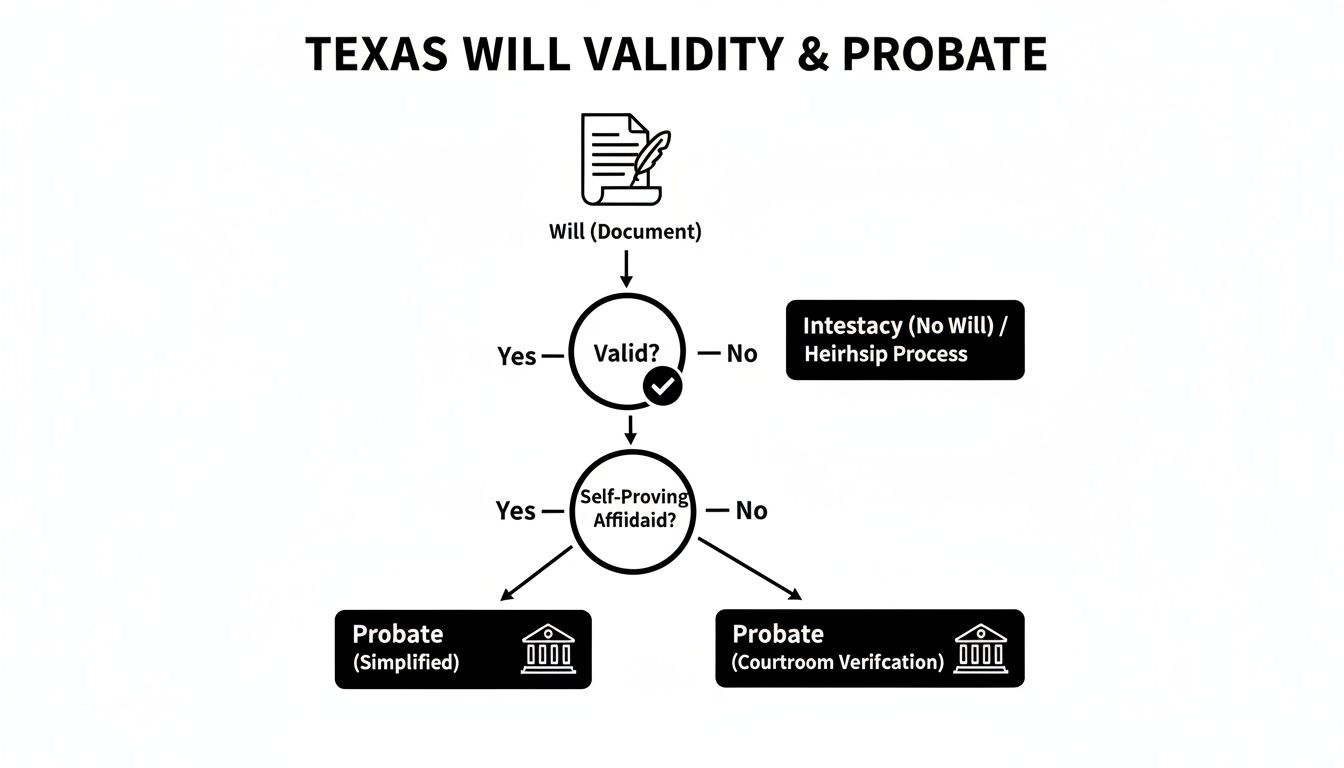
As you can see, the absence of a will triggers an entirely different legal process, one governed by a pre-set formula rather than personal wishes.
How Intestacy Divides Property in Texas
The intestacy rules are logical on the surface, but they can get messy in the real world. A huge factor is the difference between separate property (anything owned before the marriage or received as a gift or inheritance) and community property (everything acquired during the marriage). The final distribution hinges entirely on which family members are still living.
Because there's no executor named in a will, a court will appoint an administrator to manage the estate. Their job is very similar, and you can get a sense of the responsibilities by reviewing the duties of an executor of an estate.
Here are a few common scenarios to show how this plays out under Texas law:
- Survived by a Spouse and Children (from that same marriage): The spouse inherits all community property, plus one-third of the separate personal property. The children get the remaining two-thirds. The spouse also gets a life estate (the right to use for life) in one-third of the separate real estate, with the children inheriting the rest outright.
- Survived by a Spouse and Children (from another relationship): This is where it gets complicated. The surviving spouse keeps their half of the community property. The decedent's half, however, goes directly to their children from the previous relationship. The separate property rules are the same as above.
- Survived by a Spouse but No Children, Parents, or Siblings: This is the simplest scenario. The surviving spouse inherits everything—the entire estate.
- Survived by Children but No Spouse: The children inherit the entire estate, split into equal shares among them.
Intestate succession provides a safety net, ensuring property is distributed in an orderly fashion. However, it is a one-size-fits-all solution that may not reflect your loved one’s unique wishes or family dynamics.
The Downside of Default Rules
While having a default plan is better than chaos, it rarely lines up with what a person actually would have wanted. Intestacy doesn't account for unmarried partners, close friends, or special intentions for specific heirlooms. If your dad wanted his classic car to go to a specific grandchild or your mother wanted to leave a cash gift to her best friend, the law has no way of honoring that.
The process itself can also be more drawn-out and expensive than a standard probate. It often requires extra court hearings just to legally identify and prove who all the heirs are. This is precisely why working with a Texas estate planning attorney is so critical. A proper estate plan puts you in control, guaranteeing that your legacy is guided by your wishes, not a rigid state formula.
The Executor's Playbook: Fiduciary Duties in Texas

Being named an executor is a profound sign of trust. It is also a role that carries serious legal weight under the Texas Estates Code. You have been appointed the temporary manager of an estate, tasked with handling its affairs honestly and for the benefit of others.
This responsibility is legally known as a fiduciary duty—the highest standard of care the law recognizes. It requires you to set your own interests aside and act entirely for the good of the estate and its beneficiaries. This isn't just a moral suggestion; it's a legal command. Failing to meet this high bar can expose you to personal financial liability and legal battles.
Core Fiduciary Duties of an Executor
The Texas Estates Code clearly outlines several key responsibilities that form the bedrock of your role. Think of them as the non-negotiable rules for properly administering an estate.
Your primary duties are straightforward but critical:
- Duty of Loyalty: You must act exclusively in the best interests of the estate. This means no self-dealing, like selling estate property to yourself for a low price, or showing favoritism to one beneficiary over another.
- Duty of Prudence: You are required to manage the estate’s assets with the same care a reasonably prudent person would use for their own property. This involves making sensible decisions to protect assets from loss or neglect.
- Duty to Account: You must keep pristine records of every dollar that comes in and goes out. Beneficiaries have a legal right to request a formal accounting to see exactly how you've managed the finances.
These fiduciary duties in Texas are the foundation of your authority. Violating them, even accidentally, can lead to serious consequences.
Your Step-by-Step Executor Checklist
The administration process can feel overwhelming, but it can be managed by breaking it down into a clear, actionable checklist. Once the probate court officially appoints you and grants you Letters Testamentary, your duties begin.
Here is step-by-step guidance for your most important tasks:
- Inventory and Appraise All Assets: You have just 90 days from your appointment to file a detailed "Inventory, Appraisement, and List of Claims" with the court. This is a comprehensive catalog of every single asset—from bank accounts and real estate to personal belongings—and its fair market value.
- Notify Beneficiaries and Creditors: You are legally required to formally notify all beneficiaries named in the will. You must also publish a notice in a local newspaper to inform potential creditors, giving them a deadline to submit claims against the estate.
- Manage and Protect Estate Property: This is an active role. You will need to secure physical assets (like changing the locks on a home), maintain insurance policies, and consolidate and manage financial accounts. Your job is to prevent assets from losing value.
- Pay Legitimate Debts and Taxes: Using estate funds, you will settle all valid creditor claims, pay for funeral expenses, and file final income and estate taxes. If funds are tight, it's crucial to follow the legal priority for which debts get paid first.
- Distribute Remaining Assets: Only after all debts and expenses are paid can you distribute the remaining property to the beneficiaries, following the will’s instructions to the letter.
An executor is more than a paper-pusher; they are a guardian of the decedent's legacy. Your commitment to transparency and diligence is the key to a smooth and successful administration that honors your loved one and protects the family.
An experienced Texas trust administration lawyer can be an invaluable partner in this journey. They can help you navigate court deadlines, deal with complex assets, and ensure you comply with every facet of the law. Professional guidance from a firm like The Law Office of Bryan Fagan, PLLC can shield you from personal liability and give you the peace of mind to carry out your duties correctly.
Protecting Loved Ones Through Guardianship
The Texas Estates Code is more than just a set of rules for what happens after someone dies. It is also a powerful safety net, offering a compassionate system to protect the most vulnerable people in our communities.
When a child loses their parents, or an adult can no longer make safe, sound decisions for themselves, the Code provides a structured legal path called guardianship. This is a court-supervised process designed to protect a person's dignity, health, and financial well-being when they have lost the ability to do so on their own.
Navigating this path can be incredibly emotional, but it is often the only way to ensure a loved one gets the dedicated care and protection they need. The process is intentionally thorough, requiring a court to be fully convinced that a guardianship is the best and only appropriate option.
The Two Types of Guardianship in Texas
Texas law recognizes that someone might need help with their finances but be perfectly capable of making personal decisions, or vice-versa. Because of this, the law splits guardianship into two distinct roles. These jobs can be handled by one person or split between two.
- Guardian of the Person: This person is in charge of the individual’s physical well-being. Their responsibilities are deeply personal and include arranging for food, clothing, and a safe place to live, as well as making critical healthcare and medical decisions.
- Guardian of the Estate: This guardian is tasked with managing the individual’s financial world. They step in to protect, invest, and manage all property and assets, pay bills, and file taxes—all under the strict supervision of the court.
Taking on either of these roles is a massive responsibility. The guardian becomes a fiduciary, which is a legal term meaning they have a sworn duty to act only in the best interest of the person they’ve been appointed to protect.
Real-World Scenario: Seeking Guardianship
Imagine an adult son in Austin watching his mother, who has advanced dementia, struggle with her independence. She has started forgetting to pay utility bills, has gotten lost driving in her neighborhood, and can no longer keep track of her medical appointments. Her safety and financial stability are clearly at risk.
The son knows he must step in, but he has no legal authority to make decisions for her. Seeking a guardianship is the legal mechanism that empowers him to protect her.
To start, he would file an application with the local probate court. This involves submitting the application along with a detailed report from a physician that confirms his mother's incapacity and explains why she can no longer make responsible decisions for herself. The court will then appoint an independent attorney, called an "attorney ad litem," whose only job is to meet with his mother and represent her best interests, making sure her rights are protected.
Finally, the court will hold a hearing to review all the evidence. If the judge agrees that a guardianship is necessary and that the son is a suitable person for the job, the court will officially appoint him as her guardian. It’s a challenging but vital journey, and having a compassionate guardianship lawyer to guide you through the Texas Estates Code can provide clarity and reassurance every step of the way.
If you’re managing a trust or planning your estate, contact The Law Office of Bryan Fagan, PLLC for a free consultation. Our attorneys provide trusted, Texas-based guidance for every step of the process.
Common Questions About the Texas Estates Code
When you're dealing with the future of your family and assets, questions are bound to arise. The Texas Estates Code can feel like a dense, complicated rulebook, but understanding the basics is the first step toward peace of mind. Here are some of the most common questions we hear from Texans trying to navigate their responsibilities and protect their legacies.
How Long Does the Probate Process Take in Texas?
The timeline for probate in Texas depends on the complexity of the estate. If you have a clear, valid will and no one is contesting it, the process can be surprisingly smooth, often wrapping up in as little as six to twelve months. This is the best-case scenario, where the executor acts efficiently and no major issues arise.
However, the process can easily stretch beyond a year if someone challenges the will, beneficiaries are in conflict, or the estate includes hard-to-value assets. Locating every heir can also cause significant delays. Open communication and a well-organized administration are your best tools for a faster resolution, and an experienced Texas trust administration lawyer can be invaluable in keeping things on track.
Can I Avoid Probate in Texas?
Absolutely. With the right estate planning, it's entirely possible to structure your affairs so that most, if not all, of your assets bypass the probate courts. The goal is to use legal strategies that allow assets to transfer directly and automatically to your beneficiaries.
Some of the most common and effective tools for avoiding probate include:
- Revocable Living Trusts: When you place assets into a trust, they're no longer considered part of your personal estate for probate purposes. Your successor trustee simply takes over and distributes them according to your instructions—no court approval needed.
- Payable-on-Death (POD) Accounts: You can add a POD designation to bank accounts. It’s a simple form that tells the bank to transfer the funds directly to your named beneficiary when you pass away.
- Transfer-on-Death (TOD) Deeds: Texas law allows you to do the same thing for your real estate. A TOD deed works just like a POD account, transferring the property title directly to your beneficiary without getting tangled up in probate.
Working with a knowledgeable Texas estate planning attorney is the surest way to set up these tools correctly, ensuring your family stays out of court and your wishes are followed precisely.
What Happens if an Executor Mismanages an Estate?
An executor isn't just a helper; they are a fiduciary. This means they are held to a strict legal standard and have fiduciary duties in Texas to always act in the best interests of the estate and its beneficiaries. It is a position of immense trust, and the law enforces it.
If an executor abuses that trust—by mishandling funds, ignoring the will's instructions, or engaging in self-dealing like selling estate property to themselves at a low price—the beneficiaries have the power to fight back.
Beneficiaries are not powerless. The Texas Estates Code provides a legal framework for them to protect their inheritance and ensure the decedent’s wishes are honored.
The law gives beneficiaries several powerful remedies, including:
- Petitioning the court to remove the executor and have a more suitable person appointed.
- Filing a motion to compel a full accounting, which forces the executor to reveal exactly where every penny went.
- Suing the executor for damages to hold them personally liable for any financial harm they caused the estate.
If you suspect an executor is failing to meet their obligations, you should seek legal advice right away. Protecting the estate's assets means acting quickly to understand and enforce your rights.
If you’re managing a trust or planning your estate, contact The Law Office of Bryan Fagan, PLLC for a free consultation. Our attorneys provide trusted, Texas-based guidance for every step of the process.