Managing a loved one’s trust can feel overwhelming, especially when you’re waiting on a distribution and no one is giving you a straight answer. Many beneficiaries come to this issue with the same question: can a trustee withhold distribution texas, or is something going wrong?
The short answer is that a trustee can sometimes delay a distribution, but can’t hold it back just because they want to. Texas law gives trustees real authority, but it also puts them under strict rules. They must follow the trust, act fairly, and protect the beneficiaries they serve.
If you’re a beneficiary, the hardest part is often knowing what your delay means. Is the trustee doing legitimate cleanup work, or are they crossing a legal line? That’s where a calm, step-by-step approach matters.
Understanding a Trustee’s Core Responsibilities in Texas
A trustee is not the owner of the trust property in the everyday sense. A trustee is more like the person trusted to hold the keys, pay the bills, follow instructions, and deliver property to the right people at the right time.
That matters because many families assume the trustee gets to make every call without oversight. Under Texas law, that’s not how it works.

Fiduciary duties are the starting point
A trustee owes fiduciary duties in Texas. In plain English, that means the trustee must put the trust’s purpose and the beneficiaries’ interests ahead of personal feelings, convenience, or grudges.
Think of the trustee like the captain of a boat carrying several family members. The captain can’t steer safely for one passenger and ignore the others. The trustee has to manage the trust for all the people the trust is meant to benefit, and must do so with care.
Key duties often include:
- Duty of impartiality: If there is more than one beneficiary, the trustee can’t favor one over another without a valid reason found in the trust.
- Duty of prudent administration: The trustee must manage assets carefully, not casually.
- Duty to follow the trust document: The trustee’s job is to carry out the settlor’s instructions, not rewrite them.
- Duty to communicate when required: Silence is often what scares beneficiaries most. A trustee usually needs to provide meaningful information, not vague brush-offs.
Practical rule: A trustee has power, but not personal control. The trust document and Texas law set the boundaries.
If you want a deeper overview of the role itself, this explanation of what a trustee does in Texas can help frame the bigger picture.
A trustee can’t arbitrarily refuse a required distribution
One of the most important rules for families to understand is this: arbitrary withholding is not allowed. Under the Texas Trust Code, trustees are strictly prohibited from withholding distributions arbitrarily, and they owe duties that include impartiality and prudent administration, as discussed in this Texas trust distribution analysis.
That same discussion explains another point beneficiaries often want to know. For an “outright and free of trust” distribution, assets should be released within a reasonable time, typically 6 to 12 months if no estate tax return is required, which is generally relevant for estates under $13.61 million.
What “reasonable time” means in real life
Reasonable time doesn’t mean instant payment. A trustee may need time to gather records, value assets, pay final expenses, or sell property. But reasonable time also doesn’t mean endless delay.
A few common examples help:
| Situation | Likely meaning |
|---|---|
| The trustee is gathering account statements and paying trust bills | Often a normal part of administration |
| The trustee says nothing for long stretches and ignores written questions | Often a warning sign |
| The trust says distribution happens at age 30, and the beneficiary has reached 30 | The trustee usually needs to act promptly once conditions are met |
| The trustee says “I have absolute discretion, so I don’t have to explain anything” | That claim is often too broad under Texas law |
Why beneficiaries get confused
The confusion usually comes from one word: discretion.
Families hear that word and assume it means “the trustee can do whatever they want.” It doesn’t. A trustee may have judgment to exercise, but that judgment still has to fit the trust’s terms and Texas law.
That’s why a Texas trust administration lawyer often starts with the same basic review. What does the trust say? What event triggered the distribution? What explanation, if any, has the trustee given? Those questions usually tell you whether you’re seeing normal administration or the beginning of a dispute.
Legitimate Reasons a Trustee May Delay a Distribution
Not every delay means misconduct. Sometimes the trustee is doing exactly what Texas law requires, even if the wait is frustrating.
A trust works a bit like closing out a complex household after a death. Before anyone starts dividing what’s left, someone has to make sure the bills are covered, the property is identified, and the instructions are followed.
The trust may need to pay obligations first
A trustee may withhold distributions for specific, justifiable reasons such as paying trust debts, waiting for asset liquidation, or enforcing trust conditions, but unreasonable or arbitrary withholding can become a fiduciary breach under the Texas Trust Code, as explained in this discussion of trustees not distributing assets in Texas.
That means a trustee may need to pause before writing checks to beneficiaries if the trust still has unfinished business.
Some common examples include:
- Unpaid debts: The trust may owe legitimate expenses that need to be handled first.
- Administrative costs: Appraisals, tax preparation, and other administration tasks can affect timing.
- Asset liquidation: If the trust owns a house, ranch, business interest, or other non-cash asset, the trustee may need time to sell or transfer it properly.
If a trust owns a property in San Antonio, for example, the trustee may need to list it, review offers, close the sale, and then determine the net amount available for distribution.
Trust terms may require waiting
Some delays happen because the trust itself says so. This is common when distributions depend on a triggering event or a standard the trustee must apply.
Common trust conditions
- Age-based distributions: A beneficiary may receive funds only after reaching a certain age.
- HEMS standards: Some trusts permit distributions for health, education, maintenance, and support.
- Staged distributions: The trust may release one share now and another share later.
- Protective language: Some trusts are written to prevent fast payouts that might defeat the trust’s purpose.
A trustee who follows these terms is not “withholding” in the wrongful sense. The trustee is administering the trust as written.
A delayed distribution can be lawful when the trustee is tying up loose ends, converting property to cash, or checking whether the trust’s conditions have actually been met.
Asset type changes the timeline
Cash in a brokerage account is one thing. A family business, mineral interests, or real estate is another.
Beneficiaries often compare their trust to a simple bank account and wonder why payment hasn’t arrived. But some assets can’t be divided quickly without causing problems. A rushed sale can hurt value. An unfinished title issue can block transfer. A trustee may need time to act carefully.
That doesn’t give the trustee a free pass to stall. It does mean the beneficiary should ask a more focused question: is the trustee moving the administration forward, or just using complexity as an excuse?
A short comparison helps
| Trustee explanation | Usually legitimate or concerning |
|---|---|
| “We are paying debts and final expenses before making distributions.” | Often legitimate |
| “The trust owns property that must be sold before your share can be calculated.” | Often legitimate |
| “The trust says you receive funds only after a stated condition is met.” | Often legitimate |
| “I just don’t think you should get the money yet.” | Concerning |
| “You don’t need to know why.” | Concerning |
What a careful beneficiary should ask
You don’t need to accuse the trustee right away. Start by asking for clarity.
A good written request might ask:
- What specific reason is causing the delay?
- What trust provision supports that delay?
- What tasks remain before distribution can occur?
- Is there an expected timeline for completion?
That kind of message does two useful things. It gives an honest trustee a chance to explain, and it creates a record if the explanations remain vague.
When Withholding Distributions Crosses a Legal Line
The most common misunderstanding in these cases is the idea that “discretionary” means unlimited power. It doesn’t.
Texas beneficiaries often aren’t told that even in discretionary trusts, the trustee must exercise judgment in good faith and cannot act from improper motives such as hostility toward the beneficiary, as noted in this analysis of trust distribution standards.

Discretion still has limits
A discretionary trust gives the trustee room to make judgment calls. It does not let the trustee punish a beneficiary, settle old family conflicts, or make decisions based on personal dislike.
A trustee crosses the line when their reason for withholding is something like:
- Hostility: The trustee is angry with the beneficiary and uses the trust to gain an advantage.
- Favoritism: One sibling gets paid, another gets ignored, without support in the trust document.
- Self-interest: The trustee delays because keeping assets in the trust benefits the trustee personally.
- Vague authority claims: The trustee insists they have total discretion but won’t identify any actual trust language or factual basis.
A beneficiary doesn’t have to prove every bad motive immediately. But these signs often point to a problem worth investigating.
Red flags families should take seriously
Some facts, by themselves, don’t prove a breach. Still, certain patterns tend to show up when a trustee is acting outside the lines.
Look closely if you see:
- Repeated silence: Emails, letters, or calls go unanswered.
- Changing explanations: The trustee gives one reason this month and another later.
- No records: The trustee refuses to provide financial information that should exist.
- Unequal treatment: Other beneficiaries receive information or money while you get excuses.
- Moral judgments: The trustee acts like they can withhold funds because they disapprove of your spending habits, marriage, work history, or life choices.
When a trustee stops acting like a neutral fiduciary and starts acting like a gatekeeper with personal opinions, legal risk usually follows.
A short video can help put these warning signs into context.
Mandatory trusts and discretionary trusts are not the same
Many beneficiaries find this distinction confusing.
If the trust says a beneficiary must receive property when a condition is met, the trustee generally does not get to improvise. If the trust says the trustee may distribute based on a standard, the trustee has judgment to exercise, but that judgment must still be honest, reasoned, and connected to the trust’s purpose.
That difference matters in almost every dispute.
| Trust type | What it usually means |
|---|---|
| Mandatory distribution trust | The trustee generally must distribute once the stated condition occurs |
| Discretionary trust | The trustee has judgment, but must use it in good faith |
| Hybrid arrangement | Some distributions are required, while others depend on standards or timing |
The practical question to ask
Instead of asking only, “Can a trustee withhold distribution texas?” ask this: What exact authority is the trustee relying on, and does their conduct match that authority?
That question moves the issue from emotion to evidence. And in trust disputes, evidence is what matters.
Real-World Scenarios of Distribution Delays
Legal rules become easier to understand when you place them in ordinary family situations. Here are two examples that show the difference between a lawful delay and a likely breach.
The San Antonio property sale
A mother’s trust leaves equal shares to her three children. Most of the trust value is tied up in a commercial property in San Antonio.
The trust says each child is to receive an equal distribution after administration is complete. One child expects a check right away and becomes upset when months pass.
The trustee explains, in writing, that the property must be sold before shares can be calculated fairly. The trustee also provides updates about listing activity, closing steps, and expenses tied to the sale.
That kind of delay is often legitimate. The trustee isn’t refusing to distribute. The trustee is doing the work needed to turn an illiquid asset into something that can be divided.
A careful trustee in that situation usually does three things right:
- keeps beneficiaries informed,
- documents the reason for the delay,
- and connects each decision back to the trust terms.
The disfavored sibling
A father’s trust directs that his children receive equal shares after his death. One child is also named as trustee.
The trustee distributes money to one sibling but tells the other, “Dad wouldn’t have wanted you to waste this,” even though the trust contains no language allowing the trustee to deny or reduce that child’s share. The trustee avoids written explanations and ignores requests for records.
This example raises a very different concern. The issue is not administration. The issue is personal judgment replacing legal duty.
Texas law does not generally allow a trustee to withhold a required distribution because of disapproval, resentment, or a family grudge. If the trust requires equal treatment, the trustee can’t rewrite that instruction based on personal beliefs.
A trustee may manage trust property, but the trustee does not get to edit the settlor’s instructions to reward one child and punish another.
How to compare your situation
If you’re trying to judge your own case, these questions can help:
| Question | Why it matters |
|---|---|
| Did the trustee give a clear reason for the delay? | A real explanation is easier to evaluate than silence |
| Does the reason connect to the trust language? | Trustees must act under actual authority |
| Is the trustee sharing updates and records? | Transparency often signals proper administration |
| Are all beneficiaries being treated consistently? | Uneven treatment can point to partiality |
Families often know something feels off before they know why. That instinct shouldn’t replace legal analysis, but it also shouldn’t be ignored.
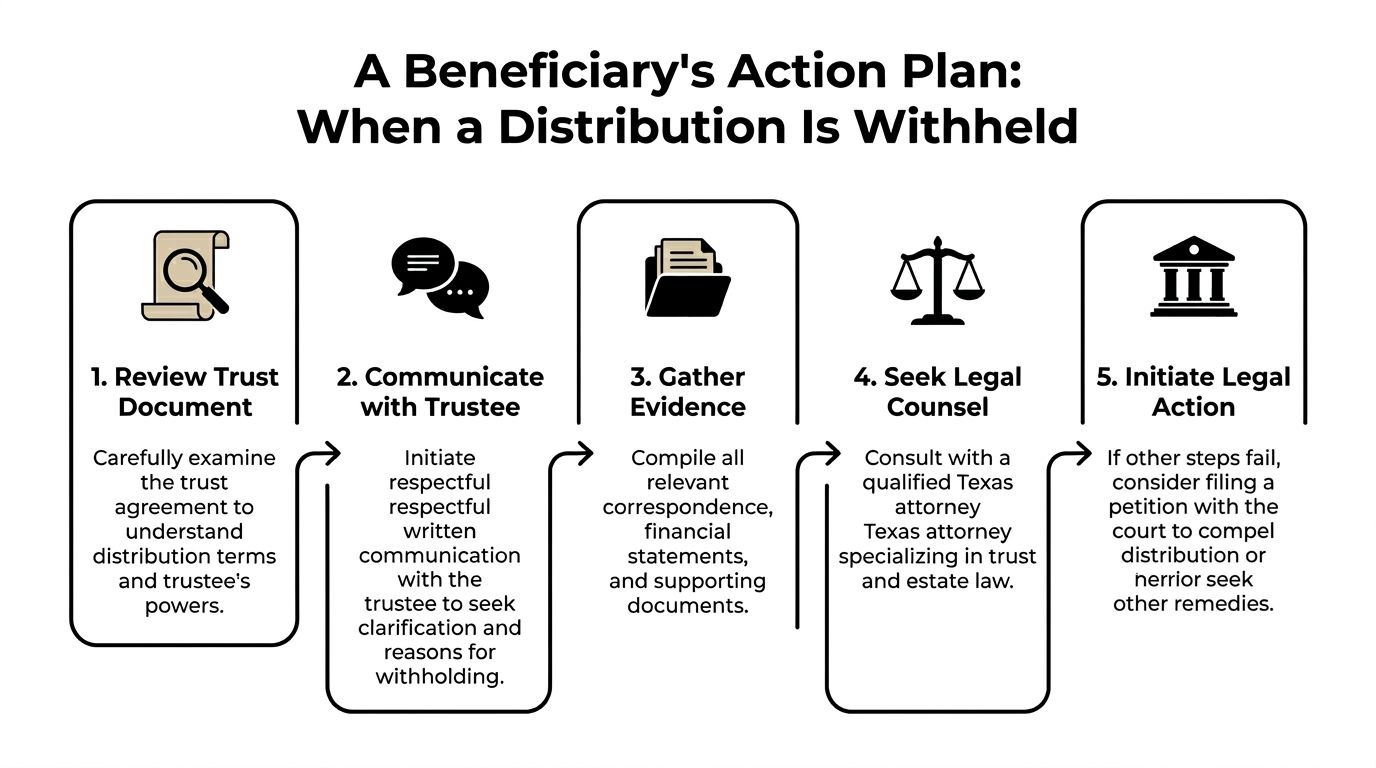
A Beneficiary's Action Plan When a Distribution Is Withheld
When a trustee won’t distribute, many beneficiaries freeze. They don’t want to start a family fight, but they also don’t want to sit still while money or property remains tied up.
A better approach is to move in stages. Start with information. Build a record. Escalate only as needed.
Step one: review the trust carefully
If you have a copy of the trust, read the actual distribution language. Look for the exact event that triggers payment.
You’re trying to answer basic but powerful questions:
- Is the distribution mandatory or discretionary
- Has the triggering event already happened
- Does the trustee have any stated condition to satisfy first
If you don’t have the trust document, requesting it is usually part of the process.
Step two: send a respectful written request
Phone calls are easy to deny or misremember. Written communication is better.
Your message should be calm and specific. Ask why the distribution has not been made, what tasks remain, and when the trustee expects to finish them.
A useful written request often includes:
- The date of your request
- The provision or event you believe triggered the distribution
- A request for a written explanation
- A request for a timeline
This isn’t just about getting answers. It also creates a paper trail.
Step three: ask for an accounting
One major gap in many Texas resources is that they mention remedies but don’t clearly explain practical prerequisites such as requesting an accounting before litigation, as discussed in this overview of beneficiary enforcement issues.
An accounting can help reveal what the trustee has done with trust property, what expenses have been paid, and whether the delay has a real basis. If you need guidance on that process, this resource on a demand for trust accounting in Texas is a useful starting point.
Step four: organize your evidence
At this point, details matter. Keep everything in one place.
That includes:
- Emails and letters: Save every message with dates.
- Trust documents: Keep the full trust and any amendments together.
- Financial records received: Statements, summaries, or partial accountings can become important.
- Your own timeline: Write down what happened and when.
Key takeaway: The beneficiary with the clearest records is usually in a stronger position than the beneficiary with the strongest suspicions.
Step five: get legal advice before the dispute gets worse
If the trustee keeps dodging, an attorney can evaluate the trust language, the communications, and the likely next move. Sometimes a lawyer’s letter is enough to force a meaningful response. Sometimes it reveals that court action is the only realistic option.
This is also where a beneficiary can weigh cost, timing, and likely outcomes in a practical way. A dispute isn’t only about legal principles. It’s also about whether the next step is worth taking now.
One option families sometimes consider is consulting a Texas firm that handles trust administration and beneficiary disputes, such as the Law Office of Bryan Fagan, PLLC, which provides guidance on trustee duties, accountings, and trust litigation matters.
A simple roadmap
| Step | What you do | Why it helps |
|---|---|---|
| Review documents | Read the trust terms closely | Confirms whether a distribution is actually due |
| Write the trustee | Ask for reasons and timing in writing | Creates a clear record |
| Request an accounting | Seek formal financial information | Tests whether the delay is supported by facts |
| Gather records | Organize communications and documents | Prepares you for negotiation or litigation |
| Consult counsel | Get a legal assessment of your options | Helps you act strategically, not emotionally |
A lot of beneficiaries wait too long because they hope silence will clear on its own. Sometimes it does. Often it doesn’t.
Legal Remedies a Texas Court Can Enforce
If a trustee still won’t act after requests for information and an accounting, the court can step in. Litigation isn’t the first choice in every case, but it is the tool Texas law provides when a trustee stops honoring the trust.
Texas courts can enforce trustee accountability through remedies that include surcharge, trustee removal, compelled accounting, and court orders for distribution, particularly when delays stretch for months or years, as described in this discussion of trustee penalties for withholding distributions.
A court can order the trustee to provide information
Sometimes the first meaningful court remedy is not immediate payment. It is forced transparency.
If a trustee has refused to explain what’s happening, the court can require an accounting or require the trustee to produce records. That often changes the case quickly. Once records are on the table, the reason for the delay becomes much easier to evaluate.
A court can compel distribution
If the trust terms are clear and the trustee is not following them, a court can order the trustee to make the required distribution.
This is especially important in mandatory distribution situations. If the trust says the beneficiary receives property after a stated event and that event has occurred, the trustee may have little room to resist once the court reviews the documents.
A court can remove the trustee
Removal is one of the strongest remedies. Courts may remove a trustee when the trustee’s conduct shows they can no longer serve fairly or effectively.
Examples may include:
- Bias that affects administration
- Refusal to follow the trust document
- Repeated failures to communicate
- Mismanagement of trust property
- Conduct showing the trustee cannot act impartially
Removal changes the power structure of the case. Once a neutral replacement takes over, administration often becomes more orderly.
A surcharge can make the trustee pay personally
The word surcharge sounds technical, but the idea is simple. If a trustee’s wrongful conduct causes losses, the court can require the trustee to repay those losses personally.
That matters when a delay causes measurable harm, such as missed opportunities, unnecessary expense, or avoidable depletion of trust value. The trust itself should not have to absorb losses caused by a trustee’s breach.
Court remedies do more than punish misconduct. They protect the trust and put pressure on the trustee to follow the law.
What the court process often looks like
Every case is different, but the basic path usually involves:
- Reviewing the trust and evidence
- Filing a petition with the proper court
- Serving the trustee and any required parties
- Seeking targeted relief, such as an accounting, distribution, removal, or surcharge
- Presenting documents and testimony if the dispute isn’t resolved earlier
For beneficiaries considering that step, this guide on how to sue a trustee gives a practical overview of the process.
Related legal issues sometimes overlap
Trust disputes don’t always stay neatly inside one box. A delayed distribution can overlap with probate issues, family settlement questions, concerns about incapacity, or even guardianship-related matters when a vulnerable beneficiary is involved.
That’s one reason families often benefit from talking with a Texas estate planning attorney or Texas trust administration lawyer who can see the whole picture. Sometimes the trust dispute is the main issue. Sometimes it is one part of a larger estate administration problem that also touches probate, guardianship, or asset protection planning.
If you’re managing a trust or planning your estate, contact Law Office of Bryan Fagan, PLLC for a free consultation. Our attorneys provide trusted, Texas-based guidance for every step of the process, including trust administration, probate, guardianship, estate planning, and asset protection. If you’re a beneficiary dealing with a delayed distribution, we can help you understand your rights, evaluate your next step, and pursue a practical solution grounded in Texas law.