A parent dies. One child finds the will in a desk drawer. Another asks whether probate is required. A third says, “Didn’t Mom have a trust?” Meanwhile, bills keep coming, family tension starts to rise, and the person named to handle everything worries about making a mistake.
That moment is where many Texas families begin. They’re not looking for theory. They want to know which path is simpler, which path is safer, and which path protects the people left behind.
The comparison between independent administration Texas vs trust matters because both can work well, but they solve different problems. One is a simplified probate process under the Texas Estates Code. The other is a private administration structure under the Texas Trust Code. Both involve fiduciary duties in Texas. Both require someone to act carefully for others. But they differ in court involvement, privacy, speed, control, and one issue families often miss until it’s too late: the personal risk carried by the person in charge.
Good planning doesn’t eliminate grief. It does remove confusion. It also gives executors, trustees, beneficiaries, and relatives a clearer map for what happens next.
Planning Your Legacy in Texas An Introduction
Texas families usually arrive at this decision from one of two places. Some are planning ahead and trying to avoid future stress. Others are already in the middle of an estate and need to decide how a loved one’s property will move from one generation to the next.
Consider two familiar situations. In the first, a widow owns a home, a few bank accounts, and some investment accounts. She wants a clean transfer to her adult children and doesn’t want them stuck in court longer than necessary. In the second, a business owner has real estate, private company interests, and family members who don’t always agree. He worries less about paperwork and more about privacy, continuity, and whether the person in charge could face blame if something goes wrong.
Those families aren’t asking the same question, even if they both say, “Should I just do a will, or do I need a trust?”
Practical rule: The right estate plan isn’t the one with the most documents. It’s the one that fits your assets, your family dynamics, and the level of risk your fiduciary can realistically manage.
In Texas, a will often leads to independent administration, which is a probate process designed to reduce court supervision. A revocable living trust works differently. It holds assets under trust terms so a successor trustee can manage and distribute them privately.
That difference sounds technical, but it affects real-life issues fast. Who can act right away. Who must file papers with the court. Whether the family’s financial information becomes public. Whether a fiduciary has room to make decisions without asking a judge first. And whether that freedom creates hidden exposure.
When people meet with a Texas estate planning attorney, they often assume the main question is cost. Cost matters. But so do liability, family harmony, and the kind of assets involved. Those points often decide the better path.
The Two Paths for Your Texas Estate
A family often reaches this point after a hard conversation. One child asks, “Can we keep this simple?” Another asks, “Who gets blamed if something goes wrong?” In Texas, those questions usually lead to two different legal paths.

Independent administration under the Texas Estates Code
Independent administration is the probate route many Texas wills are designed to use. The court admits the will to probate, appoints an executor, and then gives that executor broad room to act without asking the judge for approval at every turn.
That efficiency is the appeal. It can save time, reduce court involvement, and keep routine estate business moving.
But the freedom comes with a tradeoff that families often miss. The executor is standing in a very exposed position. He or she may be collecting assets, paying debts, dealing with beneficiaries, signing tax returns, and making judgment calls under fiduciary duties, often with less active court guidance than people expect. For some families, that works well. For others, it places a heavy personal burden on the person named in the will.
Probate still matters here because the executor’s authority starts inside the court process. Families who are unsure which assets require probate can review when probate is required in Texas before assuming a will controls everything.
Revocable living trusts under the Texas Trust Code
A revocable living trust works differently. During life, the trust is set up to hold assets under written trust terms. At incapacity or death, a successor trustee steps in under those terms and manages trust property without opening a probate case for assets that were properly transferred into the trust.
That changes more than privacy. It changes the operating environment for the person in charge.
A trustee still owes fiduciary duties. No trust removes responsibility. But a trustee usually works inside a more detailed set of instructions, with trust-owned assets already positioned for management and transfer. In practice, that structure can reduce the confusion that leads to personal exposure, especially where there are ongoing accounts, real estate, business interests, or beneficiaries who second-guess every decision.
For a plain-language overview of basic concepts, Wills vs Trusts offers a helpful starting point.
Why Texans use both
These are not just two document choices. They are two different ways to place legal authority after death.
Independent administration often fits a simpler estate where the executor is organized, the assets are easy to identify, and the beneficiaries are likely to cooperate. A trust often makes more sense where the family wants privacy, faster continuity, or added structure around the person serving in charge.
That last point deserves attention. Many online comparisons focus on probate cost or speed. Those points matter, but they are not the whole decision. In many families, the better question is whether you are asking an executor to operate with broad authority and real personal risk, or giving a trustee a framework that offers clearer guardrails from the start.
A will with independent administration can be efficient. A funded trust can be more protective for the person who has to carry out the plan.
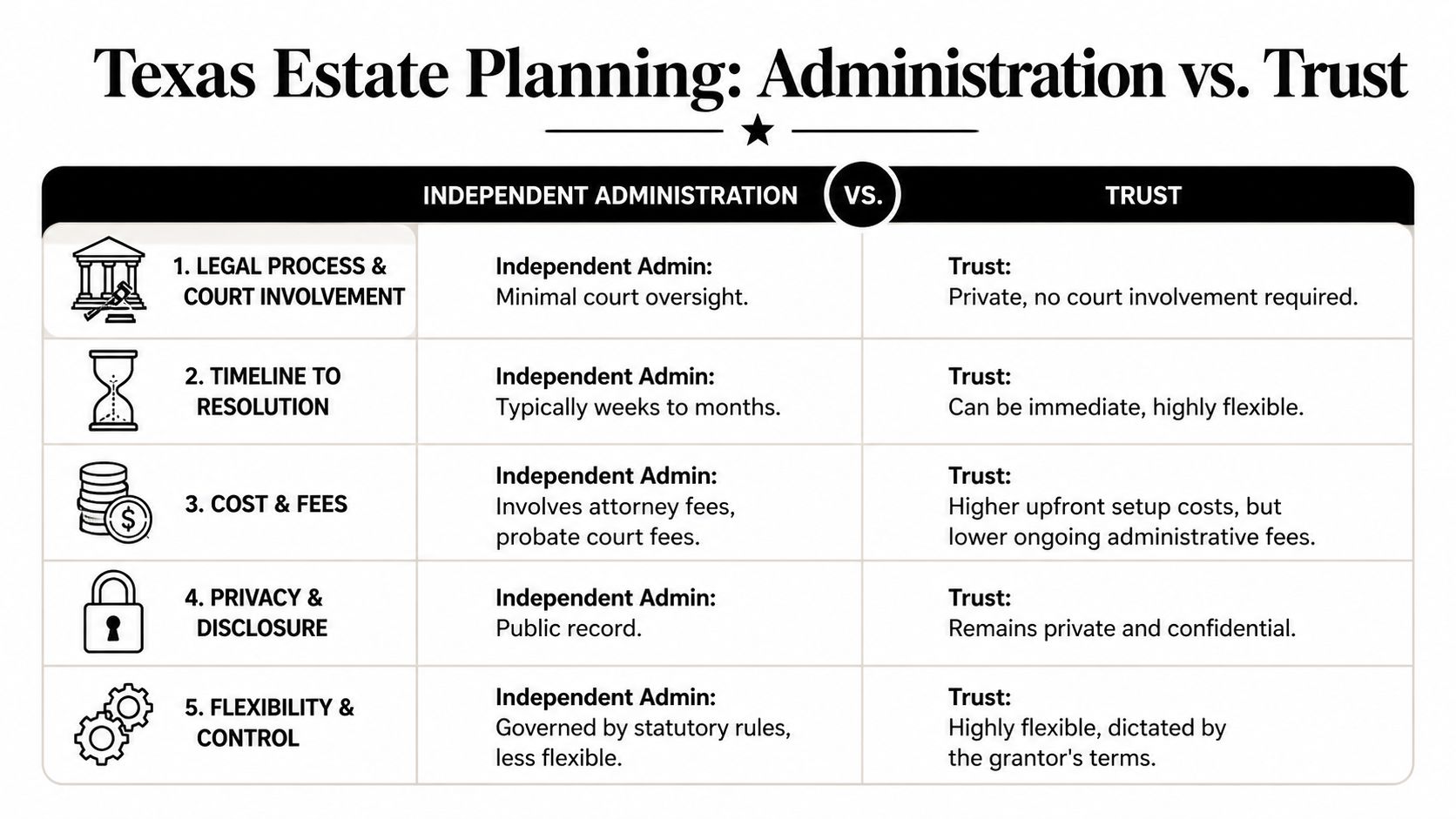
Comparing Key Factors Administration vs Trust
A side-by-side comparison helps most families faster than abstract definitions do.
| Factor | Independent Administration (Probate) | Revocable Living Trust |
|---|---|---|
| Legal framework | Texas Estates Code probate process | Texas Trust Code trust administration |
| Court role | Probate court opens the estate, then oversight is limited | No probate court involvement required for trust-owned assets |
| Person in charge | Executor or independent administrator | Trustee or successor trustee |
| Public or private | Probate filings are public | Trust administration remains private |
| Speed | Often slower than a funded trust | Often faster when assets are already in trust |
| Authority | Broad powers once appointed, but within probate structure | Immediate operational authority under trust terms |
| Best fit | Straightforward estates and aligned beneficiaries | Privacy-focused or more complex planning situations |
Legal process and court involvement
The biggest structural difference is where the administration happens.
With independent administration, the estate still passes through probate. The will must be admitted, the executor must qualify, and probate filings create a court record. The process is lighter than dependent administration, but it’s still probate.
A trust works outside that framework for assets owned by the trust. The trustee acts under the trust agreement rather than waiting for the court to appoint an executor. That can matter when a home needs immediate attention, a business must keep operating, or beneficiaries need coordinated communication early.
If you’re creating or updating a trust-based plan, the practical step that makes the trust work is funding it. This overview on how to transfer property to a trust is often where people realize the document alone isn’t enough.
Timeline to distribution
For many families, speed isn’t about impatience. It’s about carrying costs, mortgage payments, business payroll, tax deadlines, and beneficiary expectations.
Independent administration in Texas typically completes in 6-12 months with costs often under $5,000, while dependent administration can exceed a year and cost 40-60% more, according to this analysis of independent administration without court supervision in Texas. That same discussion notes that a well-funded trust can settle even faster, often in 2-4 months, because it bypasses probate court delays.
Those ranges don’t mean every trust ends quickly or every probate drags on. Asset type, tax issues, creditor problems, and family disputes can change the pace. But the operating principle is clear. The more a family depends on the probate court to start legal authority, the more delay they usually face.
Faster access matters most when the estate includes ongoing obligations like mortgage payments, real estate maintenance, or business operations.
Overall costs
Families often compare the upfront cost of drafting a trust to the later cost of probate. That’s a fair comparison, but it’s incomplete.
Independent administration is usually less expensive than dependent administration because the executor doesn’t need court permission for nearly every significant action. That reduces hearings, motions, and repeated legal work. A trust, however, can reduce later administration costs by avoiding probate on trust-owned assets.
The key cost question is this: where do you want to spend money, on planning before death or on administration after death?
A simple estate may tolerate probate well. A more complex estate often benefits from investing in planning early. That’s especially true when the family wants ongoing management during incapacity, not just clean transfer at death.
Privacy and public record
This is one of the clearest distinctions.
Probate is a court process. That means filings are part of the public record. Anyone with enough interest and persistence may be able to see information connected to the probate file. Some families don’t care. Others care intensely.
Trust administration is different. A trustee still owes duties to beneficiaries, still has to follow the governing document, and still may need legal guidance. But the process itself isn’t built around a public probate file.
Privacy matters in several situations:
- Business ownership: Owners may not want succession details exposed through a court file.
- Second marriages or blended families: Sensitive distributions can create friction if every filing becomes easier to inspect.
- High-value real estate or investment holdings: Public exposure can invite unwanted attention.
- Incapacity planning: A trust can provide continuity without requiring the same public probate path after death.
For many clients, privacy isn’t about secrecy. It’s about reducing noise, conflict, and outside scrutiny.
Control over assets
Control means two things in practice. First, who has authority to act. Second, how customized the instructions can be.
An executor in independent administration has meaningful authority after appointment, but that authority exists inside a probate administration. A trustee acts under the trust instrument itself, which often allows much more detailed instructions for timing, conditions, subtrusts, management standards, and beneficiary protections.
A trust can also continue after death. That matters if you don’t want a beneficiary receiving assets outright or if you want staggered distributions, creditor protection features, or long-term management for a child, family member with special concerns, or spendthrift beneficiary.
A simple way to frame the choice
If your top priority is simplified probate for a relatively straightforward estate, independent administration may be enough.
If your top priority is privacy, continuity, and customized control, a trust usually gives you more tools.
Where readers often get confused
People often assume a will and a trust compete in exactly the same way. They don’t.
A trust-centered estate plan often still includes a will, usually to catch assets left outside the trust. The key question isn’t “Will or trust?” It’s “Do I want my plan to rely mainly on probate, or do I want my plan to rely mainly on trust administration?”
That distinction is where a Texas trust administration lawyer or planning counsel adds value. The documents matter, but so does the design behind them.
Navigating Creditors and Legal Challenges
A family can be getting along well, then death brings a hospital bill, a credit card claim, a tax notice, or a relative who suddenly questions every decision. At that point, the legal structure matters in a very practical way. It shapes who has to respond, how public the dispute becomes, and who bears the risk if something is handled poorly.

Handling creditor issues in an independent administration
In independent administration, the executor stands in the middle of the process. That person has to locate assets, sort valid debts from invalid ones, give required notices, and make judgment calls under Texas law. For families, it can look simpler than court-supervised probate. For the executor, it can feel like being handed the controls without much guardrail.
Timing is one of the first trouble spots. Creditor issues do not wait for the family to get organized, and missed notice or claims procedures can create expensive problems later. Independent administration works best when the executor quickly gathers records, gets advice early, and treats deadlines as legal duties, not paperwork details.
That is one reason the choice of fiduciary matters so much. A person serving as executor of the will in Texas may have broad authority, but broad authority also means more room for personal mistakes.
How trust administration changes the picture
A trustee still has real work to do. Debts must be reviewed, assets must be collected, beneficiaries must be informed, and the trustee must follow fiduciary standards. The difference is structural. The trustee is usually working from an existing trust arrangement rather than opening a probate estate to gain authority over trust-owned property.
That often reduces procedural friction and keeps the administration more private. Creditors may still assert claims, and beneficiaries may still raise objections, but the process usually feels less public because it does not begin with the same court filing and docket activity that a probate estate does.
The liability angle is easy to miss here. With a trust, the office of trustee often comes with clearer operating rules inside the trust instrument and a stronger framework for acting on behalf of the trust itself. With independent administration, the executor may have similar fiduciary duties but less practical insulation if a creditor, heir, or beneficiary later argues that a debt was paid incorrectly or an asset was distributed too soon.
A trust is only as helpful as its funding. If important assets never made it into the trust, the family can end up handling both trust administration and probate, which increases cost, delay, and the chance of inconsistent decisions.
A well-drafted trust cannot avoid probate for assets that were never transferred into it.
Which structure is easier to contest
Probate places the will and the administration into a formal court setting. That gives a disgruntled heir a visible forum and a defined target. Sometimes that clarity helps resolve disputes. Sometimes it accelerates them.
A funded trust begins from a more private position. Privacy does not eliminate conflict, but it can lower the temperature at the start because every disagreement is not immediately tied to a public probate file. That matters in families where suspicion is already present.
Many estate fights begin with process failures, not dramatic misconduct. An unexplained payment, a delayed response, or an early distribution can make beneficiaries assume the worst. In an independent administration, those moments can expose the executor more directly. In a trust administration, the trustee is still accountable, but the structure often provides a better buffer between the dispute and the individual acting in the role.
The Executor's Hidden Risk You Cannot Ignore
Families often hear that independent administration is efficient, flexible, and less tied up in court. That’s true. What they often don’t hear is the tradeoff.
The more freedom an executor has to act without a judge looking over every step, the more responsibility that executor personally carries.

Independence can create personal exposure
A verified source focused on this exact blind spot explains that a critical and often overlooked risk is the executor’s personal liability exposure. In independent administration, “every decision could come back to haunt you,” and executors may be “personally liable” for missed deadlines or overlooked assets, while a trust structure provides a greater liability shield for trustees acting in good faith, as discussed in this article on hidden Texas independent administration probate risks.
That point deserves plain language. If an executor distributes too soon, misses an important asset, mishandles notices, or overlooks a property issue, the problem may not stay with the estate. The executor may be the one beneficiaries look to for repayment or correction.
For readers serving in that role now, guidance on the practical duties of an executor of the will can help frame the job before mistakes happen.
Why trustees often have a stronger protective position
A trustee is not free from fiduciary duties. Trustees still owe loyalty, prudence, and proper administration. They can still face claims if they act carelessly or fraudulently.
But the trust structure often gives trustees a stronger platform when they act in good faith under the trust terms. That difference matters for risk-averse families choosing who should be in charge.
Here’s the practical contrast:
- Executor in independent administration: Broad discretion, less routine court supervision, greater chance that a bad decision becomes a personal problem.
- Trustee under a funded trust: Broad authority too, but exercised within a trust framework that often offers stronger protection when the trustee acts properly.
- Family impact: The person willing to serve may change once they understand this difference.
Some families choose a trust not because they distrust probate, but because they don’t want to place a son, daughter, or sibling in a role with avoidable personal exposure.
A short overview may help if you want a visual explanation of how these responsibilities can play out in practice.
Common mistakes that trigger problems
The pattern is usually predictable. The executor means well. The estate seems simple. The executor acts quickly. Then a detail surfaces that changes everything.
That detail might be an old debt, a disputed account, unclear title to real estate, or an asset nobody initially found. In Texas, mineral interests and similar property issues can be especially easy to miss if the family has incomplete records.
Many online comparisons often fall short. They tell families that independent administration is easier than dependent administration, which is often true. They don’t pause long enough to ask whether “easier” for the process may still be riskier for the person serving.
Real-World Scenarios When to Choose Each Path
A family often sees the difference more clearly when the choice is attached to a real person, a real asset list, and a real person being asked to carry the legal burden.
A straightforward family estate
Maria is a widow in Texas. She owns a home, a checking account, a savings account, and little else. Her adult children communicate well, her will is clear, and nobody expects a fight over who gets what.
In that setting, independent administration often makes practical sense. The executor can usually handle the estate with less court involvement, assuming the will authorizes it or the beneficiaries agree, which is part of the framework described in this overview of dependent vs independent administration in Texas.
The key question is not whether probate exists. It is whether the job is simple enough that the executor’s risk stays manageable. If the estate is easy to identify, debts are known, and the family is cooperative, independent administration may be a reasonable fit.
A business owner who wants continuity and privacy
David owns a closely held company, commercial real estate, and investment accounts. If he becomes incapacitated, payroll still has to run, leases still have to be handled, and decisions cannot sit still while someone works through probate authority.
A funded revocable living trust often fits better here. The successor trustee can step in under the trust terms and keep things moving. That is especially helpful when business operations depend on quick decisions and clear authority.
Privacy matters here too, but privacy is only part of the analysis. The other part is risk allocation. If the assets are layered and the decisions are time-sensitive, many families prefer a structure that gives the acting fiduciary a clearer operating framework than an individual executor may have in independent administration.
A blended family that needs more than a one-time distribution
Angela is remarried. She wants her current spouse supported during life, but she also wants her children from a prior marriage to receive what remains later. A simple gift at death may not carry out that plan very well.
A revocable living trust can set the rules with much more precision. It can direct who may use the assets, what income may be distributed, when principal may be used, and what happens after the surviving spouse dies.
That kind of planning works like a set of written guardrails. A will can express intent, but a trust usually gives the family a clearer structure for carrying that intent out over time.
The child who says yes before understanding the risk
James is the oldest son. Everyone trusts him. He is organized, honest, and good with paperwork, so the family naturally says he should serve as executor.
Then James learns what the role can involve. He may have to identify creditors, sort out unclear accounts, deal with title problems, and make judgment calls before all the facts are known. If he makes a serious mistake in independent administration, the problem may not stay inside the estate. It can become his personal problem.
That is the scenario many online comparisons skip over. The family asks, "Which option is easier?" A better question is, "Which option places this son or daughter in a safer legal position while still accomplishing the plan?"
If the estate is complex, records are incomplete, or conflict seems likely, a funded trust may be the better answer for that reason alone.
A practical way to choose
The choice usually becomes clearer when you match the tool to the family’s actual risk:
- Independent administration may fit when the estate is modest, the assets are easy to locate, debts are not expected to be complicated, and the executor understands the job and is comfortable accepting the exposure that comes with it.
- A trust may fit better when privacy matters, incapacity planning matters, distributions need specific control, or the family wants stronger protection for the person serving.
- Either option can create trouble when beneficiary designations, deeds, account titles, and estate documents do not line up, or when the person serving does not understand fiduciary duties under Texas law.
The best choice is usually the one that reduces friction for the family and avoids placing avoidable personal risk on the person you love enough to name in charge.
Making Your Decision With Confidence
A good estate plan should answer practical questions before a crisis forces them to the surface.
Questions worth asking now
Start with the issues that matter most in real administration:
- Do you want privacy? If public court filings would bother you or your family, trust planning deserves serious attention.
- How complex are your assets? Business interests, layered real estate holdings, and hard-to-track property often benefit from stronger planning structure.
- Who will serve? The right choice depends partly on whether your executor or trustee can realistically handle the job.
- Are you planning only for death, or also for incapacity? Trusts often provide smoother continuity during lifetime incapacity.
- How likely is conflict? If you expect disputes, surprises, or difficult family communication, your structure should reflect that risk.
What many families miss
People often focus on who gets what. That’s only part of estate planning.
The harder question is who has to carry the legal burden of getting it done. That’s why the fiduciary role matters so much. Executors and trustees both owe duties. But they don’t operate in identical environments, and those differences affect stress, exposure, and administration quality.
The best estate plan protects beneficiaries, but it should also protect the person you ask to serve.
A calm next step
If your estate is modest and your family is aligned, independent administration may be fully appropriate. If privacy, continuity, long-term control, or fiduciary protection matter more, a trust may be the stronger path.
Either way, don’t rely on assumptions. Texas law gives families useful tools, but each tool works best in the right setting. A conversation with a Texas estate planning attorney can help you assess probate exposure, trust funding needs, guardianship planning, tax questions, and asset protection concerns without guesswork.
If you’re managing a trust or planning your estate, contact Law Office of Bryan Fagan, PLLC for a free consultation. Our attorneys provide trusted, Texas-based guidance for every step of the process, including estate planning, probate, guardianship, fiduciary duties in Texas, trust administration, dispute resolution, and asset protection. If you need a Texas trust administration lawyer or want help understanding how to modify a trust in Texas, the firm can help you move forward with clarity and confidence.