Skip to content
Losing a loved one often creates two problems at the same time. Your family is grieving, and someone suddenly has to figure out what happens to the house, the bank account, the car, the bills, and the will.
That’s usually when the question comes up: when is probate required in texas?
A lot of families assume every estate has to go through probate. Others assume that having a will means probate isn’t needed. Neither is always true. In Texas, whether probate is required usually depends on what the person owned, how those assets were titled, whether a valid will exists, and whether a simpler legal option can be used instead.
A common example looks like this. A parent dies with a will in a desk drawer, a checking account in their name alone, and a home that was never transferred into a trust. One child thinks the will settles everything automatically. Another thinks the family can just take the death certificate to the bank. Then someone learns there may be court filings, deadlines, and rules under the Texas Estates Code. That can feel like a lot when you’re already carrying the emotional weight of a loss.
The good news is that Texas probate law is often more practical than people expect. With clear information and careful steps, families can usually sort out what needs court involvement and what doesn’t. You don’t need to know every legal term on day one. You need a calm roadmap.
Introduction Navigating a Loved One’s Estate in Texas
When a death happens, families rarely start with legal questions. They start with immediate concerns. Who has the keys to the house? Is the mortgage getting paid? Where is the original will? Can someone access the bank account to handle funeral costs?
Those questions matter because probate is not just a legal formality. It’s the process that often gives someone authority to act. Without that authority, banks may freeze accounts, county records may still show the deceased as the owner of real estate, and family members may disagree about what should happen next.
Texas law gives families several ways to handle an estate, but the right path depends on the facts. Some estates need a full probate administration. Some can use a more limited court procedure. Some assets pass outside probate altogether. That’s why two families can both lose a parent and have very different legal experiences.
Confusion usually starts when people use the word “estate” to mean everything the person owned. In practice, you have to separate assets into categories. Some assets transfer by contract or beneficiary designation. Others require action under the Texas Estates Code. That distinction is where the answer begins.
Practical rule: Probate is usually required only when there’s property that cannot be transferred legally without court-recognized authority.
If you’re the person holding the will, named as executor, or trying to protect your family from mistakes, a steady, step-by-step approach helps. Probate can feel intimidating at first, but it becomes much more manageable once you know what the court is being asked to do.
What Is Probate and Why Does It Exist
Probate is the legal process for wrapping up a person’s affairs after death. A simple way to think about it is this: probate is the official closing of someone’s legal and financial life. It gives the court a chance to confirm who has authority, what document controls, who should receive property, and how debts should be handled.
Why families need probate
Probate exists to solve real problems, not just create paperwork.
If a home is titled only in the deceased person’s name, someone usually needs legal authority to transfer title. If a bank account is only in that person’s name, the bank may require probate documents before releasing funds. If creditors must be addressed, the estate needs a recognized representative to deal with those claims.
Probate also protects against fraud. The court can confirm that the will presented is the proper will, that the nominated executor is appropriate, and that property passes according to law.
What the court usually does
In a typical Texas probate matter, the court may do several things:
- Validate a will: The court determines whether the will can be admitted to probate.
- Appoint a personal representative: If there’s a will, that person is often the executor. If there’s no will, the court may appoint an administrator.
- Create legal authority: That authority allows someone to collect assets, address debts, and distribute property.
- Support clear title transfers: This matters most with real estate, vehicles, and financial accounts.
- Provide a forum for disputes: If relatives disagree, probate gives them a legal place to raise those issues.
Testate and intestate estates
Two terms appear often in probate law.
A testate estate means the person died with a valid will. In that situation, the will guides who inherits and who serves as executor, subject to court approval.
An intestate estate means the person died without a valid will, or the will cannot control the transfer. Then Texas law supplies the default rules. The Texas Estates Code acts as the rulebook for who inherits when no valid will directs the outcome.
That default system matters because it may not match what the deceased wanted. A person may have intended for one child to receive a family business or for a partner to remain in the home, but intestate succession follows statutory rules, not private conversations.
Probate is often less about conflict and more about legal proof. Title companies, banks, and courts usually want formal authority before they recognize a transfer after death.
Probate is also about fiduciary responsibility
Once someone becomes executor or administrator, fiduciary principles apply. That means the person in charge must act for the benefit of the estate and its beneficiaries, not for personal convenience. They must handle assets carefully, avoid self-dealing, keep records, and follow the will or Texas law.
That fiduciary role is one reason probate can’t always be handled casually inside the family. Good intentions are not enough. Authority and accountability matter.
The Deciding Factor Probate vs Non-Probate Assets
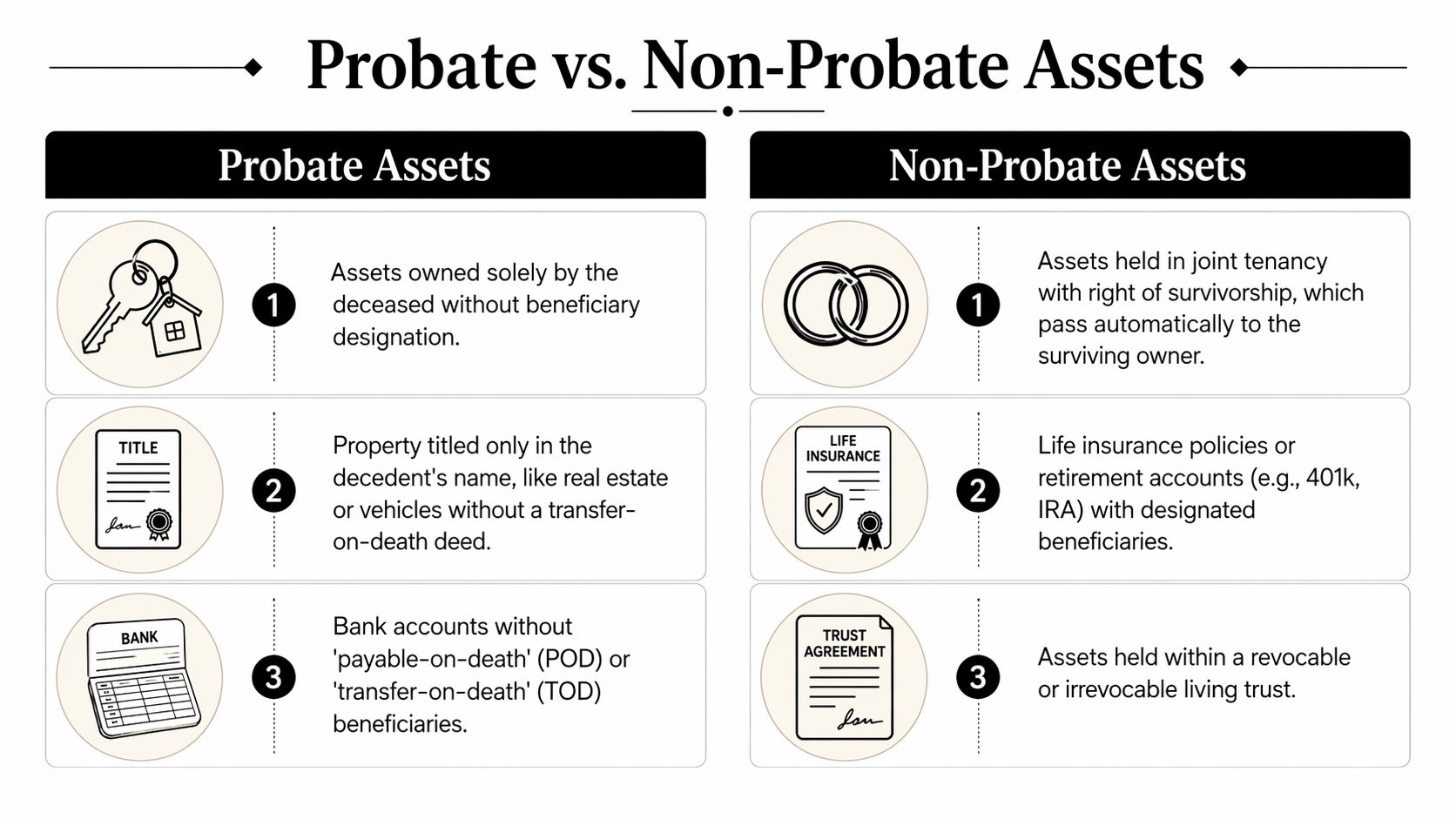
For most families, this is the primary answer to the question. Probate is usually required only for probate assets. Those are assets that were owned by the deceased person in a way that does not transfer automatically at death.
By contrast, non-probate assets pass outside the probate process because another legal mechanism already controls the transfer.
The basic rule that answers most questions
If an asset is titled in the deceased person’s name alone and has no surviving joint owner, no payable-on-death or transfer-on-death designation, and no trust ownership, probate is often required to move that asset to the next owner.
If an asset already names who receives it at death, it often avoids probate.
Probate vs Non-Probate Assets in Texas
| Asset Type | Typically Requires Probate? (Probate Asset) | Typically Avoids Probate? (Non-Probate Asset) |
|---|---|---|
| House titled only in decedent’s name | Yes | No |
| Bank account in decedent’s name only, no beneficiary | Yes | No |
| Vehicle titled only in decedent’s name, no transfer setup | Yes | No |
| Personal property controlled only by a will | Often yes | No |
| Life insurance with a named beneficiary | No | Yes |
| Retirement account with designated beneficiary | No | Yes |
| Bank account with POD beneficiary | No | Yes |
| Property held with survivorship rights | No | Yes |
| Assets owned by a living trust | No | Yes |
For a closer look at how these categories work, see this guide to probate and non-probate assets in Texas.
Common probate assets
These are the assets that most often trigger probate:
- Sole-name real estate: A house, land, or rental property owned only by the deceased.
- Single-owner bank accounts: Accounts with no POD beneficiary and no joint owner with survivorship rights.
- Vehicles without a transfer arrangement: If the title remains only in the deceased person’s name.
- Personal property that needs legal authority to distribute: That can include valuable collections, business interests, or items relatives dispute.
A will does not automatically change title by itself. The will tells the court what should happen. Probate is often what makes that transfer legally effective.
Common non-probate assets
These assets usually pass without formal probate administration:
- Life insurance proceeds with a named beneficiary
- Retirement accounts with beneficiary designations
- POD or TOD financial accounts
- Property owned in a trust
- Jointly held property with survivorship rights
Many families often get tripped up on this point. They assume all jointly owned property avoids probate. That isn’t always true. The exact title language matters. They also assume every asset listed in a will must go through the court. That also isn’t always true if the asset already transfers by beneficiary designation or trust ownership.
A practical family example
Suppose a father dies owning these assets:
- A home in his name alone
- An IRA naming his daughter as beneficiary
- A checking account with no POD beneficiary
- A life insurance policy naming his son
- A truck titled only in his name
In that situation, the IRA and life insurance would usually pass outside probate to the named beneficiaries. The house, checking account, and truck may require probate or another Texas transfer procedure, depending on the full facts.
The will controls only property that is still part of the probate estate at death. Beneficiary designations and trust ownership often control first.
Why this distinction matters so much
Families often ask, “Do we have to probate the will?” A better question is, “What property are we trying to transfer, and how is it titled?” That framing is more useful because the need for probate is tied to transfer problems, not just the existence of a will.
This distinction also affects planning. A Texas estate planning attorney may help clients reduce future probate needs by coordinating deed language, beneficiary designations, trusts, and transfer-on-death tools. Those choices can simplify administration later and reduce stress for beneficiaries.
Streamlined Alternatives to Formal Probate in Texas
A family often learns about these options at the kitchen table, not in a lawyer’s office. Someone has the death certificate, someone else has a stack of bank statements, and everyone is asking the same question: “Is there a simpler way to transfer what Mom or Dad owned without opening a full probate case?”
Sometimes, yes. Texas offers a few narrower procedures that can work well when the facts line up. The key is matching the tool to the problem. A small shortcut can save time and expense, but only if the estate qualifies.

Small Estate Affidavit
A Small Estate Affidavit can work for some estates with limited probate property. Texas law sets strict rules for this option, including a value cap based on the probate estate, not the whole financial picture of the person who died.
That distinction trips up many families.
The number people focus on is $75,000, excluding homestead and exempt property. The harder question is how to measure the estate correctly. Families often count property that should not be counted, or leave out property that should be included. Either mistake can cause problems if the affidavit is filed and later rejected by a court or refused by a bank or title company. A helpful overview of these qualification issues appears in this discussion of when probate is necessary in Texas.
Here is the practical way to think about it. The Small Estate Affidavit is not based on everything your loved one ever owned. It is based on the probate assets that still need a legal transfer. Property that passes automatically to someone else usually does not go into that calculation.
Families usually need to sort through questions like these:
- Do life insurance proceeds count? Usually not, if there is a valid named beneficiary.
- Does a bank account with a payable-on-death beneficiary count? Usually not, because it passes outside the probate estate.
- What about a house? The homestead gets special treatment, which is one reason families should be careful before trying to total the estate on their own.
- Do jointly owned assets count? Sometimes yes, sometimes no. It depends on the exact ownership terms and whether the deceased person’s interest passes automatically at death.
- What if someone owed money to the person who died? That claim may still belong to the estate, even if no money has been collected yet.
A good analogy is a carry-on bag at the airport. Only the items that fit the airline’s rules count toward that limit. The same idea applies here. Only certain estate assets count toward the Small Estate Affidavit threshold, and Texas families often run into trouble because they are measuring the wrong bag.
This is one of the places where practical detail matters most. Many guides mention the dollar limit and stop there. In real life, families need to know how to value the estate correctly before relying on this procedure.
Key point: Do not treat a Small Estate Affidavit as a fill-in-the-blank form. The real work is deciding whether the estate qualifies before you sign anything.
Muniment of Title
A Muniment of Title is another Texas-specific option. It is often useful when the person who died left a valid will, debts are limited, and the main goal is to transfer title to property, especially real estate, without a full administration.
In plain English, this procedure asks the court to admit the will as proof of ownership transfer. There is no full executor process in the usual sense if the court approves muniment. For the right estate, that can be a very efficient path.
Families often consider muniment when the biggest unanswered question is, “How do we get the house into the right name?” If that sounds familiar, this guide to Muniment of Title in Texas is a useful starting point.
A short overview can help if you're comparing options before calling a lawyer:
When these options help, and when they do not
These procedures solve specific transfer problems. They do not fix every estate issue.
A family usually needs a fuller probate process if:
- Debts need to be handled
- The will may be contested
- Heirship is unclear
- Asset ownership records do not match what the family believes
- Property falls outside what a Small Estate Affidavit or muniment can transfer
There is one more problem families often overlook. Sometimes they spend months assuming one of these simpler options will work, only to learn later that it will not. By then, valuable time may have passed. That matters in Texas because probate deadlines can affect what options remain, especially if the four-year deadline for offering a will to probate has been missed.
Before choosing a path, gather the original will, death certificate, deeds, vehicle titles, account statements, and a rough list of debts. That first sorting step often reveals whether the estate fits a simpler procedure or whether a formal probate filing is the safer choice.
Understanding the Types of Texas Probate and Key Deadlines
A family can do many things right and still get stuck here. They find the will, agree on what their loved one wanted, and assume probate is just one standard court process. Then they learn Texas has different probate tracks, and the deadline question can change which track is still available.
The easiest way to understand this section is to separate two questions. First, what type of probate fits the estate? Second, has too much time passed to use the will in the usual way? Those are different issues, but families often discover them at the same time.
Independent Administration
Texas often allows Independent Administration. This is usually the more practical form of probate because the executor can handle many tasks without asking the court for permission at every step. If you want a fuller overview of how that process typically works, this guide to the Texas probate process and timeline gives useful context.
For a family, that usually means fewer hearings, less delay, and lower administrative cost. The executor still has serious duties. They must gather assets, deal with creditors properly, keep records, and distribute property according to the will or the law. But they usually have more room to do the job efficiently.
A simple comparison helps. Independent administration is like giving the executor a map and the legal authority to follow it. The court stays available, but it does not sit in the passenger seat for every turn.
Dependent Administration
A Dependent Administration involves closer court supervision. The personal representative may need approval before taking actions that an independent executor could handle directly, such as certain sales or settlements.
This type of probate often appears where there is conflict, uncertainty, or a need for tighter oversight. Examples include family disagreement, questions about the will, or concern that estate property could be mishandled.
That added supervision can protect the estate. It also usually means more procedure, more cost, and more time.
Probate without a will
If there is no valid will, probate may still be necessary. The court may need to determine the heirs and appoint an administrator to collect property, pay valid debts, and transfer what remains under Texas intestacy law.
This is one of the hardest points for families emotionally. They may know exactly what their loved one said they wanted. Verbal instructions and handwritten notes that do not meet legal requirements usually do not control the estate. In that situation, Texas law supplies the inheritance plan.
The four-year deadline
Texas also has a deadline families should treat seriously. Under Texas Estates Code §256.003, a will generally must be offered for probate within four years after the person’s death. That rule matters most in real life when a family waits because no one feels urgency yet. The house is still in the deceased parent’s name, the bank account is left alone, and everyone assumes they can deal with it later.
Then later arrives.
A title company refuses to insure a sale. A buyer backs out. A bank asks for letters testamentary that no one can now easily obtain. At that point, the missed deadline stops being an abstract legal rule and becomes a practical property problem.
What can happen if the deadline is missed
Missing the four-year deadline can limit how the will may be used. In many cases, the estate can no longer proceed through ordinary probate based on that will, and property may need to pass under Texas intestacy rules instead.
That shift can change who inherits. It can also create long delays, especially with real estate, mineral interests, or old accounts that were never retitled.
Families should understand the specific risks:
- The will may not be admitted through the usual probate route
- Property may pass under intestacy rules instead of the will
- The person who held the will and delayed action may face blame if the delay caused harm
- Real estate title problems may continue until the family completes a different corrective process
Missing the deadline can change both the legal path and the practical outcome. The question is no longer just “Do we have a will?” It becomes “What can we still do with it now?”
What families can still do after four years
This is the point many articles skip, but it is often the point families need most.
If more than four years have passed, the will is not always the end of the story. The available options depend on the property involved, whether anyone has already taken possession, and whether the heirs agree. In some situations, the family may need to shift from a standard probate strategy to a title-clearing or heirship strategy.
For real property, one possible tool is an Affidavit of Heirship. This document is commonly used to help establish the family history of who inherited when no full probate was opened. It is often recorded in the county deed records. It can help clear title over time, but it is not a perfect substitute for probate in every case, and title companies may want additional support depending on the facts.
Another option is a determination of heirship proceeding in court. This is more formal. The court identifies the legal heirs, which can be necessary when there is no usable probate route, no valid will admitted to probate, or significant uncertainty about who inherited. If an administrator is also needed, that request may be paired with the heirship case.
Some families also need to review whether any assets passed outside probate after all. An account with a beneficiary designation, a survivorship feature, or a trust may avoid the missed-deadline problem entirely because it was never dependent on probate to transfer ownership.
The practical first steps are simple:
- List each asset separately, especially real estate, mineral interests, vehicles, and bank accounts
- Check how each asset is titled and whether a beneficiary or survivorship designation exists
- Find the exact date of death and confirm whether the four-year period has already expired
- Pull the deed records for any real estate to see what still stands in the decedent’s name
- Get legal advice before signing heirship papers or trying to sell property
That last step matters because the remedy has to match the problem. A family may need probate, heirship, an affidavit in the deed records, or a combination of those tools. Using the wrong shortcut can create another round of delay.
Early action preserves more options. After four years, the goal often changes from “open probate in the usual way” to “figure out the cleanest lawful path to transfer title and protect the family from a bigger mess later.”
A Practical Guide for Executors and Beneficiaries
A lot of families reach this point in the process with the same feeling. They know something needs to be done, but they are not sure what to do first, what can wait, and what mistake could cause trouble later.
The good news is that probate becomes much more manageable when you treat it like a series of jobs instead of one giant legal problem. Your role is to protect property, gather information, and choose the right procedure before anyone starts transferring or spending estate assets.
Step one: secure the estate
Start with anything that could be lost, damaged, or overlooked in the first few weeks after death. A vacant house, an uninsured vehicle, or unopened mail can create expensive problems fast.
Focus on immediate protection:
- Secure the home and vehicles
- Forward or monitor the mail
- Locate keys, passwords, and account information
- Check that insurance coverage is still in place
- Save financial records and legal papers in one folder
Then gather the core documents the court, banks, or a lawyer will usually ask for:
- Death certificate
- Original will, if there is one
- Deeds and vehicle titles
- Recent bank and investment statements
- Insurance policies
- Trust documents, if any
Step two: find the original will and read it carefully
The original will often matters more than a copy. Families commonly find it in a home safe, a fireproof box, a lawyer’s file, or a safe-deposit box.
If you find more than one will, stop and get guidance before acting. The newest document is not always the one that controls. Validity can depend on signatures, witnesses, dates, and whether a later document revoked an earlier one.
A missing original also changes the analysis. That issue needs to be handled carefully from the start.
Step three: pause before using a shortcut
This is the step families skip when they are trying to be efficient. It is also where many estates go off track.
An executor or administrator has fiduciary duties under Texas law. In plain English, that means the person in charge must handle estate property with care, keep good records, avoid self-dealing, and act for the benefit of the estate and the people entitled to inherit. Even if you are the main beneficiary, estate money is not your money yet.
Extra caution is needed if the four-year deadline may have passed. Many families do not realize that missing that deadline can limit the probate options that are still available. At that point, the question is no longer just, "How do we probate the will?" It may become, "What is the lawful way to clear title, transfer property, or prove heirs now?" That is one of the biggest failure points in Texas estates, and getting early advice can prevent a much bigger cleanup later.
For background on why wills still need court involvement in many situations, this article about whether a will has to be probated in Texas gives a helpful overview.
Step four: choose the correct court process
Filing in the right county matters. So does choosing the right procedure.
Texas offers several paths, and they are not interchangeable. One estate may call for full probate with an executor. Another may qualify for probate as a muniment of title. Another may fit a small estate affidavit. If there is no valid will in probate, an heirship case may be necessary.
This is also where estate value matters in a practical way. Families often misjudge whether a small estate affidavit will work because they count the wrong assets, leave out debts, or misunderstand how homestead property is treated. A Texas probate lawyer or Texas trust administration lawyer can help determine the best path forward for the estate.
Step five: attend the hearing and get formal authority
The court hearing is often the moment when the judge admits the will to probate and approves the appointment of the executor or administrator. After that, the representative can usually obtain the documents that prove authority to act for the estate.
Those papers matter more than families expect. Banks, title companies, and other institutions often will not deal with an executor based on a will alone. They usually want the court-issued authority.
Step six: build a clean inventory and communicate early
Once appointed, the representative should identify what the estate owns, what the estate owes, and which assets pass outside probate. This is the working map for the rest of the administration.
Use a checklist that is simple enough to maintain:
- List each asset and note whose name is on it
- Mark each item as probate or non-probate
- Track debts, taxes, and ongoing bills
- Keep estate funds separate from personal funds
- Write down distributions, expenses, and major decisions
- Update beneficiaries before confusion turns into conflict
Good records protect everyone. A clear paper trail often answers questions before they become disputes.
If you are trying to decide whether an estate may qualify for a small estate affidavit, be careful with the math. Families often assume they qualify because the estate feels modest, but the legal calculation depends on which assets count and how they are valued. Getting that number wrong can waste time and lead to a rejected filing.
Frequently Asked Questions About the Texas Probate Process
What happens if the original will cannot be found
That creates a serious issue, but it doesn’t always end the case. The family may need to determine whether the original was lost, destroyed accidentally, or revoked. Texas courts treat missing originals carefully because the absence of the original can raise questions about intent. Don’t assume a photocopy will be accepted automatically.
How are the decedent’s debts handled during probate
Debts are usually addressed through the estate before final distribution of probate assets. The executor or administrator gathers information about valid claims and estate obligations, then handles them according to Texas procedure. Beneficiaries should not rush to divide probate assets before debts are properly evaluated.
Does having a will guarantee we can avoid probate
No. A will often makes probate easier, but it does not by itself avoid probate. If property is still titled in the decedent’s name alone, the will may need to be admitted to probate so the property can be transferred legally.
What if a family member wants to contest the will
That can turn a relatively straightforward probate into a dispute. The court may need to hear objections based on issues such as capacity, execution, or undue influence. If conflict seems likely, get legal advice early and avoid informal promises or distributions.
Are trusts relevant to this question
Yes. Assets held in a trust often avoid probate because the trust, not the individual, owns the property or controls its transfer. Trusts are part of broader estate planning and can also connect to fiduciary duties in Texas, especially for trustees managing assets for beneficiaries.
Can probate affect guardianship or asset protection planning
Yes. Probate often overlaps with larger family planning concerns. A death can expose weak estate planning, missing beneficiary designations, outdated powers of attorney, or a need for guardianship planning for a surviving dependent. That’s one reason many families review probate, estate planning, and asset protection together rather than treating them as separate issues.
Get Trusted Guidance for Your Family’s Estate
When families ask when probate is required in Texas, the right answer is usually tied to how assets are titled and whether a simpler transfer option applies. Some estates need formal probate. Some fit a simplified Texas procedure. Some assets never enter probate at all.
The hardest problems usually arise in two places. First, families wait too long and run into the four-year deadline. Second, they assume a small-estate option applies without carefully valuing the estate. Both mistakes can create delays, title issues, and preventable conflict.
Strong communication also helps during a difficult time. For families comparing tools that make legal help more accessible and responsive, this overview of a law firm answering service offers practical context on how firms handle urgent client communication when families need answers quickly.
If you’re managing a loved one’s estate or planning your own, a personalized legal review can save time, reduce risk, and protect the people involved.
If you’re managing a trust or planning your estate, contact Law Office of Bryan Fagan, PLLC for a free consultation. Our attorneys provide trusted, Texas-based guidance for every step of the process.