Yes, a properly managed trust is one of the most effective ways to avoid probate in Texas. But that result is not automatic. It depends on one critical step many families miss, which is making sure the trust is fully funded with the assets you intend to keep out of probate.
If you're reading this, you may be in a familiar spot. Maybe you have aging parents, a growing family, a house in your name, some bank accounts, and a nagging concern about leaving a court process behind for the people you love. Or maybe someone told you, “Just get a trust,” and now you're wondering whether that advice is right, incomplete, or both.
The honest answer is that a trust can work very well in Texas. It can also fail to do the job if it's treated like a stack of signed papers instead of a living part of your estate plan. Texas law gives families several probate-avoidance tools, and a trust is often the strongest option when you want privacy, continuity, and clear instructions under the Texas Trust Code and Texas Estates Code. Still, it isn't always the only option, and it isn't always the simplest one.
Answering Your Key Question on Trusts and Probate
A family often comes into an estate planning office with the same concern. They have a will, they own a home, and they assume their children will “just handle it” later. Then they learn that a will usually has to go through probate before anyone can act with full authority over probate assets.
That's where the question gets more practical. Does a trust avoid probate in Texas? Yes, if the trust is properly set up and properly funded. A revocable living trust is designed to hold assets during your lifetime so your chosen successor trustee can manage and distribute them later without going through the probate court process.
The part that trips people up is that signing the trust document alone doesn't move your house, account, or business interest into the trust. That transfer has to happen separately. If it doesn't, the trust may exist on paper but not control the property you meant it to protect.
A useful starting point is learning how living trusts in Texas work in day-to-day planning. Once you understand the mechanics, the decision becomes less mysterious and much more practical.
Practical rule: A trust avoids probate only for the assets the trust actually owns.
Texas families also need to know that probate in this state is often simpler than in many others. That matters because a trust isn't about fear. It's about choosing the level of privacy, control, and convenience that fits your family.
Understanding the Texas Probate Process
Probate is the court process used to transfer property that stayed in a person's sole name at death. If a house, bank account, or vehicle was never moved into a trust and does not pass by beneficiary designation or survivorship rights, the probate court may need to clear the path before anyone can act.

For many Texas families, the surprise is not that probate exists. The surprise is what the court is doing. The judge is not rewriting your wishes. The court is confirming who has legal authority to gather assets, pay valid debts, and transfer what remains under a will, or under Texas intestacy rules if there is no will.
A helpful way to view probate is as a title-clearing process. Before heirs can sell the home, close accounts, or deal with financial institutions, someone needs recognized authority. A Texas probate process overview shows why many estates use independent administration, which often involves less court supervision than people expect.
What families usually dislike about probate
Even in a fairly routine estate, probate creates a few practical friction points:
- It is public: Probate filings become part of the court record. Anyone with enough interest can usually see basic information about the estate.
- It takes time: Courts, notices, paperwork, and creditor periods do not move on a family's preferred schedule.
- It costs money: Filing fees, legal fees, appraisal costs, and related expenses can reduce what passes to beneficiaries.
Texas probate is often more manageable than probate in other states. That matters. It also explains why some families are better served by simpler tools, such as beneficiary designations, transfer on death deeds, or payable on death accounts, instead of building a trust for every situation.
Why Texas probate still matters in planning
Texas has a reputation for simplified probate, especially when there is a valid will and an estate that qualifies for independent administration. That reputation is largely fair. But efficient does not mean private, and it does not mean immediate.
A will still has to be filed. Someone still has to be appointed. Institutions still want paperwork.
If you want a plain-language outside overview of the court process itself, this general probate guide offers a broad explanation of what families often encounter after a death.
Probate in Texas is often workable, but it is still a court process at a time when families usually want fewer tasks, not more.
How a Living Trust Bypasses the Texas Probate System
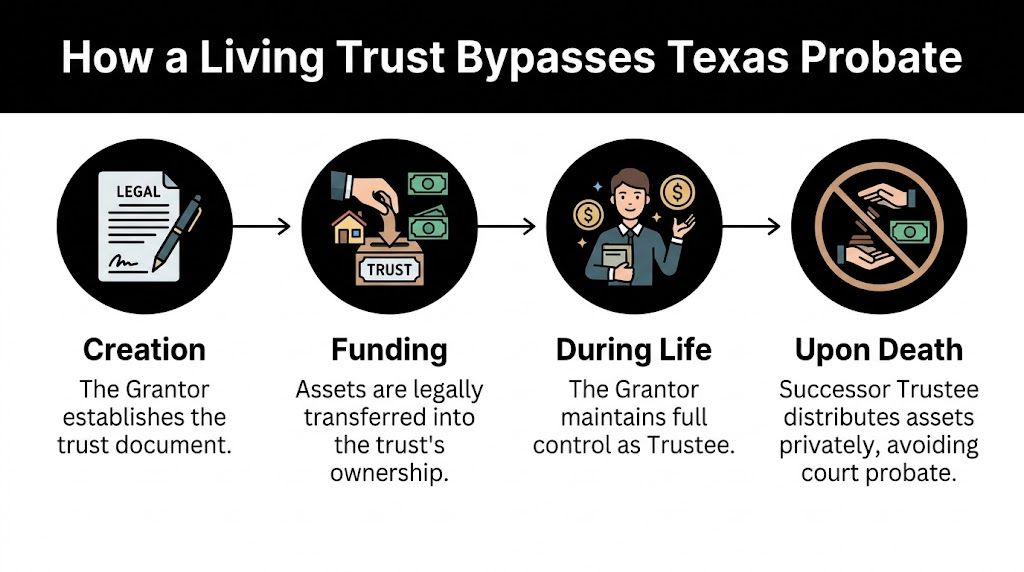
A living trust avoids probate in Texas for one practical reason. The trust owns the asset before death, so the court does not need to transfer that asset after death.
That ownership piece is what families often miss.
With a revocable living trust, you usually wear two hats while you are alive. You are the grantor, meaning you created the trust, and you are usually the trustee, meaning you manage what is in it. In everyday life, that often feels much the same as owning property in your own name because you still buy, sell, invest, and handle the assets. The legal title, however, is different once the asset has been transferred to the trust.
The legal mechanism in plain language
A trust works like a container with instructions attached to it. The instructions say who manages the property, who benefits from it, and what should happen if you become incapacitated or die.
Once an asset is retitled into the trust, that asset is no longer sitting in your individual name alone. At your death, your successor trustee steps in and follows the trust instructions. That person is not asking the probate court for authority to move a trust-owned bank account or trust-owned house to the next person. The authority is already built into the trust document.
Here is a simple way to picture the difference. If your home is titled to you individually, someone may need probate authority to deal with it after your death. If your home is titled in the name of your living trust, your successor trustee can usually handle it under the trust terms instead.
That is the practical "how."
The people involved and why their roles matter
Texas trust administration depends on clear roles:
- Grantor: The person who creates the trust and sets the rules.
- Trustee: The person or institution managing trust property.
- Successor trustee: The person who takes over when the original trustee dies or cannot serve.
- Beneficiaries: The people or organizations who benefit from the trust property.
Those roles matter because a trust is private administration, not free-form administration. A trustee has legal duties under Texas law. The trustee must follow the trust terms, act loyally, keep property managed with care, and treat beneficiaries according to the document. That structure gives families a roadmap at a time when they usually want fewer decisions made in crisis.
Why this often feels easier for families
A funded living trust can let the successor trustee act sooner and more directly than an executor waiting on court steps. Bills still need to be paid. A home may need insurance, maintenance, or a sale. Investment accounts may need to be managed without delay.
The trust does not erase legal responsibility. It shifts the process from court-supervised transfer to private administration under the trust terms.
That difference is why the answer to "does a trust avoid probate in Texas" is really about timing and setup, not just the document itself. If the asset is in the trust when death occurs, the trust can do its job. If it is not, the probate question may come right back.
Revocable vs Irrevocable Trusts Which Is Right for You
When people ask whether a trust avoids probate, they usually mean a revocable living trust. That's the common tool for probate avoidance because it lets you keep control during your lifetime. But some families need a different structure.
The core difference
A revocable trust can usually be changed, amended, or revoked by the person who created it. An irrevocable trust is generally much harder, and often impossible, to change in any simple way once it's established.
That tradeoff matters. Revocable trusts offer flexibility and ease of use. Irrevocable trusts may be used when the goal is stronger asset separation, creditor planning, or more advanced tax planning.
| Feature | Revocable Trust | Irrevocable Trust |
|---|---|---|
| Control | You usually keep control as trustee during life | You usually give up significant control |
| Changes | Can usually be amended or revoked | Generally not easy to change |
| Probate avoidance | Yes, if properly funded | Can also avoid probate if structured and funded correctly |
| Creditor protection | Limited | Often stronger than a revocable trust |
| Typical use | Probate avoidance, incapacity planning, private distribution | Asset protection, specialized planning, advanced legacy goals |
Which one fits a normal family estate plan
For many Texas families, the answer is the revocable trust because the goal is practical. They want someone to step in if they become incapacitated. They want privacy. They want a smoother handoff at death. They do not want to give up control now.
An irrevocable trust usually comes into the conversation when the planning goals are more specialized. That might include protecting certain assets, setting terms for beneficiaries, or coordinating broader asset protection strategies.
A revocable trust is often about convenience and continuity. An irrevocable trust is often about separation and protection.
Where a Texas attorney adds value
In such scenarios, a Texas estate planning attorney earns their keep. The trust type should match the goal. If your concern is avoiding probate for a home, brokerage account, and family business interest, a revocable trust may make sense. If your concern is a more advanced wealth-preservation plan, the conversation may shift.
Families also need to think beyond the trust itself. Powers of attorney, medical directives, beneficiary designations, and a will still matter. Trust planning works best as part of a coordinated estate plan, not as a stand-alone document.
The Most Important Step Funding Your Trust
The trust document is only the beginning. Funding the trust is the step that makes probate avoidance real.

An unfunded trust is like a safe with nothing in it. The safe may be well built. It may have clear instructions taped to the door. But if the house deed, account title, and ownership records never go inside, it won't protect those assets from probate.
A guide on how to transfer property to a trust can help families understand the mechanics, but the big idea is simple. You must move ownership from your individual name to the trust's name when the asset is one that should be held there.
What funding usually involves
Different assets are funded in different ways:
- Real estate: The deed is retitled into the trust.
- Non-retirement financial accounts: The account registration may be changed to the trust.
- Business interests: Membership interests or shares may be assigned or retitled according to governing documents.
- Personal property: Some items can be transferred by assignment.
Texas planning gets practical here. According to this Texas trust analysis, probate in Texas is often efficient, but over 50% of estates may still include probate-eligible property unless assets are proactively titled. That is exactly why funding matters.
Assets that often need extra thought
Not every asset belongs in the trust.
Retirement accounts and life insurance usually pass by beneficiary designation. Some bank and investment accounts can transfer by payable-on-death or transfer-on-death designations. Married couples may also use survivorship arrangements for some property. In other words, good planning is not “put everything in the trust no matter what.” Good planning is matching each asset to the right transfer method.
That is where a Texas trust administration lawyer or estate planning attorney can prevent expensive mistakes. The review isn't just legal drafting. It's ownership review, beneficiary review, and coordination.
This short video gives a practical look at the funding issue many families overlook.
A workable checklist for families
If you're creating a trust, make sure someone is answering these questions:
What do you own in your individual name
A trust only controls assets that are transferred to it or otherwise connected to it.Which assets should stay outside the trust
Beneficiary-driven assets may work better with direct designations.Who is responsible for follow-up
New assets are often the weak spot. A new property purchase or account can undo careful planning if no one updates title.Who will act as successor trustee
The right person needs the temperament and organization to handle fiduciary tasks, records, notices, and distributions.
When Probate Might Still Be Necessary
A trust can do a lot. It can't fix assets that never made it into the plan.
The most common reason probate still happens after trust planning is simple. Someone signs the trust, feels relieved, and never retitles key property. Later, a house, mineral interest, vehicle, or account remains in the decedent's individual name. That asset may still need a probate path before it can be transferred.
The role of a pour-over will
Many trust-based estate plans include a pour-over will. This will acts as a backup. If an asset is left outside the trust, the will directs that asset into the trust after death.
That backup is helpful, but it doesn't magically avoid probate for the unfunded asset. The asset may still need to pass through the probate system before it can be “poured over” into the trust and distributed under the trust terms.
A pour-over will is a safety net, not a substitute for funding.
Other situations that create problems
Probate or probate-like complications can also arise when:
- A newly acquired asset was never titled in the trust.
- A trust transfer was incomplete because paperwork was prepared but never recorded or accepted.
- An asset had its own beneficiary rules and those designations conflicted with the trust plan.
- A dispute develops over capacity, undue influence, fiduciary conduct, or ownership.
This is why trust administration and probate are often connected in practice. The legal system may still be part of the story even when the family intended to avoid it. That doesn't mean the trust failed completely. It usually means one or two assets were left outside the system.
Families dealing with this often need both trust guidance and probate guidance, especially where a trustee, executor, or beneficiary isn't sure who has authority over what.
Texas Alternatives for Avoiding Probate
A living trust is one tool in the Texas estate-planning toolbox. It is not always the first tool you should reach for.
For example, a married couple may own a home together, have retirement accounts with updated beneficiaries, and keep most of their savings in accounts that already allow payable-on-death designations. In that situation, creating and funding a trust for every asset may add work without solving a real problem. A simpler plan may transfer those assets just as effectively.
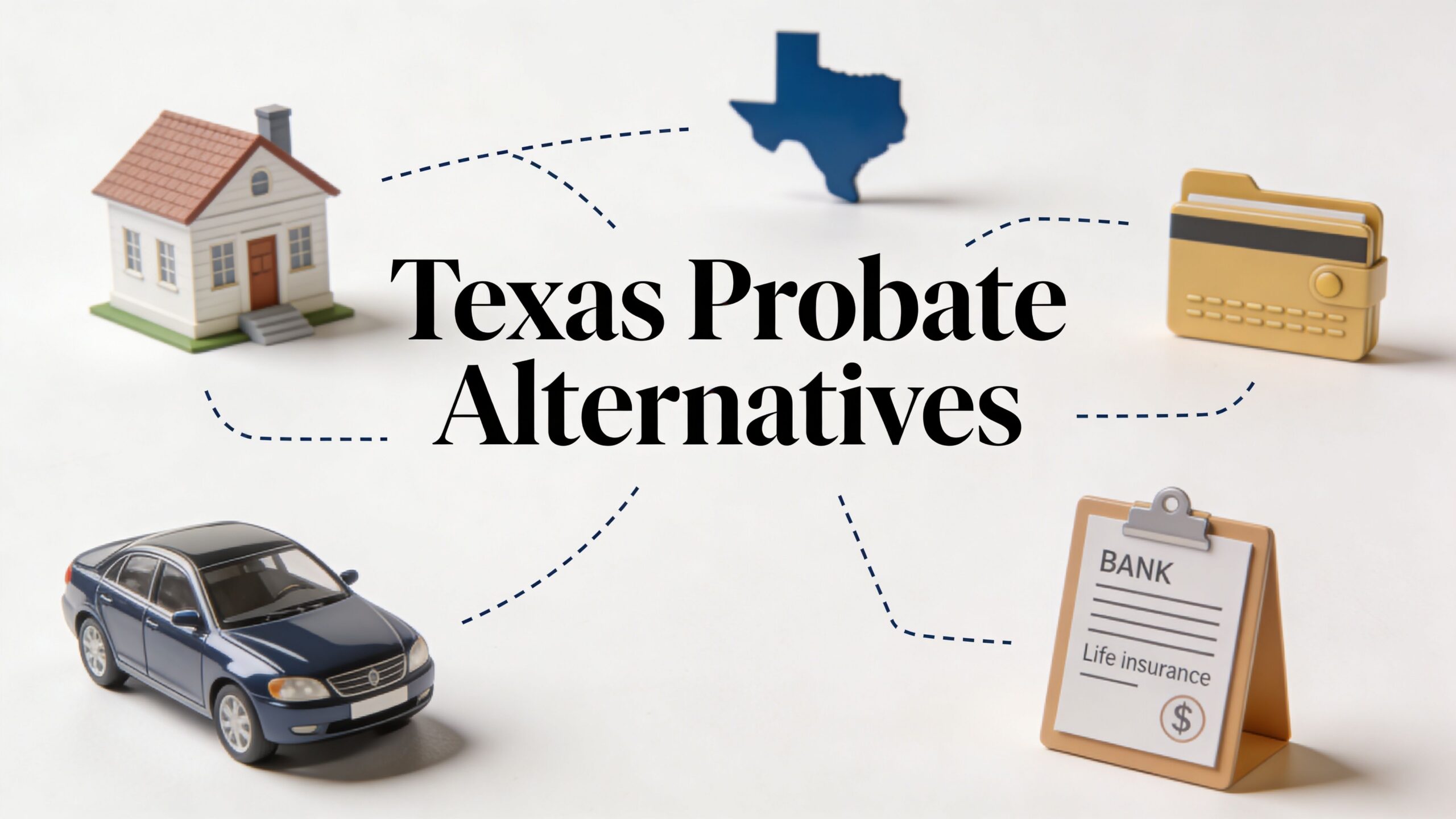
Texas law gives families several ways to pass property outside the probate court process. Each one works on a different type of asset, which is why the practical question is not merely, "Do I need a trust?" The better question is, "Which asset needs which transfer method?"
Common Texas probate-avoidance tools
Here are several options Texas families often use:
Community Property with Right of Survivorship
Married spouses can sign a CP-ROS agreement for qualifying community property so the surviving spouse becomes the owner automatically at death.Beneficiary designations
Life insurance, IRAs, 401(k)s, and many annuities usually pass under the beneficiary form on file, not under a will or trust.POD and TOD registrations
Bank accounts and some brokerage accounts can transfer directly to the person named in a payable-on-death or transfer-on-death designation.Transfer on Death Deeds
A Texas Transfer on Death Deed can let real estate pass to a named beneficiary without probate, if the deed is prepared and recorded correctly during the owner's lifetime.
Each of these tools works like a direct lane around probate for a particular asset. A trust, by comparison, is often better suited for assets that need ongoing management, staggered distributions, protection for a young beneficiary, or a plan for incapacity.
When a hybrid plan works better than a trust-only plan
Many Texas estates work best with a mix of tools rather than a trust-centered design.
A common example looks like this: retirement accounts pass by beneficiary form, a married couple uses survivorship language where appropriate, a home may pass by deed or through a trust depending on the family's goals, and a will remains in place for anything that does not transfer automatically. That approach can reduce cost and paperwork while still keeping the plan organized.
The choice often turns on your goals, not just your assets. If privacy, delayed distributions, blended-family planning, or management during incapacity are top concerns, a trust may deserve a larger role. If the estate is straightforward, simpler transfer methods may do the job with less maintenance.
Families should also coordinate probate avoidance with long-term care planning. Asset transfers that look simple for probate purposes can affect Medicaid timing and eligibility, which is why it helps to understand the Medicaid look-back period before changing ownership or moving property into a trust.
The best Texas plan is usually the one that matches each asset to the right transfer method and keeps the overall plan easy for your family to carry out.
Secure Your Legacy with Confidence and Clarity
Estate planning can feel heavy because it asks you to think about family, property, illness, and loss all at once. But the legal side becomes much easier once you separate myth from mechanism. A trust can avoid probate in Texas. It does so by ownership, not by magic. And the trust only works for the assets that are properly connected to it.
For some families, a revocable living trust is the right center of the plan. For others, a combination of survivorship agreements, beneficiary designations, transfer-on-death tools, and a well-drafted will may be enough. The right answer depends on your property, your family dynamics, your goals for privacy, and who may need to step in during incapacity.
If long-term care planning is also part of your concern, it helps to understand related issues like the Medicaid look-back period, because trust and asset-transfer decisions can affect more than probate alone.
If you need help evaluating options, a lawyer can review how your assets are titled, explain fiduciary duties in Texas, help with trust administration, and discuss how to modify a trust in Texas when circumstances change. The Law Office of Bryan Fagan, PLLC handles estate planning, probate, guardianship, and asset protection matters for Texas families who want a coordinated plan rather than isolated documents.
If you’re managing a trust or planning your estate, contact The Law Office of Bryan Fagan, PLLC for a free consultation. Our attorneys provide trusted, Texas-based guidance for every step of the process.