A family trust is supposed to bring stability. But after a parent, grandparent, or spouse passes away, many beneficiaries feel the opposite. Phone calls go unanswered. Basic questions about money get vague responses. Distributions seem delayed. You may start wondering whether the trustee is overwhelmed, or whether something is wrong.
That uncertainty is hard. It affects grief, family relationships, and your confidence in what your loved one intended. If that’s where you are, asking for a trust accounting isn’t hostile. It’s a reasonable request for clarity.
Texas law gives beneficiaries, and in some situations other interested people, a path to get answers. In many cases, the best path starts discreetly. A calm request can solve the problem. If it doesn’t, the law provides a structured way to push for transparency through a formal written demand and, if necessary, a court filing called a petition for accounting texas trust.
When Trust Becomes a Question Your Path to Clarity
Maria’s father named her uncle as trustee of a family trust. At first, Maria assumed things were being handled properly. Then months passed. She received no clear statement of what property was in the trust, what bills had been paid, or whether the trustee had taken compensation. Each time she asked, she got a short answer: “Everything is under control.”
That kind of response leaves people stuck. You don’t want to accuse a family member unfairly. But you also don’t want to ignore warning signs.

A trust accounting gives structure to that uncertainty. It’s a detailed written record showing what the trustee has done with trust property. In plain terms, it answers basic questions families care about. What came into the trust? What went out? What’s left? Who got paid? What changed?
Why families hesitate
Many people wait too long because they worry a request will create conflict. Others assume the trustee has to send yearly updates automatically, the way some court-supervised matters work. Private Texas trusts usually don’t work that way. Often, the beneficiary has to take the first step and ask.
That matters because silence can feel normal when it isn’t.
A request for an accounting is often less about starting a fight and more about restoring trust through documentation.
What clarity can do
Once the records are on the table, several things can happen. You may learn the trustee has been careful and organized. You may find harmless delays caused by tax paperwork, property cleanup, or title issues. Or you may spot deeper problems that need legal attention.
Either way, you’re no longer guessing. You’re working from facts.
Understanding Your Right to a Trust Accounting Under Texas Law
Texas trust law puts trustees in a position of confidence. They hold property for someone else’s benefit, so the law expects honesty, care, and transparency. Those obligations are often called fiduciary duties in Texas.
A fiduciary duty means the trustee must act for the benefit of the trust and its beneficiaries, not for personal convenience or gain. In daily life, that includes keeping records, following the trust terms, handling property prudently, and giving information when the law requires it.
Who can ask for an accounting
The first group people think about is beneficiaries. That makes sense. They are the people the trust is designed to benefit. But Texas law can reach beyond that group in some cases.
Under Texas Property Code Section 113.151(b), an interested person may file suit to compel a trustee’s accounting. That can include more than a current beneficiary. Depending on the situation, it may include a successor trustee or a creditor with a valid claim against the trust. The statute has been part of the Texas Trust Code framework since the reform effective January 1, 2004.
That broader standing matters in real life. If a trustee resigns, dies, or leaves a mess behind, the next person trying to sort out the trust may need records just as badly as a beneficiary does.
What a formal accounting includes
A proper accounting is more than a casual email or a spreadsheet with a few line items. Texas law expects a detailed report. If you want a fuller overview of what trust accountings are and why they matter, this explanation of trust accounting in Texas is a useful starting point.
A formal accounting should tell you, in understandable form:
- What property the trust owns
- What has been added to or removed from the trust
- What liabilities the trust owes
- What compensation the trustee has taken
- How trust assets have changed over time
A statutory accounting also has to be sworn under penalty of perjury. That makes it a serious legal document, not just an informal update.
Why this right matters
Consider a simple example. A trustee manages a trust that owns rental property and investment accounts. The beneficiary notices distributions have shrunk, but no explanation comes with them. An accounting may reveal ordinary repair bills and taxes. Or it may show unexplained withdrawals, excessive trustee compensation, or money moved into accounts that don’t clearly belong to the trust.
A beneficiary usually can’t evaluate the trustee’s conduct without records. That’s why the right to an accounting is so important. It gives the family a lawful way to verify what happened without relying on rumors or assumptions.
Practical rule: If you’re worried about trust management, start by asking for records before accusing anyone of misconduct.
A Texas trust administration lawyer can help you decide whether your concern is a communication problem, a record-keeping problem, or a true breach of duty. A Texas estate planning attorney can also help if the trust language itself is confusing or if your rights depend on whether your interest is current, future, or contingent.
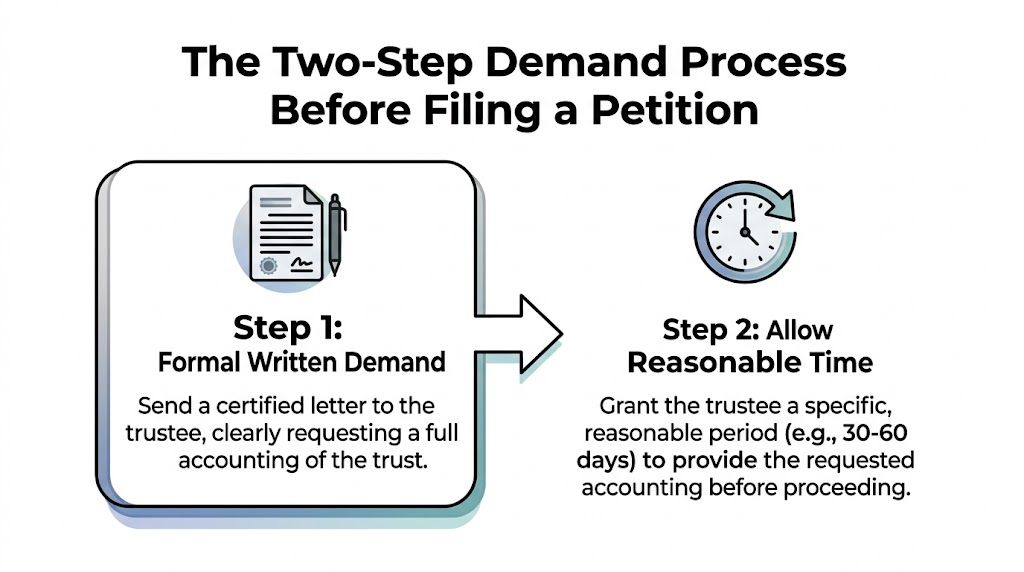
The Two-Step Demand Process Before Filing a Petition
Most trust accounting disputes shouldn’t begin in a courtroom. They should begin with a clear request. If you approach this carefully, you may get what you need without turning a family disagreement into litigation.
The key is to build a record while keeping the tone calm.
Step one starts with a respectful request
An informal request is often the best first move. It shows maturity, gives the trustee room to respond, and may uncover a simple explanation. Some trustees are not hiding anything. They may be disorganized, grieving, busy with appraisals, or waiting on banks, tax documents, or property sales.
A short written message often works better than a phone call because it creates a record. You can ask for a summary of assets, liabilities, distributions, expenses, and trustee compensation. Keep the tone neutral.
A message like this is often enough:
“I’m writing as a beneficiary to ask for an update on the trust administration, including current assets, expenses paid, distributions made, and any trustee compensation. I’d appreciate receiving this information in writing.”
That kind of request doesn’t accuse anyone. It asks for clarity.
Step two is the formal written demand
If the trustee ignores the first request, gives a partial answer, or keeps delaying, the next step is a formal written demand, as Texas law ties court relief to the demand process.
Under Texas Property Code § 113.151(a), once a beneficiary makes a written demand, the trustee must deliver a formal accounting on or before the 90th day after receiving it. The trustee is not required to provide an accounting more often than once every 12 months unless a court orders otherwise.
That timing does two things. It protects the beneficiary’s right to information, and it gives the trustee a defined window to gather records and respond properly.
If you need guidance on the demand itself, this resource on a Texas trust accounting demand letter can help you understand what to include.
What to include in the demand
Your formal demand should be specific enough that no one can later say it was vague. It should identify the trust, your role, and what accounting you want.
A strong demand usually includes:
- Your identity and status. State that you are a beneficiary and identify the trust by name if possible.
- A clear request for a statutory accounting. Ask for a written accounting detailing the trust transactions for the required period.
- The categories you expect to see. Mention assets, receipts, disbursements, liabilities, distributions, changes in property, and trustee compensation.
- Delivery details. Send it in a way that proves receipt, such as certified mail.
- A professional tone. Courts notice whether a party acted reasonably before filing suit.
A simple checklist before you send it
Use this short checklist to avoid common mistakes:
| Item | Why it matters |
|---|---|
| Trust identified clearly | Prevents confusion about which trust you mean |
| Beneficiary status stated | Shows why you’re entitled to ask |
| Request made in writing | Creates the legal foundation for later relief |
| Proof of delivery kept | Helps prove the trustee received it |
| Requested information described | Reduces arguments over scope |
| Copy saved with attachments | Preserves your evidence file |
Sample language you can adapt
“I am a beneficiary of the trust and hereby request a written accounting under Texas law. Please provide a detailed written statement of accounts, including trust property, receipts, disbursements, liabilities, distributions, changes in assets, and trustee compensation.”
You don’t need to sound angry to sound serious. In fact, calm language often helps.
What not to do
Some mistakes make a later court filing harder than it needs to be:
- Don’t rely on verbal requests alone. If there’s no paper trail, proving your steps becomes harder.
- Don’t send a vague note. “Send me everything” is less useful than a direct request for an accounting.
- Don’t make threats you’re not ready to follow through on. Empty threats usually escalate tension and weaken your position.
- Don’t demand new accountings repeatedly within the restricted period. The law limits how often a trustee must respond absent court involvement.
Why patience still matters
Once the demand is sent, many beneficiaries feel pressure to act quickly. That’s understandable. But this stage still calls for discipline. Give the trustee the legal response window. Save every email, letter, and receipt. Organize your timeline.
That record becomes the backbone of your petition if the trustee still won’t comply.
How to File a Petition for Accounting in a Texas Court
A court petition usually enters the picture only after the quieter steps have failed. You asked clearly. You gave the trustee time to respond. The records still did not come. At that point, filing a petition is less about starting a fight and more about asking a judge to create a clear deadline and a clear set of rules.

What the petition must show
Judges are usually looking for an organized story, not family frustration. A solid petition gives the court a short, documented explanation of why intervention is needed.
In practical terms, your filing should establish three points:
- You are a beneficiary or other person with the legal right to request the accounting.
- You made the required written demand.
- The trustee did not provide the accounting within the time allowed by law.
Those points may sound simple, but they do a lot of work. A petition with proof attached is easier for the court to evaluate than one built around suspicion alone. Courts also tend to respond better when the request stays focused on transparency instead of turning into a broad attack before the facts are known.
What to gather before filing
Many families assume the hardest part is drafting legal language. Usually, the harder part is getting your papers in order.
Gather the documents that show the court what happened and when it happened:
- The trust agreement, or the portions available to you
- Your written demand for an accounting
- Proof the trustee received that demand
- Any reply from the trustee, including incomplete or delaying responses
- A timeline of key dates, such as the settlor’s death, trustee appointments, follow-up communications, and expired deadlines
A timeline helps more than people expect. It works like the table of contents for your case. If the judge can follow the sequence quickly, your request becomes easier to understand.
If you are working with a Texas estate planning attorney, this is often the stage where legal guidance helps prevent avoidable delays. The right court, the right wording, and the right attachments matter.
Choosing the right court
Texas trust matters do not always go to the same kind of court. Depending on the county and the details of the trust, the case may belong in a statutory probate court, a county court exercising probate jurisdiction, or a district court. Filing in the wrong court can slow everything down because the clerk cannot tell you where the case legally belongs.
That can feel frustrating, especially if you are already dealing with silence from the trustee. But it helps to view court selection as choosing the correct door before you knock. If you knock on the wrong one, you may still get redirected, but it costs time and money.
What the petition usually includes
The petition itself does not need dramatic language. In fact, plain and careful wording is often stronger.
A typical petition includes:
- The names of the parties
- The name or description of the trust
- Your relationship to the trust
- The date and method of your written demand
- The trustee’s failure to provide the accounting
- The court order you want
That requested relief is often straightforward. You are asking the court to order the trustee to provide a written accounting that satisfies Texas law. If the known facts also suggest larger fiduciary problems, your lawyer may decide whether to include additional requests. Even then, keeping the accounting issue clear and separate often helps the court address the immediate need for information first.
Courts usually respond best to a petition that reads like a documented timeline of events.
Sample petition language
A short example makes the format less intimidating:
“Petitioner is a beneficiary of the trust and previously made written demand for an accounting. The statutory response period has passed, and Respondent has not provided the required accounting. Petitioner requests that the Court order Respondent to provide a written accounting in compliance with Texas law.”
That language is only a model. Every case has its own details. Still, the tone is the takeaway. Calm. Specific. Focused on the records.
Filing and service
After the petition is prepared, it is filed with the court clerk. Then the trustee must be formally served under the Texas rules. Formal service is the legal delivery method that tells the trustee a court case now exists and a response is required.
Here is the process in simple terms:
| Stage | Purpose |
|---|---|
| Filing | Starts the court case |
| Service | Gives the trustee official legal notice |
| Response | Gives the trustee a chance to answer |
| Hearing or order | Allows the court to decide what must happen |
Service errors can stall a case even when the petition itself is well prepared. That is one reason many beneficiaries choose to hire counsel at this stage rather than trying to handle every procedural step alone.
When the problem may be bigger than missing paperwork
Sometimes a missing accounting is only the surface issue. The refusal to share records may point to self-dealing, unexplained transfers, unusual trustee fees, or distributions that do not match the trust terms. You may not know that yet. That is exactly why the accounting matters.
An accounting request works like turning on the lights in a dark room. You are not asking the court to assume wrongdoing at the start. You are asking for enough information to see whether the trustee has been acting properly. That is a measured approach, and courts often view it as a reasonable one.
Navigating Responses and Outcomes After You File
After filing, many beneficiaries feel a mix of relief and worry. Relief because the court now has the issue in front of it. Worry because they do not know whether the trustee will cooperate, fight, or say nothing at all.
All three happen.
Some trustees provide the accounting once a judge is involved because they realize the dispute can still be resolved with transparency. Others answer with objections, delays, or a packet of records that looks polished but leaves out the information that matters. A few do not respond in a meaningful way, which often pushes the court to take a firmer role.

If the trustee provides the accounting
Getting an accounting does not always end the problem. It often changes the question from, "Why will they not share records?" to, "Do these records explain what happened?"
That review should be calm and methodical. A trust accounting works like a financial map. If key roads are missing, if the starting point does not match the ending point, or if large detours appear without explanation, you may still not have a clear picture.
According to guidance on analyzing trust and estate accountings, a careful review includes checking whether the accounting contains the categories Texas law generally requires, then comparing the reported transactions to underlying records such as bank statements, invoices, and distribution support. That process often reveals errors, omissions, or conduct that needs a closer look.
A practical review usually starts here:
- Check whether the accounting is complete. It should identify trust assets, liabilities, receipts, disbursements, distributions, and trustee compensation.
- Compare the opening and closing numbers. The balances should connect logically from one period to the next.
- Match major expenses to backup records. Large payments should have statements, invoices, receipts, or another clear explanation.
- Look for signs of commingling. Trust funds should not appear mixed with the trustee’s personal money.
- Review trustee compensation carefully. Fees should be identifiable, consistent with the trust terms and Texas law, and supported by records.
If the accounting answers the questions, that may lower the temperature of the dispute. If it creates new questions, the court case may continue, but now you are working from documents instead of suspicion.
If the trustee objects or files a response
An objection does not mean you lose. It means the disagreement has shifted into a more structured setting.
Trustees often argue that the beneficiary is not entitled to the information requested, that the request is too broad, or that they already gave enough detail. Judges usually look past family tension and focus on a narrower set of issues. Who has the legal right to request the accounting? Was a proper demand made? Does the material already produced satisfy the trustee’s duty?
That is why your paper trail matters. Clear letters, dates, prior requests, and any partial records can help the court see that you asked for transparency before asking for intervention.
A partial accounting can create a common point of confusion. Families sometimes assume that any response closes the issue. It does not. If key periods are missing, transactions are lumped together, or trustee fees appear without support, the court can still require a fuller accounting.
If the trustee stays silent
Silence usually changes the pace of the case.
Courts expect parties to respond once they have been properly served. If the trustee does not answer or participate, the beneficiary may ask the court to move forward and order compliance based on that failure. Judges do not treat silence as a good faith substitute for an explanation.
In practical terms, this can put pressure on the trustee to produce records quickly or explain why they have not done so.
What outcomes are possible
The most common result is an order requiring the trustee to provide an accounting by a deadline. In some cases, the court orders a corrected accounting because the first version was incomplete or unclear. If the records point to self-dealing, unexplained transfers, excessive fees, or other fiduciary problems, the dispute may expand into a breach of trust case.
Sometimes the accounting does something just as important. It narrows the disagreement. Families may learn that poor communication, sloppy bookkeeping, or delay caused the conflict, not theft. That does not excuse the trustee’s duty to account, but it can open the door to settlement instead of a longer fight.
If the records show a real threat to the trust, the court may consider stronger remedies, including trustee removal when the facts support it. The accounting is often the turning point because it replaces guesswork with evidence.
Handling Complex Scenarios and Proactive Strategies
Some of the hardest trust accounting problems arise when no one has a clean file cabinet of answers. A parent may have named a trustee who later died, became ill, or kept records in too many places to count. Families often worry that this makes the truth impossible to find.
It usually does not.
Texas trust disputes can still be sorted out even when the paperwork is messy. The process often shifts from asking for an accounting to rebuilding one piece by piece, the same way you would reconstruct a bank register from statements, receipts, and tax records after years of disorganized filing.
When the trustee dies or can no longer serve
A trustee’s death or incapacity does not erase the trust’s history. Someone may still need to gather the financial trail and explain what happened during that trustee’s time in charge.
In practice, that often means the successor trustee, or sometimes the personal representative handling the former trustee’s estate, must help assemble the missing picture. That work can take patience. Records may come from bank statements, brokerage reports, deeds, closing files, invoices, tax returns, emails, and accounting software.
Families are often surprised by this point. They assume that if the original trustee is gone, the accounting request dies too. Texas law generally treats the duty to account more like an unfinished ledger. The person now standing in the trustee’s place may have to help complete it.
A Texas trust administration lawyer can help identify what records should exist, where to request them, and how to organize them in a way a court can use.
When the real problem is conflict, not missing records
Some cases are not about total silence. They are about partial answers wrapped in anger. A trustee may send a few statements, avoid the hard questions, and insist the beneficiary is overreacting. That pattern can drain a family quickly because every message turns into an argument instead of a solution.
A calmer strategy is important. Before asking a court for help, it often makes sense to narrow the dispute in writing.
A useful approach looks like this:
- Ask for specific categories of information. Request bank statements, tax returns, receipts for large expenses, and a transaction history for a defined time period.
- Acknowledge what the trustee already sent. That lowers the temperature and makes it harder for the trustee to claim no one is being reasonable.
- List what is still missing. A short numbered list works better than a long emotional email.
- Keep copies of everything. Save letters, emails, text screenshots, and proof of delivery.
- Watch for signs the issue is bigger than accounting. Unexplained transfers, repeated self-payment, or refusal to separate trust funds may point to a deeper fiduciary problem.
Sometimes an accounting dispute stays exactly that. Sometimes it reveals that the trustee may no longer be the right person to serve. If the facts start pointing in that direction, this guide on a Texas petition to remove a trustee explains when removal may become the next legal step.
Proactive habits that prevent trust disputes
The best trust accounting fight is the one a family never has to file.
Many beneficiaries become suspicious for a simple reason. They have been left in the dark for too long. Regular, readable updates can prevent that. A trustee does not need to overwhelm family members with every scrap of paper, but the trustee should be able to show where money came from, where it went, and why.
Trustees usually reduce conflict when they:
- Keep trust records in one organized system. Separate folders and account records beat scattered emails and handwritten notes.
- Keep trust money separate from personal money. Mixed funds create confusion and invite distrust.
- Document fees and reimbursements clearly. If the trustee was paid back or compensated, the file should show the amount, date, and reason.
- Share periodic summaries in plain language. Beneficiaries are less likely to assume misconduct when they receive understandable updates.
The Law Office of Bryan Fagan, PLLC handles formal trust accounting demands, petitions to compel accountings, and related trust administration issues for Texas families who need structured legal guidance.
How beneficiaries can stay careful without making the conflict worse
Beneficiaries also shape how these disputes unfold. A clear timeline helps. So does a focused request. General accusations usually create more resistance, while precise questions often produce better answers.
Try to treat the accounting issue like assembling a puzzle. Start with edge pieces first. What accounts existed? Who controlled them? What years are missing? Which large transactions need an explanation? That method keeps the conversation tied to facts instead of fear.
Good planning also helps prevent these problems before anyone reaches the petition stage. Careful trustee selection, clear drafting, and regular trust administration habits often spare families from the confusion that leads to court in the first place.
Take the Next Step with Confidence
A family member dies, the trust is supposed to bring order, and instead you are left with basic questions no one will answer. At that point, the goal is not to start a fight. The goal is to replace worry with facts.
That is why the smartest next step is usually the calmest one. Start by asking for clarity in a way that gives the trustee a fair chance to respond. If that works, the family may avoid court, legal expense, and more strain. If it does not, Texas law gives beneficiaries a path to ask a judge for an accounting and require real answers.
A trust accounting works like a financial map. It shows what came in, what went out, what is still there, and who made those decisions. For many families, seeing that map is enough to settle fears or confirm that a closer review is needed.
If you are a beneficiary, silence does not erase your rights. If you are a trustee, good intentions do not replace recordkeeping and clear communication. The process described in this guide is designed to encourage transparency first and formal court action only when necessary.
For readers who want to understand how law firms publish educational materials that help families spot problems early, this overview of digital marketing for law firms offers useful background.
The Law Office of Bryan Fagan, PLLC handles trust accounting demands, petitions to compel accountings, and related trust administration matters for Texas families. If you need help deciding whether an informal request is enough or whether it is time to file, a consultation can help you choose the next step with a clearer view of your options.