Discovering that a trustee—the person entrusted with a loved one’s legacy—may be failing in their duties can feel overwhelming and deeply personal. If you are a beneficiary of a trust and you suspect misconduct, mismanagement, or a breach of trust, it is important to know that you have rights. In Texas, the law provides a clear path to hold a trustee accountable, and if necessary, petition the court for their removal.
Managing a loved one’s trust can feel complicated, but with the right legal guidance, it doesn’t have to be. This guide will walk you through the process, explaining complex legal concepts in plain English to empower you and provide confidence in your next steps. You do not have to navigate this alone.
Trustee Responsibilities and When You Can Legally Remove Them in Texas

Serving as a trustee is more than just a title; it is a position of immense legal and ethical responsibility. Under Texas law, a trustee is a fiduciary, which means they have a legal duty to act solely in the best interests of the trust beneficiaries. When this duty is broken, the Texas Trust Code offers a powerful remedy.
The primary statute governing this process is Texas Trust Code §113.082. This law allows a court to remove a trustee and even deny some or all of their compensation if they have violated their duties. However, a simple disagreement over a minor decision is not enough. To succeed, a petition must be based on solid legal grounds and supported by clear evidence.
Key Grounds for Removal Under the Texas Trust Code
A successful petition requires more than a gut feeling of distrust; it needs to prove to a court that the trustee's actions (or inactions) have met a specific legal standard for removal. The law outlines several distinct situations where a judge can intervene to protect the trust and honor the wishes of its creator, the settlor.
Here are the most common reasons a Texas court will consider removing a trustee:
- Material Violation of the Trust: The trustee blatantly ignores a clear instruction in the trust document, such as selling a property they were directed to keep or failing to make a required distribution.
- Breach of Fiduciary Duty: This is a broad but critical category. It includes actions like self-dealing (using trust assets for personal benefit), showing favoritism among beneficiaries, or having a significant conflict of interest.
- Gross Mismanagement or Incompetence: The trustee's decisions are so poor or unskilled that the trust has suffered, or is likely to suffer, a material financial loss. This goes beyond a simple bad investment and points to a pattern of negligence.
- Incapacity: The trustee is no longer capable of performing their duties, whether due to physical illness, cognitive decline, or another debilitating condition.
- Significant Conflict or Hostility: The relationship between the trustee and beneficiaries has become so toxic that communication has broken down, making it impossible to administer the trust effectively.
A trustee holds a position of immense responsibility, legally defined as a fiduciary. This means they must prioritize the beneficiaries' interests above all else. When that duty is broken, Texas law provides a clear path for beneficiaries to seek a remedy through the courts.
Understanding these legal grounds is your first step. For example, if a trust requires diversified investments and the trustee dumps everything into a single risky startup, you could argue it's both a material violation and gross mismanagement. A Texas trust administration lawyer can help pinpoint which arguments best fit your circumstances.
Gathering Evidence for Your Petition
To convince a judge, you need to provide clear and convincing evidence. Your proof must directly support one of the legal grounds for removal. Just stating "I don't trust them anymore" will not be enough to sway a court.
Here’s a look at what it takes to build a case for removing a trustee in Texas.
Legal Grounds for Trustee Removal in Texas
This table breaks down the primary reasons for removal and the kind of proof you'll need to gather.
| Legal Ground (Texas Trust Code §113.082) | Practical Meaning for Beneficiaries | Example Evidence |
|---|---|---|
| Material Violation of Trust Terms | The trustee ignored a direct command in the trust document. | Trust document, emails showing refusal to follow instructions, records of prohibited transactions. |
| Breach of Fiduciary Duty (e.g., Self-Dealing) | The trustee used trust assets for their own benefit or favored one beneficiary over another. | Bank statements showing personal use of funds, property records of sales to family members. |
| Gross Mismanagement or Incompetence | The trustee's actions caused a significant financial loss or substantial risk to the trust. | Financial reports showing major losses, tax penalty notices, evidence of ignored investment advice. |
| Significant Conflict or Hostility | Animosity is so severe that communication breaks down and the trust cannot function. | A documented history of hostile emails, records of ignored requests for information. |
This is why getting advice from an experienced estate planning attorney early on is so critical. They can help you legally obtain key documents, like demanding a formal trust accounting, and frame your petition in a way that resonates with the court. This preparation is the bedrock of a successful effort to remove a trustee in Texas.
What Is a Material Violation of the Trust
When someone creates a trust, they are placing their faith in another person to carry out their wishes. The trust document is the ultimate rulebook, and the trustee's primary duty is to follow it. When a trustee goes against a direct command in the trust, it may constitute a material violation—one of the strongest grounds for removal.
A "material violation" is not a minor slip-up, like a late statement or a small accounting error that is easily corrected. It is a significant breach that strikes at the heart of the trust's purpose and disrespects the settlor's intent.
Honoring the Settlor’s Original Intent
In Texas, courts hold the settlor's intentions in the highest regard. When a trustee deviates from an explicit command in the trust document, they are not just making a poor judgment call; they are undermining the very foundation of the trust they swore to uphold.
For instance, consider a real-world scenario where a trust explicitly states that a family ranch must be preserved for future generations. If the trustee decides to sell it, even if they get a great price, it is a material violation. The settlor gave a direct order, and the trustee ignored it. The trustee's personal reasoning does not override the settlor's clear instructions.
Distinguishing Minor Errors from Major Violations
Not every mistake a trustee makes is grounds for removal. A trustee might misinterpret a vague clause or make a minor clerical error. The key is whether the action causes substantial harm or directly contradicts a non-negotiable term of the trust.
Here are a few real-world scenarios that often cross the line:
- Prohibited Investments: The trust forbids investing in volatile cryptocurrencies, but the trustee gambles trust funds on a new, high-risk coin.
- Ignoring Distribution Mandates: The trust clearly requires annual distributions to a beneficiary for living expenses, but the trustee withholds the money without a valid reason.
- Improper Asset Sales: The trust directs the trustee to hold a valuable art collection, but they sell a key piece to a friend at a steep discount.
Each of these examples shows a trustee deliberately acting against the trust’s explicit rules. These are not just administrative oversights; they are clear violations. Fiduciary litigation data shows that a trustee's failure to follow a trust's core instructions on asset management or distributions is a leading cause for court intervention.
The very first step in building a case is to comb through the trust instrument itself. You must be able to point to the exact clause the trustee has defied. This is what turns a general complaint about poor management into a powerful, specific legal claim.
An experienced trust attorney can help you dissect the legal language and pinpoint these clear-cut violations. Understanding the difference between a minor stumble and a material breach is critical. If you feel a trustee is overstepping, learning more about what constitutes a trustee breach of fiduciary duty can give you a clearer picture of your rights and the road ahead.
When Bad Management or Bad Blood Justifies Removing a Trustee
Sometimes, the problem with a trustee isn't a single dramatic event but rather a slow, steady pattern of poor decisions or a hostile attitude that makes proper trust administration impossible. Texas law recognizes that even without a clear violation of the trust's terms, a trustee can still fail so profoundly that removal is necessary.
A court can remove a trustee for gross mismanagement, incompetence, or when the relationship with beneficiaries becomes so hostile that it paralyzes the trust's ability to function. These grounds are essential when a trustee isn't technically breaking a specific rule but is absolutely failing at their job.
What Counts as Gross Mismanagement and Incompetence?
Gross mismanagement is not about second-guessing every investment. It refers to a track record of negligence so blatant that it causes or threatens material financial loss to the trust. It’s the difference between one bad stock pick and a series of reckless moves that jeopardize the entire portfolio.
Consider these all-too-common real-world scenarios:
- A trustee who "forgets" to file the trust’s tax returns for years, leading to massive IRS penalties that deplete trust assets.
- A trustee who allows a significant amount of cash to sit in a non-interest-bearing checking account for an extended period, letting inflation erode its value.
- A trustee who invests the entire trust corpus in a single, speculative "hot tip" stock, leading to a total loss.
Imagine a trustee who ignores tax filings for so long that the penalties eat up a huge chunk of your inheritance. This is a textbook case of gross mismanagement, a powerful reason for removal under Texas Trust Code §113.082. Fiduciary litigation is on the rise, with recent appellate cases showing trustees being held liable for sloppy investment practices that caused trust values to crater by as much as 40%. You can dig deeper into these issues by understanding the concept of de facto trustee status in Texas.
When Hostility Becomes a Fireable Offense
Another legitimate reason for a petition to remove a trustee in Texas is extreme hostility. To be clear, courts are not interested in simple personality clashes. The conflict must be so severe that the relationship has completely shattered, making it impossible for the trustee to perform their duties.
Texas courts want to see proof that the animosity isn't just a personality clash but is actively sabotaging the trust's administration. If a trustee can't even talk to a beneficiary without it devolving into a shouting match, how can they possibly handle distributions or provide accountings?
For instance, if a beneficiary's reasonable request for information is consistently met with stonewalling, accusations, or threats, you are building a strong case. If that hostility causes the trustee to act with spite—like deliberately withholding a required distribution—they have crossed a serious line. The focus is on whether their animosity prevents them from upholding their fiduciary duties in Texas.
The Process Of Filing A Petition In Texas
Knowing you have solid legal grounds is the first step, but taking decisive action is what protects the trust. Filing a petition to remove a trustee in Texas is the formal process of asking a court to intervene. While it may sound like a daunting legal battle, understanding the steps involved can provide the confidence needed to protect your family's legacy.
The journey begins with preparing and filing a legal document, often titled "Petition for Removal of Trustee and for Other Relief," with the appropriate Texas court. This document is the foundation of your entire case.
Drafting The Petition And Gathering Your Evidence
This is where you officially present your case to the court. An experienced Texas trust administration lawyer will draft a petition that does more than list legal reasons for removal—it tells a compelling, fact-based story. Knowing how to approach drafting legal complaints is crucial for making your case clear and persuasive from the start.
Your petition must be filled with specific facts detailing the trustee’s misconduct. Vague complaints like "they're doing a bad job" are ineffective. You must draw a direct line from the trustee's actions to the harm they caused, and for that, you need solid evidence.
This infographic breaks down three of the most common reasons a petition might be filed.
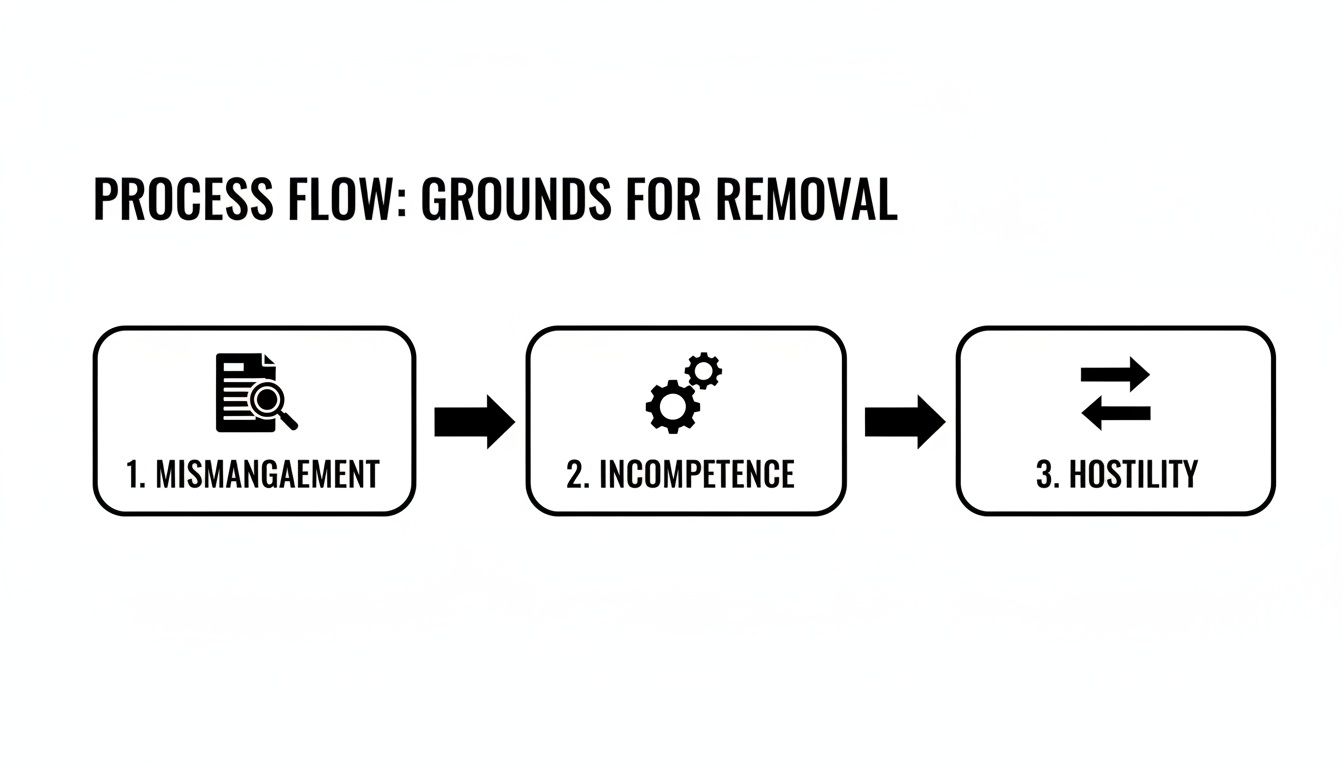
As you can see, mismanagement, incompetence, and hostility are distinct legal arguments, each requiring its own supporting evidence to be effective in front of a judge.
To build that powerful case, your attorney will help you gather critical documents. This process often includes:
- Bank Statements and Financial Records: These can clearly show unauthorized spending, self-dealing, or a complete failure to invest assets prudently.
- Email and Written Correspondence: A documented paper trail is invaluable. It can reveal a trustee ignoring beneficiary requests, acting hostile, or admitting to a breach of duty.
- The Trust Document: This is the rulebook. It lays out exactly what the trustee was supposed to do—and what they were forbidden from doing.
A well-crafted petition acts like a roadmap for the entire legal journey. It clearly tells the court who's involved, what the trustee did wrong, how they broke Texas law or the trust's own rules, and exactly what you're asking the court to do about it.
Filing The Petition And Notifying The Trustee
Once the petition is drafted, it is filed with the clerk of the court that has jurisdiction over the trust, typically a statutory probate court or a district court in the county where the trust is administered. This filing officially commences the lawsuit.
Next, the trustee must be formally notified that they are being sued. This is accomplished through a formal process called "service of process." A sheriff, constable, or private process server will personally deliver a copy of your petition and a court-issued "citation" to the trustee. This step is a constitutional requirement and ensures the trustee has official notice and an opportunity to respond.
Seeking Immediate Protection For The Trust
Sometimes, you cannot afford to wait months for a final hearing, especially if the trustee is actively depleting trust assets. In these high-stakes situations, your lawyer can ask the court for immediate protective measures.
One of the most powerful tools is a Temporary Restraining Order (TRO). A TRO can be requested at the start of a case to freeze trust accounts and prevent the trustee from taking any further action. It is a short-term solution, typically lasting about 14 days, designed to maintain the status quo until the court can hold a more detailed hearing for a temporary injunction. These emergency measures are critical for stopping a rogue trustee in their tracks and preserving what's left while the removal lawsuit proceeds. You can learn more in our guide on how to sue a trustee in Texas.
Navigating the Court Hearing and Potential Defenses
Once the petition is filed and the trustee is served, you are on the path to a court hearing. This is where a judge will hear both sides and decide whether the trustee's conduct justifies removal. Knowing what to expect can give you the confidence to present a clear, compelling case.
The hearing is a formal, structured process where your attorney presents evidence and arguments. The judge's role is to determine if your claims align with the legal grounds for removal under the Texas Trust Code.
The Role of Evidence and Testimony
At the hearing, your case is built on more than just paperwork. Witness testimony is critical. You and other beneficiaries will likely be asked to testify about your experiences with the trustee. Your attorney will prepare you for this, helping you clearly explain the harm caused by the trustee’s behavior.
The goal is to tell an organized story backed by undeniable proof. Your attorney will methodically present evidence, which may include:
- Financial Records: Bank statements or investment reports that clearly show mismanagement or self-dealing.
- Correspondence: A trail of emails or letters that demonstrates the trustee's hostility, neglect, or outright refusal to communicate.
- Expert Testimony: In some cases, a financial expert may be called to explain precisely how the trustee’s investment strategy was incompetent or reckless.
It is this combination of personal accounts and hard evidence that paints a full picture for the judge, showing not just what happened, but the real-world damage it caused.
The strongest cases are built on a clear, chronological narrative. We work with our clients to organize every email, statement, and piece of evidence to walk the judge through the trustee’s pattern of misconduct, making the request for removal feel like the only logical conclusion.
Understanding the Trustee’s Potential Defenses
To build a strong case, you must anticipate the trustee's arguments. A trustee facing removal will have a legal team ready to defend their actions.
Common defenses include:
- Exercising Discretionary Powers: The trustee might argue the trust document gave them broad authority to make certain decisions, even if those decisions turned out poorly.
- Blaming Third Parties: It's common for a trustee to point a finger at a financial advisor or other professionals they hired for guidance.
- Justifying Actions as Necessary: They may claim a questionable action, like selling a family property, was essential to cover taxes or other trust expenses.
Knowing these potential defenses allows your Texas estate planning attorney to prepare sharp counter-arguments and dismantle them with evidence. This proactive approach is a cornerstone of successful dispute resolution and litigation in Texas trusts.
Possible Outcomes of the Hearing
After reviewing all testimony and evidence, the judge will make a ruling. If your petition to remove a trustee in Texas is successful, the court can order several remedies.
The most obvious outcome is the removal of the trustee. The judge will sign an order officially firing them. The court can also:
- Appoint a Successor Trustee: The court will either install the successor named in the trust document or appoint a qualified individual or corporate trustee.
- Order a Full Accounting: The court will almost certainly compel the removed trustee to provide a final, detailed accounting of every transaction during their tenure.
- Award Damages: If the trustee's breach of duty cost the trust money, the court can order them to personally repay those losses (a "surcharge").
- Deny Compensation: As a penalty for misconduct, the judge can strip the trustee of some or all of their fees.
With the right legal guidance and thorough preparation, you can enter the courtroom ready to fight for the justice needed to secure your loved one's legacy.
What Happens After a Trustee Is Removed

You have successfully petitioned the court, and the judge has ordered the removal of the trustee. This is a significant victory and a moment of relief, but the process is not quite over. The next phase—ensuring a smooth and clean transition of power—is critical to getting the trust back on solid ground.
Appointing a New Trustee
The first order of business is to install new leadership. Often, the trust document itself will name one or more successor trustees. If a qualified and willing person is named, they can step in to manage the trust.
However, if no successor is named, or if those listed are unable or unwilling to serve, the court will appoint one. This could be a trusted family member, but often, to avoid further conflict, the court will appoint a professional fiduciary, such as a corporate trustee (from a bank's trust department) or an experienced private professional. While this involves an administrative expense, it provides impartiality and expertise that can be invaluable after a period of turmoil. An experienced Texas estate planning attorney can guide you through this important selection process.
The Formal Handover and Final Accounting
The removed trustee cannot simply walk away. They have a final legal duty to hand over all trust-related assets and records. This is a formal, meticulously documented transfer of control.
The handover process includes:
- Transferring control of all bank, brokerage, and other financial accounts.
- Executing documents to transfer title for real estate and other assets.
- Turning over a complete set of trust records, including past statements, tax filings, and correspondence.
As a final act, the removed trustee must file a final accounting with the court and provide it to the beneficiaries. This report is meant to detail every financial transaction that occurred on their watch. Your attorney will go over this with a fine-toothed comb to spot any red flags before the court gives its final approval.
From there, the focus shifts to building a productive relationship with the new trustee. With clear communication and a shared goal of honoring the settlor's intentions, you can finally get the trust running smoothly and secure your family's future. For help with these next steps or related issues like guardianship or asset protection, our firm is here to guide you.
Frequently Asked Questions About Removing a Texas Trustee
Facing a conflict with a trustee can be stressful, and it's natural to have many questions. Getting clear, straightforward answers is the first step toward regaining control and peace of mind. Here are some of the most common questions beneficiaries have when considering a petition to remove a trustee in Texas.
How Much Does It Cost To Petition for Removal?
This is a critical question, and the honest answer is: it depends. The total cost can vary significantly based on the complexity of the case, whether the trustee contests the removal, and the amount of evidence gathering required. Legal fees are the primary expense, but you should also account for court filing fees and potential costs for expert witnesses.
However, there is an important consideration: if you are successful, the Texas Trust Code allows the court to order the trustee who breached their duties to pay your attorney’s fees. While not guaranteed, judges often order a misbehaving trustee to pay these costs from their own funds, not from the trust.
Can Beneficiaries Agree to Remove a Trustee Without Court?
Sometimes, yes, but this is the exception. If the trust document itself provides a specific mechanism for beneficiaries to remove and replace a trustee, you may be able to do so without court intervention. This path almost always requires the unanimous agreement of all beneficiaries.
If the trust is silent on this issue, a court order is necessary. Even if all beneficiaries agree that the trustee must go, a judge’s order makes the removal legally binding and ensures a clean, official transfer of power, which protects both the beneficiaries and the incoming trustee.
What Happens If a Trustee Refuses to Step Down?
If you have asked a trustee to resign and they have refused, your only remaining option is to go to court. A strongly worded letter or a phone call carries no legal power to force them out.
A formal petition to the court is your only move. After you file the petition and present your evidence at a hearing, a judge can issue an order compelling the trustee to step down. That order is not a request—it is a legal command that forces them to relinquish control of the trust's assets. A Texas trust administration lawyer can navigate this entire legal process for you, from filing the initial petition to obtaining the final court order.
If you’re managing a trust or planning your estate, contact The Law Office of Bryan Fagan, PLLC for a free consultation. Our attorneys provide trusted, Texas-based guidance for every step of the process. Visit us at https://texastrustadministration.com to learn more.