When a trustee mismanages a trust, it’s more than a financial problem—it’s a betrayal of a sacred duty. Taking legal action against that trustee in Texas is how you enforce fairness, recover lost assets, and protect the inheritance your loved one intended for you. At its heart, the process means filing a lawsuit to hold them accountable for breaching their fiduciary duties, whether through negligence, self-dealing, or simply refusing to distribute the trust’s assets.
Your Guide to Holding a Texas Trustee Accountable

Managing a loved one’s trust can feel overwhelming—but with the right legal guidance, it doesn’t have to be. Discovering that the person in charge of your inheritance might be mishandling it can be a deeply unsettling experience. It’s completely normal to feel betrayed, confused, and anxious about what this means for your future. The good news is that Texas law provides powerful protections for beneficiaries in your exact situation.
This protection is built around the trustee's fiduciary duty—a serious legal obligation under the Texas Trust Code that requires them to act only in your best interest. When a trustee violates this promise, you have every right to hold them accountable in court.
Understanding Your Rights as a Beneficiary
Suing a trustee isn’t about retaliation; it's a structured legal path designed to correct what’s gone wrong. Think of it as using the law to restore order and safeguard what's rightfully yours. The main goals are usually straightforward:
- Enforce fairness by compelling the trustee to follow the trust's specific instructions.
- Recover assets that have been lost due to poor decisions or improper actions.
- Secure your inheritance for the long term by ensuring the trust is managed correctly moving forward.
This guide will walk you through that process step by step, translating complex legal concepts into a clear, actionable plan.
Key Takeaway: The Texas Trust Code is your shield. A lawsuit is the formal tool you can use to enforce a trustee's legal and ethical duties, ensuring they manage the trust's assets with loyalty, prudence, and good faith.
For example, imagine a trustee uses trust funds to make a down payment on their personal vacation home. This is a classic example of self-dealing and a significant breach of their fiduciary duties. As a beneficiary, you have the legal standing to challenge this action and demand that the money be returned to the trust.
Our aim is to empower you with the knowledge needed to move forward confidently, knowing your rights are firmly protected. A skilled Texas trust administration lawyer can help you navigate these complex waters, from the initial investigation through a potential lawsuit. Understanding your options is the first step toward safeguarding your legacy and holding a negligent trustee accountable.
We offer practical advice for trustees, executors, and families navigating estate planning and trust administration.
Recognizing the Grounds for a Lawsuit

Before pursuing a lawsuit against a trustee, it’s crucial to understand what constitutes valid grounds for legal action in a Texas court. This isn’t about frustration over slow communication or minor disagreements. A lawsuit must be built on a solid foundation of legally recognized wrongdoing, known as a breach of trust.
The most common reason for suing a trustee is a breach of fiduciary duty. In Texas, this duty is a cornerstone of trust law. It legally obligates a trustee to act with absolute loyalty and sound judgment, always placing the beneficiaries' financial interests above their own. When a trustee violates this duty, they can be held personally liable for the resulting damages.
What Constitutes a Breach of Fiduciary Duty
A breach isn’t always a dramatic act of theft. More often, it’s a pattern of questionable behavior or a series of poor decisions that erode the trust's value. Identifying these actions is the first step in building a strong case.
Here are some of the most common red flags that can justify a lawsuit:
- Self-Dealing: This occurs when a trustee uses trust assets for their own benefit. For instance, they might "borrow" money from the trust to fund a personal business venture or sell a trust property to a family member at a below-market price. This is a clear conflict of interest.
- Failure to Account: Trustees have a duty of transparency. If your trustee ignores formal requests for financial statements or provides a vague, incomplete report, they are failing a fundamental duty under Texas law.
- Imprudent Investments: Texas law requires a trustee to invest assets as a "reasonably prudent investor" would. Pouring trust money into a high-risk startup or failing to diversify the portfolio isn’t just poor judgment—it can be a breach of duty if it leads to significant losses.
- Failure to Distribute Assets: The trust document specifies when and how assets should be distributed. A trustee who refuses to make these required distributions without a valid, legally sound reason is directly violating the trust's terms.
Real-World Scenario: Let's say a trust owns a valuable piece of commercial real estate. The trustee, who is also a real estate agent, sells the property to one of their own clients without listing it on the open market. This creates a blatant conflict of interest and likely means the trust did not receive the best possible price, directly harming the beneficiaries' inheritance.
Connecting Actions to Trustee Responsibilities
To determine if you have a viable case, you must connect the trustee’s actions—or inactions—to their specific legal duties under the Texas Trust Code. These are not mere suggestions; they are strict legal requirements. Beyond loyalty, a trustee owes duties of care, prudence, and good faith. You can learn more by reading our guide on a trustee's breach of fiduciary duty.
When a trustee gambles half the trust's funds on a risky, unproven investment, they have violated the duty of prudence. When they mix their personal funds with trust funds (commingling), they have breached the duty of loyalty. Identifying these specific violations gives your claim legal merit.
As you explore the grounds for a lawsuit, it’s helpful to understand the various legal tools available, including how to protect assets and recover misapplied funds. An experienced Texas estate planning attorney can review the facts of your situation and advise you on whether the trustee's actions constitute a legal breach and how to proceed with probate.
Texas Law Gives Beneficiaries the Upper Hand in a Lawsuit
When you decide to sue a trustee in Texas, you are not starting from a position of weakness. The law is structured to give you, the beneficiary, a significant advantage through a powerful legal principle called "burden-shifting."
Here’s how it works: As the person filing the lawsuit, your initial responsibility is to present credible evidence suggesting the trustee may have acted improperly. You don't need to have every detail proven at the outset. You just need to make a solid initial case that a breach occurred.
Once you meet this threshold, the tables turn. The legal burden of proof shifts entirely to the trustee. It is now their responsibility to prove to the court that their actions were fair, honest, and in the absolute best interest of the trust. This is a high standard for any trustee to meet, especially one who has been less than transparent.
Laying the Groundwork for Your Case
To initiate this burden-shifting process, your attorney will focus on building a strong foundation for your lawsuit. This involves clearly establishing three key elements.
- The Fiduciary Relationship: First, you must show that a trust exists and that you are a beneficiary. This is typically straightforward and can be proven with the trust document itself.
- The Breach of Duty: Next, you need to identify a specific duty the trustee violated. For example, they may have engaged in self-dealing (a breach of the duty of loyalty) or made reckless investments with trust assets (a breach of the duty of care).
- The Damage Done: Finally, you must connect that breach to a tangible financial loss suffered by the trust.
Consider this scenario: a trustee sells a valuable trust property to their business partner for a price that seems suspiciously low. You would prove the trust's existence (first point), demonstrate that the sale was a conflict of interest (second point), and then use a formal appraisal to show how much money the trust lost in the transaction (third point).
The Power of Burden-Shifting in Practice
This burden-shifting rule is what makes Texas law such a strong shield for beneficiaries. Under the Texas Estates Code and Trust Code, a breach of trust is any violation of a duty a trustee owes. The moment a beneficiary provides initial evidence of wrongdoing—such as bank statements showing unusual withdrawals—the dynamic changes. The trustee cannot simply say, "prove it." They are legally compelled to prove their own innocence.
Key Takeaway: In Texas trust litigation, the law presumes the trustee is at fault once you provide some evidence of misconduct. This puts the pressure squarely on them to justify their actions, not on you to uncover every single detail alone.
This is a significant procedural advantage that levels the playing field, particularly when a trustee has been secretive or attempted to hide their actions.
If your case is successful, the court has a wide range of powerful remedies at its disposal. It can:
- Force the trustee to repay any lost money to the trust (this is called a "surcharge").
- Order the trustee to provide a complete and transparent accounting of all trust activities.
- Remove the trustee from their position and appoint a successor.
- Even reverse improper transactions, such as forcing the return of property sold in a self-dealing scheme.
These remedies are not just punitive; they are designed to make the trust whole and restore its proper administration. Understanding these protections is a key part of knowing the full scope of beneficiary rights in Texas. This system ensures that when you make the difficult decision to sue a trustee, you have the full weight of Texas law on your side.
The Practical Steps in a Trust Litigation Lawsuit
Contemplating a lawsuit against a trustee can feel like entering a legal maze. However, the process is more structured than you might think. It is a clear path designed to bring facts to light and achieve a just resolution. Knowing the roadmap ahead can make the journey feel much less intimidating. This step-by-step guidance for dispute resolution can help you feel more secure.
Often, the most effective action occurs before anyone enters a courtroom. It begins with a formal demand letter from your attorney. This is not merely a note; it is a legal document that outlines how the trustee has failed in their duties, details the damage caused, and demands a specific remedy—such as returning misappropriated funds or providing a complete accounting.
Sometimes, a well-crafted demand letter is enough to bring a negligent trustee to the negotiating table and resolve the issue without a prolonged legal battle.
Filing the Lawsuit and Choosing the Right Court
If the demand letter is ignored or rejected, the next step is to file a lawsuit. Your lawyer will draft a petition, the official document that initiates the case, and file it in the appropriate Texas court. The decision of where to file, known as venue, is a critical strategic choice.
Most trust disputes are handled in a district court or a statutory probate court in the county where the trust is administered. For particularly complex, high-stakes cases, Texas has a specialized court.
The Texas Business Court, which began operations on September 1, 2024, was created to handle complex fiduciary disputes with greater expertise and efficiency. With a jurisdictional minimum of $5 million for many cases, it has become a key venue for major trust disputes in hubs like Houston and Dallas–Fort Worth.
Key Phases of Trust Litigation
Once the petition is filed, the case will proceed through several distinct stages. Each phase serves a purpose in building your argument and moving toward a final resolution.
Key Stages in a Texas Trustee Lawsuit
| Phase | Key Actions | Objective |
|---|---|---|
| Pleadings | Your attorney files the petition; the trustee files an answer. | To formally state your claims and establish the legal battle lines. |
| Discovery | Depositions (sworn testimony), interrogatories (written questions), requests for documents. | To gather all necessary evidence and uncover facts the trustee may be hiding. |
| Resolution | Mediation, settlement negotiations, or a full trial before a judge or jury. | To reach a final outcome, whether through a negotiated agreement or a court verdict. |
Navigating these stages requires a deliberate and methodical approach. It is about building your case piece by piece, ensuring you are prepared for every development.
This diagram visualizes the core relationship in a trust dispute—from the beneficiary's right to act to holding the trustee accountable for damages.
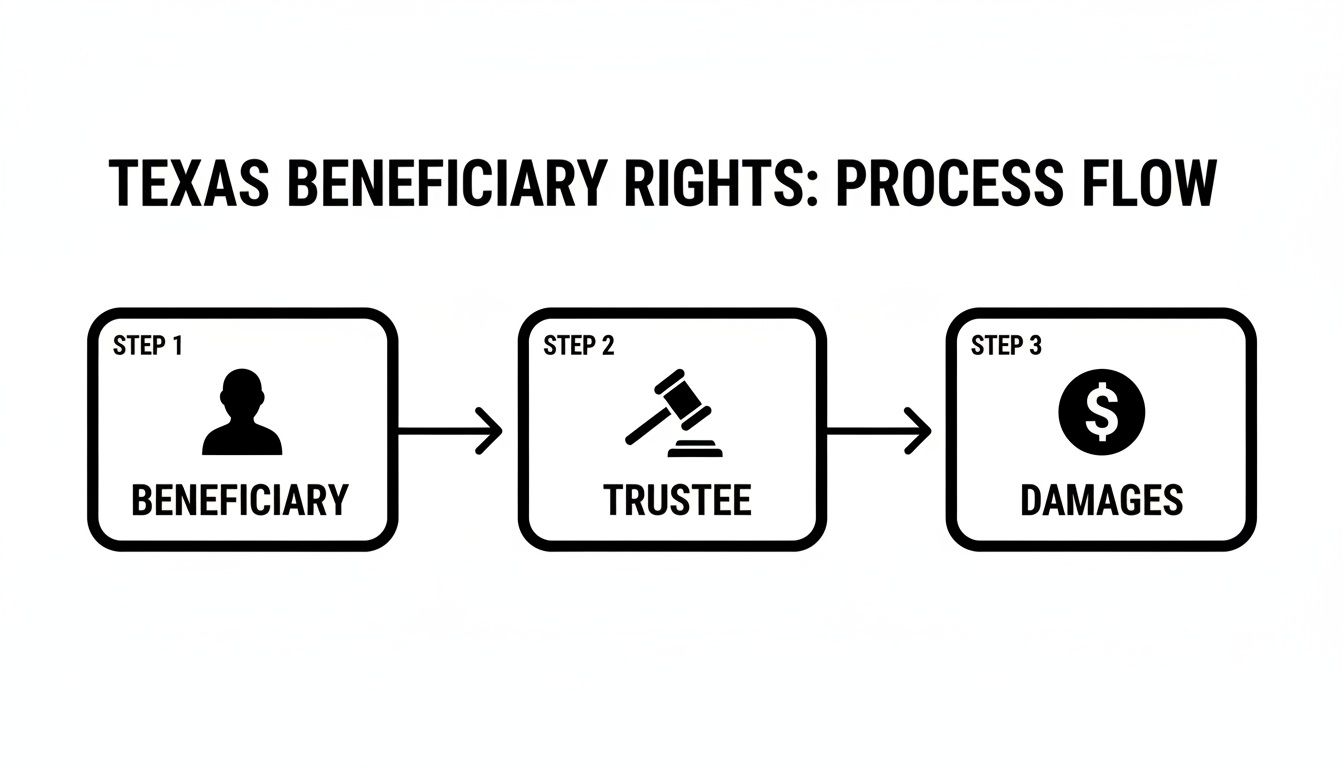
As you can see, the process empowers you, the beneficiary, to initiate legal action and directly challenge a trustee’s poor decisions to recover what is rightfully yours.
Our Approach: We are with you every step of the way, ensuring you understand what is happening and why. Our goal is to use the discovery phase to build an undeniable case against the trustee, placing you in the strongest possible position to either settle on favorable terms or win at trial.
In a complex trust lawsuit, managing documents and deadlines can be overwhelming. An AI Litigation Support Agent can be a useful tool for organizing the vast amount of information. From cataloging evidence to tracking key dates, it helps keep the case on track. Knowing how to modify a trust in Texas is also a critical part of the process.
Ultimately, every step in this process is a building block. It’s about methodically gathering proof and presenting your story in a way the court cannot ignore. With an experienced Texas trust administration lawyer by your side, you are not just filing a lawsuit—you are executing a strategy designed to protect your inheritance.
6. Gathering the Evidence Needed to Win Your Case

Winning a lawsuit against a trustee is not a matter of luck; it is built on a foundation of solid, undeniable evidence. You must approach this like an investigator, and your first task is to collect every relevant document. A clear paper trail is often your most powerful weapon when determining how to sue a trustee in Texas.
First, obtain a copy of the trust document itself. This is the official rulebook for the trust, outlining the trustee's duties and limitations in black and white. Ensure you have every version, including any amendments.
Next, follow the money. Bank statements, investment reports, and any accessible financial records are crucial. These documents can reveal suspicious transactions, poor investments, or missing funds. Additionally, save every email, letter, and your own notes from conversations with the trustee. This collection helps paint a comprehensive picture of their conduct.
What if the Trustee Is Hiding Documents?
This is a common and frustrating challenge. You suspect wrongdoing, but the person you suspect holds all the key documents. Do not give up. This is where a skilled attorney uses a powerful legal process called discovery.
Discovery is the court-supervised exchange of information between both sides of a lawsuit. It gives your lawyer the legal authority to compel the trustee to produce documents and answer questions under oath.
Here are the primary tools we use to uncover the truth:
- Requests for Production: These are formal, written demands for specific documents like bank statements, receipts, investment records, and the trustee's emails.
- Interrogatories: We send a list of written questions that the trustee must answer completely, in writing, and under oath. This is an effective way to establish specific facts.
- Depositions: This is a face-to-face interview where your lawyer questions the trustee directly while a court reporter records every word. This sworn testimony is powerful evidence that can be used at trial.
For instance, if you suspect the trustee used trust funds for a personal European vacation, your lawyer can use discovery to demand the trust’s credit card statements for that period. If the records show charges for flights to Paris and luxury hotels unrelated to trust business, you have your proof.
The Clock Is Ticking
As you gather evidence, be mindful of the calendar. In Texas, there is a strict deadline for filing a lawsuit, known as the statute of limitations. For most claims involving a breach of fiduciary duty, you have four years from the date you knew—or reasonably should have known—about the breach.
Key Takeaway: The clock starts ticking the moment you have reason to suspect something is wrong. If you wait too long to act, you could lose your right to sue forever, regardless of the evidence you have.
This is why prompt action is so important. The moment you suspect a breach, you should consult a Texas trust administration lawyer. They can help protect your legal rights, initiate the evidence-gathering process, and ensure you meet all critical deadlines for matters like guardianship or asset protection.
Finally, remember that a trustee's accounting is often a key piece of the puzzle. You have a legal right to this information, and our guide on what trust accounting entails can show you what to look for. A sloppy, incomplete, or nonexistent accounting is often the first major red flag that something is seriously wrong.
Frequently Asked Questions About Suing a Trustee
When you are considering legal action against a trustee, it is natural to have many questions. It is a significant step, and the path forward can seem unclear. We understand your concerns.
Here are straightforward answers to some of the most common questions we hear from beneficiaries, designed to provide clarity and confidence as you decide your next steps.
Can a Trustee Be Held Personally Liable for Losses?
Absolutely. This is one of the most powerful tools Texas law provides to beneficiaries when a trustee fails in their duties. If a court finds that a trustee acted improperly and caused the trust to lose money, it can order a surcharge.
A surcharge is not a minor penalty. It is a court order compelling the trustee to use their personal funds to repay the trust for every dollar lost, including any profits that should have been earned. This money does not come from the trust itself; it comes directly from the trustee. The goal is to make the trust whole again at the personal expense of the person responsible for the damage.
How Much Does It Cost to Sue a Trustee in Texas?
There is no single answer, as the cost can vary widely depending on the complexity of the case and how vigorously the trustee defends their actions. Most trust litigation attorneys work on an hourly basis. However, if the case involves recovering a significant amount of money, some lawyers may accept it on a contingency fee basis. This means you do not pay legal fees unless they win the case, and their fee is a percentage of the amount recovered.
Important Consideration: The Texas Trust Code is on your side. It includes provisions that may allow your attorney's fees to be paid from the trust's funds or even by the trustee personally, especially if the court determines they acted in bad faith. We are always transparent about fee structures during our free consultation.
This legal flexibility ensures that beneficiaries with a strong claim have a real opportunity for justice, even if they do not have significant funds available for legal fees.
Can I Remove a Trustee Without Going to Court?
Sometimes, yes. The first step is often to have an experienced Texas trust administration lawyer send a firm demand letter. When confronted with a credible threat of a lawsuit and clear evidence of their wrongdoing, many trustees will choose to resign rather than face the expense, time, and public scrutiny of a court battle.
Also, review the trust document itself. It may outline a process for removing a trustee without court intervention, such as a majority vote from the beneficiaries. However, if the trust is silent on removal and the trustee refuses to step down, a court order is your only option to force them out. Your lawyer can file for removal as part of the lawsuit.
What Happens After a Trustee Is Removed?
Once the problematic trustee is removed, a successor trustee must be appointed to manage the trust. The trust document usually names who is next in line to serve. It might list one or several successors in a specific order.
If the trust document does not name a successor, or if the named individuals are unable or unwilling to serve, the court will intervene. A judge will appoint a new trustee. To ensure impartiality and professional management, courts often appoint a neutral third party, such as a corporate trustee (like a bank's trust department) or another qualified professional. This step helps restore stability and ensures the trust is managed correctly.
Ultimately, the goal is always to protect the trust's assets and ensure the original creator's wishes are honored. Removing a bad actor and appointing a competent, honest trustee is how we secure your inheritance for the future.
If you’re managing a trust or planning your estate, contact The Law Office of Bryan Fagan, PLLC for a free consultation. Our attorneys provide trusted, Texas-based guidance for every step of the process.