Managing a loved one’s trust can feel overwhelming, but with the right legal guidance, it doesn’t have to be. While every situation is unique, a straightforward trust administration in Texas generally takes about 6 to 12 months. For more complex estates involving businesses, significant assets, or beneficiary conflicts, the timeline for trust administration Texas can extend to 24 months or longer.
This guide provides a clear, step-by-step overview of the process, empowering you with the knowledge to navigate your responsibilities with confidence and compassion.
How Long Does Trust Administration Take in Texas?
When you accept the role of trustee, you assume significant legal and financial responsibilities known as fiduciary duties. The entire process of fulfilling these duties—from managing assets to distributing them to beneficiaries—is called trust administration. Unlike probate, which is a public court proceeding, trust administration is typically handled privately. However, it is strictly governed by the Texas Trust Code and the terms of the trust document.
The administration timeline is not fixed; it is shaped by the specifics of the trust you are managing. Your primary responsibility is to carry out the grantor's instructions accurately and respectfully. Understanding the path ahead is the first step toward a smooth process. It's also helpful to understand how trusts fit into broader estate planning, such as the key differences between Wills vs. Trusts.
Simple vs. Complex Trust Timelines
So, what is the biggest factor affecting the timeline? The nature and complexity of the assets. A trust holding only a primary residence and a few bank accounts can be settled much more quickly than one containing a family business, multiple real estate properties, and a sophisticated investment portfolio.
This timeline offers a visual guide to what you can expect for both simple and more involved trust administrations.
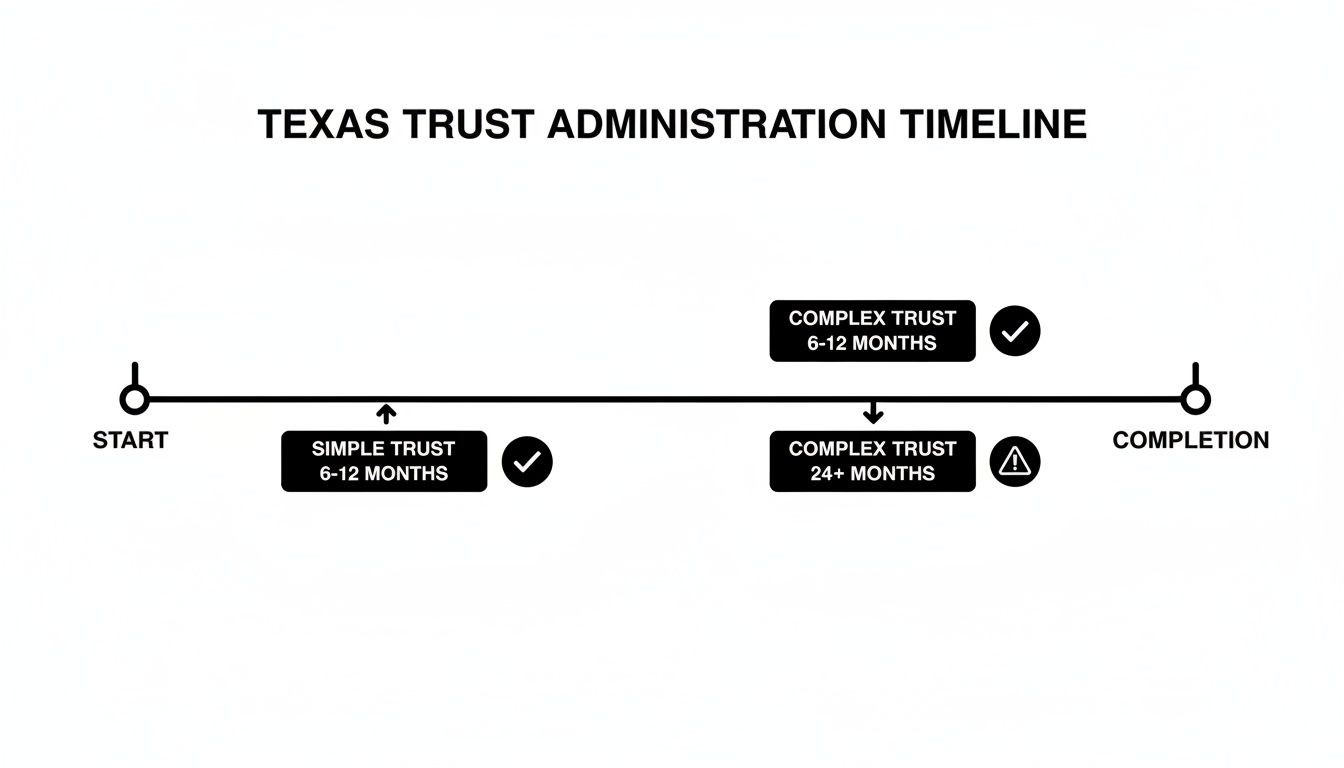
As you can see, factors like managing a business, dealing with hard-to-value assets, or navigating disagreements among beneficiaries can easily double or triple the time required to settle the trust.
Estimated Timelines for Texas Trust Administration
To provide a clearer picture, this table breaks down the typical timeframes you might encounter. It is a useful tool for setting expectations from the outset.
| Trust Scenario | Typical Timeline | Key Influencing Factors |
|---|---|---|
| Simple Trust | 6 – 12 months | Contains straightforward assets like a primary home, bank accounts, and publicly traded stocks. All beneficiaries are cooperative. |
| Complex Trust | 12 – 24 months | Includes a family business, multiple real estate properties, private investments, or requires an estate tax return (Form 706). |
| Contested Trust | 24+ months | Involves disputes among beneficiaries, challenges to the trust's validity, or litigation against the trustee. |
These timelines are estimates, as the unique details of your loved one's estate and family dynamics will ultimately set the pace for the administration.
A trustee’s fundamental duty is to follow the trust document and Texas law with absolute diligence. Rushing the process can lead to costly errors and personal liability, while unnecessary delays can frustrate beneficiaries and create legal challenges. The key is a careful, deliberate pace.
Our guide is designed to walk you through each step with confidence. We will cover everything from your initial duties and inventorying assets to handling taxes and making final distributions. For a complete walkthrough, you can explore our detailed guide on how to administer a trust in Texas. Our goal is to provide the knowledge you need to honor your loved one's legacy without undue stress.
The First 90 Days: Your Immediate Trustee Responsibilities
The first three months as a trustee are a critical period that lays the foundation for the entire trust administration. The decisive and correct actions you take now will prevent significant complications later.
Your journey begins with the trust document itself. This legal instrument is your instruction manual, detailing the grantor's wishes, identifying the beneficiaries, and defining your powers as trustee. Obtain the original document and review it meticulously.
At the same time, you must order certified copies of the grantor's death certificate. These are required for nearly every official task, from accessing bank accounts to filing insurance claims. Ordering at least 10-15 copies is a practical measure, as many institutions require an original.
Securing Trust Assets and Notifying Beneficiaries
With the essential paperwork in hand, your focus shifts to securing the trust's assets. This is an active responsibility; you must proactively identify and take control of all trust property to protect it from neglect, loss, or misuse.
Your immediate to-do list should include:
- Real Estate: If the trust holds property, confirm it is physically secure, all insurance policies are current, and utilities are being paid.
- Bank and Brokerage Accounts: Contact all financial institutions to have the accounts retitled from the grantor's name into your name, as trustee.
- Personal Property: Begin creating an initial inventory of tangible valuables such as art, jewelry, vehicles, and collectibles.
While you are marshaling the assets, you have a parallel legal duty under the Texas Trust Code: formally notifying the beneficiaries. This is a legal requirement with a strict deadline, not merely a courtesy.
The Legal Requirement for Beneficiary Notice
Texas law is explicit: as a trustee, you must provide written notice to all beneficiaries of an irrevocable trust within a specific timeframe after accepting the trusteeship. This notice formally informs them of the trust's existence and your role as manager. This step is a cornerstone of your fiduciary duties in Texas.
According to Texas Property Code § 115.014, this notice must include a copy of the trust document. This act of transparency is fundamental to building a relationship of trust with the beneficiaries and heading off potential disputes before they even start.
Failure to provide this notice properly and on time can expose you to personal liability and breed suspicion. This initial communication sets the tone for the entire administration, demonstrating that you are acting in good faith and in accordance with the law. A clear, professionally drafted notice helps manage expectations and establishes your authority. For a detailed guide on all your duties, our firm has compiled a comprehensive trust administration checklist for you to follow.
This is precisely why engaging a Texas trust administration lawyer from the outset is so valuable. An attorney ensures your notices are legally compliant, helps you navigate the complexities of securing assets, and develops a clear strategy for the months ahead. Obtaining expert legal guidance in these first 90 days is the single best way to begin the process on solid ground and honor your loved one’s legacy without a misstep.
Stage 3: Inventory and Management of Trust Assets
With the required notices sent, your role as trustee shifts to one of the most hands-on phases: gathering, valuing, and managing all trust assets. This is more than just creating a list; it is a critical part of your legal duty to protect and account for every asset for the beneficiaries.
Think of yourself as a financial detective. Your job is to track down every piece of the grantor's legacy—from bank and investment statements to real estate deeds, car titles, business records, and insurance policies. You are piecing together the complete financial picture.

Getting the Valuations Right
Once you have identified all the assets, you must determine their precise value as of the grantor's date of death. This "date-of-death" valuation is non-negotiable. It establishes the baseline for your accounting and serves as the foundation for preparing any required estate or income tax returns.
For some assets, this is straightforward. The value of a bank account is its balance. However, many other assets require professional expertise.
- Real Estate: You will almost certainly need to hire a licensed appraiser to establish the fair market value of any homes, land, or commercial properties.
- Business Interests: Valuing a private business or partnership interest is a complex task that requires a specialized business valuation expert.
- Unique Collectibles: High-value items like fine art, antiques, or rare jewelry require an appraiser specializing in those markets.
Securing accurate, defensible valuations protects all parties. It ensures beneficiaries are treated fairly at the time of distribution and shields you, the trustee, from potential disputes.
Your Duty as a "Prudent Investor" in Texas
Your responsibilities extend beyond merely holding the assets. Under Texas law, you have an active duty to manage them wisely. This is governed by the Texas Uniform Prudent Investor Act (UPIA), a vital component of the Texas Trust Code.
The UPIA requires you to manage the trust’s portfolio as a "prudent investor." This means making investment decisions that balance risk and return based on the trust’s specific goals, timeline, and the needs of the beneficiaries. Texas updated its laws in 2003 to adopt this modern, portfolio-based approach, which you can read about in this overview on the evolution of Texas trust law here.
Your core mission under the UPIA is to preserve and, where appropriate, grow the trust's value. This often means you cannot simply leave assets sitting in a low-interest checking account. You have a duty to make them productive.
This active management role involves several key responsibilities:
- Consolidating Accounts: It is often prudent to combine multiple bank or brokerage accounts to simplify management, obtain a clearer financial picture, and potentially reduce fees.
- Adjusting Investments: You may need to sell certain assets and reinvest the proceeds to build a diversified portfolio that aligns with the trust's objectives.
- Maintaining Property: For any real estate, you are responsible for paying property taxes, keeping the property insured, and handling all necessary maintenance and repairs.
- Protecting All Assets: You must ensure all trust property is properly secured and insured against potential loss, theft, or damage.
Properly inventorying and managing trust assets is meticulous work and is often the most time-consuming part of the timeline for trust administration Texas. Executing these duties correctly is essential. A Texas estate planning attorney can provide crucial guidance, from helping you find qualified appraisers to ensuring your investment plan fully complies with your fiduciary duties.
Handling Tax Obligations and Creditor Claims
As trustee, you now act as the financial manager of the trust. This part of your role directly impacts the overall timeline for trust administration Texas and carries significant weight. You are responsible for two critical duties: paying tax obligations and settling the grantor's debts. Handling these correctly protects the trust’s assets and shields you from personal liability.

One of your first actions should be to obtain a taxpayer identification number (TIN or EIN) from the IRS. This small but crucial step officially establishes the trust as its own legal and taxable entity. From this point forward, all trust finances will be managed under this number.
Navigating Tax Filing Requirements
Your fiduciary duty demands that you file all required tax returns correctly and on time. Depending on the trust's specific financial situation, this could involve several different forms.
- Final Personal Income Tax Return (Form 1040): You must file a final income tax return for the grantor, covering the period from January 1st of the year they passed away up to their date of death.
- Fiduciary Income Tax Return (Form 1041): The trust itself is a taxpayer. If the trust generates more than $600 in income during a year or has a non-resident alien as a beneficiary, you must file a Form 1041.
- Federal Estate Tax Return (Form 706): This return is required only for very large estates. For 2024, an estate tax return is triggered only if the gross estate exceeds $13.61 million. While most trusts do not meet this threshold, you must perform the calculation to be certain.
These filings have strict deadlines. Missing them can result in penalties and interest that diminish the assets intended for beneficiaries. Working with a Texas trust administration lawyer or a CPA is a vital safeguard against costly errors.
Identifying and Settling Legitimate Debts
Before any assets can be distributed to beneficiaries, Texas law requires you to pay the grantor's debts. This duty is non-negotiable. If you distribute assets prematurely, you could be held personally liable for those unpaid bills.
One of the most important principles of trust administration is that creditors are paid before beneficiaries. Your duty is to identify all legitimate claims against the estate and use trust assets to settle them.
The process for handling debts is methodical and designed to bring a clean and final resolution to the grantor’s financial affairs.
- Identify Potential Creditors: Your first task is to identify anyone the grantor may have owed money to. This involves reviewing their mail, financial records, and credit reports.
- Publish Official Notice: In many cases, it is advisable to publish a formal "Notice to Creditors" in a local newspaper. This initiates a legal countdown for creditors to submit their claims.
- Validate or Reject Claims: When claims are submitted, you must verify their legitimacy. Valid debts are paid from trust funds, while any claims you determine to be invalid are formally rejected.
Once notice is properly given, creditors have a limited time to act. Adhering to these statutory deadlines is crucial. For a deeper understanding of this process, our firm explains what happens to debt when someone dies in Texas. Properly managing this stage gives you the legal clearance to proceed to the final step: distributing the remaining assets to the beneficiaries.
How to Avoid Common Administration Delays
Even the most carefully planned trust can encounter obstacles. As a trustee, your responsibility is to guide the administration forward, ensuring everything is handled correctly and efficiently. The best way to achieve a smooth and predictable timeline for trust administration Texas is to anticipate and avoid common pitfalls.
Some delays are a natural part of the process. It may take time to locate a forgotten bank account or an old stock certificate. Obtaining an accurate appraisal for complex assets—such as a family business, valuable mineral rights, or an art collection—cannot be rushed. These steps are essential for fair distribution and proper tax filings.
However, the most disruptive and expensive delays often stem from human factors.
Preventing Beneficiary Disputes and Conflicts
Nothing stalls a trust administration faster than disagreements among beneficiaries. When family members feel uninformed, confused by the process, or suspicious of your actions, minor questions can escalate into a full-blown legal challenge.
Your best defense is proactive and consistent communication. To mitigate these conflicts, you should:
- Set Expectations Early: From the beginning, provide beneficiaries with a clear, straightforward overview of the process and a realistic timeline.
- Provide Regular Updates: Do not wait for beneficiaries to request information. Send periodic updates on your progress, even if it is just to inform them you are awaiting an appraisal or a response from the IRS.
- Keep Meticulous Records: Document everything. Every expense paid, every decision made, and every communication with a beneficiary should have a clear record.
This level of transparency builds trust. It demonstrates that you are taking your duties under the Texas Trust Code seriously and creates a clear record that protects both you and the trust.
Avoiding Breach of Fiduciary Duty Claims
The most significant threat to an efficient trust administration is an accusation of a breach of fiduciary duty. These are serious claims alleging that a trustee has mismanaged funds, favored one beneficiary over another, or engaged in self-dealing. Such an accusation can bring the entire process to a halt, drawing it into protracted and costly litigation.
A breach of fiduciary duty claim, whether based on an honest mistake or not, can derail an administration for years. The focus shifts from settling the trust to defending your actions in court, adding immense stress and expense.
Unfortunately, these disputes are all too common. Breaches of trust in Texas have a major impact on administration timelines, with a firm 4-year statute of limitations from the moment a breach is discovered. These claims make up over 40% of all fiduciary disputes, as trustees misappropriate funds, fail to provide an accounting, or make negligent investments. Occurring in 25-30% of cases, these breaches can stretch a typical 1-3 year administration to 5 years or more in litigation, costing families twice or even three times as much in legal fees.
The surest way to shield yourself from these claims is to partner with a Texas trust administration lawyer from day one. An experienced attorney acts as a crucial safeguard. They ensure every action you take complies with the law, your accountings are precise, and your beneficiary communications are professional and clear. This legal oversight allows you to manage the trust with confidence and drastically reduces the risk of disputes that could devastate your timeline.
Making Final Distributions and Closing the Trust
This is the final stage of the journey, the moment a trustee has been working towards throughout the entire timeline for trust administration Texas. After all the hard work of managing assets, paying debts, and handling taxes, you are finally ready to fulfill the trust’s ultimate purpose: distributing the remaining property to the beneficiaries.
Reaching this stage is a significant milestone. It signifies that the trust’s creditors have been satisfied, the final tax returns are filed (or prepared for filing), and all administrative expenses are paid. Your focus can now shift entirely to making the final distributions.
Preparing the Final Accounting
Before distributing any assets to a beneficiary, you must prepare a final, comprehensive accounting. This document serves as the complete financial history of your trusteeship. It is a detailed report showing every transaction that occurred under your management.
A proper final accounting must clearly show:
- The starting value of all trust assets (the initial inventory).
- All income the trust generated, such as interest, dividends, or rent.
- Every expense paid out, from legal fees and appraisal costs to property maintenance.
- Any preliminary distributions that were previously made.
- The final, exact value of the assets remaining for distribution.
This report is then shared with every beneficiary. It is your proof that you have upheld your fiduciary duties in Texas with complete transparency and diligence.
Distributing Assets and Obtaining Releases
Once the beneficiaries have reviewed and approved the final accounting, you can begin making the distributions. You must follow the trust's instructions precisely. If it dictates a specific property goes to someone, you transfer the title. If it calls for a percentage of the trust's value, you calculate the amount and issue the payment.
Along with the final check or property deed, it is absolutely crucial to have each beneficiary sign a Receipt and Release document. This legal form is your safeguard. It confirms that the beneficiary has received their full inheritance and, just as importantly, releases you from any future liability related to your management of the trust.
This step is your legal shield. Without these signed releases, a beneficiary could potentially raise questions or claims months or even years later. Obtaining them allows you to close the trust with confidence.
A Texas trust administration lawyer is the right professional to draft these agreements, ensuring they are legally sound and provide you with complete protection. Once all assets are distributed and the releases are in hand, the trust is officially terminated, and your duties as trustee are finally complete.
Frequently Asked Questions About Texas Trust Administration
Even after reviewing the process, it is natural to have questions. The role of a trustee is filled with responsibility, and various issues can arise. Here are answers to some of the most common questions we hear from trustees and beneficiaries about the timeline for trust administration Texas.

How Much Does a Trustee Get Paid in Texas?
The Texas Trust Code provides for "reasonable compensation" for a trustee's services. "Reasonable" is not a fixed amount. If the trust document itself does not specify a fee, the compensation is determined by the demands of the role, including the complexity of the assets, the time invested, and the expertise required. For many trusts, a common fee is a small percentage of the total assets under management, often around 1% annually.
Is Trust Administration Faster Than Probate?
In most instances, yes. Avoiding probate is a primary reason many people establish trusts. Probate is a public, court-supervised process that can be delayed by crowded court schedules. Trust administration, by contrast, is a private matter, which typically allows for a more efficient settlement. However, a trust with complex assets or beneficiary disputes can face delays that rival even a lengthy probate case.
What Happens if a Beneficiary Cannot Be Found?
A trustee has a fiduciary duty in Texas to make a diligent, good-faith effort to locate every beneficiary. This is an active duty that may involve searching public records or hiring professional investigators. If, after exhaustive efforts, a beneficiary remains missing, the trustee should seek guidance from the court. A judge may order the trustee to hold that person's share in the trust for a specified period or provide other legal instructions to resolve the matter.
A trustee’s duty to a beneficiary is absolute, even to one who is missing. Documenting every search attempt is critical to prove you have fulfilled your legal obligations and to protect yourself from future claims of negligence.
Can a Trustee Also Be a Beneficiary in Texas?
Yes, and this is very common, especially in family trusts where a surviving spouse or an adult child is named as both trustee and a primary beneficiary. This dual role, however, can create potential conflicts of interest. The trustee must be exceptionally careful to remain impartial and always fulfill their fiduciary duties to all beneficiaries—not just themselves.
If you’re managing a trust or planning your estate, contact The Law Office of Bryan Fagan, PLLC for a free consultation. Our attorneys provide trusted, Texas-based guidance for every step of the process. For more information, please visit us at https://www.texastrustadministration.com.