Skip to content
Managing a loved one’s trust after they're gone can feel overwhelming, like being handed a complex set of instructions during a difficult time. It's a significant responsibility, but with the right legal guidance, it doesn’t have to be a source of stress.
At its heart, trust administration is the methodical process of managing and distributing a trust's assets according to the creator's final wishes. This process is guided by the trust document and Texas law. Think of it as a private, efficient alternative to the public court system of probate, designed to honor your loved one’s legacy with dignity and precision.
The Trust Administration Journey in Texas

When someone establishes a trust as part of their estate planning, they appoint a trustee to manage it. The trustee acts as the captain of a ship, responsible for steering the creator's assets to their intended destination—the beneficiaries. Trust administration is the official map they must follow, ensuring every action complies with Texas law and the trust’s specific terms.
The goal is simple: to carry out the creator’s instructions faithfully while meeting all legal and financial obligations. This involves a series of crucial tasks, from gathering assets and paying debts to communicating with beneficiaries and filing tax returns. Unlike probate, which is a public court proceeding, trust administration is handled privately, offering families confidentiality and control during a sensitive time.
The Key People Involved
To understand the process, it helps to know the key players. Each role is clearly defined by the trust document and the Texas Trust Code, ensuring a clear division of responsibilities.
Here’s a simple breakdown of who’s who:
| Role | Description | Primary Responsibility |
|---|---|---|
| The Grantor (or Settlor) | The person who created the trust and funded it with their assets. | To provide clear instructions that guide the entire process. |
| The Trustee | The person or institution named to manage the trust. | To manage the trust's assets and follow the grantor's instructions with utmost care. |
| The Beneficiaries | The individuals, charities, or entities who will receive the assets. | To receive the benefits of the trust as outlined by the grantor. |
The trustee is the central figure responsible for executing the grantor's plan, acting with integrity and diligence at every step.
In Texas, a trustee's duties are not mere suggestions—they are legally binding obligations under the Texas Trust Code. Failure to uphold these fiduciary duties in Texas can lead to personal liability and costly legal disputes.
The need for skilled guidance in this field is growing. The Trusts & Estates industry in the US is projected to reach $290.1 billion in revenue in 2025, driven by an increasing demand for professional fiduciary services. You can get a closer look at the industry's growth in this detailed industry report. This trend highlights the increasing complexity of modern estate management.
Whether you've been named a trustee or are a beneficiary seeking to understand what comes next, clarity is crucial. A knowledgeable Texas trust administration lawyer can help you navigate your responsibilities, ensure every legal requirement is met, and protect the legacy your loved one worked so hard to build.
Trustee Responsibilities Under Texas Law
Accepting the role of trustee means stepping into a position of significant legal and ethical responsibility. Under the Texas Trust Code, a trustee is bound by legally enforceable obligations known as fiduciary duties. These principles are the bedrock of trust administration, designed to protect beneficiaries and ensure the grantor's wishes are honored precisely.
A fiduciary is someone legally required to act in another person’s best interest. For a trustee, this duty is absolute. The needs of the beneficiaries must come before your own. A breach of this duty is not just a simple mistake; it can result in personal financial liability and contentious legal battles. A seasoned Texas trust administration lawyer can provide the practical advice needed to ensure your actions align with these critical duties.
The Duty of Loyalty
The cornerstone of a trustee's role is the Duty of Loyalty. This is an unwavering commitment to act solely in the best interest of the trust's beneficiaries. You cannot use your position for personal gain or engage in any transaction that presents a conflict of interest.
For example, imagine the trust owns a valuable piece of real estate in Austin. As trustee, you discover it is undervalued and consider buying it for yourself to sell for a profit later. This would be a flagrant violation of your Duty of Loyalty. Your obligation is to maximize the property's value for the beneficiaries, not for your own benefit.
This duty strictly prohibits:
- Self-dealing: Buying assets from or selling assets to the trust.
- Conflicts of interest: Avoiding any situation where your personal interests could conflict with those of the beneficiaries.
- Favoritism: Treating all beneficiaries impartially according to the terms of the trust.
The Duty of Prudence
Next is the Duty of Prudence, which requires you to manage the trust’s assets with the care and skill a reasonably prudent person would use for their own affairs. You don't have to be a Wall Street expert, but you must make informed, sensible decisions. The "prudent investor rule" in Texas law evaluates your overall investment strategy, not the performance of a single asset.
A trustee who invests the trust's entire liquid assets into a single, high-risk cryptocurrency would likely be breaching this duty. A prudent trustee, in contrast, would diversify investments to balance risk and growth, protecting the trust principal while seeking a reasonable return.
The Duty to Be Impartial and Inform
A trustee must act as an impartial administrator, treating all beneficiaries fairly unless the trust specifies otherwise. This can be challenging when beneficiaries have competing interests—for instance, one may need immediate income while another prefers long-term growth of the principal.
Furthermore, you have a duty to keep beneficiaries reasonably informed about the trust and its administration. This includes providing clear, accurate information about assets, liabilities, income, and expenses. A key part of this is preparing a formal trust accounting, which is a detailed financial report. You can learn more about this requirement in our guide on what is trust accounting.
A trustee’s failure to communicate is a common catalyst for family disputes. Clear, consistent communication builds confidence and can prevent misunderstandings from escalating into legal challenges.
Fulfilling these fiduciary duties is paramount. It ensures you honor your loved one's legacy, protect the beneficiaries, and shield yourself from legal liability.
Your Step-by-Step Guide to the Administration Process
Stepping into the role of a trustee can feel like being handed the keys to a complicated machine with no instruction manual. It's a heavy responsibility, but it doesn't have to be a bewildering one. With a clear roadmap, what seems like an overwhelming job becomes a series of logical, manageable tasks.
Think of the following steps as your playbook. We'll walk through the process chronologically, giving you the confidence to navigate your duties, comply with the Texas Trust Code, and faithfully carry out the grantor's final wishes.
Step 1: Locating Documents and Notifying Beneficiaries
Your duties begin as soon as the trust’s creator (the grantor) passes away. The first task is to locate the original trust document and any amendments. This document is your primary guide, containing all the instructions you are legally bound to follow.
Once you have the trust document, you must formally notify all beneficiaries named in the trust. This initial communication informs them that the trust is now active and that you are serving as trustee. It establishes transparency from the start and can prevent future confusion or conflict.
Step 2: Marshaling and Inventorying Trust Assets
Next, you must "marshal the assets"—a legal term for taking control of everything the trust owns. This requires creating a detailed inventory of all trust property, which may include:
- Real Estate: The family home, rental properties, or land.
- Financial Accounts: Bank accounts, brokerage accounts, and retirement funds.
- Business Interests: Shares in a family business or other company.
- Personal Property: Valuable items like artwork, jewelry, or vehicles.
You will need to re-title assets into your name as trustee, obtain official date-of-death valuations for tax purposes, and ensure all property is secured. Meticulous records are essential, as this inventory forms the basis for all future accounting.
At the heart of every action you take are three core duties: Loyalty, Prudence, and Communication. This simple visual breaks them down.
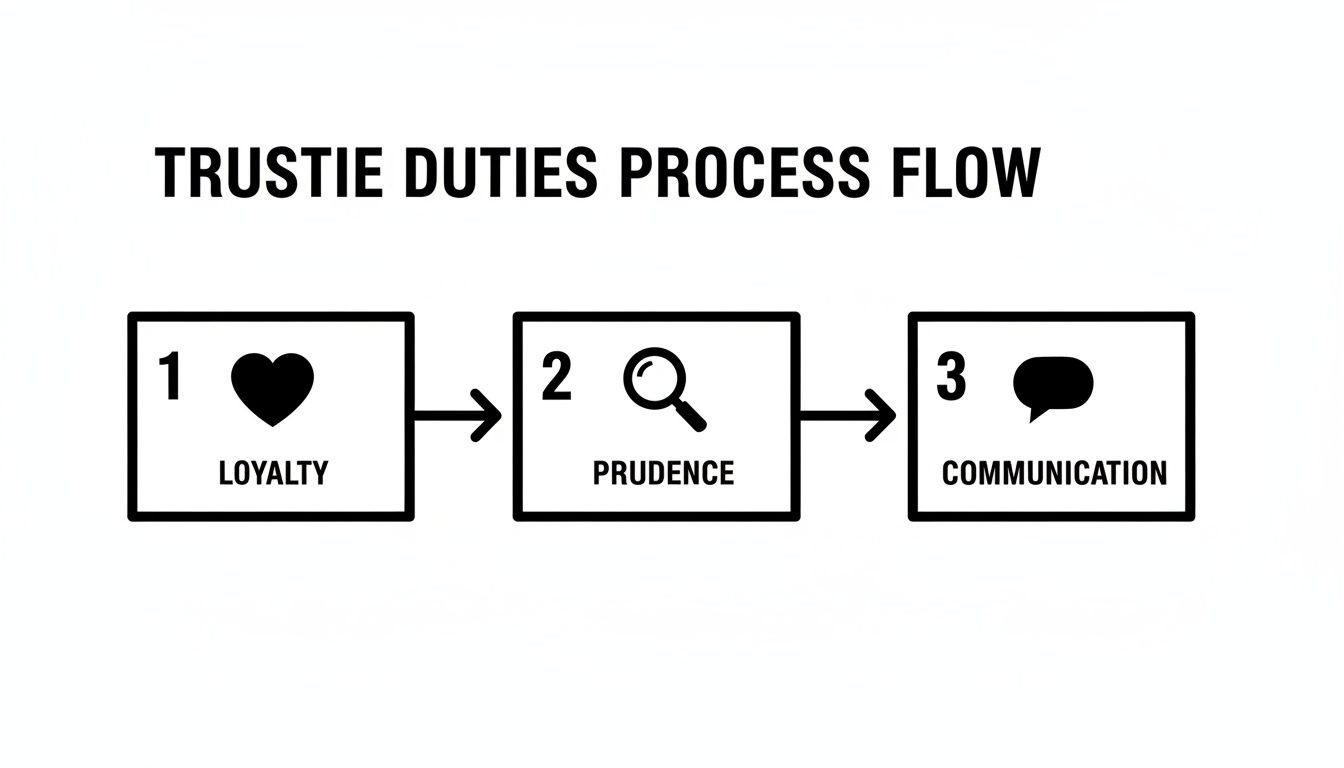
These duties are interconnected. Every decision you make should be filtered through them, always keeping the beneficiaries' best interests at the forefront.
Step 3: Managing Debts and Preparing Taxes
As trustee, you are responsible for handling the grantor’s final financial affairs. This includes identifying and paying any legitimate debts, such as final medical bills, credit card balances, or a mortgage. These obligations must be settled using trust funds before any assets can be distributed to beneficiaries.
You must also manage all tax-related matters. This typically involves filing a final personal income tax return for the grantor and an annual income tax return for the trust (IRS Form 1041). For larger estates, a federal estate tax return may also be required. This is an area where professional help is vital; a skilled Texas estate planning attorney or CPA can ensure compliance and prevent costly errors.
Meticulous record-keeping is your best defense against future challenges. Every dollar in and out of the trust must be documented, forming the basis of the formal accounting you must provide to beneficiaries.
Step 4: Accounting, Distributions, and Closing the Trust
After gathering assets and paying debts, your next major task is to prepare a formal fiduciary accounting. This is a comprehensive report for the beneficiaries detailing all financial activity—what came in, what went out, and what remains. It is the ultimate act of transparency and a legal requirement.
Once the beneficiaries have reviewed and approved the accounting, you can proceed with distributing assets as directed by the trust. This is the moment the grantor's legacy is formally passed on.
After all distributions are made, you will perform the final administrative tasks to terminate the trust. A Texas trust administration lawyer can ensure you complete this final step correctly, which officially concludes your duties and releases you from future legal liability.
Navigating Common Trust Disputes and Challenges
Even with a well-drafted trust, disputes can arise. When grief, family history, and finances mix, disagreements can strain relationships and stall the administration process. Understanding the common sources of conflict is the first step toward resolving them effectively.

These challenges are expected to become more frequent. Experts predict a massive $72.6 trillion wealth transfer from baby boomers to their heirs in the coming years. This wave of complex estates will require skilled and steady guidance. With so much at stake, knowing how to handle disputes is more critical than ever. You can read more about these independent trust company trends on mercercapital.com.
Common Triggers for Trust Conflicts
Trust disputes often stem from a few common friction points. A proactive trustee can often mitigate these issues before they escalate into a full-blown legal battle.
Common causes of conflict include:
- Vague Instructions: Ambiguous language in a trust document can lead to arguments among beneficiaries over what the grantor truly intended.
- Perceived Favoritism: If one beneficiary feels the trustee is not acting impartially, it can destroy trust and lead to accusations of breaching fiduciary duties.
- Disagreements Over Asset Values: Valuing unique assets like a family business, art collection, or real estate is subjective and often sparks disputes over sale prices or distribution.
- Lack of Communication: A trustee who fails to provide regular, clear updates can make beneficiaries suspicious and resentful. Feeling uninformed is a fast track to conflict.
A Real-World Texas Scenario: The Family Ranch
Let's consider a common Texas scenario. Three siblings inherit the family ranch near San Antonio through a trust. The trust instructs the trustee to divide the assets equally.
However, the siblings have different ideas. Sibling A, who lives in Dallas, wants to sell the ranch immediately to access their inheritance. Sibling B, who helped work the ranch for years, wants to keep it in the family. Sibling C believes the land value will skyrocket and wants to hold onto it as an investment.
The trustee is caught in the middle. Selling now might shortchange Sibling C, while holding onto it could be seen as ignoring Sibling A's rights. This classic conflict of interests can quickly escalate into an expensive legal battle without proper guidance.
Strategies for Proactive Resolution
The most effective way to handle disputes is to address them proactively. A great trustee prevents fires instead of just putting them out.
Open communication is key. The trustee could arrange a family meeting, present a professional appraisal of the ranch, and outline the options available under Texas law. By transparently explaining their duties, the trustee can help the family find common ground.
When communication is not enough, mediation can be a powerful tool. A neutral third-party mediator can facilitate a constructive conversation, helping the family reach a mutually agreeable solution without the cost and emotional toll of a lawsuit. If a dispute has already escalated, it is crucial to understand your legal options. You can learn more about dispute resolution and litigation in Texas trusts in our detailed guide.
Ultimately, a trustee’s best protection is to follow the trust document meticulously, act impartially, and document every decision. When conflicts arise, seeking advice from a Texas trust administration lawyer is the smartest way to protect the trust, the beneficiaries, and the trustee.
When to Modify or Terminate a Trust in Texas
Many people assume a trust’s terms are set in stone once it is created. While trusts are designed for stability, Texas law recognizes that circumstances change. Life is unpredictable, and a plan made years ago may no longer be practical today.
For this reason, the Texas Trust Code provides legal pathways to modify (change) or terminate (end) a trust. This is not about disregarding the grantor’s wishes but adapting them to new realities they may not have anticipated. Knowing how to modify a trust in Texas requires a careful legal approach to honor the grantor's original intent while complying with state law.
When Can a Trust's Rules Be Changed?
A Texas court can order a trust modification if unforeseen circumstances arise that make the original terms impractical or if a change would help achieve the trust's original goals.
Common reasons for modification include:
- Impractical or Wasteful Terms: If following the trust's original rules becomes impossible, illegal, or would waste trust assets, a court can approve an update.
- Unexpected Beneficiary Needs: A beneficiary may develop a disability, requiring a new distribution structure to preserve their eligibility for government benefits.
- Changes in the Law: New tax laws or other legal shifts can render a trust's original provisions inefficient or even detrimental.
A court’s primary consideration is whether the proposed change aligns with the grantor’s probable intent. The goal is to uphold the spirit of the trust, even if the literal instructions need updating.
Ending a Trust Ahead of Schedule
It is also possible to terminate a trust before its planned end date. This typically occurs when the trust's purpose has been fulfilled or is no longer achievable.
For instance, a trust created to fund a grandchild’s college education may no longer be needed if the grandchild receives a full scholarship. Similarly, if a trust’s value has diminished to the point where administrative fees are consuming the remaining assets, it may be more practical to terminate it and distribute the funds to the beneficiaries.
What About Agreements Between Beneficiaries?
In some cases, beneficiaries can unanimously agree to modify or terminate a trust. However, it's not as simple as taking a vote.
Under Texas law, such an agreement is only permissible if it does not conflict with a material purpose of the trust.
For example, a key purpose of the trust may have been to protect a young beneficiary from mismanaging a large inheritance before reaching a certain age (a "spendthrift" provision). The beneficiaries cannot simply agree to terminate the trust and distribute the funds early, as this would defeat one of the grantor’s primary objectives.
This is where guidance from a Texas trust administration lawyer becomes invaluable. For a more detailed look at the process, you can read our guide on how to amend a trust in Texas.
Whether you need to adjust distribution terms or end a trust entirely, you must have a sound legal basis supported by the Texas Trust Code. An experienced attorney can evaluate your situation, explain your options, and guide you through the legal steps to achieve a result that honors the grantor’s legacy while making sense for today’s world.
Why Partnering With a Trust Lawyer Is a Smart Move
Serving as a trustee is like navigating a legal minefield. A simple misstep, such as misinterpreting a clause in the trust or missing a deadline under the Texas Trust Code, can lead to personal liability and ignite family conflict.
Engaging a Texas trust administration lawyer is not a sign of weakness; it is a proactive step to protect yourself, the beneficiaries, and your loved one’s legacy.
An attorney acts as your professional guide, translating complex legal requirements into a clear, actionable plan. This partnership is an investment in your peace of mind, empowering you to fulfill your duties with confidence and precision.
How an Attorney Provides Critical Support
An experienced trust lawyer is an essential partner throughout the administration process. Their expertise acts as a safeguard against common errors that can derail even the most well-intentioned trustee.
Here are key areas where an attorney’s guidance is invaluable:
- Interpreting Trust Language: They decipher complex legal terms to ensure you understand and execute the grantor's exact intentions.
- Ensuring Legal Compliance: They help you navigate the Texas Trust Code, ensuring all requirements for notices, accountings, and distributions are met.
- Navigating Disputes: If disagreements arise, an attorney can mediate and facilitate resolution, preventing conflicts from escalating into costly litigation.
- Preparing Accurate Accountings: They assist in preparing the detailed financial reports required by law, promoting transparency and reducing the likelihood of beneficiary challenges.
A crucial, often-overlooked aspect of their role is helping to implement robust data security measures to protect sensitive financial and personal information. This professional oversight ensures all data is handled confidentially and securely.
Engaging legal counsel is the single most effective way to limit your personal liability as a trustee. It demonstrates that you took your fiduciary duties seriously by seeking expert guidance.
By partnering with a knowledgeable law firm, you can transform a potentially overwhelming burden into a structured, manageable process. You gain a dedicated advocate committed to protecting your family’s future and ensuring a smooth and successful administration.
If you’re managing a trust or planning your estate, contact The Law Office of Bryan Fagan, PLLC for a free consultation. Our attorneys provide trusted, Texas-based guidance for every step of the process.
Got Questions About Trust Administration? We've Got Answers.
When you're navigating the complexities of trust administration, questions are inevitable. It is a detailed process, and it is normal to feel uncertain. Below, we have answered some of the most common questions we hear from trustees and beneficiaries in Texas to provide you with clarity and confidence.
How Long Does Trust Administration Take in Texas?
There is no one-size-fits-all timeline. The duration can range from a few months to over a year, depending on the complexity of the trust assets and the level of cooperation among the parties involved.
A simple trust holding liquid assets like cash and stocks can often be administered relatively quickly. However, a trust that includes a family business, multiple real estate properties, or other complex assets will naturally require more time to manage properly. Tax filing deadlines and potential disputes can also extend the timeline.
Does a Trustee Get Paid for Their Work?
Yes. Under the Texas Trust Code, serving as a trustee is a significant responsibility that requires time, skill, and diligence. It is not a volunteer role. Trustees are entitled to reasonable compensation for their services.
The trust document itself may specify the trustee’s fee. If it does not, Texas law permits a fee that is reasonable given the complexity of the trust, the work performed, and the value of the assets being managed. This compensation acknowledges the professional duties and personal liability the trustee assumes.
What if a Trustee Makes a Mistake?
While minor administrative errors can often be corrected, significant mistakes—especially those that constitute a breach of fiduciary duties in Texas—can have serious consequences. Trustees can be held personally liable for losses resulting from their negligence or misconduct.
For example, if a trustee makes a reckless investment that causes a substantial loss to the trust, the beneficiaries can take legal action. A court may order the trustee to personally repay the lost funds, remove them from their position, and appoint a successor. This is a primary reason why seeking guidance from a Texas trust administration lawyer is so important—it protects the trustee as much as it protects the beneficiaries.
If you’re managing a trust or planning your estate, contact The Law Office of Bryan Fagan, PLLC for a free consultation. Our attorneys provide trusted, Texas-based guidance for every step of the process.